SHAPE, SIZE AND ARRANGEMENT
OF BACTERIA
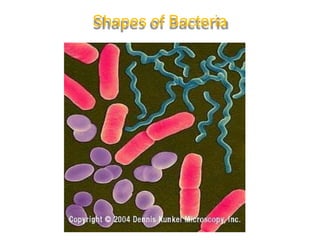
Shapes of Bacteria
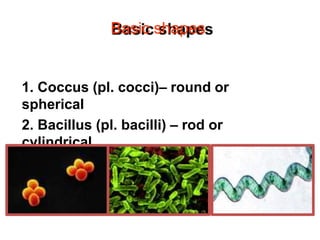
Basic shapes
1. Coccus (pl. cocci)– round or
spherical
2. Bacillus (pl. bacilli) – rod or
cylindrical
3. Spirillum (pl. spirlli) – spiral
Cocci – Spherical or ovoid cells, e.g. Staphylococcus .
Bacilli –
Straight and cylindrical rods, e.g. Bacillus spp.
long, thin filamentous form, e.g. Actinomycetes
Spirillum –
comma-shaped (vibrio), e.g. Vibrio,
Campylobacter
spiral-shaped, loosely coiled (spirochete), e.g.
Spirochetes,
elongated, tightly coiled (spirillum), e.g.
Azospirillum spp)
Pleomorphic – variable shape
SHAPES OF BACTERIA
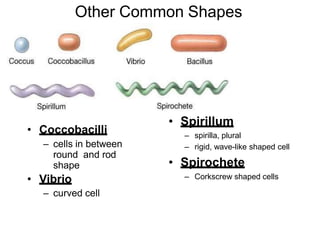
• Coccobacilli
– cells in between
round and rod
shape
• Vibrio
– curved cell
• Spirillum
– spirilla, plural
– rigid, wave-like shaped cell
• Spirochete
– Corkscrew shaped cells
Other Common Shapes
 Bacteria are very small in size
cocci are approx. 0.5 to 1.0 μm in diameter.
 rods range from 2 to 5 μm in length by 0.5 to 1.0 μm in width
 Spirochetes are longer (up to 20 μm) and narrower (0.1 to 1.0 μm)
 varies with the medium and growth phase
 usually smallest in the logarithmic phase of
growth.
SIZE OF
BACTERIA
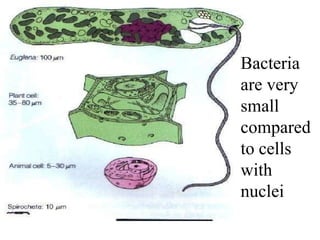
Bacteria
are very
small
compared
to cells
with
nuclei
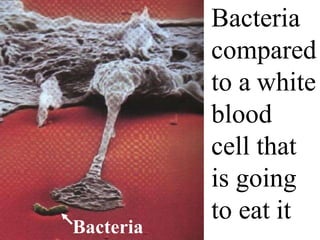
Bacteria
compared
to a white
blood
cell that
is going
to eat it
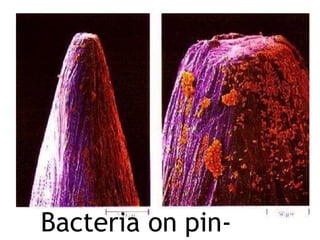
Bacteria
Bacteria on pin-
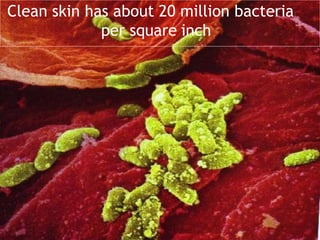
Clean skin has about 20 million bacteria
per square inch
The surface area/volume ratio of a spherical bacteria of 1
µm in diameter is high (6:1) as compared to a spherical
eukaryotic cell having a diameter of 20 µm (0.3:1).
Consequently:
• the intake of nutrients and removal of waste products
is quick - the bacteria has high rate of growth and
metabolism.
• no circulatory mechanism for nutrients is needed - the
cytoplasmic streaming is absent.
Surface area/volume
ratio
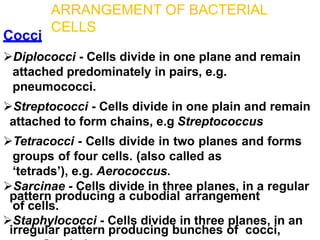
ARRANGEMENT OF BACTERIAL
CELLS
Cocci
Diplococci - Cells divide in one plane and remain
attached predominately in pairs, e.g.
pneumococci.
Streptococci - Cells divide in one plain and remain
attached to form chains, e.g Streptococcus
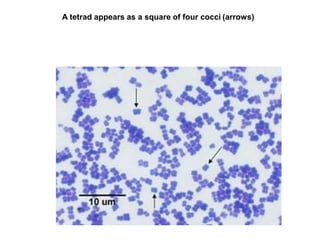
Tetracocci - Cells divide in two planes and forms
groups of four cells. (also called as
‘tetrads’), e.g. Aerococcus.
Sarcinae - Cells divide in three planes, in a regular
pattern producing a cubodial arrangement
of cells.
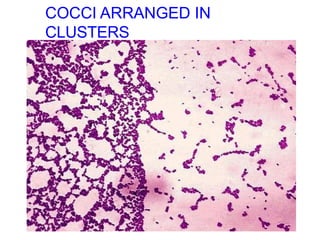
Staphylococci - Cells divide in three planes, in an
irregular pattern producing bunches of cocci,
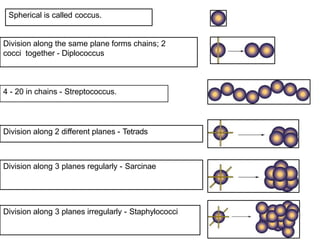
Spherical is called coccus.
Division along the same plane forms chains; 2
cocci together - Diplococcus
4 - 20 in chains - Streptococcus.
Division along 2 different planes - Tetrads
Division along 3 planes regularly - Sarcinae
Division along 3 planes irregularly - Staphylococci
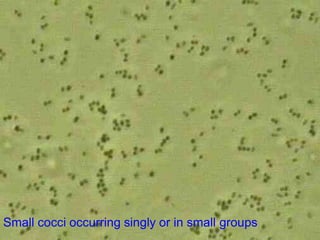
Small cocci occurring singly or in small groups
A tetrad appears as a square of four cocci (arrows)
COCCI ARRANGED IN
CLUSTERS
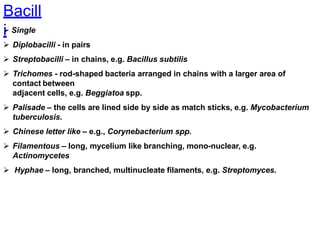
Bacill
i
 Single
 Diplobacilli - in pairs
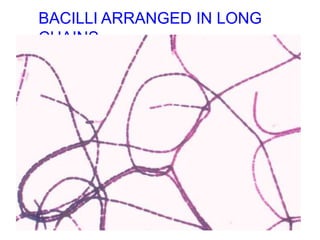
 Streptobacilli – in chains, e.g. Bacillus subtilis
 Trichomes - rod-shaped bacteria arranged in chains with a larger area of
contact between
adjacent cells, e.g. Beggiatoa spp.
 Palisade – the cells are lined side by side as match sticks, e.g. Mycobacterium
tuberculosis.
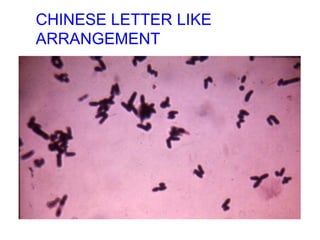
 Chinese letter like – e.g., Corynebacterium spp.
 Filamentous – long, mycelium like branching, mono-nuclear, e.g.
Actinomycetes
 Hyphae – long, branched, multinucleate filaments, e.g. Streptomyces.
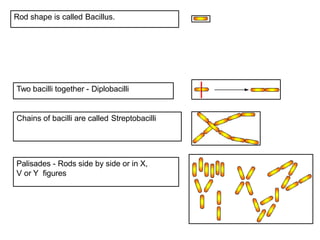
Rod shape is called Bacillus.
Two bacilli together - Diplobacilli
Chains of bacilli are called Streptobacilli
Palisades - Rods side by side or in X,
V or Y figures
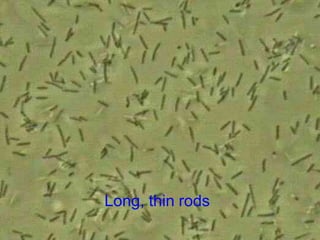
Long, thin rods
BACILLI ARRANGED IN LONG
CHAINS
CHINESE LETTER LIKE
ARRANGEMENT
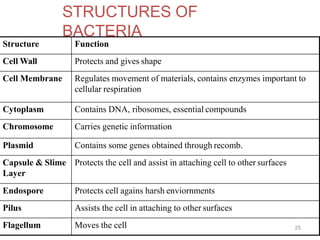
Structure Function
Cell Wall Protects and gives shape
Cell Membrane Regulates movement of materials, contains enzymes important to
cellular respiration
Cytoplasm Contains DNA, ribosomes, essential compounds
Chromosome Carries genetic information
Plasmid Contains some genes obtained through recomb.
Capsule & Slime
Layer
Protects the cell and assist in attaching cell to other surfaces
Endospore Protects cell agains harsh enviornments
Pilus Assists the cell in attaching to other surfaces
Flagellum Moves the cell 25
STRUCTURES OF
BACTERIA
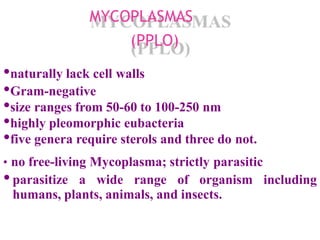
MYCOPLASMAS
(PPLO)
•naturally lack cell walls
•Gram-negative
•size ranges from 50-60 to 100-250 nm
•highly pleomorphic eubacteria
•five genera require sterols and three do not.
• no free-living Mycoplasma; strictly parasitic
•parasitize a wide range of organism including
humans, plants, animals, and insects.
MYCOPLASMAS
• facultative anaerobes and obligate anaerobes.
• growth on artificial media is slow with a generation
time ranging up to nine hours in some species.
• supplementation with other factors, such as serum,
may be required
• utilize glucose or arginine as the major source of
energy.
• ‘fried egg’ or ‘nipple shaped’ colonies, which can be
stained by Dienes’stain.
RICKETTSIA AND CHLAMYDIA
•coccoid to rods in shape, with a diameter
of 0.3-0.7 μm.
•Gram-negative type cell walls
•except one rickettsia (Rochalimaea), all are
obligate intracellular parasites.
•contain both DNA and RNA.

Shape-size-and-arrangment-of-bacteria.pptx

  • 1.
    SHAPE, SIZE ANDARRANGEMENT OF BACTERIA
  • 2.
  • 3.
    Basic shapes 1. Coccus(pl. cocci)– round or spherical 2. Bacillus (pl. bacilli) – rod or cylindrical 3. Spirillum (pl. spirlli) – spiral
  • 4.
    Cocci – Sphericalor ovoid cells, e.g. Staphylococcus . Bacilli – Straight and cylindrical rods, e.g. Bacillus spp. long, thin filamentous form, e.g. Actinomycetes Spirillum – comma-shaped (vibrio), e.g. Vibrio, Campylobacter spiral-shaped, loosely coiled (spirochete), e.g. Spirochetes, elongated, tightly coiled (spirillum), e.g. Azospirillum spp) Pleomorphic – variable shape SHAPES OF BACTERIA
  • 5.
    • Coccobacilli – cellsin between round and rod shape • Vibrio – curved cell • Spirillum – spirilla, plural – rigid, wave-like shaped cell • Spirochete – Corkscrew shaped cells Other Common Shapes
  • 6.
     Bacteria arevery small in size cocci are approx. 0.5 to 1.0 μm in diameter.  rods range from 2 to 5 μm in length by 0.5 to 1.0 μm in width  Spirochetes are longer (up to 20 μm) and narrower (0.1 to 1.0 μm)  varies with the medium and growth phase  usually smallest in the logarithmic phase of growth. SIZE OF BACTERIA
  • 7.
  • 8.
    Bacteria compared to a white blood cellthat is going to eat it Bacteria
  • 9.
  • 10.
    Clean skin hasabout 20 million bacteria per square inch
  • 11.
    The surface area/volumeratio of a spherical bacteria of 1 µm in diameter is high (6:1) as compared to a spherical eukaryotic cell having a diameter of 20 µm (0.3:1). Consequently: • the intake of nutrients and removal of waste products is quick - the bacteria has high rate of growth and metabolism. • no circulatory mechanism for nutrients is needed - the cytoplasmic streaming is absent. Surface area/volume ratio
  • 12.
    ARRANGEMENT OF BACTERIAL CELLS Cocci Diplococci- Cells divide in one plane and remain attached predominately in pairs, e.g. pneumococci. Streptococci - Cells divide in one plain and remain attached to form chains, e.g Streptococcus Tetracocci - Cells divide in two planes and forms groups of four cells. (also called as ‘tetrads’), e.g. Aerococcus. Sarcinae - Cells divide in three planes, in a regular pattern producing a cubodial arrangement of cells. Staphylococci - Cells divide in three planes, in an irregular pattern producing bunches of cocci,
  • 13.
    Spherical is calledcoccus. Division along the same plane forms chains; 2 cocci together - Diplococcus 4 - 20 in chains - Streptococcus. Division along 2 different planes - Tetrads Division along 3 planes regularly - Sarcinae Division along 3 planes irregularly - Staphylococci
  • 14.
    Small cocci occurringsingly or in small groups
  • 15.
    A tetrad appearsas a square of four cocci (arrows)
  • 16.
  • 17.
    Bacill i  Single  Diplobacilli- in pairs  Streptobacilli – in chains, e.g. Bacillus subtilis  Trichomes - rod-shaped bacteria arranged in chains with a larger area of contact between adjacent cells, e.g. Beggiatoa spp.  Palisade – the cells are lined side by side as match sticks, e.g. Mycobacterium tuberculosis.  Chinese letter like – e.g., Corynebacterium spp.  Filamentous – long, mycelium like branching, mono-nuclear, e.g. Actinomycetes  Hyphae – long, branched, multinucleate filaments, e.g. Streptomyces.
  • 18.
    Rod shape iscalled Bacillus. Two bacilli together - Diplobacilli Chains of bacilli are called Streptobacilli Palisades - Rods side by side or in X, V or Y figures
  • 19.
  • 20.
  • 21.
  • 25.
    Structure Function Cell WallProtects and gives shape Cell Membrane Regulates movement of materials, contains enzymes important to cellular respiration Cytoplasm Contains DNA, ribosomes, essential compounds Chromosome Carries genetic information Plasmid Contains some genes obtained through recomb. Capsule & Slime Layer Protects the cell and assist in attaching cell to other surfaces Endospore Protects cell agains harsh enviornments Pilus Assists the cell in attaching to other surfaces Flagellum Moves the cell 25 STRUCTURES OF BACTERIA
  • 26.
    MYCOPLASMAS (PPLO) •naturally lack cellwalls •Gram-negative •size ranges from 50-60 to 100-250 nm •highly pleomorphic eubacteria •five genera require sterols and three do not. • no free-living Mycoplasma; strictly parasitic •parasitize a wide range of organism including humans, plants, animals, and insects.
  • 27.
    MYCOPLASMAS • facultative anaerobesand obligate anaerobes. • growth on artificial media is slow with a generation time ranging up to nine hours in some species. • supplementation with other factors, such as serum, may be required • utilize glucose or arginine as the major source of energy. • ‘fried egg’ or ‘nipple shaped’ colonies, which can be stained by Dienes’stain.
  • 28.
    RICKETTSIA AND CHLAMYDIA •coccoidto rods in shape, with a diameter of 0.3-0.7 μm. •Gram-negative type cell walls •except one rickettsia (Rochalimaea), all are obligate intracellular parasites. •contain both DNA and RNA.