Kinesics.pptx non verbal communication presentation
1.
Kinesics: The Studyof Body
Language in Communication
Understanding Nonverbal Cues and Their Impact on
Interaction
Presented by : Keshav (2K22/SE/91)
2.
Introduction to Kinesics
01
02
Whatis Kinesics?
• kinesics comes from the root word
kinesis, which means “movement,”
and refers to the study of hand,
arm, body, and face movements
• It explores how body movements
can communicate emotions,
attitudes, and intentions without
words.
Why Kinesics Matters:
• Nonverbal cues account for a large
part of communication and
influence how messages are
perceived.
• Effective use and interpretation of
kinesics can improve personal
interactions, business
communication, and cross-cultural
understanding.
3.
Kinesics
It involves theusage of :
• Gestures
⚬ Adaptors
⚬ Emblems
⚬ Illustrators
• Head Movements
• Posture
• Eye Contact
• Facial Expressions
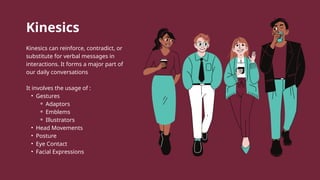
Kinesics can reinforce, contradict, or
substitute for verbal messages in
interactions. It forms a major part of
our daily conversations
4.
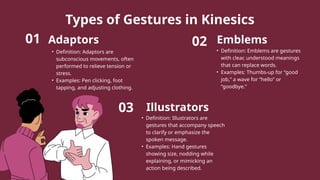
Types of Gesturesin Kinesics
01
• Definition: Adaptors are
subconscious movements, often
performed to relieve tension or
stress.
• Examples: Pen clicking, foot
tapping, and adjusting clothing.
Adaptors 02
03
• Definition: Emblems are gestures
with clear, understood meanings
that can replace words.
• Examples: Thumbs-up for “good
job,” a wave for “hello” or
“goodbye.”
Emblems
• Definition: Illustrators are
gestures that accompany speech
to clarify or emphasize the
spoken message.
• Examples: Hand gestures
showing size, nodding while
explaining, or mimicking an
action being described.
Illustrators
5.
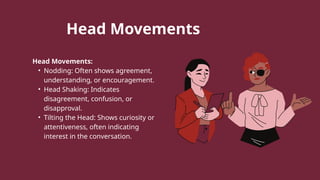
Head Movements
Head Movements:
•Nodding: Often shows agreement,
understanding, or encouragement.
• Head Shaking: Indicates
disagreement, confusion, or
disapproval.
• Tilting the Head: Shows curiosity or
attentiveness, often indicating
interest in the conversation.
6.
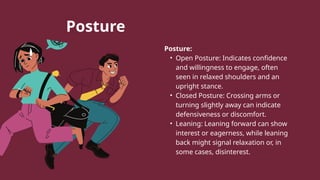
Posture:
• Open Posture:Indicates confidence
and willingness to engage, often
seen in relaxed shoulders and an
upright stance.
• Closed Posture: Crossing arms or
turning slightly away can indicate
defensiveness or discomfort.
• Leaning: Leaning forward can show
interest or eagerness, while leaning
back might signal relaxation or, in
some cases, disinterest.
Posture
7.
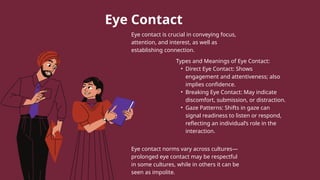
Eye Contact
Eye contactis crucial in conveying focus,
attention, and interest, as well as
establishing connection.
Eye contact norms vary across cultures—
prolonged eye contact may be respectful
in some cultures, while in others it can be
seen as impolite.
Types and Meanings of Eye Contact:
• Direct Eye Contact: Shows
engagement and attentiveness; also
implies confidence.
• Breaking Eye Contact: May indicate
discomfort, submission, or distraction.
• Gaze Patterns: Shifts in gaze can
signal readiness to listen or respond,
reflecting an individual’s role in the
interaction.
8.
Facial Expressions
Universal FacialExpressions:
• Happiness: Smiling, relaxed eyes;
universally signals friendliness or positivity.
• Sadness: Downturned mouth, slightly
closed eyes; suggests disappointment or
empathy.
• Anger: Furrowed brows, tightened mouth;
communicates frustration or displeasure.
• Surprise: Raised eyebrows, wide eyes, open
mouth; reflects shock or amazement.
Why Facial Expressions Matter:
• Facial expressions add emotional depth to
interactions and are powerful indicators of
sincerity or empathy.
• Recognizing subtle facial changes can help
in decoding emotions and responding
appropriately.
9.
Conclusion
• Other thanwords, nonverbal communication involves
body language, gestures, appearance, and silence.
• Kinesics refers to the use of body parts, such as hands,
arms, body, and face movements, in communicating
ideas or emotions.
• Improving relationships by understanding the unspoken
messages in everyday interactions.
• Valuable in professional settings for effective
presentations, negotiation, and leadership.
Applications
10.
Bibliography
• “Nonverbal Communication”,chapter 4 from the book A
Primer on Communication Studies (index.html (v. 1.0).
• https://en.wikipedia.org/wiki/Kinesics
• https://www.zellalife.com/blog/kinesics-the-art-of-body-
language/
• https://open.lib.umn.edu/communication/chapter/4-2-types-
of-nonverbal-communication/