KINESICS
BODY MOVEMENTS AND GESTURES
VALENTINE T BONDE
SYMPATHY MUTANDIRI
ENESSY MAKAURE
2
DEFINITION
Comes from the Greek word Kinesis, Which means
movement and refers to study of the arm, body and
face movements
According to (Miriam-Webster, 1952), It is the study
of the relationship between non-linguistic body
motions and communication
The most well known non-verbal form of
communication
3
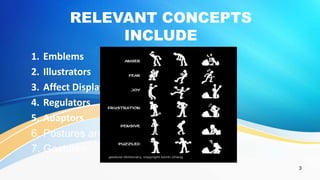
RELEVANT CONCEPTS
INCLUDE
1. Emblems
2. Illustrators
3. Affect Displays
4. Regulators
5. Adaptors
6. Postures and Gait
7. Gestures
4
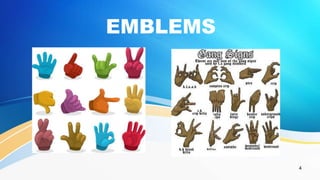
EMBLEMS
5
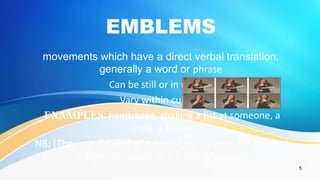
EMBLEMS
movements which have a direct verbal translation,
generally a word or phrase
Can be still or in motion
Vary within culture
EXAMPLES: handshake, shaking a fist at someone, a
smile, a frown
NB; (They are not part of a formal sign system like ASL that
is explicitly taught to a group of people)
6
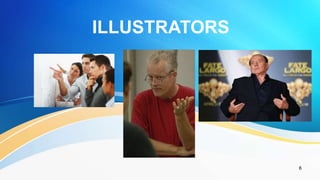
ILLUSTRATORS
7
ILLUSTRATORS
Gestures which accompany words to illustrate a verbal
message
No meaning on themselves and serves and function
emphasis
Involuntary and seemingly natural
EXAMPLES
Two palms held up signify “I don’t know."
Wagging a finger while making a point
Rolling one’s eyes in disbelief
8
ADAPTORS
9
ADAPTORS
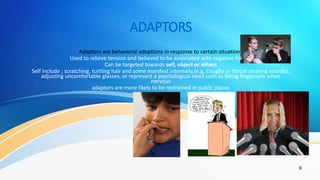
Adaptors are behavioral adoptions in response to certain situations
Used to relieve tension and believed to be associated with negative feeling
Can be targeted towards self, object or others
Self include ; scratching, turtling hair and some manifest internally,(e.g. Coughs or throat clearing sounds),
adjusting uncomfortable glasses, or represent a psychological need such as biting fingernails when
nervous
adaptors are more likely to be restrained in public places
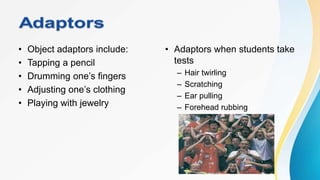
• Object adaptors include:
• Tapping a pencil
• Drumming one’s fingers
• Adjusting one’s clothing
• Playing with jewelry
• Adaptors when students take
tests
– Hair twirling
– Scratching
– Ear pulling
– Forehead rubbing
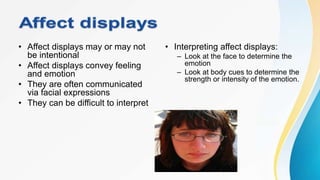
• Affect displays may or may not
be intentional
• Affect displays convey feeling
and emotion
• They are often communicated
via facial expressions
• They can be difficult to interpret
• Interpreting affect displays:
– Look at the face to determine the
emotion
– Look at body cues to determine the
strength or intensity of the emotion.
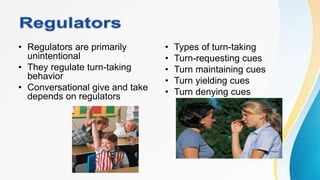
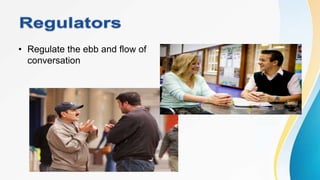
• Regulators are primarily
unintentional
• They regulate turn-taking
behavior
• Conversational give and take
depends on regulators
• Types of turn-taking
• Turn-requesting cues
• Turn maintaining cues
• Turn yielding cues
• Turn denying cues
• Regulate the ebb and flow of
conversation
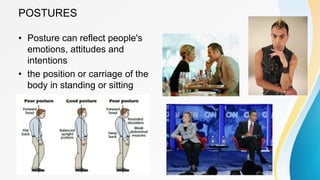
• Posture can reflect people's
emotions, attitudes and
intentions
• the position or carriage of the
body in standing or sitting
POSTURES
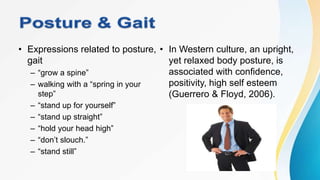
• Expressions related to posture,
gait
– “grow a spine”
– walking with a “spring in your
step”
– “stand up for yourself”
– “stand up straight”
– “hold your head high”
– “don’t slouch.”
– “stand still”
• In Western culture, an upright,
yet relaxed body posture, is
associated with confidence,
positivity, high self esteem
(Guerrero & Floyd, 2006).
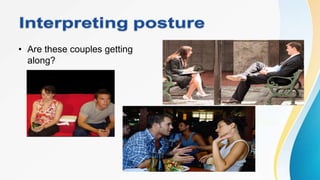
• Are these couples getting
along?
CONCLUSION
• Emblems - Substitute for words and phrases
• Illustrators - Accompany or reinforce verbal messages
• Affect Displays - Show emotion
• Regulators - Control the flow and pace of communication
• Adaptors - Release physical or emotional tension
• Kinesic behaviors are an important part of nonverbal
communication. Body movements convey information, though
interpretations vary by culture. As many movements are carried
out at a subconscious or at least a low-awareness level, kinesic
movements carry a significant risk of being misinterpreted in an
intercultural communication situation
THANK YOU

Kinesics And Non Verbal Communication.pptx

  • 1.
    KINESICS BODY MOVEMENTS ANDGESTURES VALENTINE T BONDE SYMPATHY MUTANDIRI ENESSY MAKAURE
  • 2.
    2 DEFINITION Comes from theGreek word Kinesis, Which means movement and refers to study of the arm, body and face movements According to (Miriam-Webster, 1952), It is the study of the relationship between non-linguistic body motions and communication The most well known non-verbal form of communication
  • 3.
    3 RELEVANT CONCEPTS INCLUDE 1. Emblems 2.Illustrators 3. Affect Displays 4. Regulators 5. Adaptors 6. Postures and Gait 7. Gestures
  • 4.
  • 5.
    5 EMBLEMS movements which havea direct verbal translation, generally a word or phrase Can be still or in motion Vary within culture EXAMPLES: handshake, shaking a fist at someone, a smile, a frown NB; (They are not part of a formal sign system like ASL that is explicitly taught to a group of people)
  • 6.
  • 7.
    7 ILLUSTRATORS Gestures which accompanywords to illustrate a verbal message No meaning on themselves and serves and function emphasis Involuntary and seemingly natural EXAMPLES Two palms held up signify “I don’t know." Wagging a finger while making a point Rolling one’s eyes in disbelief
  • 8.
  • 9.
    9 ADAPTORS Adaptors are behavioraladoptions in response to certain situations Used to relieve tension and believed to be associated with negative feeling Can be targeted towards self, object or others Self include ; scratching, turtling hair and some manifest internally,(e.g. Coughs or throat clearing sounds), adjusting uncomfortable glasses, or represent a psychological need such as biting fingernails when nervous adaptors are more likely to be restrained in public places
  • 10.
    • Object adaptorsinclude: • Tapping a pencil • Drumming one’s fingers • Adjusting one’s clothing • Playing with jewelry • Adaptors when students take tests – Hair twirling – Scratching – Ear pulling – Forehead rubbing
  • 11.
    • Affect displaysmay or may not be intentional • Affect displays convey feeling and emotion • They are often communicated via facial expressions • They can be difficult to interpret • Interpreting affect displays: – Look at the face to determine the emotion – Look at body cues to determine the strength or intensity of the emotion.
  • 12.
    • Regulators areprimarily unintentional • They regulate turn-taking behavior • Conversational give and take depends on regulators • Types of turn-taking • Turn-requesting cues • Turn maintaining cues • Turn yielding cues • Turn denying cues
  • 13.
    • Regulate theebb and flow of conversation
  • 14.
    • Posture canreflect people's emotions, attitudes and intentions • the position or carriage of the body in standing or sitting POSTURES
  • 15.
    • Expressions relatedto posture, gait – “grow a spine” – walking with a “spring in your step” – “stand up for yourself” – “stand up straight” – “hold your head high” – “don’t slouch.” – “stand still” • In Western culture, an upright, yet relaxed body posture, is associated with confidence, positivity, high self esteem (Guerrero & Floyd, 2006).
  • 16.
    • Are thesecouples getting along?
  • 17.
    CONCLUSION • Emblems -Substitute for words and phrases • Illustrators - Accompany or reinforce verbal messages • Affect Displays - Show emotion • Regulators - Control the flow and pace of communication • Adaptors - Release physical or emotional tension • Kinesic behaviors are an important part of nonverbal communication. Body movements convey information, though interpretations vary by culture. As many movements are carried out at a subconscious or at least a low-awareness level, kinesic movements carry a significant risk of being misinterpreted in an intercultural communication situation
  • 18.