Non –Verbal		 Communication	PRASHANT K SAHUMBA-UPES DEHRADUN
            INTRODUCTIONNon-Verbal (non word) communication means all communication without words.Nonverbal communication (NVC) is usually understood as    the process of communication through sending and receiving wordless messages. The ability to understand and use nonverbal communication is a powerful tool that will help you connect with others, express what you really mean, navigate challenging situations, and build better relationships at home and work.
Studies show that during interpersonal communication7% of the message is verbally communicated while 93% of the message is non-verbally transmitted. 	Of the 93% non verbal communication, 38% is through vocal tones, 55% is through facial expressions and non-verbal acts.
         Roles in Non-Verbal     			Communication    Nonverbal communication cues can play five roles:Repetition: they can repeat the message the person is making verballyContradiction: they can contradict a message the individual is trying to conveySubstitution: they can substitute for a verbal message. For example, a person's eyes can often convey a far more vivid message than words and often doComplementing: they may add to or complement a verbal message. A boss who pats a person on the back in addition to giving praise can increase the impact of the messageAccenting: they may accent or underline a verbal message. Pounding the table, for example, can underline a message.
     Types Of Non- Verbal  			CommunicationBODY LANGUAGECLOTHING/ARTIFACTUAL COMMUNICATIONVOICE /PARALANGUAGESPACE DISTANCE/PROXEMIC FACTORSCOLOURTIME/CHRONEMICSTOUCH/HAPTICS
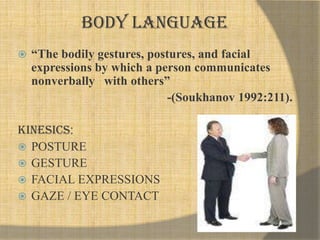
		Body Language“The bodily gestures, postures, and facial expressions by which a person communicates   nonverbally   with others”                                                  -(Soukhanov 1992:211).KINESICS:POSTUREGESTUREFACIAL EXPRESSIONSGAZE / EYE CONTACT
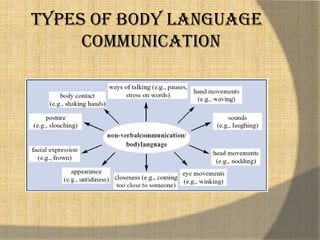
   Types of Body Language   		communication
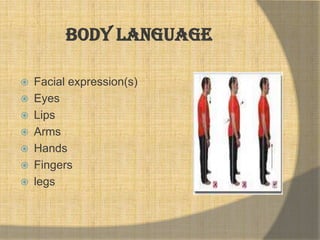
Body Language Facial expression(s)Eyes LipsArms Hands Fingerslegs
The Face Since the face cannot be easily hidden, it is an important source of nonverbal information and communicates a variety of emotions.In addition, eye contact, pupil size, and the smile  provide  additional cues to informed observers.
        Facial Expression(s)
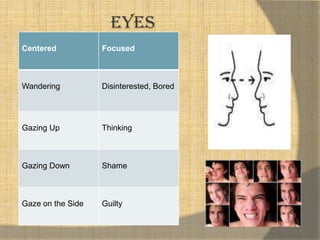
Eyes
Lips
                          Arms
                       Hands
Fingers
                      LEGSThe way we move and position our legs can convey a wide range of attitudes and emotions.
If someone is seated and their legs  are  fully  extended,  this indicates the subject  is  losing interest.
Crossed legs tend to seem disagreement.
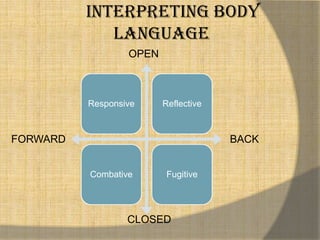
Sitting with your legs crossed and elevated foot moving in a slight circular motion indicates boredom or impatience     		 Interpreting Body     			LanguageOPENBACKFORWARD               CLOSED
               Responsive ENGAGED leaning forwardOpen BodyOpen ArmsOpen HandsEAGER (sprint position)Open LegsFeet under ChairOn ToesREADY TO AGREE closes papersPen Down Hands Flat on Table
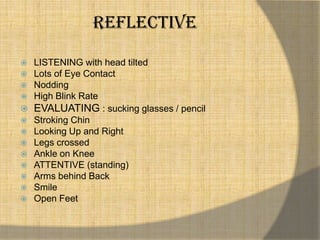
                Reflective LISTENING with head tilted Lots of Eye Contact Nodding High Blink RateEVALUATING : sucking glasses / pencilStroking Chin Looking Up and RightLegs crossed Ankle on KneeATTENTIVE (standing)Arms behind BackSmileOpen Feet
                   SPACEHave you ever felt uncomfortable during a conversation because the other person was standing too close and invading your space? We all have a need for physical space, although that need differs depending on the culture, the situation, and the closeness of the relationship. You can use physical space to communicate many different nonverbal messages, including signals of intimacy, aggression, dominance, or affection.
      LOOKING NERVOUSCrossed arms and legsCarrying books or papers across your chestSlumped postureSitting perched on the edge of the chairTapping footRocking legDrumming fingersBiting nails
          ParalanguageParalanguage, meaning “like language”.sometimes called vocalics) is the study of nonverbal cues of the voice. Various acoustic properties of speech such as tone, pitch and accent, collectively known as prosody, can all give off nonverbal cues. Paralanguage may change the meaning of words.

NON VERBAL COMMUNICATION

  • 1.
    Non–Verbal Communication PRASHANT K SAHUMBA-UPES DEHRADUN
  • 2.
    INTRODUCTIONNon-Verbal (non word) communication means all communication without words.Nonverbal communication (NVC) is usually understood as the process of communication through sending and receiving wordless messages. The ability to understand and use nonverbal communication is a powerful tool that will help you connect with others, express what you really mean, navigate challenging situations, and build better relationships at home and work.
  • 3.
    Studies show thatduring interpersonal communication7% of the message is verbally communicated while 93% of the message is non-verbally transmitted. Of the 93% non verbal communication, 38% is through vocal tones, 55% is through facial expressions and non-verbal acts.
  • 5.
    Roles in Non-Verbal Communication Nonverbal communication cues can play five roles:Repetition: they can repeat the message the person is making verballyContradiction: they can contradict a message the individual is trying to conveySubstitution: they can substitute for a verbal message. For example, a person's eyes can often convey a far more vivid message than words and often doComplementing: they may add to or complement a verbal message. A boss who pats a person on the back in addition to giving praise can increase the impact of the messageAccenting: they may accent or underline a verbal message. Pounding the table, for example, can underline a message.
  • 6.
    Types Of Non- Verbal CommunicationBODY LANGUAGECLOTHING/ARTIFACTUAL COMMUNICATIONVOICE /PARALANGUAGESPACE DISTANCE/PROXEMIC FACTORSCOLOURTIME/CHRONEMICSTOUCH/HAPTICS
  • 7.
    Body Language“The bodilygestures, postures, and facial expressions by which a person communicates nonverbally with others” -(Soukhanov 1992:211).KINESICS:POSTUREGESTUREFACIAL EXPRESSIONSGAZE / EYE CONTACT
  • 8.
    Types of Body Language communication
  • 9.
    Body Language Facialexpression(s)Eyes LipsArms Hands Fingerslegs
  • 10.
    The Face Sincethe face cannot be easily hidden, it is an important source of nonverbal information and communicates a variety of emotions.In addition, eye contact, pupil size, and the smile provide additional cues to informed observers.
  • 11.
    Facial Expression(s)
  • 12.
  • 13.
  • 14.
    Arms
  • 15.
    Hands
  • 16.
  • 17.
    LEGSThe way we move and position our legs can convey a wide range of attitudes and emotions.
  • 18.
    If someone isseated and their legs are fully extended, this indicates the subject is losing interest.
  • 19.
    Crossed legs tendto seem disagreement.
  • 20.
    Sitting with yourlegs crossed and elevated foot moving in a slight circular motion indicates boredom or impatience Interpreting Body LanguageOPENBACKFORWARD CLOSED
  • 21.
    Responsive ENGAGED leaning forwardOpen BodyOpen ArmsOpen HandsEAGER (sprint position)Open LegsFeet under ChairOn ToesREADY TO AGREE closes papersPen Down Hands Flat on Table
  • 22.
    Reflective LISTENING with head tilted Lots of Eye Contact Nodding High Blink RateEVALUATING : sucking glasses / pencilStroking Chin Looking Up and RightLegs crossed Ankle on KneeATTENTIVE (standing)Arms behind BackSmileOpen Feet
  • 23.
    SPACEHave you ever felt uncomfortable during a conversation because the other person was standing too close and invading your space? We all have a need for physical space, although that need differs depending on the culture, the situation, and the closeness of the relationship. You can use physical space to communicate many different nonverbal messages, including signals of intimacy, aggression, dominance, or affection.
  • 24.
    LOOKING NERVOUSCrossed arms and legsCarrying books or papers across your chestSlumped postureSitting perched on the edge of the chairTapping footRocking legDrumming fingersBiting nails
  • 25.
    ParalanguageParalanguage, meaning “like language”.sometimes called vocalics) is the study of nonverbal cues of the voice. Various acoustic properties of speech such as tone, pitch and accent, collectively known as prosody, can all give off nonverbal cues. Paralanguage may change the meaning of words.

Editor's Notes