COMES FROM THE ROOT
WORD KINESIS, WHICH
MEANS “MOVEMENT”
-STUDY OF HAND, ARM,
BODY, AND FACE
MOVEMENTS.
KINESICS
Group 4
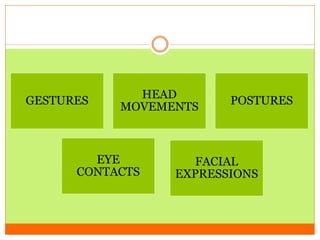
GESTURES
HEAD
MOVEMENTS
POSTURES
EYE
CONTACTS
FACIAL
EXPRESSIONS
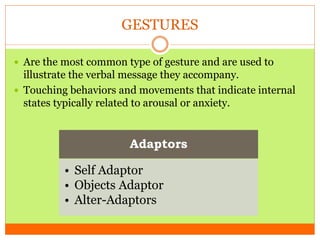
GESTURES
 Are the most common type of gesture and are used to
illustrate the verbal message they accompany.
 Touching behaviors and movements that indicate internal
states typically related to arousal or anxiety.
Adaptors
• Self Adaptor
• Objects Adaptor
• Alter-Adaptors
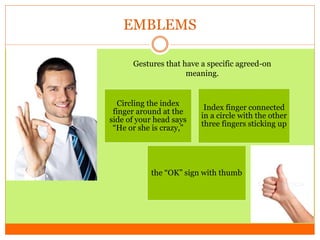
EMBLEMS
Gestures that have a specific agreed-on
meaning.
Circling the index
finger around at the
side of your head says
“He or she is crazy,”
Index finger connected
in a circle with the other
three fingers sticking up
the “OK” sign with thumb
Illustrators
Are the most common type of
gesture and are used to
illustrate the verbal message
they accompany.
HEAD MOVEMENTS AND POSTURES
 both used to acknowledge others and communicate interest or
attentiveness.
HEAD MOVEMENTS
E.g.
 the head nod essentially serves as an abbreviated bow.
 an innate and universal head movement is the head shake back and forth to signal
“no”.
 we also move our head to indicate interest.
HUMAN POSTURES
(standing, sitting, squatting, and lying down)
 - standing posture involves putting our hands on our hips and is a nonverbal cue
that we use subconsciously to make us look bigger and show assertiveness.
 -in terms of sitting, leaning back shows informality and indifference, straddling a
chair is a sign of dominance
 -leaning forward shows interest and attentiveness.
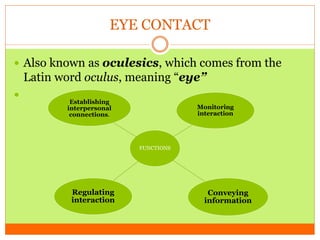
EYE CONTACT
 Also known as oculesics, which comes from the
Latin word oculus, meaning “eye”

FUNCTIONS
Regulating
interaction
Monitoring
interaction
Conveying
information
Establishing
interpersonal
connections.
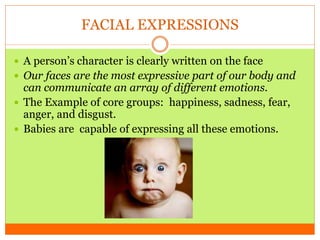
FACIAL EXPRESSIONS
 A person’s character is clearly written on the face
 Our faces are the most expressive part of our body and
can communicate an array of different emotions.
 The Example of core groups: happiness, sadness, fear,
anger, and disgust.
 Babies are capable of expressing all these emotions.
Kinesics

Kinesics

  • 1.
    COMES FROM THEROOT WORD KINESIS, WHICH MEANS “MOVEMENT” -STUDY OF HAND, ARM, BODY, AND FACE MOVEMENTS. KINESICS Group 4
  • 2.
  • 3.
    GESTURES  Are themost common type of gesture and are used to illustrate the verbal message they accompany.  Touching behaviors and movements that indicate internal states typically related to arousal or anxiety. Adaptors • Self Adaptor • Objects Adaptor • Alter-Adaptors
  • 4.
    EMBLEMS Gestures that havea specific agreed-on meaning. Circling the index finger around at the side of your head says “He or she is crazy,” Index finger connected in a circle with the other three fingers sticking up the “OK” sign with thumb
  • 5.
    Illustrators Are the mostcommon type of gesture and are used to illustrate the verbal message they accompany.
  • 6.
    HEAD MOVEMENTS ANDPOSTURES  both used to acknowledge others and communicate interest or attentiveness. HEAD MOVEMENTS E.g.  the head nod essentially serves as an abbreviated bow.  an innate and universal head movement is the head shake back and forth to signal “no”.  we also move our head to indicate interest. HUMAN POSTURES (standing, sitting, squatting, and lying down)  - standing posture involves putting our hands on our hips and is a nonverbal cue that we use subconsciously to make us look bigger and show assertiveness.  -in terms of sitting, leaning back shows informality and indifference, straddling a chair is a sign of dominance  -leaning forward shows interest and attentiveness.
  • 7.
    EYE CONTACT  Alsoknown as oculesics, which comes from the Latin word oculus, meaning “eye”  FUNCTIONS Regulating interaction Monitoring interaction Conveying information Establishing interpersonal connections.
  • 8.
    FACIAL EXPRESSIONS  Aperson’s character is clearly written on the face  Our faces are the most expressive part of our body and can communicate an array of different emotions.  The Example of core groups: happiness, sadness, fear, anger, and disgust.  Babies are capable of expressing all these emotions.