COMMUNICATION SKILL
Presentation
Direct And Present
By
ajay vaghela.
NON VERBAL
COMMUNICATION
TYPES OF NV COMMUNICATION
 KINESICS
 FACIAL EXPRESSIIONS
 GESTURES
 POSTURES
 PHYSICAL APPEARANCEE
 PROXEMICS
 PARALANGUAGE
 PHYSICAL CONTEXT
NONVERBAL COMMUNICATION I
IS IT POSSIBLE TO COMMUNICATE WITHOUT WORDS?
STUDIES SHOW THAT OVER HALF OF YOUR MESSAGE
IS CARRIED THROUGH NONVERBAL ELEMENTS:
 YOUR APPEARANCEE
 YOUR BODY LANGUAGE
 THE TONE AND
 THE PACE OF YOUR VOICE.
NONVERBAL COMMUNICATION II
WE KNOW THE IMPORTANCE OF “FIRST IMPRESSION”
BUT FIRST IMPRESSIONS HAPPEN EVERYTIME WE
INITIATE THE COMMUNICATION.
BEFORE SOMEONE PROCESSES OUR VERBAL MESSAGES,
 SHE HAS TAKEN IN OUR APPEARANCE,
 REGISTERED OUR ENTHUSIASM AND SINCERETY
 NOTED OUR TONE OF VOICE AND PROCESSED
ALL INTO NONVERBAL MESSAGE.
Nonverbal communication
 Nonverbal communication between people is people is
communication through sending and receiving wordless
clues.
 It includes the use of visual cues such as body,language
(kinesis), distance (proxemi) and physical
environments/appearance, of voice (paralanguage) and of
touch (haptics). It can also include chronemics (the use of
time) and oculesics (eye contact and the actions of looking
while talking and listening, frequency of glances, patterns
of fixation, pupil dilation, and blink rate).
 Just as speech contains nonverbal elements known as
paralanguage, including voice quality, rate, pitch,
volume, and speaking style, as well as prosodic
features such as rhythm, intonation, and stress, so
written texts have nonverbal elements such as
handwriting style, spatial arrangement of words, or the
physical layout of a page. However, much of the study
of nonverbal communication has focused on
interaction between individuals, where it can be
classified into three principal areas:
environmentalconditions where communication
 Nonverbal communication involves the conscious and
unconscious processes of encoding and decoding.
Encoding is the act of generating information such as
facial expressions, gestures, and postures. Decoding is
the interpretation of information from received
sensations from previous experiences.
 Importance
 Symbol table for non-verbal communication with
patients
 Nonverbal communication represents two-thirds of all
communication. Nonverbal communication can portray
a message both vocally and with the correct body signals
or gestures. Body signals comprise physical features,
conscious and unconsicus gestures and signals, and the
mediation of personal space.The wrong message can
also be established if the body language conveyed does
not match a verbal message.
 Nonverbal communication strengthens a first
impression in common situations like attracting a
partner or in a business interview: impressions are on
average formed within the first four seconds of
contact. First encounters or interactions with another
person strongly affect a person's perception. When the
other person or group is absorbing the message, they
are focused on the entire environment around them,
meaning the other person uses all five senses in the
interaction: 83% sight, 11% hearing, 3% smell, 2%
touch and 1% taste.
 Posture:---
 Main article: Posture (psychology)
 There are many different types of body positioning
to portray certain postures, including slouching,
towering, legs spread, jaw thrust, shoulders forward,
and arm crossing. The posture or bodily stance
exhibited by individuals communicates a variety of
messages whether good or bad.
 Gestures:--
 Gestures may be made with the hands, arms or body, and
also include movements of the head, face and eyes, such
as winking, nodding, or rolling one's eyes. Although the
study of gesture is still in its infancy, some broad
categories of gestures have been identified by
researchers. The most familiar are the so-called emblems
or quotable gestures. These are conventional, culture-
specific gestures that can be used as replacement for
words, such as the hand wave used in western cultures for
"hello" and "goodbye." A single emblematic gesture can
have a very different significance in different cultural
contexts, ranging from complimentary to highly
offensive.
 Clothing:-----
 Clothing is one of the most common forms of non-
verbal communication. The study of clothing and
other objects as a means of non-verbal communication
is known as artifactics or objectics. The types of
clothing that an individual wears conveys nonverbal
cues about his or her personality, background and
financial status, and how others will respond to them
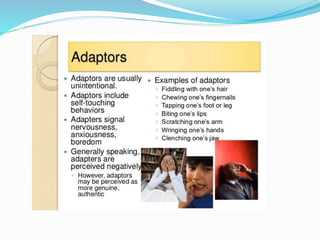
 Adapters:--
 Some hand movements are not considered to be
gestures. They consist of manipulations either of the
person or some object (e.g. clothing, pencils,
eyeglasses)—the kinds of scratching, fidgeting,
rubbing, tapping, and touching that people often do
with their hands. Such behaviors are referred to as
adapters. They may not be perceived as meaningfully
related to the speech in which they accompany, but may
serve as the basis for dispositional inferences of the
speaker's emotion (nervous, uncomfortable, bored.)
 Eye contact:-
 Eye contact occurs when two people look at each other's
eyes at the same time.In human beings, eye contact is a
form of nonverbal communication and is thought to have a
large influence on social behavior. Coined in the early to
mid-1960s, the term came from the West to often define
the act as a meaningful and important sign of confidence,
respect, and social communication. The customs and
significance of eye contact vary between societies, with
religious and social differences often altering its meaning
greatly.
 The study of eye contact is sometimes known as oculesics
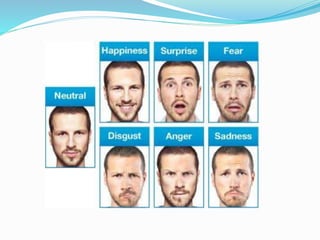
 Facial Expressions:--
 Face shows feelings, attitudes and emotions. The
degree of facial expressions are determined by
cultures. People from United States show emotions
more than their Asian counterparts. Facial expressions
are shown to be similar all over the world, but people
from different cultures do not show it in public. The
meanings of these are commonly acknowledged
everywhere. Too much expression is taken to be
shallow in some places whereas in some it is taken as
being weak.
PPT on non verbal communication

PPT on non verbal communication

  • 2.
  • 3.
  • 4.
  • 5.
    TYPES OF NVCOMMUNICATION  KINESICS  FACIAL EXPRESSIIONS  GESTURES  POSTURES  PHYSICAL APPEARANCEE  PROXEMICS  PARALANGUAGE  PHYSICAL CONTEXT
  • 6.
    NONVERBAL COMMUNICATION I ISIT POSSIBLE TO COMMUNICATE WITHOUT WORDS? STUDIES SHOW THAT OVER HALF OF YOUR MESSAGE IS CARRIED THROUGH NONVERBAL ELEMENTS:  YOUR APPEARANCEE  YOUR BODY LANGUAGE  THE TONE AND  THE PACE OF YOUR VOICE.
  • 7.
    NONVERBAL COMMUNICATION II WEKNOW THE IMPORTANCE OF “FIRST IMPRESSION” BUT FIRST IMPRESSIONS HAPPEN EVERYTIME WE INITIATE THE COMMUNICATION. BEFORE SOMEONE PROCESSES OUR VERBAL MESSAGES,  SHE HAS TAKEN IN OUR APPEARANCE,  REGISTERED OUR ENTHUSIASM AND SINCERETY  NOTED OUR TONE OF VOICE AND PROCESSED ALL INTO NONVERBAL MESSAGE.
  • 8.
    Nonverbal communication  Nonverbalcommunication between people is people is communication through sending and receiving wordless clues.  It includes the use of visual cues such as body,language (kinesis), distance (proxemi) and physical environments/appearance, of voice (paralanguage) and of touch (haptics). It can also include chronemics (the use of time) and oculesics (eye contact and the actions of looking while talking and listening, frequency of glances, patterns of fixation, pupil dilation, and blink rate).
  • 9.
     Just asspeech contains nonverbal elements known as paralanguage, including voice quality, rate, pitch, volume, and speaking style, as well as prosodic features such as rhythm, intonation, and stress, so written texts have nonverbal elements such as handwriting style, spatial arrangement of words, or the physical layout of a page. However, much of the study of nonverbal communication has focused on interaction between individuals, where it can be classified into three principal areas: environmentalconditions where communication
  • 10.
     Nonverbal communicationinvolves the conscious and unconscious processes of encoding and decoding. Encoding is the act of generating information such as facial expressions, gestures, and postures. Decoding is the interpretation of information from received sensations from previous experiences.
  • 11.
     Importance  Symboltable for non-verbal communication with patients  Nonverbal communication represents two-thirds of all communication. Nonverbal communication can portray a message both vocally and with the correct body signals or gestures. Body signals comprise physical features, conscious and unconsicus gestures and signals, and the mediation of personal space.The wrong message can also be established if the body language conveyed does not match a verbal message.
  • 12.
     Nonverbal communicationstrengthens a first impression in common situations like attracting a partner or in a business interview: impressions are on average formed within the first four seconds of contact. First encounters or interactions with another person strongly affect a person's perception. When the other person or group is absorbing the message, they are focused on the entire environment around them, meaning the other person uses all five senses in the interaction: 83% sight, 11% hearing, 3% smell, 2% touch and 1% taste.
  • 13.
     Posture:---  Mainarticle: Posture (psychology)  There are many different types of body positioning to portray certain postures, including slouching, towering, legs spread, jaw thrust, shoulders forward, and arm crossing. The posture or bodily stance exhibited by individuals communicates a variety of messages whether good or bad.
  • 14.
     Gestures:--  Gesturesmay be made with the hands, arms or body, and also include movements of the head, face and eyes, such as winking, nodding, or rolling one's eyes. Although the study of gesture is still in its infancy, some broad categories of gestures have been identified by researchers. The most familiar are the so-called emblems or quotable gestures. These are conventional, culture- specific gestures that can be used as replacement for words, such as the hand wave used in western cultures for "hello" and "goodbye." A single emblematic gesture can have a very different significance in different cultural contexts, ranging from complimentary to highly offensive.
  • 15.
     Clothing:-----  Clothingis one of the most common forms of non- verbal communication. The study of clothing and other objects as a means of non-verbal communication is known as artifactics or objectics. The types of clothing that an individual wears conveys nonverbal cues about his or her personality, background and financial status, and how others will respond to them
  • 16.
     Adapters:--  Somehand movements are not considered to be gestures. They consist of manipulations either of the person or some object (e.g. clothing, pencils, eyeglasses)—the kinds of scratching, fidgeting, rubbing, tapping, and touching that people often do with their hands. Such behaviors are referred to as adapters. They may not be perceived as meaningfully related to the speech in which they accompany, but may serve as the basis for dispositional inferences of the speaker's emotion (nervous, uncomfortable, bored.)
  • 18.
     Eye contact:- Eye contact occurs when two people look at each other's eyes at the same time.In human beings, eye contact is a form of nonverbal communication and is thought to have a large influence on social behavior. Coined in the early to mid-1960s, the term came from the West to often define the act as a meaningful and important sign of confidence, respect, and social communication. The customs and significance of eye contact vary between societies, with religious and social differences often altering its meaning greatly.  The study of eye contact is sometimes known as oculesics
  • 21.
     Facial Expressions:-- Face shows feelings, attitudes and emotions. The degree of facial expressions are determined by cultures. People from United States show emotions more than their Asian counterparts. Facial expressions are shown to be similar all over the world, but people from different cultures do not show it in public. The meanings of these are commonly acknowledged everywhere. Too much expression is taken to be shallow in some places whereas in some it is taken as being weak.