
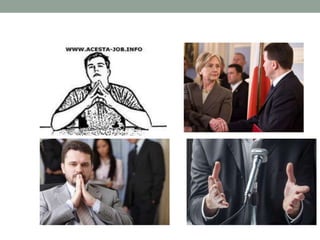



NONVERBAL COMMUNICATION
Bekhal Abubakir Hussein
UNIVERSITY OF SULAIMANI
May, 2017
The Outline
• Definition of Nonverbal Communication
• Metacommunicative Nature of Nonverbal
Communication
• Functions of Nonverbal Communication
• Characteristics of Nonverbal Communication
• Types of Nonverbal Communication
• Culture & Nonverbal Behavior
• Nonverbal Communication & Gender Styles
Definition of Nonverbal Communication
• Nonverbal Communication:
The type of communication which is expressed
through nonlinguistic means. It is the actions or
attributes of humans, including their appearance,
use of objects, sound, time, smell, and space, that
have socially shared significance & stimulate
meaning in others.
Metacommunicative Nature of
Nonverbal Communication
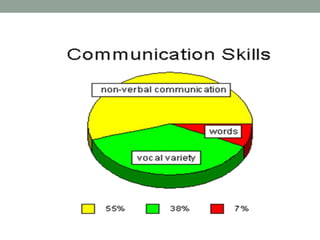
• Researchers conclude that nonverbal cues carry
approximately two-thirds of a message’s communicative
value.
• Although nonverbal messages may be sent deliberately or
accidentally, their meaning depends on how they are
interpreted.
• Consequently, they fulfill metacommunicative functions,
and communicate about communication, clarifying both:
• The nature of our relationships,
• The meaning of our verbal messages.
Functions of Nonverbal Communication
1. Contradicting: nonverbal cues can contradict or negate
verbal messages. Each interaction represents a double-
message, the words say one thing, the nonverbal cues,
another.
2. Emphasizing: nonverbal cues can emphasize or
underscore a verbal message.
3. Regulating: nonverbal cues can regulate or control
person-to-person interaction, like: turn taking, etc.
4. Complementing: nonverbal cues can reinforce or
complement a verbal message.
5. Substituting: nonverbal cues can substitute for or take
the place of spoken words.
Characteristics of Nonverbal Communication
1. All nonverbal behavior has message value.
2. Nonverbal communication may be ambiguous
& subject to misinterpretation.
3. Nonverbal communication is predominantly
relational.
4. Nonverbal behavior may reveal deception.
Interpersonal Deception Theory
• Buller & Burgoon’s Interpersonal Deception Theory:
A theory that explains deception as a process based on
falsification, concealment, or equivocation.
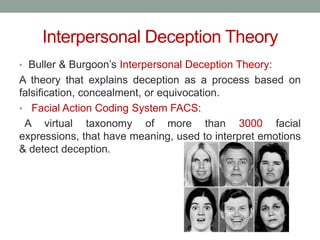
• Facial Action Coding System FACS:
A virtual taxonomy of more than 3000 facial
expressions, that have meaning, used to interpret emotions
& detect deception.
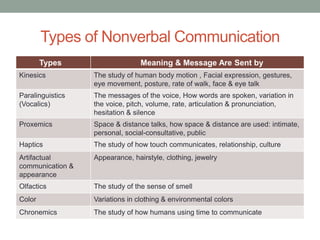
Types of Nonverbal Communication
Types Meaning & Message Are Sent by
Kinesics The study of human body motion , Facial expression, gestures,
eye movement, posture, rate of walk, face & eye talk
Paralinguistics
(Vocalics)
The messages of the voice, How words are spoken, variation in
the voice, pitch, volume, rate, articulation & pronunciation,
hesitation & silence
Proxemics Space & distance talks, how space & distance are used: intimate,
personal, social-consultative, public
Haptics The study of how touch communicates, relationship, culture
Artifactual
communication &
appearance
Appearance, hairstyle, clothing, jewelry
Olfactics The study of the sense of smell
Color Variations in clothing & environmental colors
Chronemics The study of how humans using time to communicate
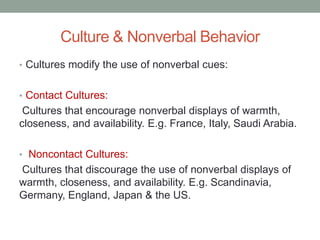
Culture & Nonverbal Behavior
• Cultures modify the use of nonverbal cues:
• Contact Cultures:
Cultures that encourage nonverbal displays of warmth,
closeness, and availability. E.g. France, Italy, Saudi Arabia.
• Noncontact Cultures:
Cultures that discourage the use of nonverbal displays of
warmth, closeness, and availability. E.g. Scandinavia,
Germany, England, Japan & the US.
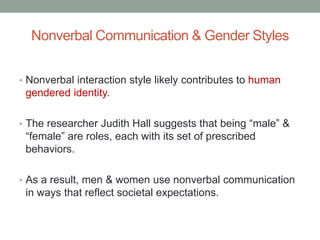
Nonverbal Communication & Gender Styles
• Nonverbal interaction style likely contributes to human
gendered identity.
• The researcher Judith Hall suggests that being “male” &
“female” are roles, each with its set of prescribed
behaviors.
• As a result, men & women use nonverbal communication
in ways that reflect societal expectations.
Men & Women
• Men exhibit assertive behaviors that demonstrate
their power & authority.
• Women exhibit reactive & responsive behaviors.
• Men talk more & interrupt women more frequently
than vice versa.
• Men are more apt to be dominant during
interactions.
Men & Women
• The visual dominance ratio of men usually is
higher than that of women which reinforces the
perception of social power.
• Men & women are also different in how they use
space & touch. Men use them to assert their
dominance.
• Men claim more personal space than women,
when they walk with women, they are more likely
to take a position in front of women than behind
them.
Men & Women
• Women display smiling more than men (although
it is culture-dependent). They even smile when
under stress.
• Men are likely to suppress their facial
expressions, thereby conveying their sense of
reserve & self-control.
• Women demonstrate an interest in affiliation.
• Men are more interested in establishing the
strength of their ideas than in sharing the floor.
• Women use of artifacts such as jewelry,
cosmetics, & hair adornments that help to
reinforce the image of a woman as a decorative
object.
• Men’s clothing tends to be less colorful & more
functional, which promotes utility, activity, & ease
of movement.
• Men & women differ in flirting which is a means of
self-promotion as well as a vehicle to express
interest in the other.
• It is claimed that women are more successful in
interpreting nonverbal behaviors, because:
• According to standpoint theory, it was women’s
subordinate societal status that compelled them
to become better message decoders so that they
could accurately predict the behavior of the more
dominant or powerful men.
• Carol Gilligan notes, since women are more
concerned than men with relationship
maintenance, it follows that they are likely to
develop an enhanced sensitivity to nonverbal
cues that facilitate & sustain relationship
development.
Thank You

Nonverbal Communication

  • 1.
    NONVERBAL COMMUNICATION Bekhal AbubakirHussein UNIVERSITY OF SULAIMANI May, 2017
  • 2.
    The Outline • Definitionof Nonverbal Communication • Metacommunicative Nature of Nonverbal Communication • Functions of Nonverbal Communication • Characteristics of Nonverbal Communication • Types of Nonverbal Communication • Culture & Nonverbal Behavior • Nonverbal Communication & Gender Styles
  • 3.
    Definition of NonverbalCommunication • Nonverbal Communication: The type of communication which is expressed through nonlinguistic means. It is the actions or attributes of humans, including their appearance, use of objects, sound, time, smell, and space, that have socially shared significance & stimulate meaning in others.
  • 4.
    Metacommunicative Nature of NonverbalCommunication • Researchers conclude that nonverbal cues carry approximately two-thirds of a message’s communicative value. • Although nonverbal messages may be sent deliberately or accidentally, their meaning depends on how they are interpreted. • Consequently, they fulfill metacommunicative functions, and communicate about communication, clarifying both: • The nature of our relationships, • The meaning of our verbal messages.
  • 6.
    Functions of NonverbalCommunication 1. Contradicting: nonverbal cues can contradict or negate verbal messages. Each interaction represents a double- message, the words say one thing, the nonverbal cues, another. 2. Emphasizing: nonverbal cues can emphasize or underscore a verbal message. 3. Regulating: nonverbal cues can regulate or control person-to-person interaction, like: turn taking, etc. 4. Complementing: nonverbal cues can reinforce or complement a verbal message. 5. Substituting: nonverbal cues can substitute for or take the place of spoken words.
  • 8.
    Characteristics of NonverbalCommunication 1. All nonverbal behavior has message value. 2. Nonverbal communication may be ambiguous & subject to misinterpretation. 3. Nonverbal communication is predominantly relational. 4. Nonverbal behavior may reveal deception.
  • 9.
    Interpersonal Deception Theory •Buller & Burgoon’s Interpersonal Deception Theory: A theory that explains deception as a process based on falsification, concealment, or equivocation. • Facial Action Coding System FACS: A virtual taxonomy of more than 3000 facial expressions, that have meaning, used to interpret emotions & detect deception.
  • 11.
    Types of NonverbalCommunication Types Meaning & Message Are Sent by Kinesics The study of human body motion , Facial expression, gestures, eye movement, posture, rate of walk, face & eye talk Paralinguistics (Vocalics) The messages of the voice, How words are spoken, variation in the voice, pitch, volume, rate, articulation & pronunciation, hesitation & silence Proxemics Space & distance talks, how space & distance are used: intimate, personal, social-consultative, public Haptics The study of how touch communicates, relationship, culture Artifactual communication & appearance Appearance, hairstyle, clothing, jewelry Olfactics The study of the sense of smell Color Variations in clothing & environmental colors Chronemics The study of how humans using time to communicate
  • 13.
    Culture & NonverbalBehavior • Cultures modify the use of nonverbal cues: • Contact Cultures: Cultures that encourage nonverbal displays of warmth, closeness, and availability. E.g. France, Italy, Saudi Arabia. • Noncontact Cultures: Cultures that discourage the use of nonverbal displays of warmth, closeness, and availability. E.g. Scandinavia, Germany, England, Japan & the US.
  • 14.
    Nonverbal Communication &Gender Styles • Nonverbal interaction style likely contributes to human gendered identity. • The researcher Judith Hall suggests that being “male” & “female” are roles, each with its set of prescribed behaviors. • As a result, men & women use nonverbal communication in ways that reflect societal expectations.
  • 16.
    Men & Women •Men exhibit assertive behaviors that demonstrate their power & authority. • Women exhibit reactive & responsive behaviors. • Men talk more & interrupt women more frequently than vice versa. • Men are more apt to be dominant during interactions.
  • 17.
    Men & Women •The visual dominance ratio of men usually is higher than that of women which reinforces the perception of social power. • Men & women are also different in how they use space & touch. Men use them to assert their dominance. • Men claim more personal space than women, when they walk with women, they are more likely to take a position in front of women than behind them.
  • 18.
    Men & Women •Women display smiling more than men (although it is culture-dependent). They even smile when under stress. • Men are likely to suppress their facial expressions, thereby conveying their sense of reserve & self-control. • Women demonstrate an interest in affiliation. • Men are more interested in establishing the strength of their ideas than in sharing the floor.
  • 19.
    • Women useof artifacts such as jewelry, cosmetics, & hair adornments that help to reinforce the image of a woman as a decorative object. • Men’s clothing tends to be less colorful & more functional, which promotes utility, activity, & ease of movement. • Men & women differ in flirting which is a means of self-promotion as well as a vehicle to express interest in the other.
  • 20.
    • It isclaimed that women are more successful in interpreting nonverbal behaviors, because: • According to standpoint theory, it was women’s subordinate societal status that compelled them to become better message decoders so that they could accurately predict the behavior of the more dominant or powerful men.
  • 21.
    • Carol Gilligannotes, since women are more concerned than men with relationship maintenance, it follows that they are likely to develop an enhanced sensitivity to nonverbal cues that facilitate & sustain relationship development.
  • 22.