KinesicsCommunication Skills
Contents
 Introduction to Kinesics as a Communication skill.
 Appearance
 Posture
 Gestures
 Eye-Contact
 Facial Expression
Kinesics :
BODY LANGUAGE
The study of the
way in which
certain body
movements and
gestures serve as a
form of non-verbal
communication.
Appearance
Appearance plays an
important role in
communication since
people are going to see
you before they hear
you.
Appearance includes :
- Clothing
- Hair
- Jewelry
- Cosmetics
∙Appearance effectively communicates and
can create hostile or pleasant mood.
∙Appearance is a part of the message you
want to communicate to the audience.
 How you hold yourself i.e, how
you SIT, WALK, STAND mainly
during a presentation can be
referred to as POSTURE.
 It is important to analyze the
effect of posture to understand
its role in non-verbal
communication.
 Positive Posture, natural, relaxed
and resting posture will
encourage audience to ask
questions and for further
discussion.
 Novice speakers tend to be unsure about their posture
due to nervousness.
 Pacing constantly, bobbling the shoulders, looking
through the notes frequently, either constantly moving or
remaining steady are as a result.
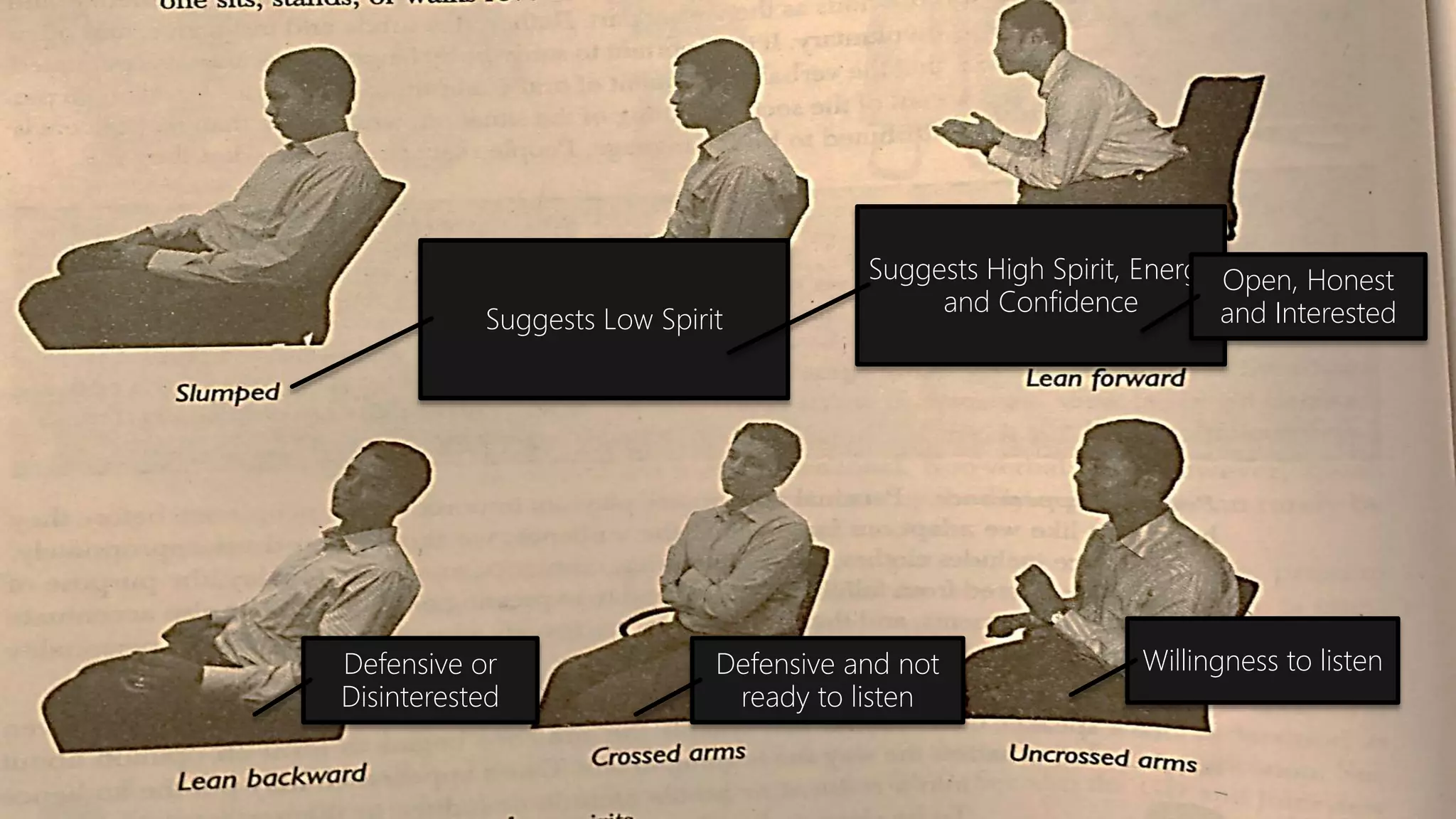
 Different body postures convey your message to the
audience such as :
Suggests Low Spirit
Suggests High Spirit, Energy
and Confidence
Open, Honest
and Interested
Defensive or
Disinterested
Defensive and not
ready to listen
Willingness to listen
G
E
S
T
U
R
E
Gesture :
Refers to the movements made
by hand, arms, head, torso,
shoulders etc.
A well timed Gesture not only
drives a point hole but also
enhances the impact and adds
greater value to what is being
said.
At the same time, untimely
gesture reduces the
effectiveness of the message.
Gestures can be
roughly be divided
into :
- Enumerated
- Descriptive
- Symbolic
- Locative
- Emphatic
Facial Expression
Face is the most expressive part of the body.
Different expressions convey different messages to the audiences such as,
 A Smile stands for FRIENDLINESS
 A Frown stands for DISCONTENT.
 Raised eyebrows stand for DISBELIEF.
 Tighten Jaw muscles stand for ANTAGONISM.
 Facial expressions are subtle.
The five basic expressions are :
 Inhibited  Restricted and Stolid
 Uninhibited  Spontaneous and impetuous.
 Substitute  Happy.
 Frozen  No change in expression.
 Blank  No expression at all.
 Eye Contact
o The eyes are considered to
be the windows of the
soul.
o Eye contact is a direct and
powerful form of non-
verbal communication.
o Eye contact is used to cull
information. However, eyes
can also be a rich source of
feedback.
Thank You!

Kinesics

  • 1.
  • 2.
    Contents  Introduction toKinesics as a Communication skill.  Appearance  Posture  Gestures  Eye-Contact  Facial Expression
  • 3.
    Kinesics : BODY LANGUAGE Thestudy of the way in which certain body movements and gestures serve as a form of non-verbal communication.
  • 4.
  • 5.
    Appearance plays an importantrole in communication since people are going to see you before they hear you. Appearance includes : - Clothing - Hair - Jewelry - Cosmetics ∙Appearance effectively communicates and can create hostile or pleasant mood. ∙Appearance is a part of the message you want to communicate to the audience.
  • 7.
     How youhold yourself i.e, how you SIT, WALK, STAND mainly during a presentation can be referred to as POSTURE.  It is important to analyze the effect of posture to understand its role in non-verbal communication.  Positive Posture, natural, relaxed and resting posture will encourage audience to ask questions and for further discussion.
  • 8.
     Novice speakerstend to be unsure about their posture due to nervousness.  Pacing constantly, bobbling the shoulders, looking through the notes frequently, either constantly moving or remaining steady are as a result.  Different body postures convey your message to the audience such as : Suggests Low Spirit Suggests High Spirit, Energy and Confidence Open, Honest and Interested Defensive or Disinterested Defensive and not ready to listen Willingness to listen
  • 9.
  • 10.
    Gesture : Refers tothe movements made by hand, arms, head, torso, shoulders etc. A well timed Gesture not only drives a point hole but also enhances the impact and adds greater value to what is being said. At the same time, untimely gesture reduces the effectiveness of the message.
  • 11.
    Gestures can be roughlybe divided into : - Enumerated - Descriptive - Symbolic - Locative - Emphatic
  • 12.
  • 13.
    Face is themost expressive part of the body. Different expressions convey different messages to the audiences such as,  A Smile stands for FRIENDLINESS  A Frown stands for DISCONTENT.  Raised eyebrows stand for DISBELIEF.  Tighten Jaw muscles stand for ANTAGONISM.  Facial expressions are subtle.
  • 14.
    The five basicexpressions are :  Inhibited  Restricted and Stolid  Uninhibited  Spontaneous and impetuous.  Substitute  Happy.  Frozen  No change in expression.  Blank  No expression at all.
  • 15.
  • 16.
    o The eyesare considered to be the windows of the soul. o Eye contact is a direct and powerful form of non- verbal communication. o Eye contact is used to cull information. However, eyes can also be a rich source of feedback.
  • 17.