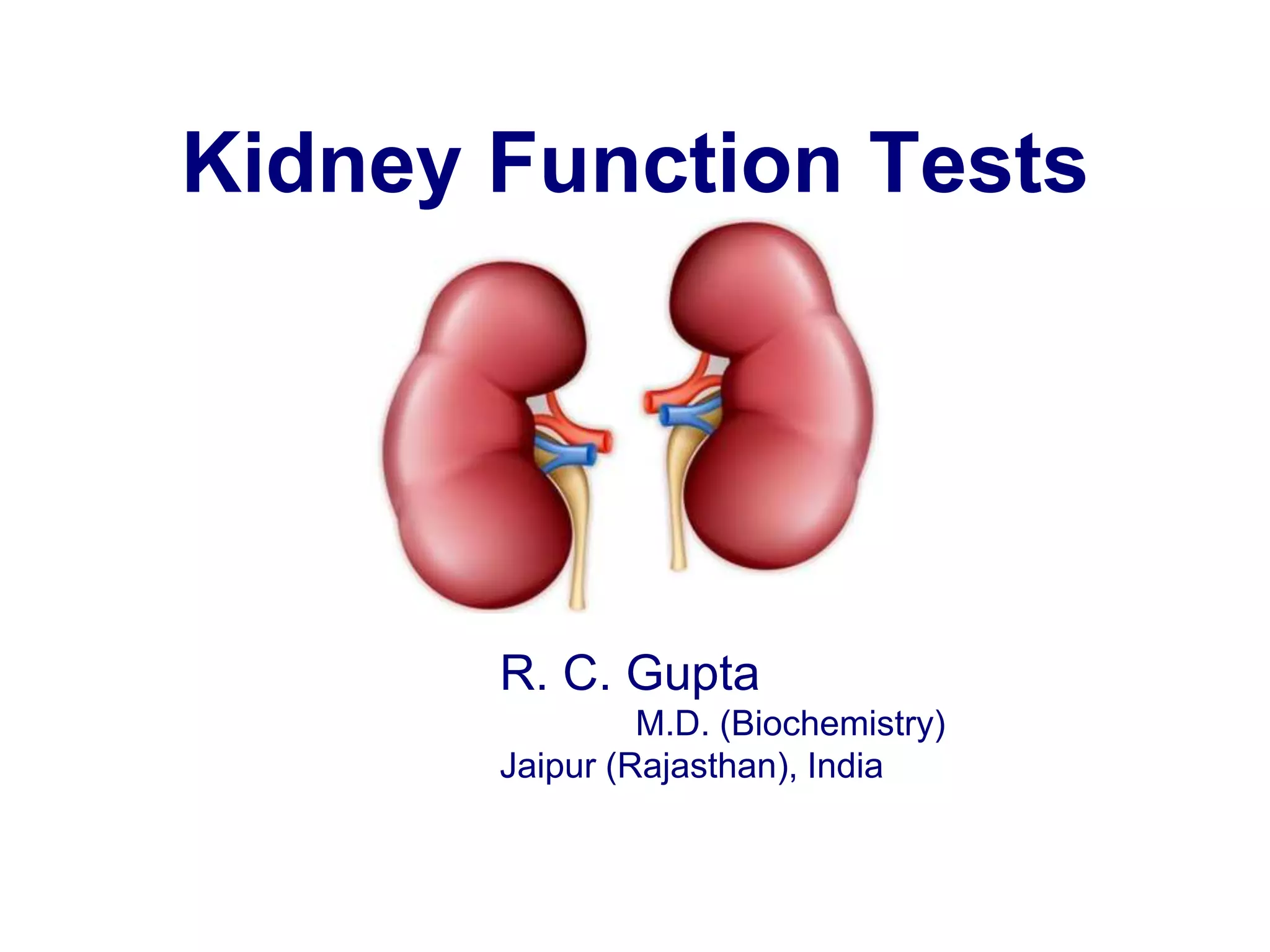
Kidney Function Tests
R. C. Gupta
M.D. (Biochemistry)
Jaipur (Rajasthan), India
Kidney function tests are done:
To detect the presence of an active
lesion in the excretory system
To assess the functional status of
the kidneys
In early stage of renal disease, functional
efficiency may be normal despite the
presence of an active lesion
Conversely, renal function may be
impaired due to permanent tissue damage
even after healing of the active lesion
Hence, the results should be interpreted
in the light of clinical features
Some of these tests may be affected by
extra-renal factors
Tests of tubular function
Tests of glomerular function
Kidney function tests may be broadly
divided into:
Common kidney function tests
are:
• Urine examination
• Serum urea
• Serum creatinine
• Urea clearance
• Creatinine clearance
A qualitative examination of urine should
precede quantitative analysis of blood and
urine
Physical examination and tests for proteins
and blood may provide useful clues about
the presence of an active lesion
Urine examination
Normally, proteins present in plasma do
not cross the glomerular membrane
Presence of proteins in urine is a sign of
glomerular damage
Microproteinuria (excretion of 30-300 mg
of proteins/day) is an early indicator of
glomerular damage
Urea is the end product of protein
catabolism
It is synthesized in liver, and is excreted by
kidneys
Normal range of serum urea is 20-45 mg/dl
Serum urea
Impaired glomerular function decreases
glomerular filtration
Urea cannot be excreted and its level in
blood increases
However, it is not a sensitive indicator of
glomerular filtration rate (GFR)
Serum urea begins to rise only when GFR
decreases below 50% of the normal
Still, serum urea is a widely used renal
function test
Uraemia (a rise in serum urea) has
become a synonym of renal failure
Serum urea may be altered in some extra-
renal diseases also
Hence, the results should be interpreted in
conjunction with the clinical findings
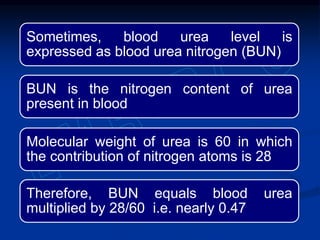
Sometimes, blood urea level is
expressed as blood urea nitrogen (BUN)
BUN is the nitrogen content of urea
present in blood
Molecular weight of urea is 60 in which
the contribution of nitrogen atoms is 28
Therefore, BUN equals blood urea
multiplied by 28/60 i.e. nearly 0.47
The normal range of BUN is 10-20 mg/dl
A rise in nitrogen content of blood is called
azotaemia
Creatinine is formed from creatine in
muscles
It is released in blood and is excreted by
kidneys in urine
Normal range of serum creatinine is 0.6-
1.5 mg/dl
Serum creatinine
Glomerular filtration is decreased in renal
failure
This causes retention of creatinine in blood
Hence, serum creatinine is raised in renal
failure
Serum creatinine is a better indicator of
glomerular function than serum urea
A simple measurement of serum urea is
not a sensitive test of glomerular function
Moller, MacIntosh and Van Slyke devised
the concept of urea clearance
Urea clearance is a better indicator of
glomerular function
Urea clearance
Urea clearance is the hypothetical volume
of blood from which all the urea is
removed by kidneys per minute
Rate of urinary excretion of urea is
compared with the serum urea level for
calculating urea clearance
Clearance equals glomerular
filtration rate if the substance
chosen for clearance is:
Completely filtered by glomeruli
Not secreted by tubules
Not reabsorbed by tubules
Urea is completely filtered by glomeruli
but is partially reabsorbed by tubules
Therefore, urea clearance is less than
the GFR
Urea clearance is measured over two
consecutive periods of 60 minutes each
Then, their mean is calculated
The patient takes two glasses of water
and empties his bladder completely
The time is noted and the patient
micturates again exactly 60 minutes later
The entire urine specimen is collected
A specimen of blood is also collected at
the same time
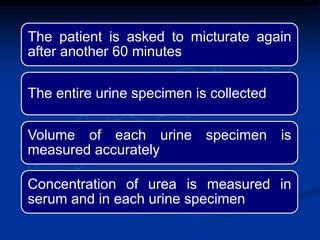
The patient is asked to micturate again
after another 60 minutes
The entire urine specimen is collected
Volume of each urine specimen is
measured accurately
Concentration of urea is measured in
serum and in each urine specimen
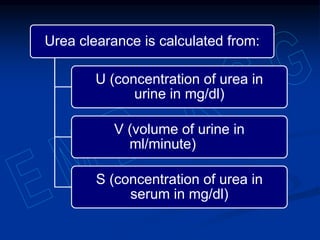
Urea clearance is calculated from:
U (concentration of urea in
urine in mg/dl)
V (volume of urine in
ml/minute)
S (concentration of urea in
serum in mg/dl)
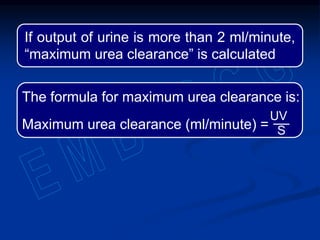
The formula for maximum urea clearance is:
Maximum urea clearance (ml/minute) =
UV
S
If output of urine is more than 2 ml/minute,
“maximum urea clearance” is calculated
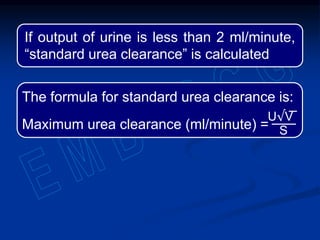
If output of urine is less than 2 ml/minute,
“standard urea clearance” is calculated
The formula for standard urea clearance is:
Maximum urea clearance (ml/minute) =
U√V
S
Maximum urea clearance is 75 ml/minute
in a normal person having a body
surface area of 1.73 square metres
Standard urea clearance 54 ml/minute in
a normal person having a body surface
area of 1.73 square metres
The calculated clearance has to be
corrected for body surface area
It is multiplied by 1.73/body surface area
of the subject
Urea clearance below 60% of the normal
indicates impaired glomerular function
Creatinine present in plasma is completely
filtered by glomeruli
There is very little tubular reabsorption of
creatinine
Therefore, creatinine clearance is closer to
GFR than is urea clearance
Creatinine clearance
Creatinine clearance is usually measured
over a 24-hour period
The urine passed in the 24-hour period is
collected carefully
A blood sample is also collected during
this period
Volume of 24-hour urine is measured
accurately
Concentration of creatinine in urine and
serum is measured
Creatinine clearance is calculated from
the formula UV/S
The normal range of creatinine clearance
is:
▪ 100-120 ml/minute in males
▪ 95-105 ml/minute in females
Values below normal indicate impairment
of glomerular function
Some less common kidney function
tests are:
• Serum cystatin C
• Inulin clearance
• Phenolsulphonephthalein excretion
test
• Concentration test
• Dilution test
• para-Amino hippurate clearance
Serum cystatin C
Creatinine synthesis depends on muscle
mass
Serum creatinine level may be misleading
if muscle mass is abnormally high or low
Cystatin C is useful in such individuals as
it is not affected by body mass
Cystatin C is an inhibitor of lysosomal
proteases
It is a protein, made up of 120 amino
acids
It is formed in all nucleated cells and is
released in blood
Cystatin C present in plasma is filtered by
glomeruli and is excreted in urine
Normal level of cystatin C in serum is
0.5 to 1.0 mg/L
If glomerular function declines, level of
cystatin C in serum rises
Serum cystatin C is a more precise test
of kidney function than serum creatinine
In glomerular dysfunction, rise in cystatin
C occurs earlier than rise in creatinine
Cystatin C also returns to normal more
quickly than creatinine
Cystatin C can be measured in a random
sample of serum by immunoassay
True GFR can be measured by inulin
clearance
Inulin is a polysaccharide of relatively low
molecular weight made up of fructose
Inulin clearance
Inulin is:
Non-toxic
Not metabolized in human beings
Completely filtered by glomeruli
Neither secreted nor reabsorbed by
tubules
Hence, inulin clearance is equal to GFR
Inulin is given by slow intravenous
infusion to maintain a constant blood level
during the test period
First, 30 ml of 10% inulin solution is mixed
with 250 ml of isotonic saline
It is infused at the rate of 20 ml/minute to
achieve the desired concentration
Then, 70 ml of 10% inulin solution is
mixed with 500 ml of isotonic saline
It is infused at the rate of 4 ml/minute to
maintain the inulin concentration
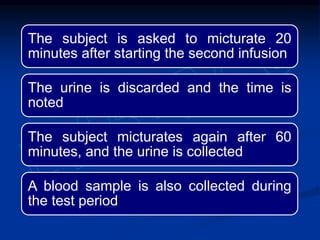
The subject is asked to micturate 20
minutes after starting the second infusion
The urine is discarded and the time is
noted
The subject micturates again after 60
minutes, and the urine is collected
A blood sample is also collected during
the test period
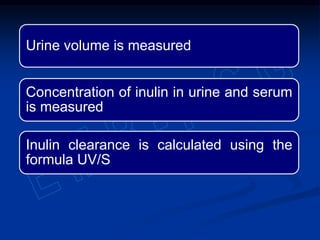
Urine volume is measured
Concentration of inulin in urine and serum
is measured
Inulin clearance is calculated using the
formula UV/S
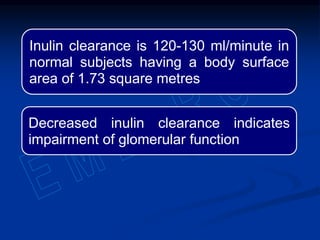
Inulin clearance is 120-130 ml/minute in
normal subjects having a body surface
area of 1.73 square metres
Decreased inulin clearance indicates
impairment of glomerular function
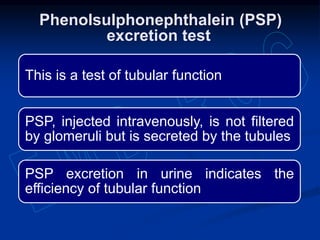
This is a test of tubular function
PSP, injected intravenously, is not filtered
by glomeruli but is secreted by the tubules
PSP excretion in urine indicates the
efficiency of tubular function
Phenolsulphonephthalein (PSP)
excretion test
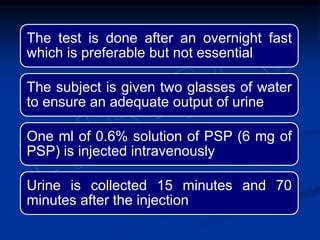
The test is done after an overnight fast
which is preferable but not essential
The subject is given two glasses of water
to ensure an adequate output of urine
One ml of 0.6% solution of PSP (6 mg of
PSP) is injected intravenously
Urine is collected 15 minutes and 70
minutes after the injection
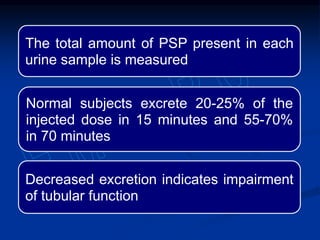
The total amount of PSP present in each
urine sample is measured
Normal subjects excrete 20-25% of the
injected dose in 15 minutes and 55-70%
in 70 minutes
Decreased excretion indicates impairment
of tubular function
This is also a test of tubular function
This is done to conserve water; the urine
becomes concentrated

Concentration test
When water content of body decreases,
tubular reabsorption of water is increased
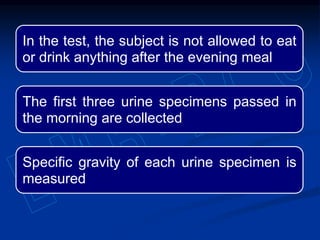
In the test, the subject is not allowed to eat
or drink anything after the evening meal
The first three urine specimens passed in
the morning are collected
Specific gravity of each urine specimen is
measured
In normal subjects, at least one of the
urine specimens will have a specific
gravity of 1.025 or more
If the specific gravity is less than 1.025 in
all the specimens, it means that tubular
function is impaired
This is also a test of tubular function
When an excess of water enters the
body, tubules reabsorb less water
This results in dilution of urine
Dilution test
The test is done in the morning after an
overnight fast
The subject is asked to drink 1,200 ml of
water within 30 minutes
Urine specimens are collected every hour
for four hours
Specific gravity of each urine sample is
measured
In normal subjects, at least one of the
specimens should have a specific gravity
of 1.003 or less
If the specific gravity is above 1.003 in all
the specimens, it shows impairment of
tubular function
para-Amino hippurate (PAH) is an
exogenous compound which is filtered by
glomeruli and is also secreted by tubules
At low plasma PAH levels, kidneys remove
the entire PAH present in blood in a single
circulation of blood through the kidneys
para-Amino hippurate clearance
At low plasma PAH levels, PAH clearance
is a measure of renal plasma flow (RPF)
The procedure is similar to that of inulin
clearance
First, a loading dose of PAH is infused,
followed by maintenance dose
The loading dose is 3 ml of 20% PAH
mixed with 250 ml of isotonic saline
It is infused at the rate of 20 ml/minute
The maintenance dose is 14 ml of 20%
PAH mixed with 500 ml of isotonic saline
It is infused at the rate of 4 ml/minute
Urine and blood samples are collected as
in inulin clearance test
Urine output and PAH concentrations in
urine and serum are measured
PAH clearance is calculated by the
formula UV/S
PAH clearance is equal to renal plasma
flow
Normal RPF is about 600 ml/minute for a
body surface area of 1.73 square metres
Normal filtration fraction (GFR/RPF) is
about 0.2
Filtration fraction decreases in glomerulo-
nephritis
Kidney function tests

Kidney function tests

  • 1.
    Kidney Function Tests R.C. Gupta M.D. (Biochemistry) Jaipur (Rajasthan), India
  • 2.
    Kidney function testsare done: To detect the presence of an active lesion in the excretory system To assess the functional status of the kidneys
  • 3.
    In early stageof renal disease, functional efficiency may be normal despite the presence of an active lesion Conversely, renal function may be impaired due to permanent tissue damage even after healing of the active lesion
  • 4.
    Hence, the resultsshould be interpreted in the light of clinical features Some of these tests may be affected by extra-renal factors Tests of tubular function Tests of glomerular function Kidney function tests may be broadly divided into:
  • 5.
    Common kidney functiontests are: • Urine examination • Serum urea • Serum creatinine • Urea clearance • Creatinine clearance
  • 6.
    A qualitative examinationof urine should precede quantitative analysis of blood and urine Physical examination and tests for proteins and blood may provide useful clues about the presence of an active lesion Urine examination
  • 7.
    Normally, proteins presentin plasma do not cross the glomerular membrane Presence of proteins in urine is a sign of glomerular damage Microproteinuria (excretion of 30-300 mg of proteins/day) is an early indicator of glomerular damage
  • 8.
    Urea is theend product of protein catabolism It is synthesized in liver, and is excreted by kidneys Normal range of serum urea is 20-45 mg/dl Serum urea
  • 9.
    Impaired glomerular functiondecreases glomerular filtration Urea cannot be excreted and its level in blood increases However, it is not a sensitive indicator of glomerular filtration rate (GFR) Serum urea begins to rise only when GFR decreases below 50% of the normal
  • 10.
    Still, serum ureais a widely used renal function test Uraemia (a rise in serum urea) has become a synonym of renal failure Serum urea may be altered in some extra- renal diseases also Hence, the results should be interpreted in conjunction with the clinical findings
  • 11.
    Sometimes, blood urealevel is expressed as blood urea nitrogen (BUN) BUN is the nitrogen content of urea present in blood Molecular weight of urea is 60 in which the contribution of nitrogen atoms is 28 Therefore, BUN equals blood urea multiplied by 28/60 i.e. nearly 0.47
  • 12.
    The normal rangeof BUN is 10-20 mg/dl A rise in nitrogen content of blood is called azotaemia
  • 13.
    Creatinine is formedfrom creatine in muscles It is released in blood and is excreted by kidneys in urine Normal range of serum creatinine is 0.6- 1.5 mg/dl Serum creatinine
  • 14.
    Glomerular filtration isdecreased in renal failure This causes retention of creatinine in blood Hence, serum creatinine is raised in renal failure Serum creatinine is a better indicator of glomerular function than serum urea
  • 15.
    A simple measurementof serum urea is not a sensitive test of glomerular function Moller, MacIntosh and Van Slyke devised the concept of urea clearance Urea clearance is a better indicator of glomerular function Urea clearance
  • 16.
    Urea clearance isthe hypothetical volume of blood from which all the urea is removed by kidneys per minute Rate of urinary excretion of urea is compared with the serum urea level for calculating urea clearance
  • 17.
    Clearance equals glomerular filtrationrate if the substance chosen for clearance is: Completely filtered by glomeruli Not secreted by tubules Not reabsorbed by tubules
  • 18.
    Urea is completelyfiltered by glomeruli but is partially reabsorbed by tubules Therefore, urea clearance is less than the GFR Urea clearance is measured over two consecutive periods of 60 minutes each Then, their mean is calculated
  • 19.
    The patient takestwo glasses of water and empties his bladder completely The time is noted and the patient micturates again exactly 60 minutes later The entire urine specimen is collected A specimen of blood is also collected at the same time
  • 20.
    The patient isasked to micturate again after another 60 minutes The entire urine specimen is collected Volume of each urine specimen is measured accurately Concentration of urea is measured in serum and in each urine specimen
  • 21.
    Urea clearance iscalculated from: U (concentration of urea in urine in mg/dl) V (volume of urine in ml/minute) S (concentration of urea in serum in mg/dl)
  • 22.
    The formula formaximum urea clearance is: Maximum urea clearance (ml/minute) = UV S If output of urine is more than 2 ml/minute, “maximum urea clearance” is calculated
  • 23.
    If output ofurine is less than 2 ml/minute, “standard urea clearance” is calculated The formula for standard urea clearance is: Maximum urea clearance (ml/minute) = U√V S
  • 24.
    Maximum urea clearanceis 75 ml/minute in a normal person having a body surface area of 1.73 square metres Standard urea clearance 54 ml/minute in a normal person having a body surface area of 1.73 square metres
  • 25.
    The calculated clearancehas to be corrected for body surface area It is multiplied by 1.73/body surface area of the subject Urea clearance below 60% of the normal indicates impaired glomerular function
  • 26.
    Creatinine present inplasma is completely filtered by glomeruli There is very little tubular reabsorption of creatinine Therefore, creatinine clearance is closer to GFR than is urea clearance Creatinine clearance
  • 27.
    Creatinine clearance isusually measured over a 24-hour period The urine passed in the 24-hour period is collected carefully A blood sample is also collected during this period
  • 28.
    Volume of 24-hoururine is measured accurately Concentration of creatinine in urine and serum is measured Creatinine clearance is calculated from the formula UV/S
  • 29.
    The normal rangeof creatinine clearance is: ▪ 100-120 ml/minute in males ▪ 95-105 ml/minute in females Values below normal indicate impairment of glomerular function
  • 30.
    Some less commonkidney function tests are: • Serum cystatin C • Inulin clearance • Phenolsulphonephthalein excretion test • Concentration test • Dilution test • para-Amino hippurate clearance
  • 31.
    Serum cystatin C Creatininesynthesis depends on muscle mass Serum creatinine level may be misleading if muscle mass is abnormally high or low Cystatin C is useful in such individuals as it is not affected by body mass
  • 32.
    Cystatin C isan inhibitor of lysosomal proteases It is a protein, made up of 120 amino acids It is formed in all nucleated cells and is released in blood Cystatin C present in plasma is filtered by glomeruli and is excreted in urine
  • 33.
    Normal level ofcystatin C in serum is 0.5 to 1.0 mg/L If glomerular function declines, level of cystatin C in serum rises Serum cystatin C is a more precise test of kidney function than serum creatinine
  • 34.
    In glomerular dysfunction,rise in cystatin C occurs earlier than rise in creatinine Cystatin C also returns to normal more quickly than creatinine Cystatin C can be measured in a random sample of serum by immunoassay
  • 35.
    True GFR canbe measured by inulin clearance Inulin is a polysaccharide of relatively low molecular weight made up of fructose Inulin clearance
  • 36.
    Inulin is: Non-toxic Not metabolizedin human beings Completely filtered by glomeruli Neither secreted nor reabsorbed by tubules
  • 37.
    Hence, inulin clearanceis equal to GFR Inulin is given by slow intravenous infusion to maintain a constant blood level during the test period
  • 38.
    First, 30 mlof 10% inulin solution is mixed with 250 ml of isotonic saline It is infused at the rate of 20 ml/minute to achieve the desired concentration Then, 70 ml of 10% inulin solution is mixed with 500 ml of isotonic saline It is infused at the rate of 4 ml/minute to maintain the inulin concentration
  • 39.
    The subject isasked to micturate 20 minutes after starting the second infusion The urine is discarded and the time is noted The subject micturates again after 60 minutes, and the urine is collected A blood sample is also collected during the test period
  • 40.
    Urine volume ismeasured Concentration of inulin in urine and serum is measured Inulin clearance is calculated using the formula UV/S
  • 41.
    Inulin clearance is120-130 ml/minute in normal subjects having a body surface area of 1.73 square metres Decreased inulin clearance indicates impairment of glomerular function
  • 42.
    This is atest of tubular function PSP, injected intravenously, is not filtered by glomeruli but is secreted by the tubules PSP excretion in urine indicates the efficiency of tubular function Phenolsulphonephthalein (PSP) excretion test
  • 43.
    The test isdone after an overnight fast which is preferable but not essential The subject is given two glasses of water to ensure an adequate output of urine One ml of 0.6% solution of PSP (6 mg of PSP) is injected intravenously Urine is collected 15 minutes and 70 minutes after the injection
  • 44.
    The total amountof PSP present in each urine sample is measured Normal subjects excrete 20-25% of the injected dose in 15 minutes and 55-70% in 70 minutes Decreased excretion indicates impairment of tubular function
  • 45.
    This is alsoa test of tubular function This is done to conserve water; the urine becomes concentrated Concentration test When water content of body decreases, tubular reabsorption of water is increased
  • 46.
    In the test,the subject is not allowed to eat or drink anything after the evening meal The first three urine specimens passed in the morning are collected Specific gravity of each urine specimen is measured
  • 47.
    In normal subjects,at least one of the urine specimens will have a specific gravity of 1.025 or more If the specific gravity is less than 1.025 in all the specimens, it means that tubular function is impaired
  • 48.
    This is alsoa test of tubular function When an excess of water enters the body, tubules reabsorb less water This results in dilution of urine Dilution test
  • 49.
    The test isdone in the morning after an overnight fast The subject is asked to drink 1,200 ml of water within 30 minutes Urine specimens are collected every hour for four hours Specific gravity of each urine sample is measured
  • 50.
    In normal subjects,at least one of the specimens should have a specific gravity of 1.003 or less If the specific gravity is above 1.003 in all the specimens, it shows impairment of tubular function
  • 51.
    para-Amino hippurate (PAH)is an exogenous compound which is filtered by glomeruli and is also secreted by tubules At low plasma PAH levels, kidneys remove the entire PAH present in blood in a single circulation of blood through the kidneys para-Amino hippurate clearance
  • 52.
    At low plasmaPAH levels, PAH clearance is a measure of renal plasma flow (RPF) The procedure is similar to that of inulin clearance First, a loading dose of PAH is infused, followed by maintenance dose
  • 53.
    The loading doseis 3 ml of 20% PAH mixed with 250 ml of isotonic saline It is infused at the rate of 20 ml/minute The maintenance dose is 14 ml of 20% PAH mixed with 500 ml of isotonic saline It is infused at the rate of 4 ml/minute
  • 54.
    Urine and bloodsamples are collected as in inulin clearance test Urine output and PAH concentrations in urine and serum are measured PAH clearance is calculated by the formula UV/S PAH clearance is equal to renal plasma flow
  • 55.
    Normal RPF isabout 600 ml/minute for a body surface area of 1.73 square metres Normal filtration fraction (GFR/RPF) is about 0.2 Filtration fraction decreases in glomerulo- nephritis