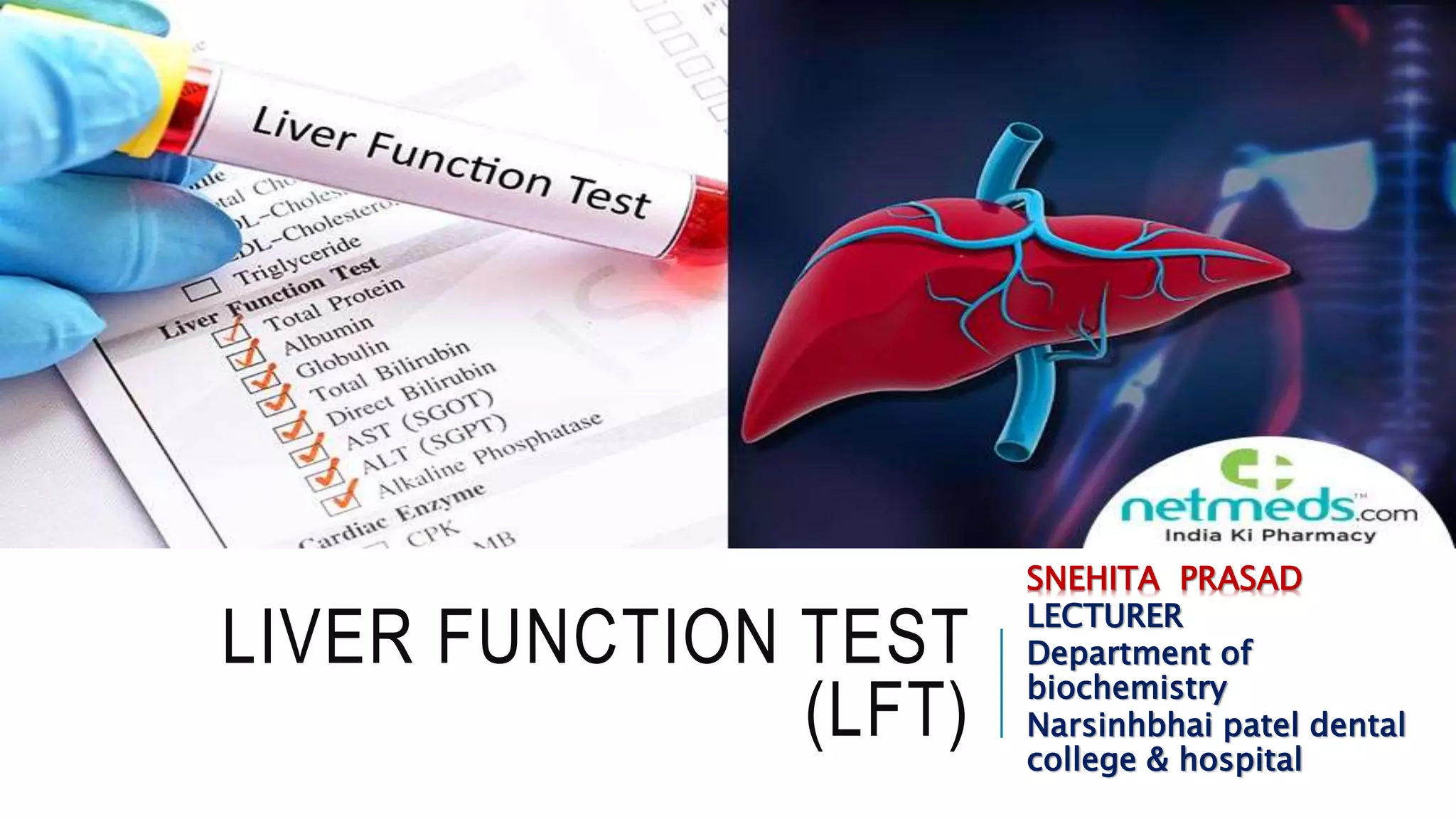

LIVER FUNCTION TEST
(LFT)
SNEHITA PRASAD
LECTURER
Department of
biochemistry
Narsinhbhai patel dental
college & hospital
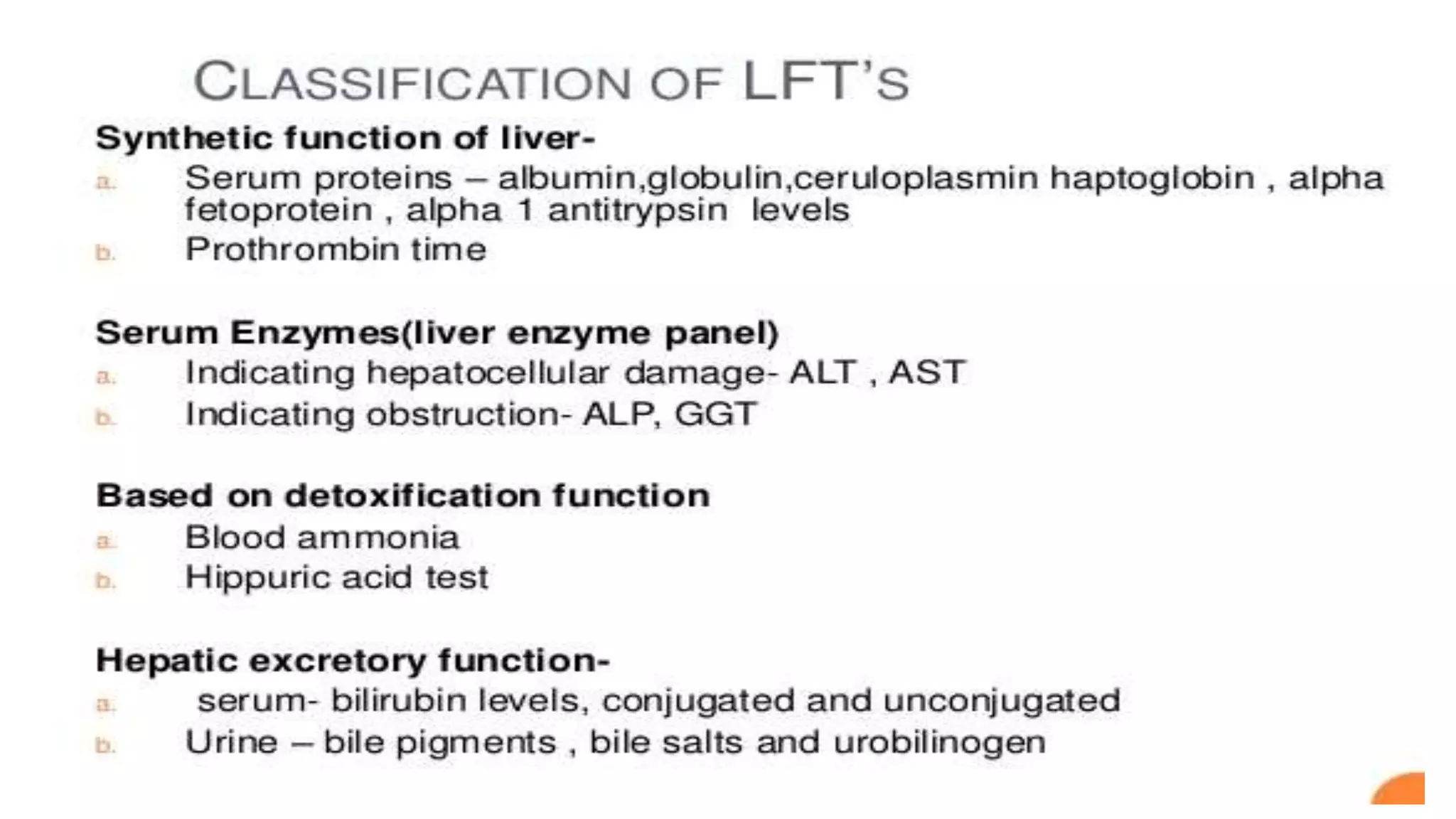
Biochemical tests are of immense value in diagnosis and
monitoring of liver diseases. These tests are usually referred
to as “liver function tests” (LFT). LFTs are the most widely
performed biochemical tests in the laboratory.
 Detect the presence of liver disease
Distinguish among different types of liver disorders
Gauge the extent of known liver damage
Follow the response to treatment
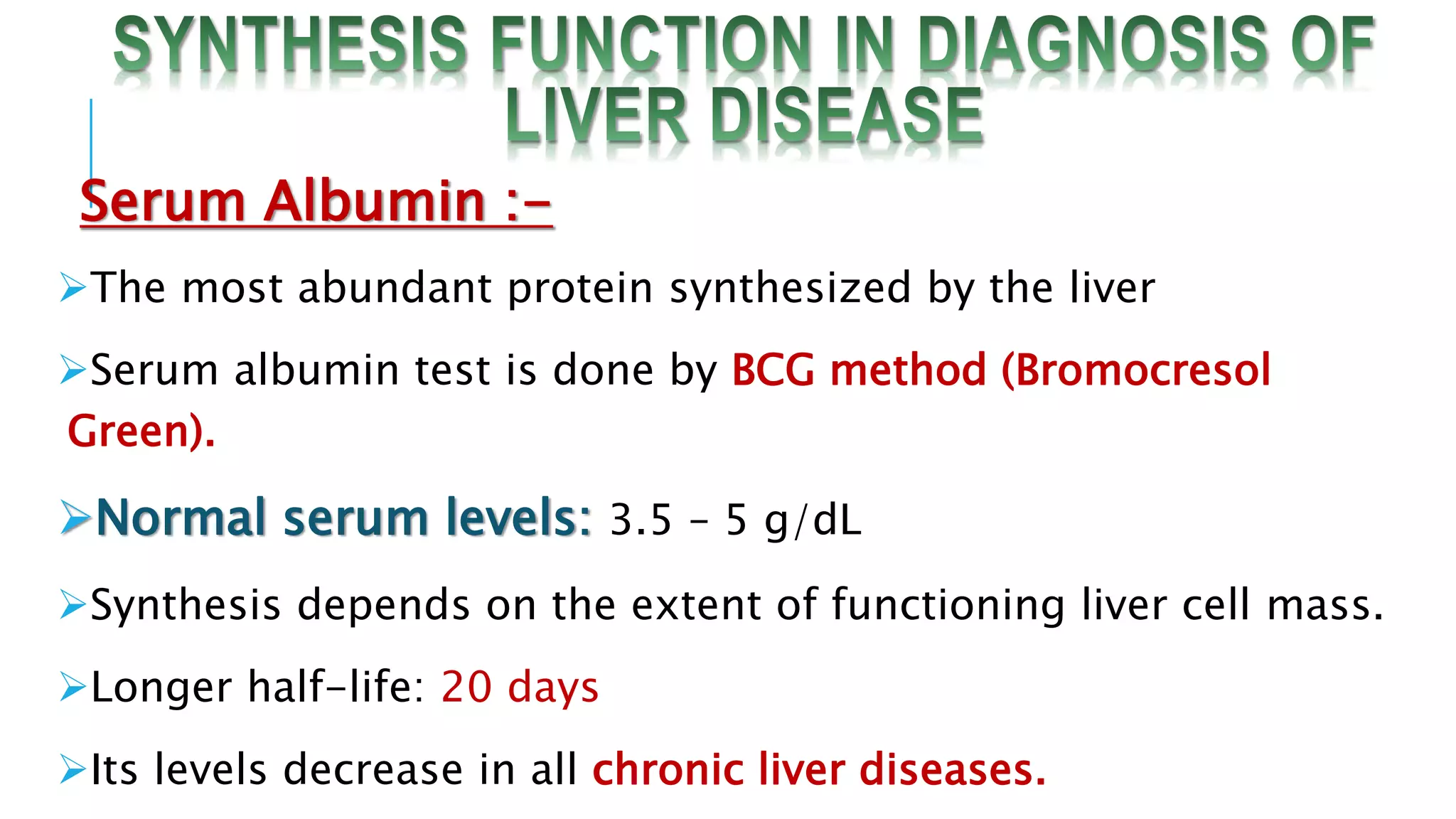
Serum Albumin :-
The most abundant protein synthesized by the liver
Serum albumin test is done by BCG method (Bromocresol
Green).
Normal serum levels: 3.5 – 5 g/dL
Synthesis depends on the extent of functioning liver cell mass.
Longer half-life: 20 days
Its levels decrease in all chronic liver diseases.
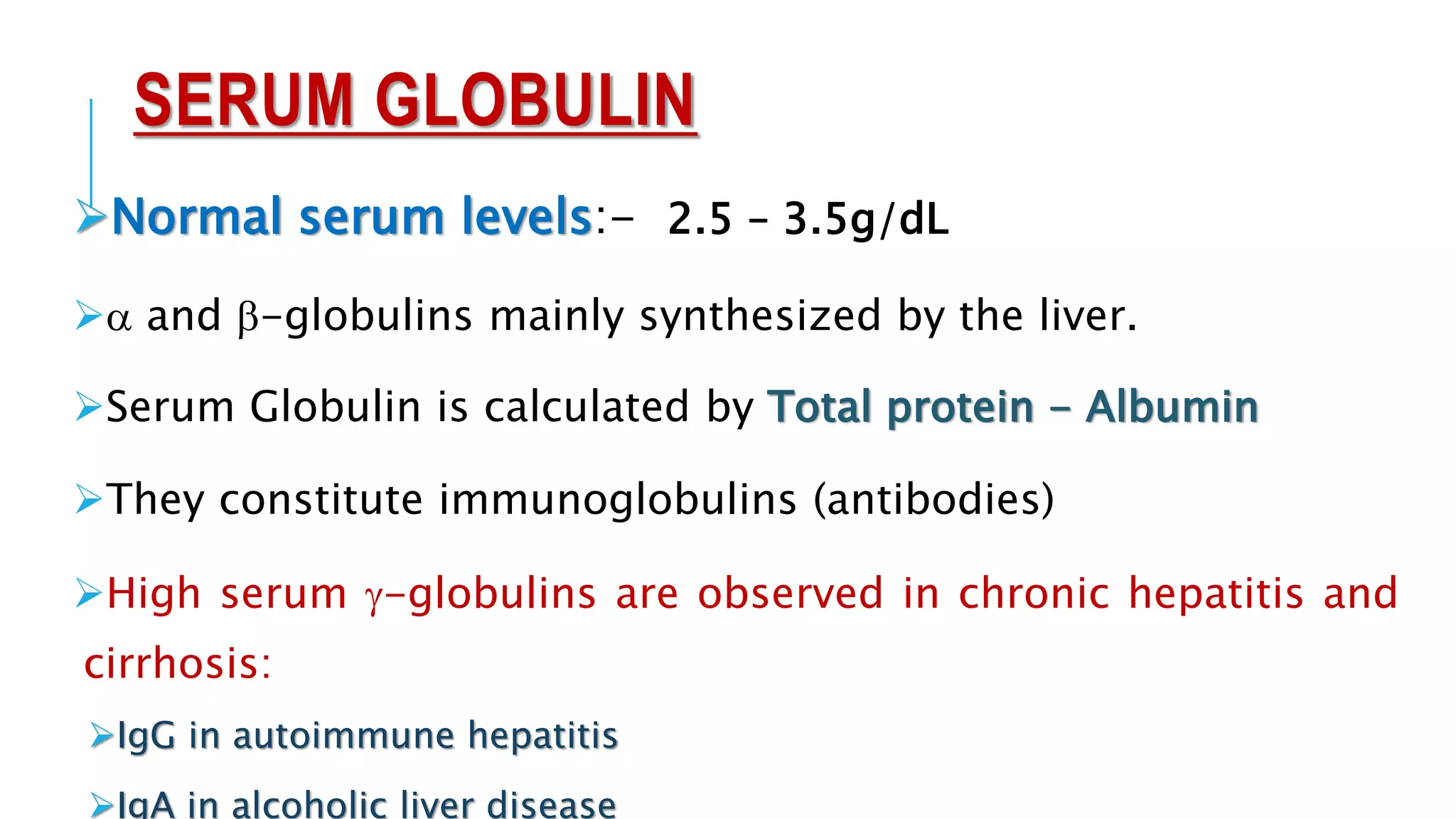
SERUM GLOBULIN
Normal serum levels:- 2.5 – 3.5g/dL
a and b-globulins mainly synthesized by the liver.
Serum Globulin is calculated by Total protein - Albumin
They constitute immunoglobulins (antibodies)
High serum g-globulins are observed in chronic hepatitis and
cirrhosis:
IgG in autoimmune hepatitis
IgA in alcoholic liver disease
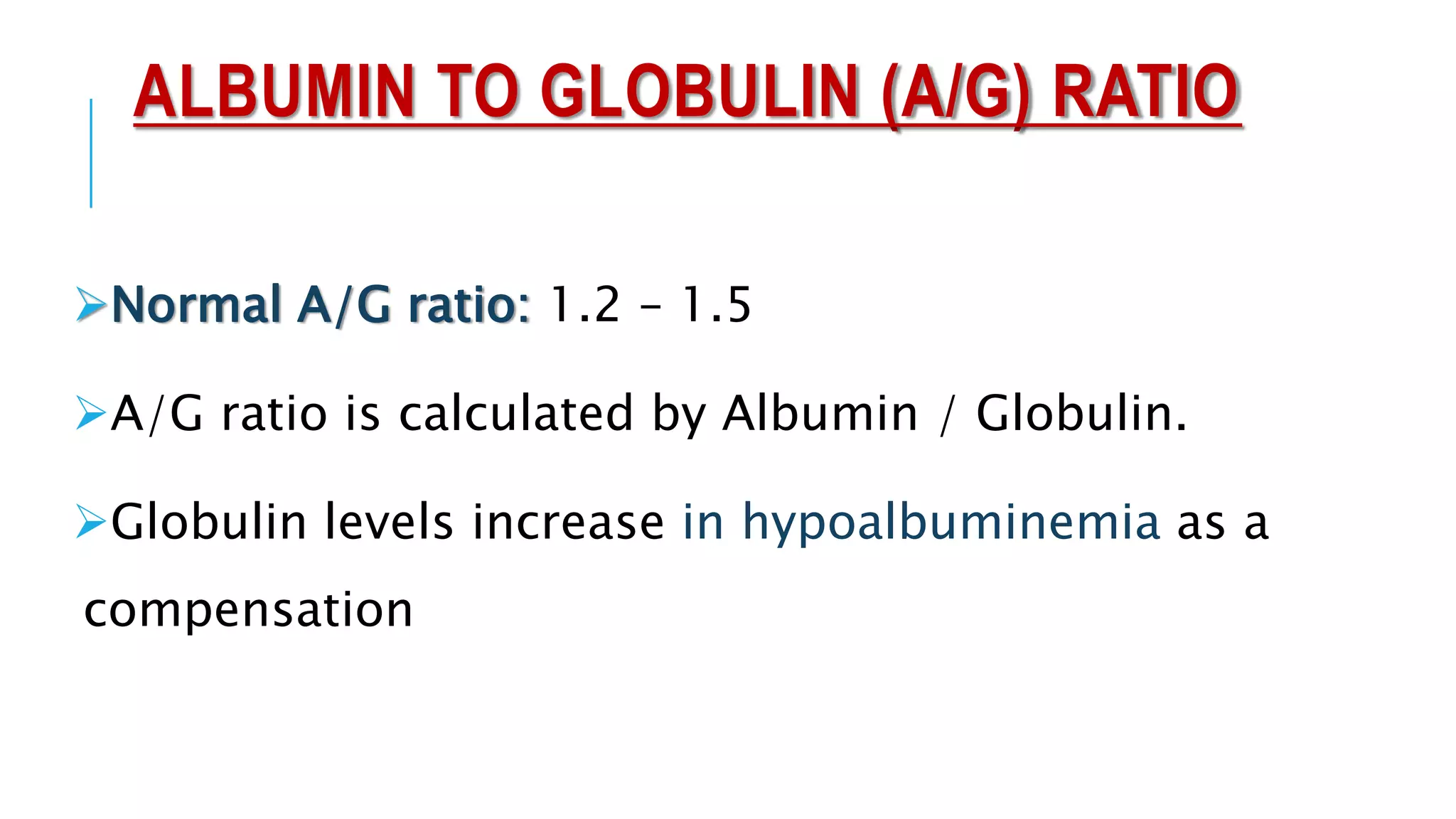
ALBUMIN TO GLOBULIN (A/G) RATIO
Normal A/G ratio: 1.2 – 1.5
A/G ratio is calculated by Albumin / Globulin.
Globulin levels increase in hypoalbuminemia as a
compensation
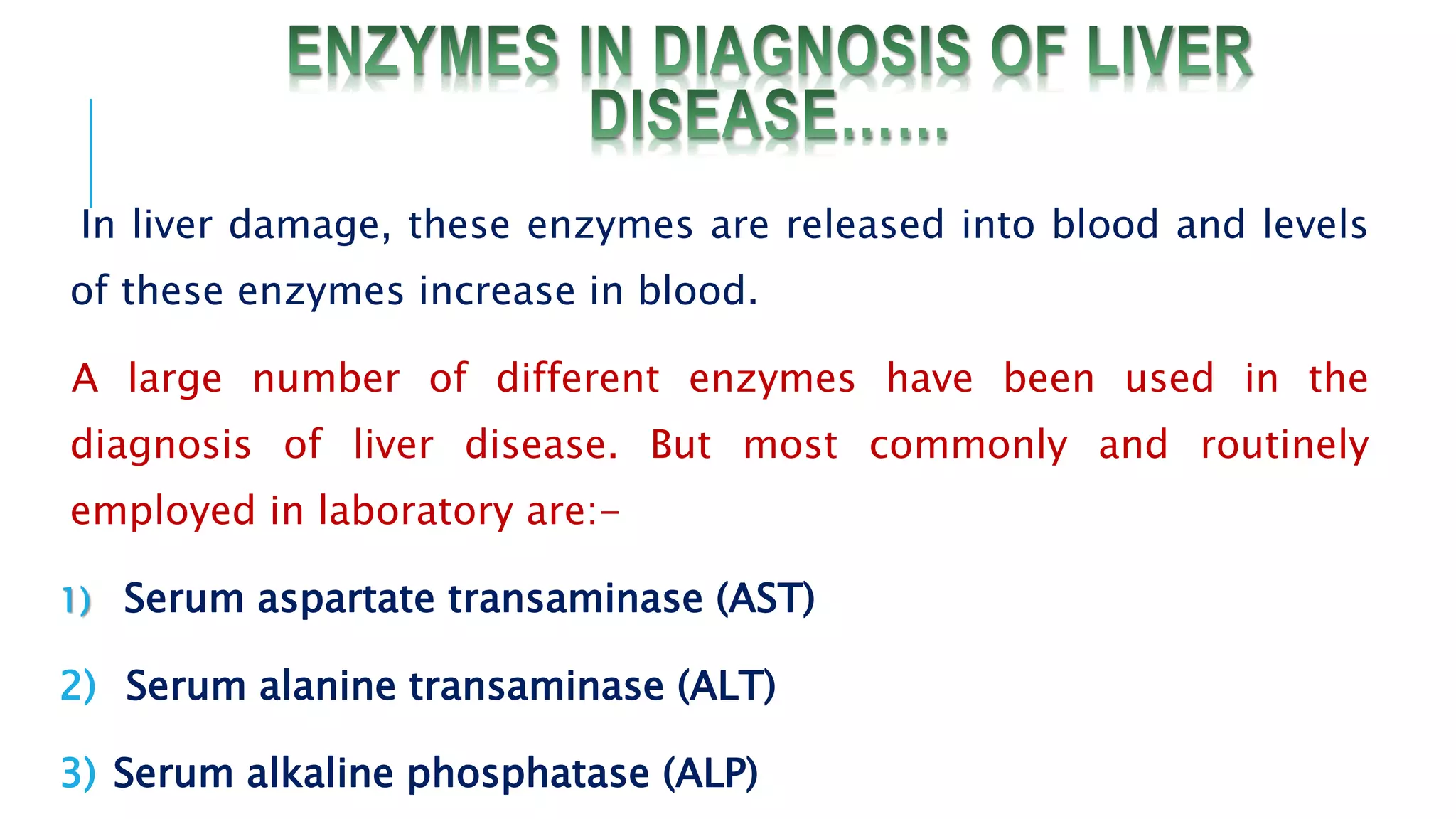
In liver damage, these enzymes are released into blood and levels
of these enzymes increase in blood.
A large number of different enzymes have been used in the
diagnosis of liver disease. But most commonly and routinely
employed in laboratory are:-
1) Serum aspartate transaminase (AST)
2) Serum alanine transaminase (ALT)
3) Serum alkaline phosphatase (ALP)
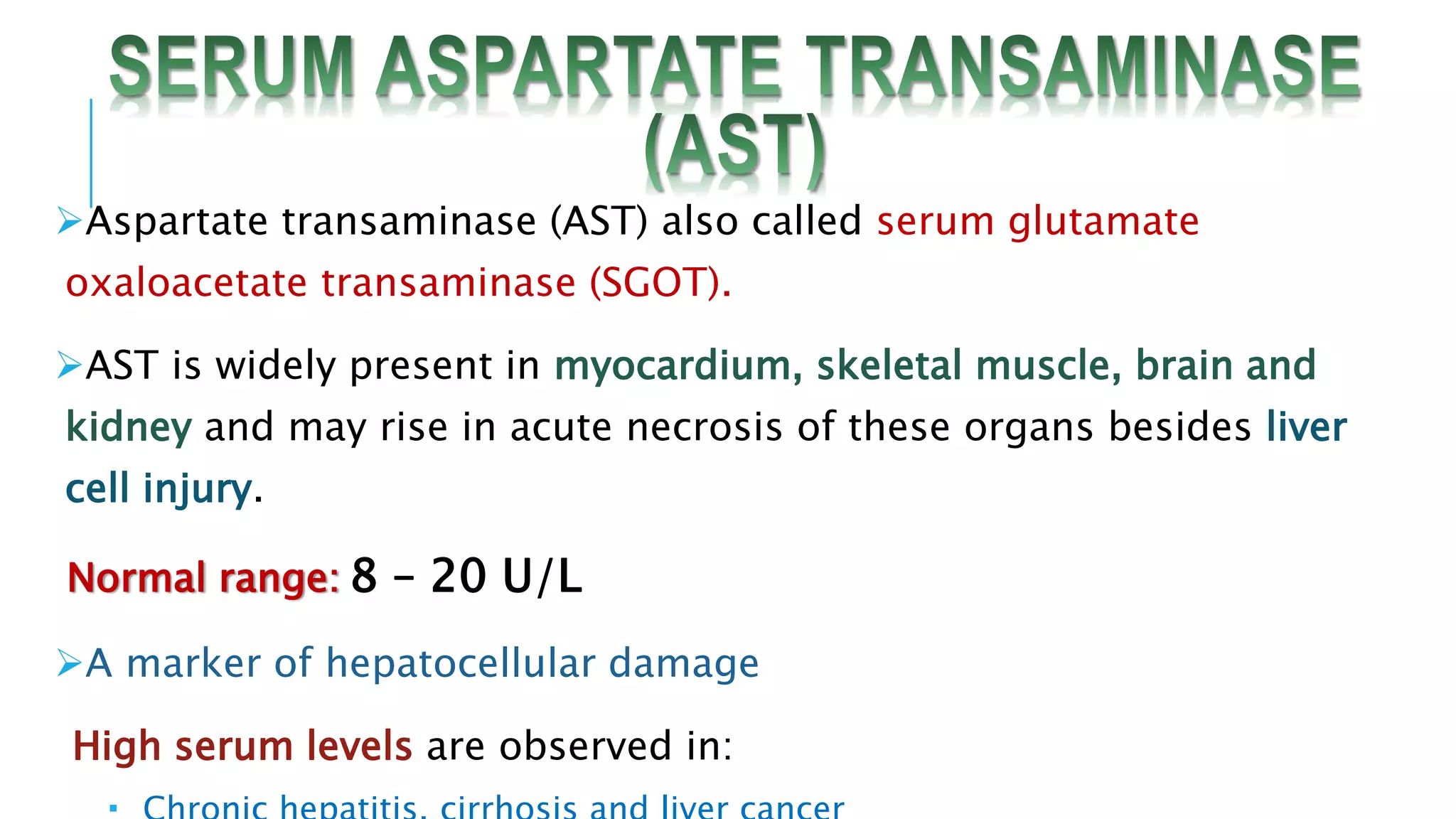
Aspartate transaminase (AST) also called serum glutamate
oxaloacetate transaminase (SGOT).
AST is widely present in myocardium, skeletal muscle, brain and
kidney and may rise in acute necrosis of these organs besides liver
cell injury.
Normal range: 8 – 20 U/L
A marker of hepatocellular damage
High serum levels are observed in:
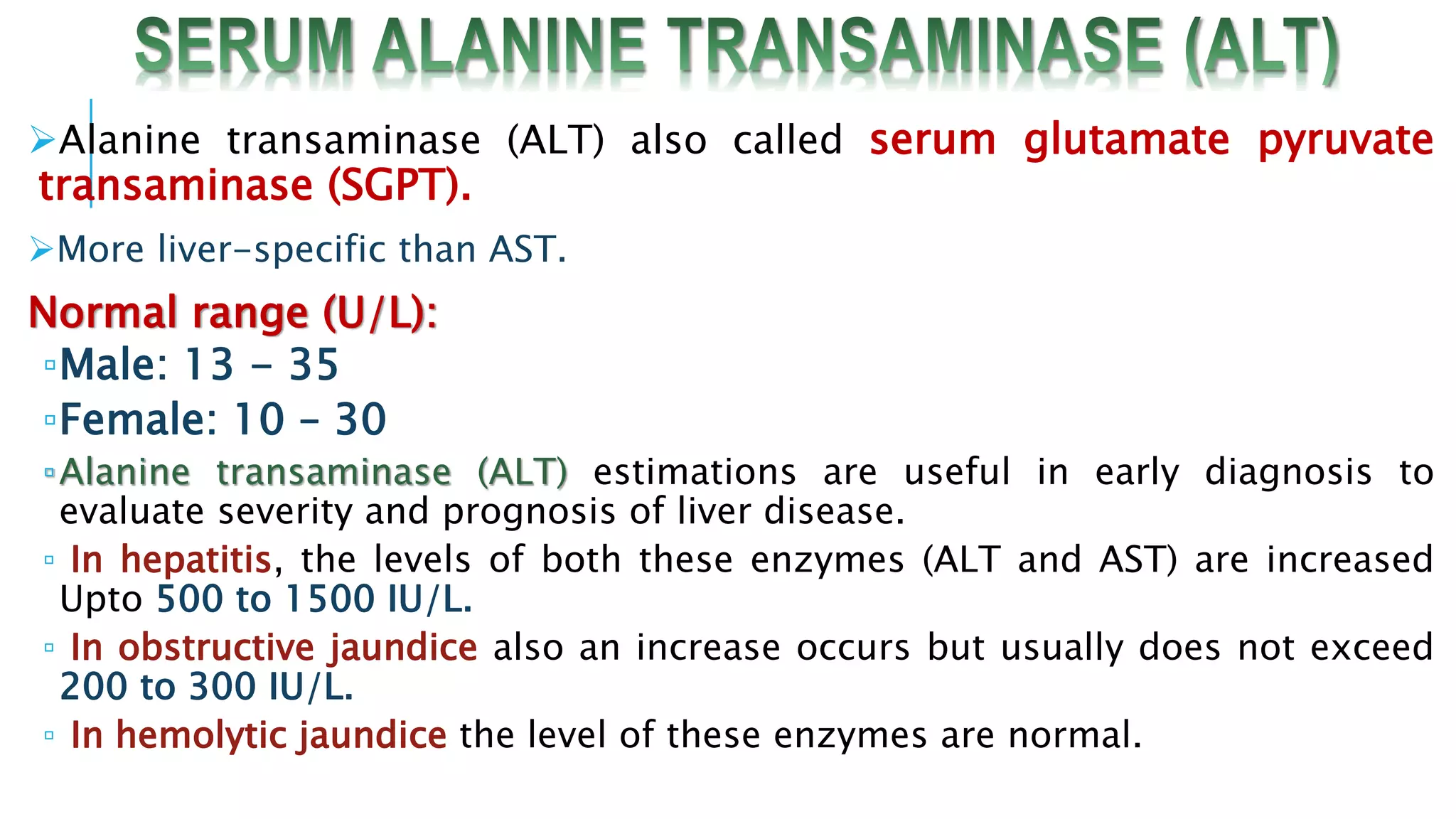
Alanine transaminase (ALT) also called serum glutamate pyruvate
transaminase (SGPT).
More liver-specific than AST.
Normal range (U/L):
▫Male: 13 - 35
▫Female: 10 – 30
▫Alanine transaminase (ALT) estimations are useful in early diagnosis to
evaluate severity and prognosis of liver disease.
▫ In hepatitis, the levels of both these enzymes (ALT and AST) are increased
Upto 500 to 1500 IU/L.
▫ In obstructive jaundice also an increase occurs but usually does not exceed
200 to 300 IU/L.
▫ In hemolytic jaundice the level of these enzymes are normal.
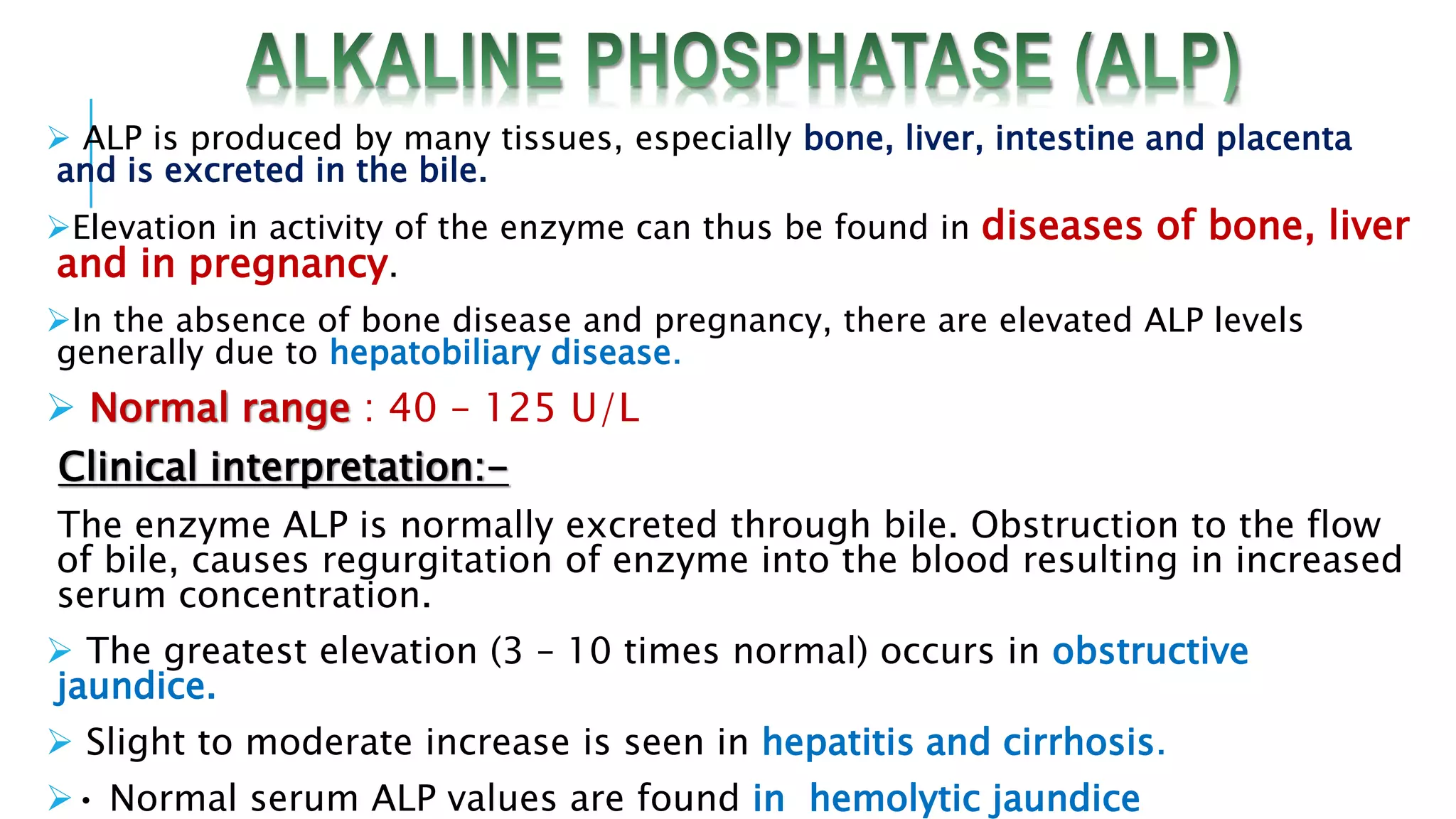
 ALP is produced by many tissues, especially bone, liver, intestine and placenta
and is excreted in the bile.
Elevation in activity of the enzyme can thus be found in diseases of bone, liver
and in pregnancy.
In the absence of bone disease and pregnancy, there are elevated ALP levels
generally due to hepatobiliary disease.
 Normal range : 40 – 125 U/L
Clinical interpretation:-
The enzyme ALP is normally excreted through bile. Obstruction to the flow
of bile, causes regurgitation of enzyme into the blood resulting in increased
serum concentration.
 The greatest elevation (3 – 10 times normal) occurs in obstructive
jaundice.
 Slight to moderate increase is seen in hepatitis and cirrhosis.
• Normal serum ALP values are found in hemolytic jaundice
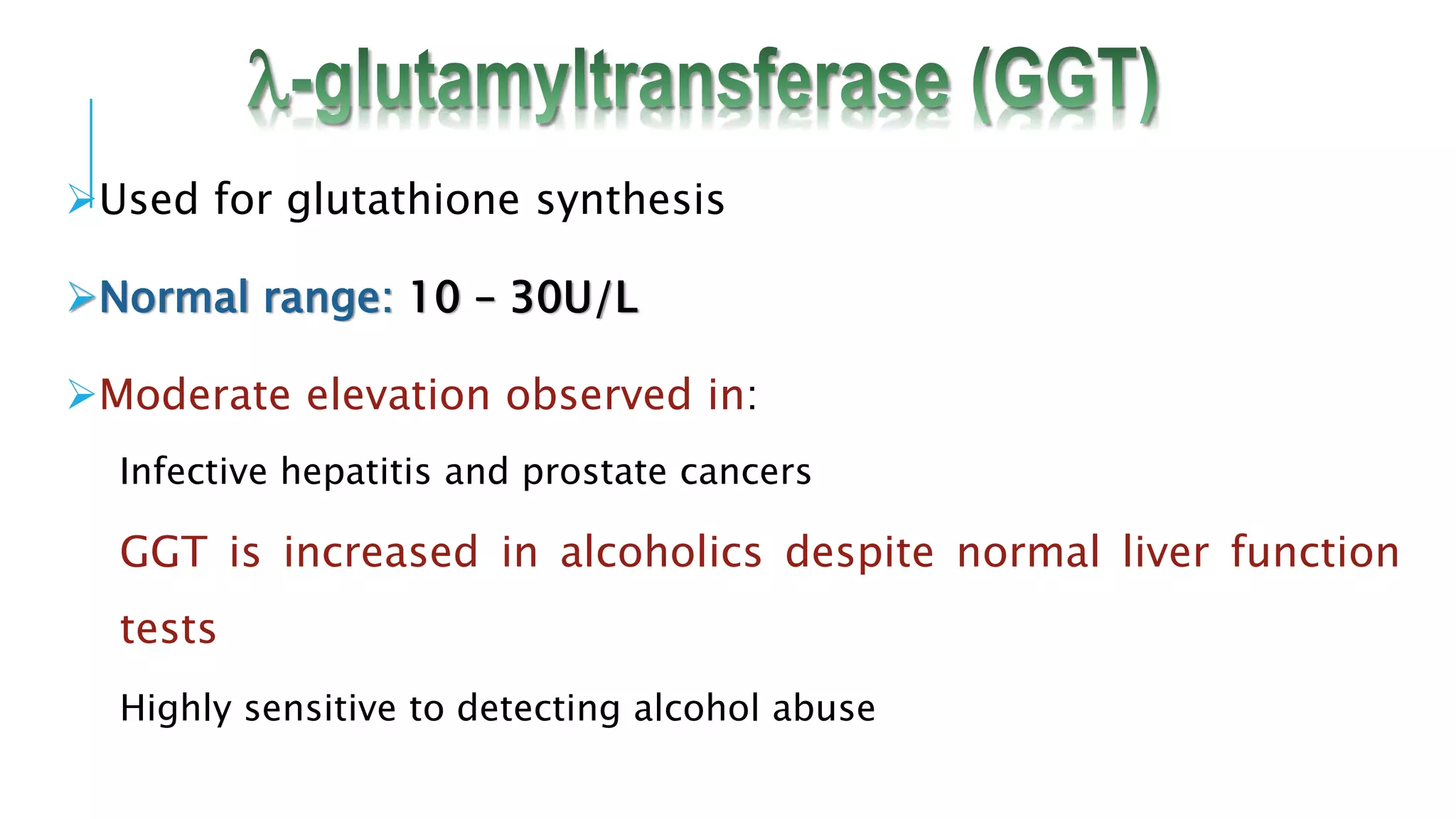
Used for glutathione synthesis
Normal range: 10 – 30U/L
Moderate elevation observed in:
Infective hepatitis and prostate cancers
GGT is increased in alcoholics despite normal liver function
tests
Highly sensitive to detecting alcohol abuse
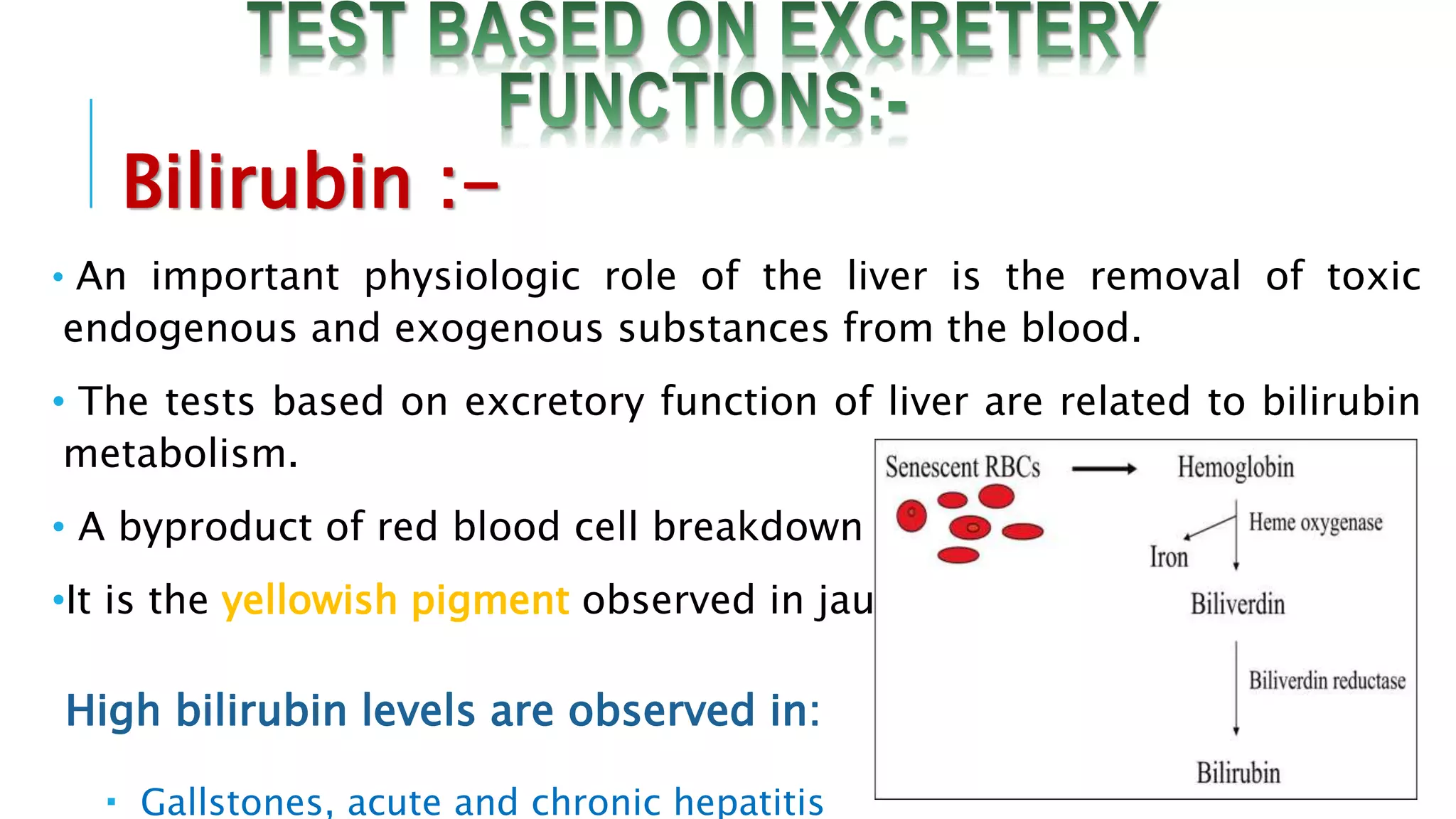
Bilirubin :-
• An important physiologic role of the liver is the removal of toxic
endogenous and exogenous substances from the blood.
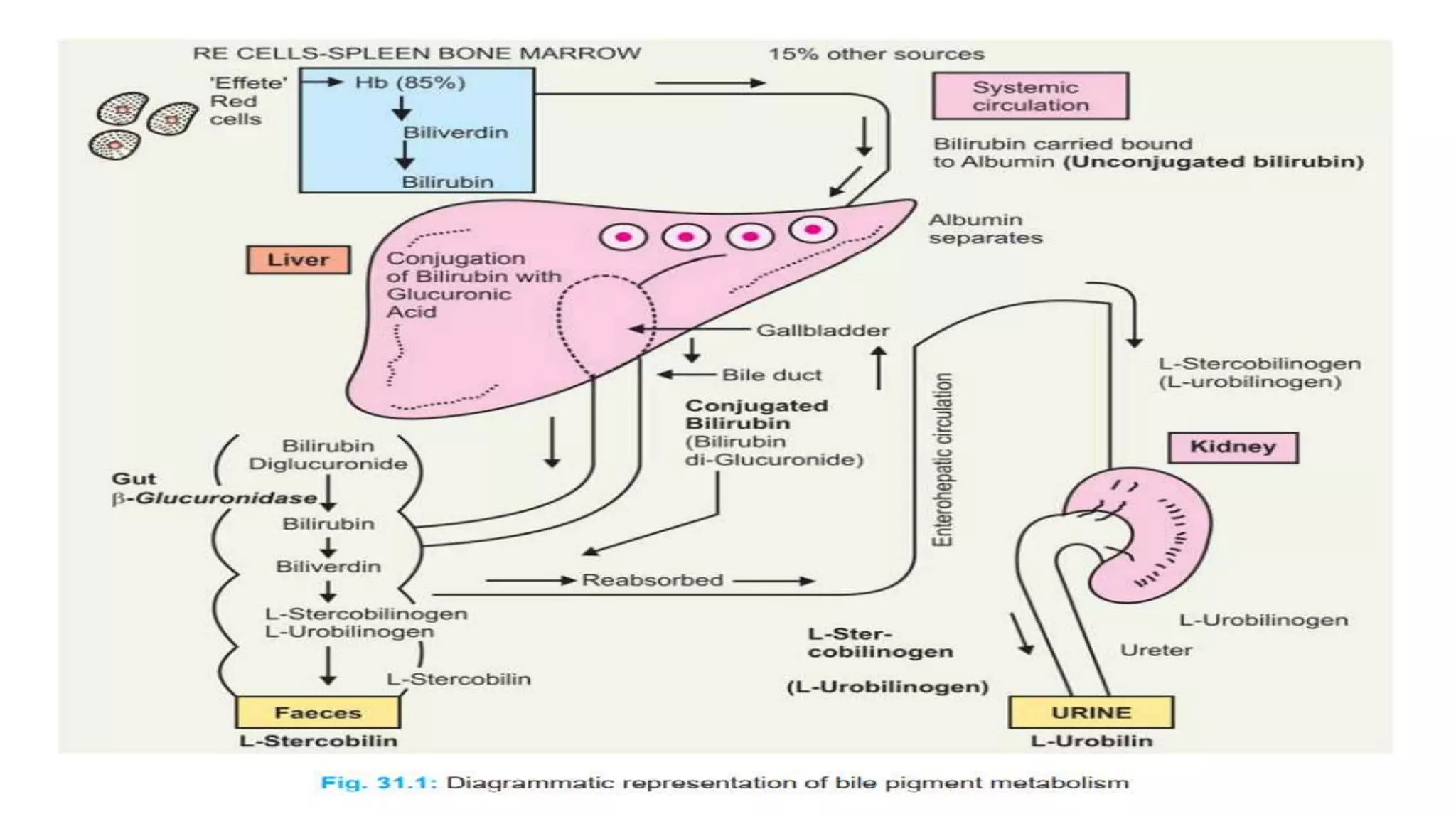
• The tests based on excretory function of liver are related to bilirubin
metabolism.
• A byproduct of red blood cell breakdown
•It is the yellowish pigment observed in jaundice
High bilirubin levels are observed in:
 Gallstones, acute and chronic hepatitis
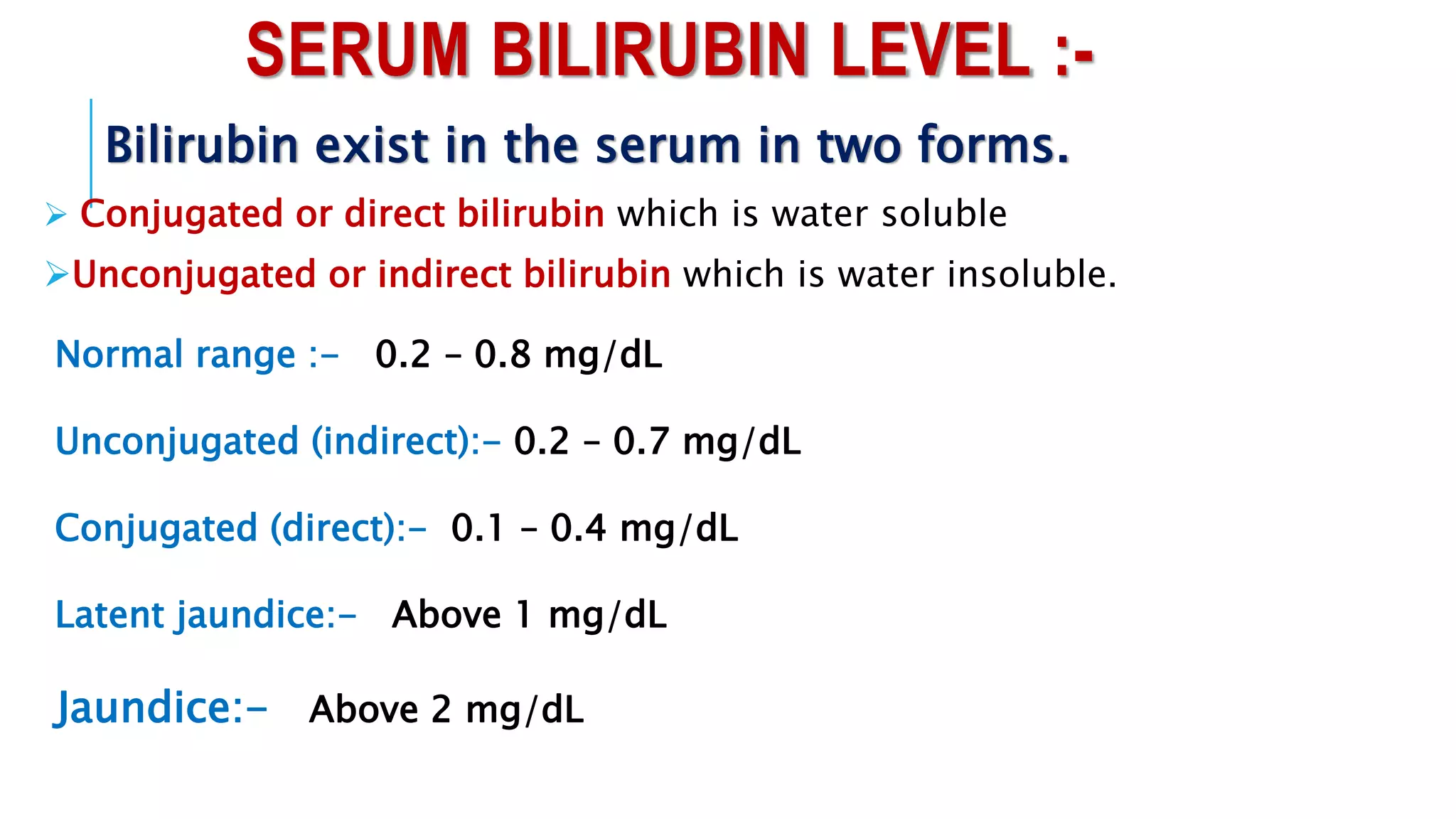
SERUM BILIRUBIN LEVEL :-
Bilirubin exist in the serum in two forms.
 Conjugated or direct bilirubin which is water soluble
Unconjugated or indirect bilirubin which is water insoluble.
Normal range :- 0.2 – 0.8 mg/dL
Unconjugated (indirect):- 0.2 – 0.7 mg/dL
Conjugated (direct):- 0.1 – 0.4 mg/dL
Latent jaundice:- Above 1 mg/dL
Jaundice:- Above 2 mg/dL
CLINICAL INTERPRETATION
JAUNDICE
 Jaundice, there is yellow colouration of conjunctivae, mucous membrane
and skin due to increased bilirubin level.
Jaundice is visible when serum bilirubin exceeds 2.4 mg/dl.
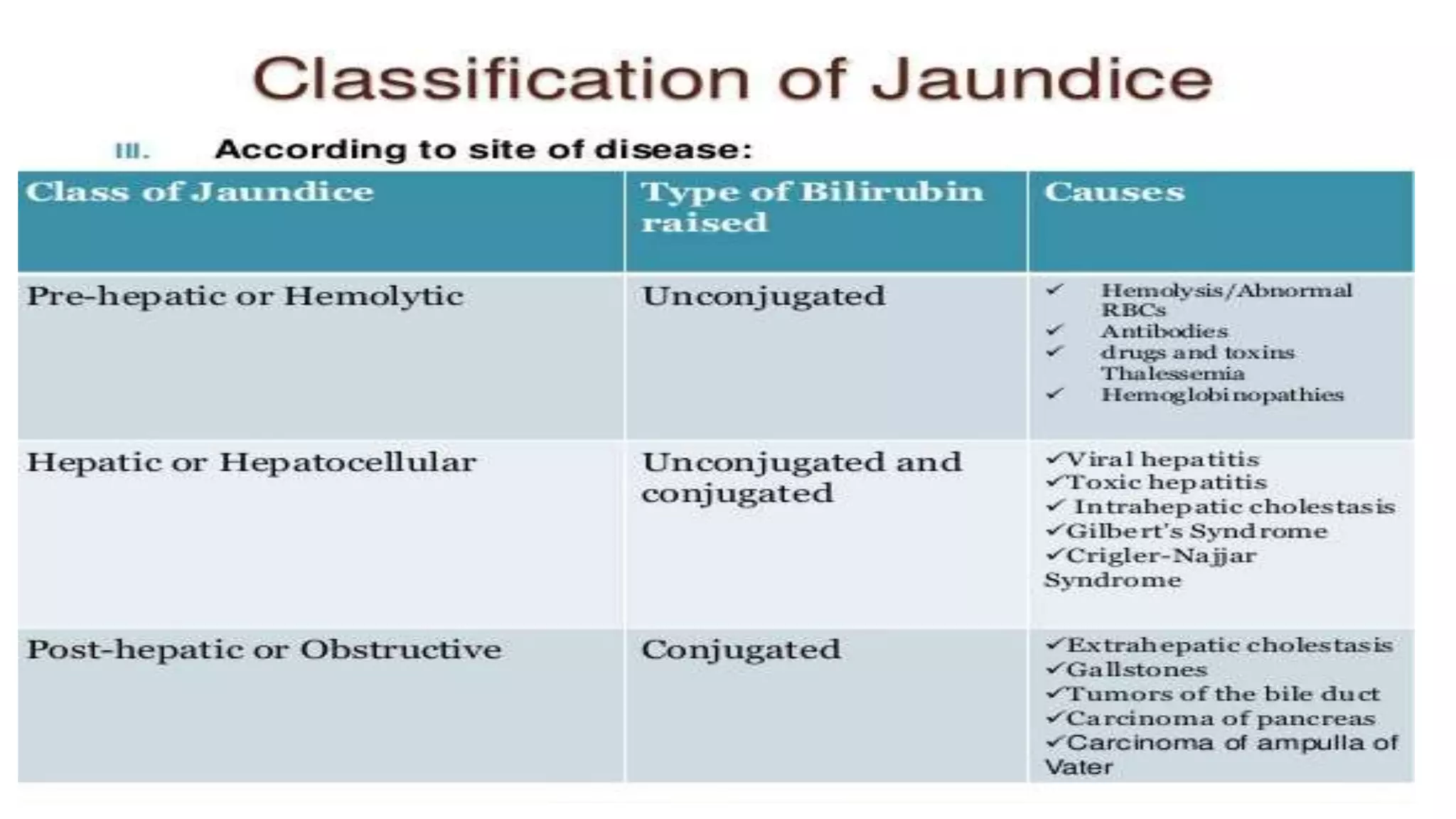
 Estimation of direct and indirect bilirubin is useful for the differential
diagnosis of jaundice.
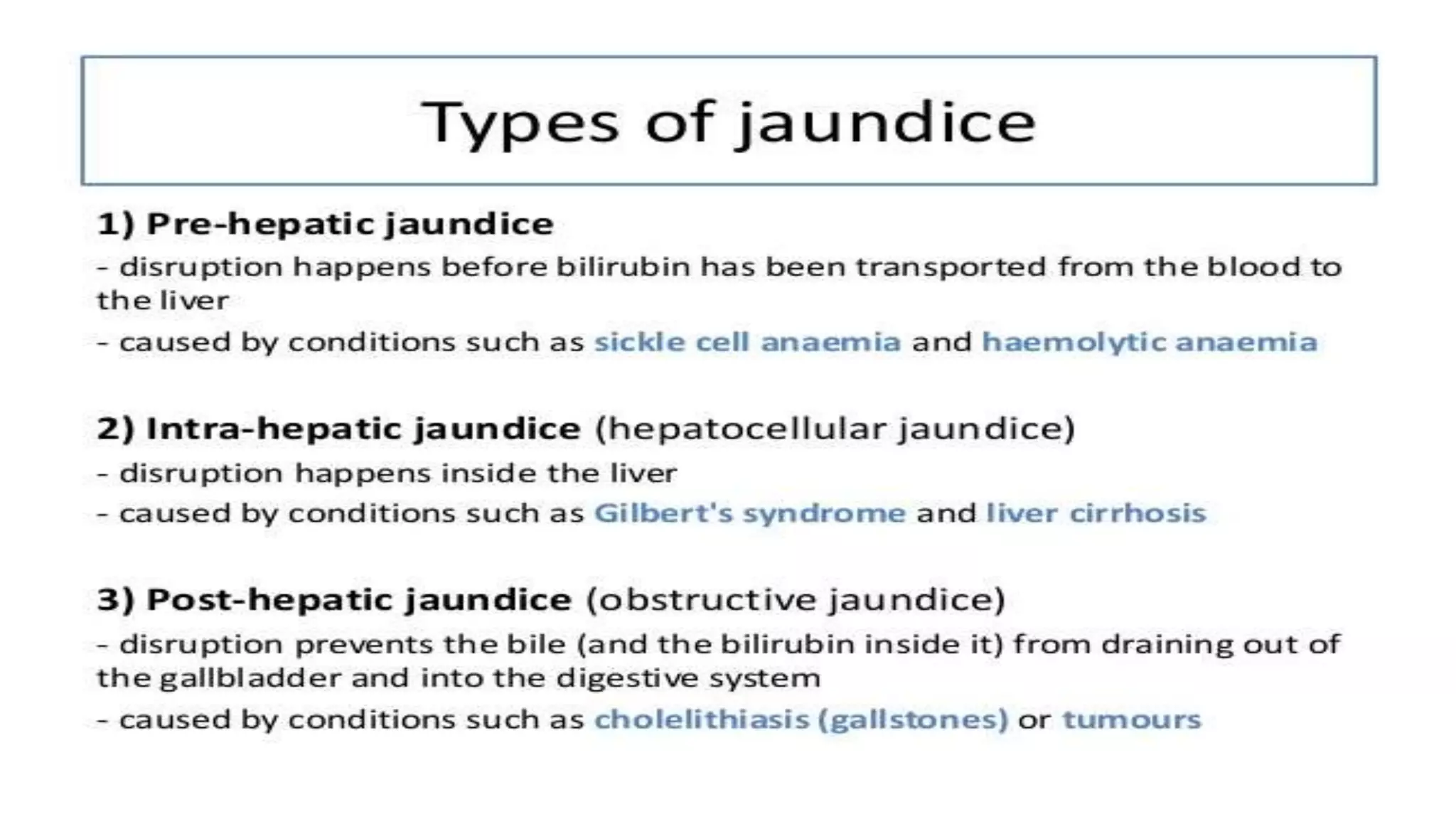
 Bilirubin metabolism is deranged in three important diseases.
They are:
 Hemolytic jaundice (pre-hepatic jaundice)
Hepatic jaundice (Intra-hepatic jaundice)
Obstructive jaundice (post-hepatic jaundice)
Liver function test (LFT)

Liver function test (LFT)

  • 1.
    LIVER FUNCTION TEST (LFT) SNEHITAPRASAD LECTURER Department of biochemistry Narsinhbhai patel dental college & hospital
  • 2.
    Biochemical tests areof immense value in diagnosis and monitoring of liver diseases. These tests are usually referred to as “liver function tests” (LFT). LFTs are the most widely performed biochemical tests in the laboratory.
  • 4.
     Detect thepresence of liver disease Distinguish among different types of liver disorders Gauge the extent of known liver damage Follow the response to treatment
  • 6.
    Serum Albumin :- Themost abundant protein synthesized by the liver Serum albumin test is done by BCG method (Bromocresol Green). Normal serum levels: 3.5 – 5 g/dL Synthesis depends on the extent of functioning liver cell mass. Longer half-life: 20 days Its levels decrease in all chronic liver diseases.
  • 7.
    SERUM GLOBULIN Normal serumlevels:- 2.5 – 3.5g/dL a and b-globulins mainly synthesized by the liver. Serum Globulin is calculated by Total protein - Albumin They constitute immunoglobulins (antibodies) High serum g-globulins are observed in chronic hepatitis and cirrhosis: IgG in autoimmune hepatitis IgA in alcoholic liver disease
  • 8.
    ALBUMIN TO GLOBULIN(A/G) RATIO Normal A/G ratio: 1.2 – 1.5 A/G ratio is calculated by Albumin / Globulin. Globulin levels increase in hypoalbuminemia as a compensation
  • 9.
    In liver damage,these enzymes are released into blood and levels of these enzymes increase in blood. A large number of different enzymes have been used in the diagnosis of liver disease. But most commonly and routinely employed in laboratory are:- 1) Serum aspartate transaminase (AST) 2) Serum alanine transaminase (ALT) 3) Serum alkaline phosphatase (ALP)
  • 10.
    Aspartate transaminase (AST)also called serum glutamate oxaloacetate transaminase (SGOT). AST is widely present in myocardium, skeletal muscle, brain and kidney and may rise in acute necrosis of these organs besides liver cell injury. Normal range: 8 – 20 U/L A marker of hepatocellular damage High serum levels are observed in:
  • 11.
    Alanine transaminase (ALT)also called serum glutamate pyruvate transaminase (SGPT). More liver-specific than AST. Normal range (U/L): ▫Male: 13 - 35 ▫Female: 10 – 30 ▫Alanine transaminase (ALT) estimations are useful in early diagnosis to evaluate severity and prognosis of liver disease. ▫ In hepatitis, the levels of both these enzymes (ALT and AST) are increased Upto 500 to 1500 IU/L. ▫ In obstructive jaundice also an increase occurs but usually does not exceed 200 to 300 IU/L. ▫ In hemolytic jaundice the level of these enzymes are normal.
  • 12.
     ALP isproduced by many tissues, especially bone, liver, intestine and placenta and is excreted in the bile. Elevation in activity of the enzyme can thus be found in diseases of bone, liver and in pregnancy. In the absence of bone disease and pregnancy, there are elevated ALP levels generally due to hepatobiliary disease.  Normal range : 40 – 125 U/L Clinical interpretation:- The enzyme ALP is normally excreted through bile. Obstruction to the flow of bile, causes regurgitation of enzyme into the blood resulting in increased serum concentration.  The greatest elevation (3 – 10 times normal) occurs in obstructive jaundice.  Slight to moderate increase is seen in hepatitis and cirrhosis. • Normal serum ALP values are found in hemolytic jaundice
  • 13.
    Used for glutathionesynthesis Normal range: 10 – 30U/L Moderate elevation observed in: Infective hepatitis and prostate cancers GGT is increased in alcoholics despite normal liver function tests Highly sensitive to detecting alcohol abuse
  • 14.
    Bilirubin :- • Animportant physiologic role of the liver is the removal of toxic endogenous and exogenous substances from the blood. • The tests based on excretory function of liver are related to bilirubin metabolism. • A byproduct of red blood cell breakdown •It is the yellowish pigment observed in jaundice High bilirubin levels are observed in:  Gallstones, acute and chronic hepatitis
  • 15.
    SERUM BILIRUBIN LEVEL:- Bilirubin exist in the serum in two forms.  Conjugated or direct bilirubin which is water soluble Unconjugated or indirect bilirubin which is water insoluble. Normal range :- 0.2 – 0.8 mg/dL Unconjugated (indirect):- 0.2 – 0.7 mg/dL Conjugated (direct):- 0.1 – 0.4 mg/dL Latent jaundice:- Above 1 mg/dL Jaundice:- Above 2 mg/dL
  • 17.
    CLINICAL INTERPRETATION JAUNDICE  Jaundice,there is yellow colouration of conjunctivae, mucous membrane and skin due to increased bilirubin level. Jaundice is visible when serum bilirubin exceeds 2.4 mg/dl.  Estimation of direct and indirect bilirubin is useful for the differential diagnosis of jaundice.  Bilirubin metabolism is deranged in three important diseases. They are:  Hemolytic jaundice (pre-hepatic jaundice) Hepatic jaundice (Intra-hepatic jaundice) Obstructive jaundice (post-hepatic jaundice)