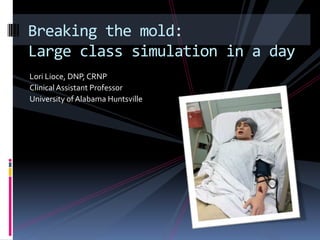



Breaking the mold:
Large class simulation in a day
Lori Lioce, DNP, CRNP
Clinical Assistant Professor
University of Alabama Huntsville
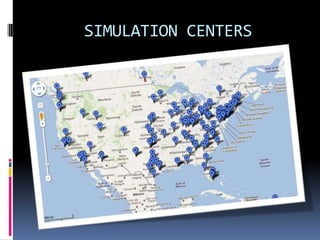
SIMULATION CENTERS
Objectives

1. Audience will be able to understand
   theoretical and curriculum integration
   framework for simulation
2. Audience will be able to discuss a rotation
   schedule for a large class
3. Audience will be able to explain resources to
   facilitate simulation large class
4. Lessons Learned
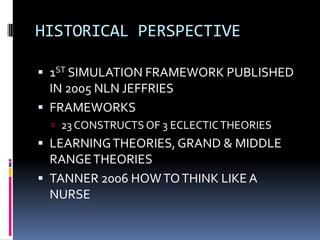
HISTORICAL PERSPECTIVE

 1ST SIMULATION FRAMEWORK PUBLISHED
  IN 2005 NLN JEFFRIES
 FRAMEWORKS
   23 CONSTRUCTS OF 3 ECLECTIC THEORIES
 LEARNING THEORIES, GRAND & MIDDLE
  RANGE THEORIES
 TANNER 2006 HOW TO THINK LIKE A
  NURSE
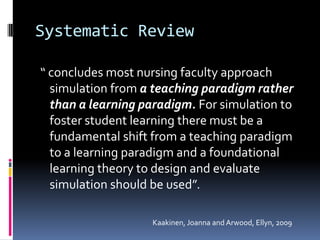
Systematic Review

“ concludes most nursing faculty approach
  simulation from a teaching paradigm rather
  than a learning paradigm. For simulation to
  foster student learning there must be a
  fundamental shift from a teaching paradigm
  to a learning paradigm and a foundational
  learning theory to design and evaluate
  simulation should be used”.

                   Kaakinen, Joanna and Arwood, Ellyn, 2009
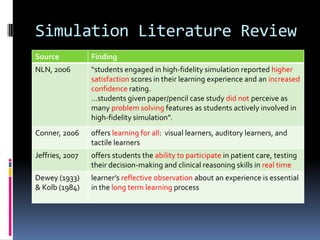
Simulation Literature Review
Source           Finding
NLN, 2006        “students engaged in high-fidelity simulation reported higher
                 satisfaction scores in their learning experience and an increased
                 confidence rating.
                 …students given paper/pencil case study did not perceive as
                 many problem solving features as students actively involved in
                 high-fidelity simulation”.
Conner, 2006     offers learning for all: visual learners, auditory learners, and
                 tactile learners
Jeffries, 2007   offers students the ability to participate in patient care, testing
                 their decision-making and clinical reasoning skills in real time
Dewey (1933)     learner’s reflective observation about an experience is essential
& Kolb (1984)    in the long term learning process
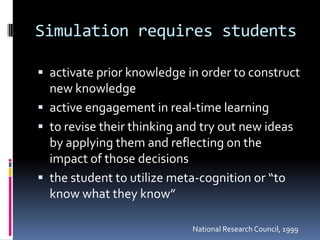
Simulation requires students

 activate prior knowledge in order to construct
  new knowledge
 active engagement in real-time learning
 to revise their thinking and try out new ideas
  by applying them and reflecting on the
  impact of those decisions
 the student to utilize meta-cognition or “to
  know what they know”

                             National Research Council, 1999
Experiential Learning (Kolb)

 Learner Centered Learning
 Learning styles in a multi-dimensional format
 Perception (grasping) and processing
  (transformation)
 4 ASPECTS:
   providing a concrete experience
   reflective observation
   conceptualization
   active experimentation.
Armstrong’s Curriculum
         Planning Framework


 Reinforces student centered learning
 Learners may be kinesthetic, auditory, or
  visual and succeed within this framework


                                UAB GEC, 2011.
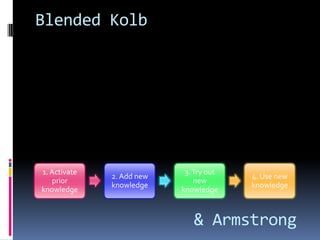
Blended Kolb


1. Activate                 3. Try out
              2. Add new                 4. Use new
   prior                       new
              knowledge                  knowledge
knowledge                  knowledge


                              & Armstrong
Types of Evaluation

 Formative
  ongoing gives students feedback, addresses gaps


 Summative
  end of term – how competent - grade
Tanner’s Clinical Judgment Model


                           2006
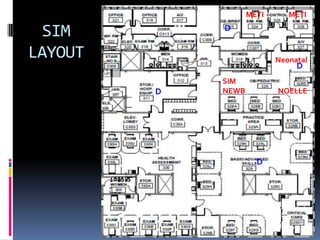
METI      METI

  SIM        D


LAYOUT                     Neonatal
                                D
             SIM
         D   NEWB          NOELLE


                      D
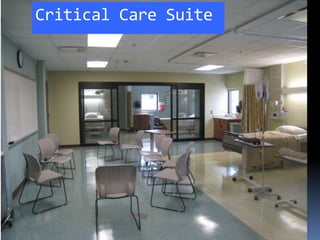
Critical Care Suite
Framework
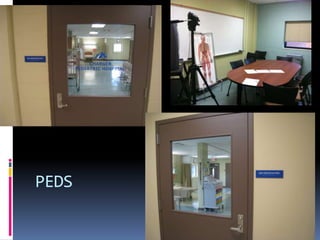
PEDS
Overview
Setting
 up for
success
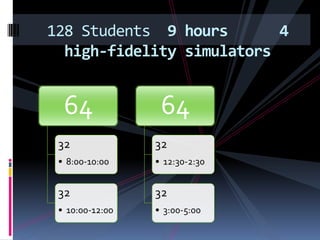
128 Students 9 hours       4
  high-fidelity simulators


  64              64
 32              32
 • 8:00-10:00    • 12:30-2:30


 32              32
 • 10:00-12:00   • 3:00-5:00
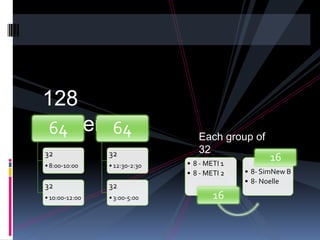
128
students
 64    64                         Each group of
32              32                32
                               • 8 - METI 1
                                                     16
• 8:00-10:00    • 12:30-2:30
                               • 8 - METI 2   • 8- SimNew B
                                              • 8- Noelle
32              32
• 10:00-12:00   • 3:00-5:00            16
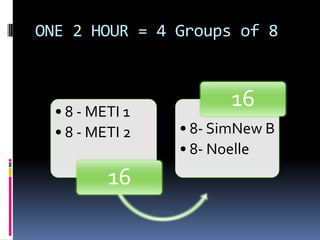
ONE 2 HOUR = 4 Groups of 8


  • 8 - METI 1
                        16
  • 8 - METI 2   • 8- SimNew B
                 • 8- Noelle
          16
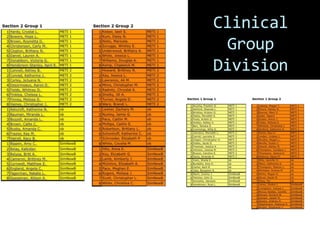
Clinical
 Group
Division
Resources

 4 Simulators
 Sim Coordinator/Faculty Expert
 4 Faculty
 9 hours
 Supplies
 Preparation Time
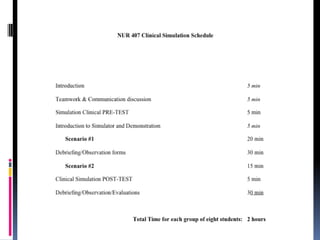
Consistent Repetitive Format

 Introduction to simulation/simulator
 Pre-test
 Scenario Overview-Observers/Participants
  assigned
 Scenario #1
 Debriefing with video review
 Scenario #2
 Debriefing with video review
 Post Test
 Evaluations of facilitator and experience
Course Manager/Liason
 Meeting with simulation coordinator at the beginning/end
    of each semester
   Connecting the didactic portions of course to clinical
    simulation
   Selecting the appropriate case scenarios with coordinator
    (reservation form must be completed)
   Reserving LRC equipment and rooms through the LRC
    Director
   Selecting an evaluation method
   Coordinating clinical group rotation for simulation
   Completion of evaluations and tests
   Documents are maintained at LRC in simulation filing
    cabinet and data entered by GTA
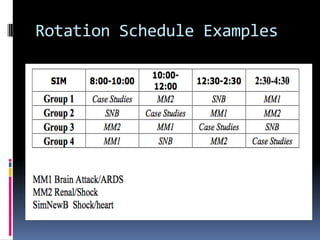
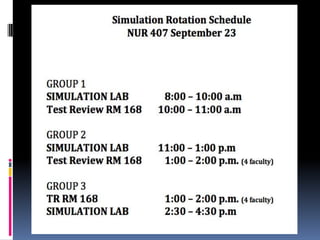
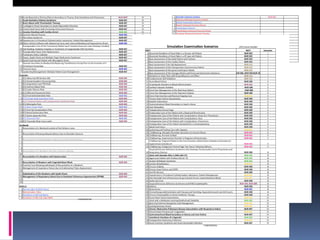
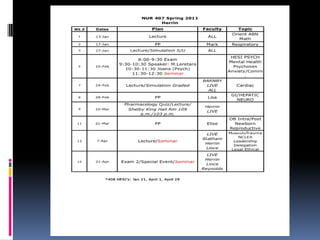
Rotation Schedule Examples
Audience Discussion
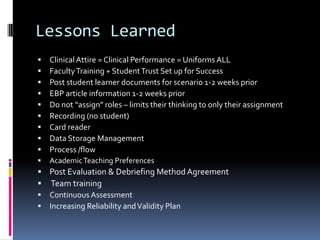
Lessons Learned
   Clinical Attire = Clinical Performance = Uniforms ALL
   Faculty Training + Student Trust Set up for Success
   Post student learner documents for scenario 1-2 weeks prior
   EBP article information 1-2 weeks prior
   Do not “assign” roles – limits their thinking to only their assignment
   Recording (no student)
   Card reader
   Data Storage Management
   Process /flow
   Academic Teaching Preferences
 Post Evaluation & Debriefing Method Agreement
 Team training
 Continuous Assessment
 Increasing Reliability and Validity Plan
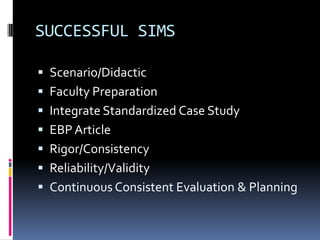
SUCCESSFUL SIMS

 Scenario/Didactic
 Faculty Preparation
 Integrate Standardized Case Study
 EBP Article
 Rigor/Consistency
 Reliability/Validity
 Continuous Consistent Evaluation & Planning
Not everything that counts,
   can be counted and
Not everything that can be
      counted, counts.

              Albert Einstein
References
Arundell, F., & Cioffi, J. (2005). Using a simulation strategy: An educator’s experience. Nurse Education in Practice, 5.
Brown, J. S., Collins, A., & Duguid, S. (1989). Situated cognition and the culture of learning. Educational Researcher, 18(1), 32-42.
Byrne, D. (1985). Simulation work with large classes. English Teachers’ Journal 32, 26-33.
Gaba, D. M. (2007). The future vision of simulation in healthcare. Simulation in Healthcare, 2.
Gordon, J. (2004). High fidelity patient simulation: A revolution in medical education. In W.L. Dunn (Ed.), Simulators in critical care and beyond (pg 3-6).
     U.S.A.: Des Plaines, IL.
Institute of Medicine. (2010). The future of nursing: Leading change, advancing health. Retrieved from http://www.iom.edu/Reports/2010/The-Future-of-
       Nursing-Leading-Change-Advancing-Health.aspx
Jeffries, P. (2007). Simulation in Nursing Education: From Conceptualization to Evaluation. National League of Nursing.
Kaakinen, J., & Arwood, E. (2009). Systematic review of nursing simulation literature for use of learning theory. International Journal of Nursing Education
      Scholarship, (6)1.
Larew, C., Lessons, S., Spunt, D., Foster, D., & Covington, B. (2006). Innovations in clinical simulation: Application of Benner’s theory in an interactive
      patient care simulation. Nursing Education Perspectives, 27(1). National League for Nursing, New York.
Lasater, K. (2007). Clinical judgment development: Using simulation to create an assessment rubric. Journal of Nursing Education, 46(11), 496-503.
Lashley, M. (2005). Teaching health assessment in the virtual classroom. Journal of Nursing Education, 44(8), 348-350.
Lave, J., & Wenger, E. (1990). Situated learning: Legitimate peripheral participation. Cambridge, UK: Cambridge University Press. Retrieved from
       www.learning-Theories.com
Paulson, D., & Faust, J. (2011). Learning for the college classroom. Center for Research on Learning and Teaching: The Regents of the University of
      Michigan. Retrieved from http://www.calstatela.edu/dept/chem/chem2/Active/main.htm
Rance-Roney, J. (2010). Reconceptualizing interactional groups: Grouping schemes for maximizing language learning. English Teaching Forum, 48, 20-
     26.
Rauen, C. (June 2004). Simulation as a teaching strategy for nursing education and orientation in cardiac surgery. Critical Care Nurse, 24(3), 46-51.
Shoemaker, M., Beasley, J., Cooper, M., Perkins, R., Smith, J., & Swank, C. (2011). A method for providing high-volume inter-professional simulation
     encounters in physical and occupational therapy education programs. Journal of Allied Health Professionals. (40)1 15-21.
Tuller, M., Gonzalez, M., and Rice, J. (2009). Using simulation as an effective teaching strategy: A faculty guide. University of Texas Health Science
       Center: San Antonio School of Nursing.
Waldner, M., & Olson, J. (2007). Taking the patient to the classroom: Applying theoretical frameworks to simulation in nursing education. International
     Journal of Nursing Education Scholarship, (4)1.
Weiner, E. (2008). Supporting the integration of technology into contemporary nursing education. Nursing Clinics of North America, 43, 497-506.
QUESTIONS
Jeffries 2007

 Synthesize knowledge
 Make mistakes, learn from their mistakes, and
    immediately correct mistakes
   Integrate evidence
   Work in Collaboration
   Provide ethical and safe care
   Allows for clinical reasoning
   Practice decision making skills
   Reflections on their skills and decision making
   Develop self-confidence
   Develops leadership and delegation skills
Thinking like a nurse: a research-based
model of clinical judgment in nursing.

(1) Clinical judgments are more influenced by what nurses bring to the
    situation than the objective data about the situation at hand;
(2) Sound clinical judgment rests to some degree on knowing the
   patient and his or her typical pattern of responses, as well as an
   engagement with the patient and his or her concerns;
(3) Clinical judgments are influenced by the context in which the
    situation occurs and the culture of the nursing care unit;
(4) Nurses use a variety of reasoning patterns alone or in combination;
    and
(5) Reflection on practice is often triggered by a breakdown in clinical
    judgment and is critical for the development of clinical knowledge
    and improvement in clinical reasoning.


                                       Tanner, CA J Nurs Educ. 2006 Jun;45(6):204-11.
Chris Tanner’s
        Clinical Judgment Model
 Implementation proposal for simulation
 Four domains of clinical judgment:
   Noticing
   Interpreting
   Responding
   Reflecting
 Provides an evaluation tool in which
  educators may benchmark progress and
  implement goal setting with students
C.J. PROMPTS

 What did you notice about your patient when
    you walked into the room?
   What you expected to see?
   You assessed... What did you make of those
    findings?
   What were your initial priorities?
    How did they change?
   Your patient said “.....” What do you think was
    important to her/him at this time?
UNDERPINNINGS OF CJ RESEARCH

 OUTCOMES DRIVE LEARNING STRATEGIES
  AND EVALUATION
 THEORY PRACTICE GAP STILL EXISTS
  (CARNEGIE FOUNDATION BENNER
  PROFESSIONAL PREPARATION)
 LEARNER CENTERED
UNDERPINNINGS OF CJ RESEARCH

 OUTCOMES DRIVE LEARNING STRATEGIES
  AND EVALUATION
 THEORY PRACTICE GAP STILL EXISTS
  (CARNEGIE FOUNDATION BENNER
  PROFESSIONAL PREPARATION)
 LEARNER CENTERED
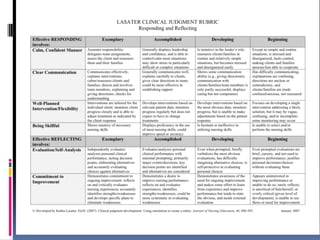
Lassater Rubric
 Clinical reasoning process into common language that
    will help us all
   Identify a developmental scale that students could see
    themselves on
   Use to set goals for themselves and identify next steps
   Uses the 4 aspects of Tanner & adds dimension (words
    across top descriptors)
   Goal accomplished level before they leave program
   Developmental = does not equivalate to grades
   Change the setting goes back to beginning level
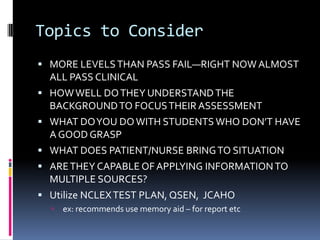
Topics to Consider
 MORE LEVELS THAN PASS FAIL—RIGHT NOW ALMOST
    ALL PASS CLINICAL
   HOW WELL DO THEY UNDERSTAND THE
    BACKGROUND TO FOCUS THEIR ASSESSMENT
   WHAT DO YOU DO WITH STUDENTS WHO DON’T HAVE
    A GOOD GRASP
   WHAT DOES PATIENT/NURSE BRING TO SITUATION
   ARE THEY CAPABLE OF APPLYING INFORMATION TO
    MULTIPLE SOURCES?
   Utilize NCLEX TEST PLAN, QSEN, JCAHO
       ex: recommends use memory aid – for report etc
National Research Council, 1999. “How People
 Learn” downloaded on July 17,2011 from
 http://www.pkal.org/documents/HowPeopleL
 earn1999Page16.cfm
HPSN 2012: Large Class Simulation

HPSN 2012: Large Class Simulation

  • 2.
    Breaking the mold: Largeclass simulation in a day Lori Lioce, DNP, CRNP Clinical Assistant Professor University of Alabama Huntsville
  • 3.
  • 4.
    Objectives 1. Audience willbe able to understand theoretical and curriculum integration framework for simulation 2. Audience will be able to discuss a rotation schedule for a large class 3. Audience will be able to explain resources to facilitate simulation large class 4. Lessons Learned
  • 5.
    HISTORICAL PERSPECTIVE  1STSIMULATION FRAMEWORK PUBLISHED IN 2005 NLN JEFFRIES  FRAMEWORKS  23 CONSTRUCTS OF 3 ECLECTIC THEORIES  LEARNING THEORIES, GRAND & MIDDLE RANGE THEORIES  TANNER 2006 HOW TO THINK LIKE A NURSE
  • 6.
    Systematic Review “ concludesmost nursing faculty approach simulation from a teaching paradigm rather than a learning paradigm. For simulation to foster student learning there must be a fundamental shift from a teaching paradigm to a learning paradigm and a foundational learning theory to design and evaluate simulation should be used”. Kaakinen, Joanna and Arwood, Ellyn, 2009
  • 7.
    Simulation Literature Review Source Finding NLN, 2006 “students engaged in high-fidelity simulation reported higher satisfaction scores in their learning experience and an increased confidence rating. …students given paper/pencil case study did not perceive as many problem solving features as students actively involved in high-fidelity simulation”. Conner, 2006 offers learning for all: visual learners, auditory learners, and tactile learners Jeffries, 2007 offers students the ability to participate in patient care, testing their decision-making and clinical reasoning skills in real time Dewey (1933) learner’s reflective observation about an experience is essential & Kolb (1984) in the long term learning process
  • 8.
    Simulation requires students activate prior knowledge in order to construct new knowledge  active engagement in real-time learning  to revise their thinking and try out new ideas by applying them and reflecting on the impact of those decisions  the student to utilize meta-cognition or “to know what they know” National Research Council, 1999
  • 9.
    Experiential Learning (Kolb) Learner Centered Learning  Learning styles in a multi-dimensional format  Perception (grasping) and processing (transformation)  4 ASPECTS:  providing a concrete experience  reflective observation  conceptualization  active experimentation.
  • 10.
    Armstrong’s Curriculum Planning Framework  Reinforces student centered learning  Learners may be kinesthetic, auditory, or visual and succeed within this framework UAB GEC, 2011.
  • 11.
    Blended Kolb 1. Activate 3. Try out 2. Add new 4. Use new prior new knowledge knowledge knowledge knowledge & Armstrong
  • 12.
    Types of Evaluation Formative ongoing gives students feedback, addresses gaps  Summative end of term – how competent - grade
  • 13.
  • 15.
    METI METI SIM D LAYOUT Neonatal D SIM D NEWB NOELLE D
  • 17.
  • 20.
  • 22.
  • 23.
  • 25.
  • 26.
    128 Students 9hours 4 high-fidelity simulators 64 64 32 32 • 8:00-10:00 • 12:30-2:30 32 32 • 10:00-12:00 • 3:00-5:00
  • 27.
    128 students 64 64 Each group of 32 32 32 • 8 - METI 1 16 • 8:00-10:00 • 12:30-2:30 • 8 - METI 2 • 8- SimNew B • 8- Noelle 32 32 • 10:00-12:00 • 3:00-5:00 16
  • 28.
    ONE 2 HOUR= 4 Groups of 8 • 8 - METI 1 16 • 8 - METI 2 • 8- SimNew B • 8- Noelle 16
  • 29.
  • 30.
    Resources  4 Simulators Sim Coordinator/Faculty Expert  4 Faculty  9 hours  Supplies  Preparation Time
  • 31.
    Consistent Repetitive Format Introduction to simulation/simulator  Pre-test  Scenario Overview-Observers/Participants assigned  Scenario #1  Debriefing with video review  Scenario #2  Debriefing with video review  Post Test  Evaluations of facilitator and experience
  • 32.
    Course Manager/Liason  Meetingwith simulation coordinator at the beginning/end of each semester  Connecting the didactic portions of course to clinical simulation  Selecting the appropriate case scenarios with coordinator (reservation form must be completed)  Reserving LRC equipment and rooms through the LRC Director  Selecting an evaluation method  Coordinating clinical group rotation for simulation  Completion of evaluations and tests  Documents are maintained at LRC in simulation filing cabinet and data entered by GTA
  • 33.
  • 35.
  • 36.
    Lessons Learned  Clinical Attire = Clinical Performance = Uniforms ALL  Faculty Training + Student Trust Set up for Success  Post student learner documents for scenario 1-2 weeks prior  EBP article information 1-2 weeks prior  Do not “assign” roles – limits their thinking to only their assignment  Recording (no student)  Card reader  Data Storage Management  Process /flow  Academic Teaching Preferences  Post Evaluation & Debriefing Method Agreement  Team training  Continuous Assessment  Increasing Reliability and Validity Plan
  • 37.
    SUCCESSFUL SIMS  Scenario/Didactic Faculty Preparation  Integrate Standardized Case Study  EBP Article  Rigor/Consistency  Reliability/Validity  Continuous Consistent Evaluation & Planning
  • 38.
    Not everything thatcounts, can be counted and Not everything that can be counted, counts. Albert Einstein
  • 39.
    References Arundell, F., &Cioffi, J. (2005). Using a simulation strategy: An educator’s experience. Nurse Education in Practice, 5. Brown, J. S., Collins, A., & Duguid, S. (1989). Situated cognition and the culture of learning. Educational Researcher, 18(1), 32-42. Byrne, D. (1985). Simulation work with large classes. English Teachers’ Journal 32, 26-33. Gaba, D. M. (2007). The future vision of simulation in healthcare. Simulation in Healthcare, 2. Gordon, J. (2004). High fidelity patient simulation: A revolution in medical education. In W.L. Dunn (Ed.), Simulators in critical care and beyond (pg 3-6). U.S.A.: Des Plaines, IL. Institute of Medicine. (2010). The future of nursing: Leading change, advancing health. Retrieved from http://www.iom.edu/Reports/2010/The-Future-of- Nursing-Leading-Change-Advancing-Health.aspx Jeffries, P. (2007). Simulation in Nursing Education: From Conceptualization to Evaluation. National League of Nursing. Kaakinen, J., & Arwood, E. (2009). Systematic review of nursing simulation literature for use of learning theory. International Journal of Nursing Education Scholarship, (6)1. Larew, C., Lessons, S., Spunt, D., Foster, D., & Covington, B. (2006). Innovations in clinical simulation: Application of Benner’s theory in an interactive patient care simulation. Nursing Education Perspectives, 27(1). National League for Nursing, New York. Lasater, K. (2007). Clinical judgment development: Using simulation to create an assessment rubric. Journal of Nursing Education, 46(11), 496-503. Lashley, M. (2005). Teaching health assessment in the virtual classroom. Journal of Nursing Education, 44(8), 348-350. Lave, J., & Wenger, E. (1990). Situated learning: Legitimate peripheral participation. Cambridge, UK: Cambridge University Press. Retrieved from www.learning-Theories.com Paulson, D., & Faust, J. (2011). Learning for the college classroom. Center for Research on Learning and Teaching: The Regents of the University of Michigan. Retrieved from http://www.calstatela.edu/dept/chem/chem2/Active/main.htm Rance-Roney, J. (2010). Reconceptualizing interactional groups: Grouping schemes for maximizing language learning. English Teaching Forum, 48, 20- 26. Rauen, C. (June 2004). Simulation as a teaching strategy for nursing education and orientation in cardiac surgery. Critical Care Nurse, 24(3), 46-51. Shoemaker, M., Beasley, J., Cooper, M., Perkins, R., Smith, J., & Swank, C. (2011). A method for providing high-volume inter-professional simulation encounters in physical and occupational therapy education programs. Journal of Allied Health Professionals. (40)1 15-21. Tuller, M., Gonzalez, M., and Rice, J. (2009). Using simulation as an effective teaching strategy: A faculty guide. University of Texas Health Science Center: San Antonio School of Nursing. Waldner, M., & Olson, J. (2007). Taking the patient to the classroom: Applying theoretical frameworks to simulation in nursing education. International Journal of Nursing Education Scholarship, (4)1. Weiner, E. (2008). Supporting the integration of technology into contemporary nursing education. Nursing Clinics of North America, 43, 497-506.
  • 40.
  • 43.
    Jeffries 2007  Synthesizeknowledge  Make mistakes, learn from their mistakes, and immediately correct mistakes  Integrate evidence  Work in Collaboration  Provide ethical and safe care  Allows for clinical reasoning  Practice decision making skills  Reflections on their skills and decision making  Develop self-confidence  Develops leadership and delegation skills
  • 44.
    Thinking like anurse: a research-based model of clinical judgment in nursing. (1) Clinical judgments are more influenced by what nurses bring to the situation than the objective data about the situation at hand; (2) Sound clinical judgment rests to some degree on knowing the patient and his or her typical pattern of responses, as well as an engagement with the patient and his or her concerns; (3) Clinical judgments are influenced by the context in which the situation occurs and the culture of the nursing care unit; (4) Nurses use a variety of reasoning patterns alone or in combination; and (5) Reflection on practice is often triggered by a breakdown in clinical judgment and is critical for the development of clinical knowledge and improvement in clinical reasoning. Tanner, CA J Nurs Educ. 2006 Jun;45(6):204-11.
  • 45.
    Chris Tanner’s Clinical Judgment Model  Implementation proposal for simulation  Four domains of clinical judgment:  Noticing  Interpreting  Responding  Reflecting  Provides an evaluation tool in which educators may benchmark progress and implement goal setting with students
  • 46.
    C.J. PROMPTS  Whatdid you notice about your patient when you walked into the room?  What you expected to see?  You assessed... What did you make of those findings?  What were your initial priorities?  How did they change?  Your patient said “.....” What do you think was important to her/him at this time?
  • 47.
    UNDERPINNINGS OF CJRESEARCH  OUTCOMES DRIVE LEARNING STRATEGIES AND EVALUATION  THEORY PRACTICE GAP STILL EXISTS (CARNEGIE FOUNDATION BENNER PROFESSIONAL PREPARATION)  LEARNER CENTERED
  • 48.
    UNDERPINNINGS OF CJRESEARCH  OUTCOMES DRIVE LEARNING STRATEGIES AND EVALUATION  THEORY PRACTICE GAP STILL EXISTS (CARNEGIE FOUNDATION BENNER PROFESSIONAL PREPARATION)  LEARNER CENTERED
  • 49.
    Lassater Rubric  Clinicalreasoning process into common language that will help us all  Identify a developmental scale that students could see themselves on  Use to set goals for themselves and identify next steps  Uses the 4 aspects of Tanner & adds dimension (words across top descriptors)  Goal accomplished level before they leave program  Developmental = does not equivalate to grades  Change the setting goes back to beginning level
  • 50.
    Topics to Consider MORE LEVELS THAN PASS FAIL—RIGHT NOW ALMOST ALL PASS CLINICAL  HOW WELL DO THEY UNDERSTAND THE BACKGROUND TO FOCUS THEIR ASSESSMENT  WHAT DO YOU DO WITH STUDENTS WHO DON’T HAVE A GOOD GRASP  WHAT DOES PATIENT/NURSE BRING TO SITUATION  ARE THEY CAPABLE OF APPLYING INFORMATION TO MULTIPLE SOURCES?  Utilize NCLEX TEST PLAN, QSEN, JCAHO  ex: recommends use memory aid – for report etc
  • 51.
    National Research Council,1999. “How People Learn” downloaded on July 17,2011 from http://www.pkal.org/documents/HowPeopleL earn1999Page16.cfm

Editor's Notes

  • #3 Background
  • #4 >125 yet little research on LARGE Class Simulation
  • #6 UNCLEAR : TIME SIM, DEBRIEIFING, FORMAT
  • #7 SIMULATION AS ACTIVE LEARNING STRATEGY WAS AMAZINGFIRST SIMULATIONS ABLE TO WATCH STUDENTSBEGINNNING TO END OF PATIENT (NOT ON FLOOR)ENGAGED IN ACTIVE LEARNING WHERE I COULD WATCH THEM –SEE WHERE THEY DON’T UNDERSTAND THINGSSTUDENTS WERE SEEING ASSESSMENT AS SOMETHING YOU CHECK OFF AND YOUR DONEFOSTERING REFLECTION OFFERS HUGEPOTENTIAL FOR LEARNING OPPORTUNITIES (PROCESS AND LEARN FROM EXPERIENCES- REINFORCES LEARNING (ESP QUICK TIMEFRAME – NEED A LITTLE TIME TO PROCESS WHAT THEY ARE SEEING AND DOING
  • #10 Not
  • #13 Not a quick fix to evaluate clinical competency, all so frustrated with trying to grade students clinical thinking
  • #14 NOT THE NURSING PROCESSUSES A NOT SO LINEAR WAY OF THINKINGLED BY WHAT NURSE BRINGS TO SITUATION Tanner 2006 Think Like a Nurse
  • #32 (max. of 8 = 4 participants/4 observers evaluating)
  • #33 Goal ot an evaluation instrument for simulation
  • #45 This article reviews the growing body of research on clinical judgment in nursing and presents an alternative model of clinical judgment based on these studies. Based on a review of nearly 200 studies, five conclusions can be drawn: A model based on these general conclusions emphasizes the role of nurses' background, the context of the situation, and nurses' relationship with their patients as central to what nurses notice and how they interpret findings, respond, and reflect on their response.
  • #50 Dissertation research, looked at critical thinking construct to consider, literature didn’t agree on critical thinking in nursing, even though it was an accreditation criterion and in every syllabus and objective for years.Asking instructors how to evaluate critical thinking: “I know what it is and you don’t have it…..”Rubric considers what life experiences these students bring. Epidemiologist, air-force pilots (calm & confident skill already there – didn’t mean she knew what she was talking about but I would have followed her anywhere because the manner in which she performed)Skillful last dimension added to rubric – start an IV drip and came out crying because the patient talked to her – Benner- head heart & the hands cant separate them outDrove
  • #54 Words across the top are descriptors