University of Bohol 
Graduate School & Professional Studies Department 
Tagbilaran City, Bohol, Philippines 
PATRICIA BENNER 
Novice-Expert Model 
Mary Ann Tejano Adiong, RN, UUSSRRNN -- MMaasstteerraanndd
Patricia Benner, RN, PhD, 
FAAN, FRCN
Benner : As Author 
Dr. Benner is the author of books including: 
1.From Novice to Expert 
2.The Primacy of Caring 
3.Interpretive Phenomenology: Embodiment, 
Caring and Ethics in Health and Illness 
4. The Crisis of Care 
5. Expertise in Nursing Practice: Caring, 
Clinical Judgment, and Ethics 
6. Caregiving 
7. Clinical Wisdom and Interventions in 
Critical Care: A Thinking-In-Action Approach.
 Is an internationally noted researcher and lecturer 
on health, stress and coping, skill acquisition and 
ethics. 
 Recently elected an honorary fellow of the Royal 
College of Nursing. 
 Staff nurse in the areas of medical-surgical, 
emergency room, coronary care, intensive care 
units and home care. 
 Currently, her research includes the study of 
nursing practice in intensive care units and 
nursing ethics.
An Influential Nurse in the Development of the 
Profession of Nursing 
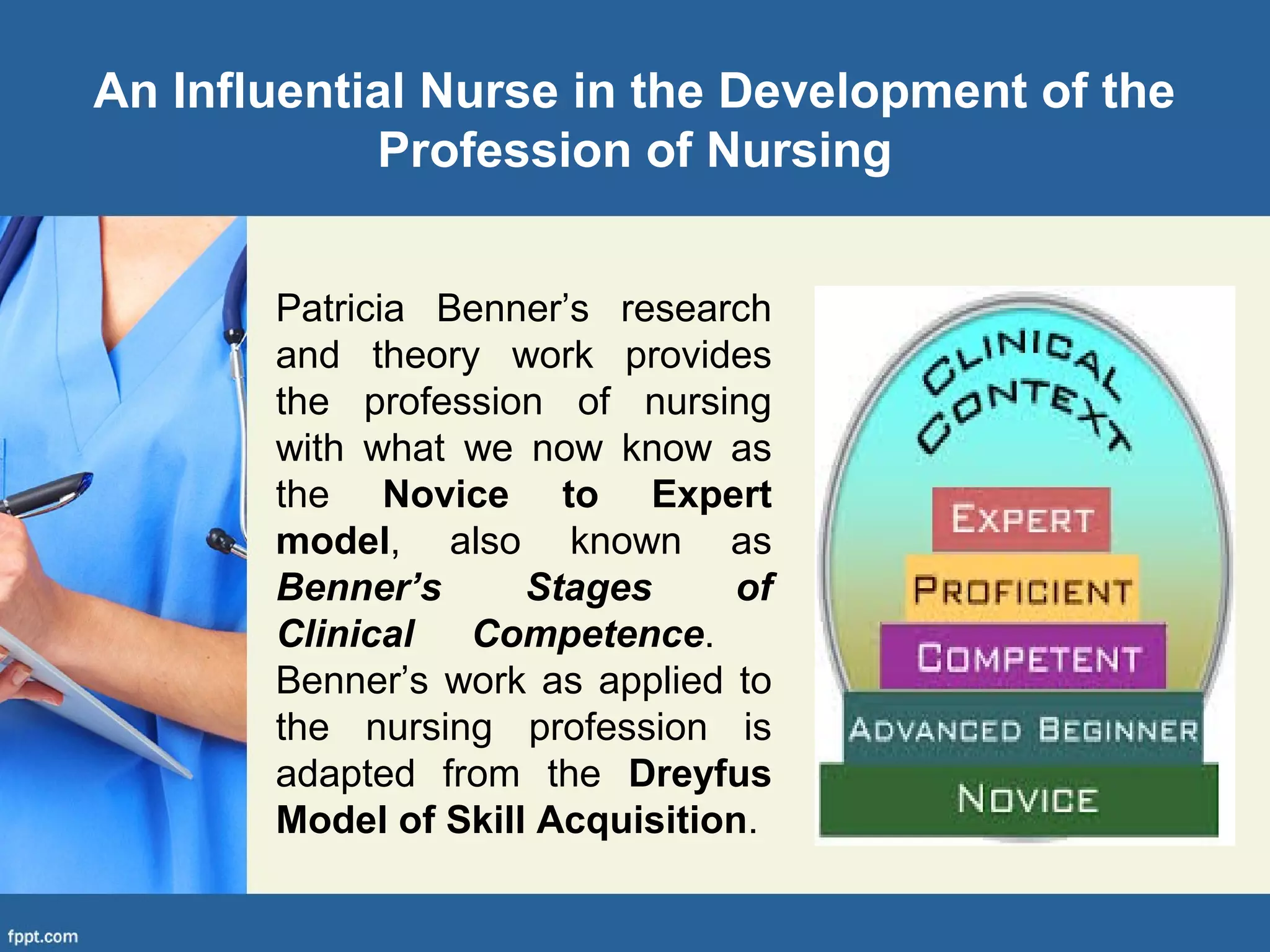
Patricia Benner’s research 
and theory work provides 
the profession of nursing 
with what we now know as 
the Novice to Expert 
model, also known as 
Benner’s Stages of 
Clinical Competence. 
Benner’s work as applied to 
the nursing profession is 
adapted from the Dreyfus 
Model of Skill Acquisition.
SSkkiillll AAccqquuiissiittiioonn 
“The utility of the concept of skill 
acquisition lies in helping the 
teacher understand how to assist 
the learner in advancing to the 
next level” (McClure, 2005)
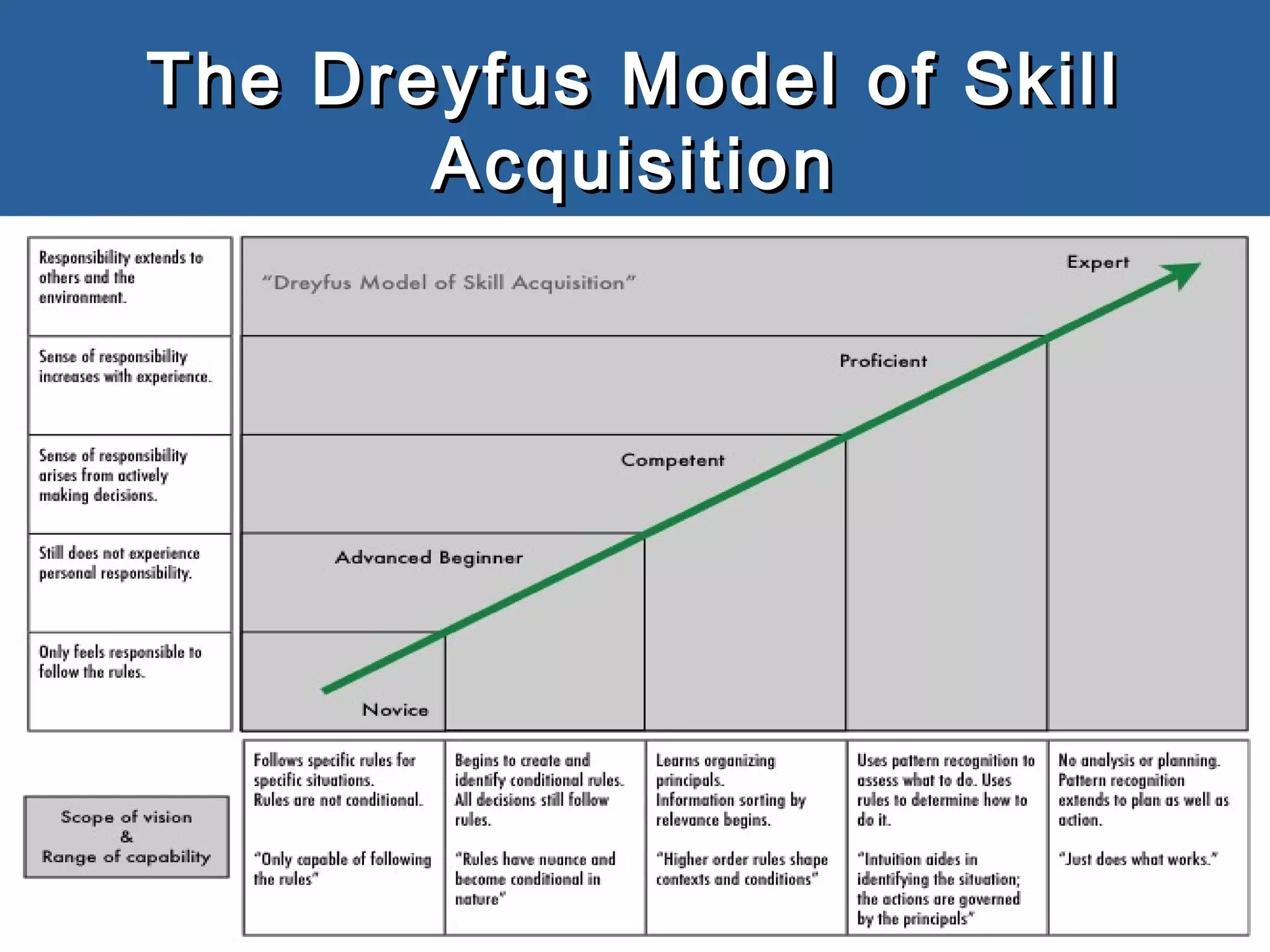
The Dreyfus MMooddeell ooff SSkkiillll 
AAccqquuiissiittiioonn
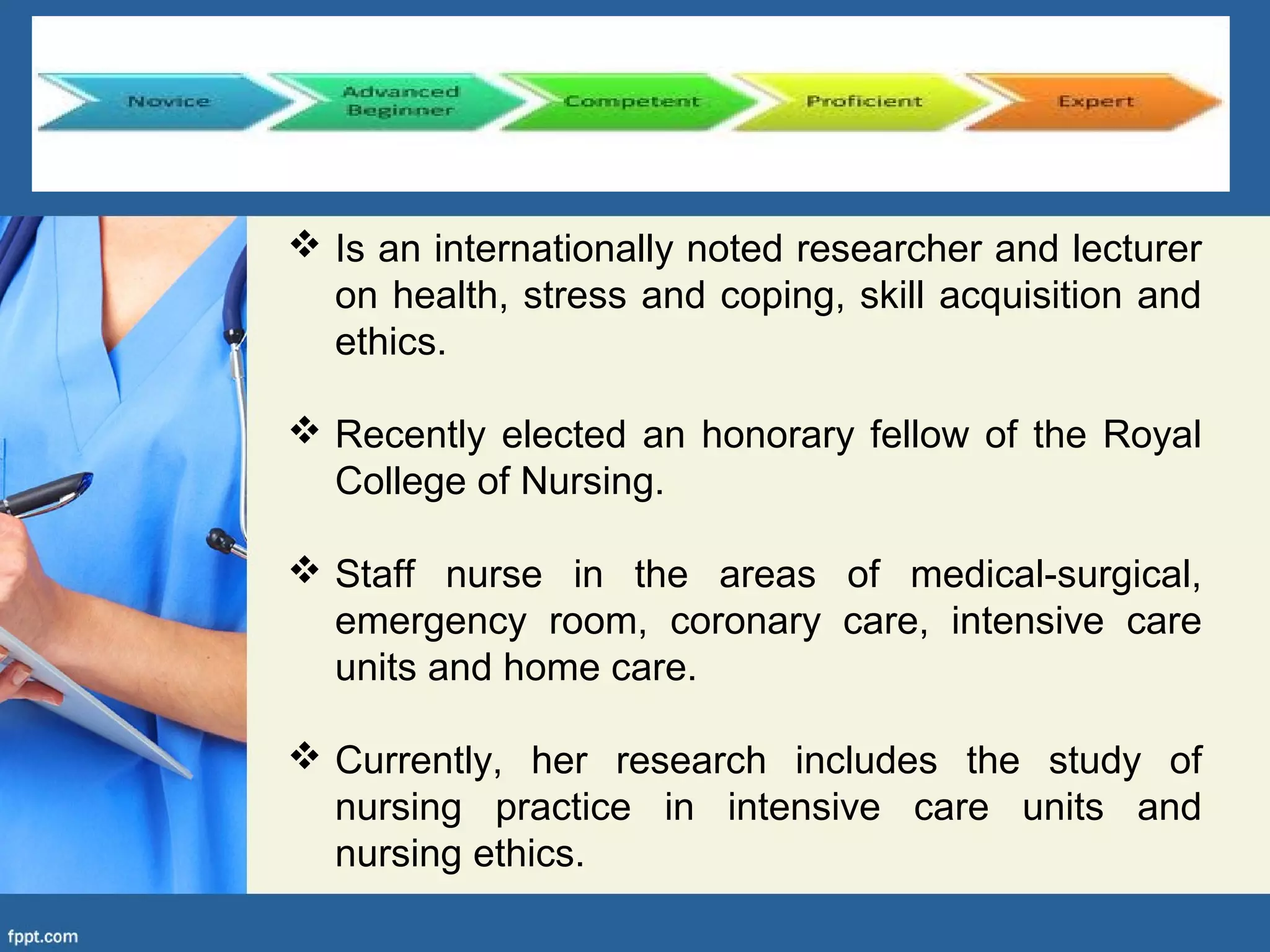
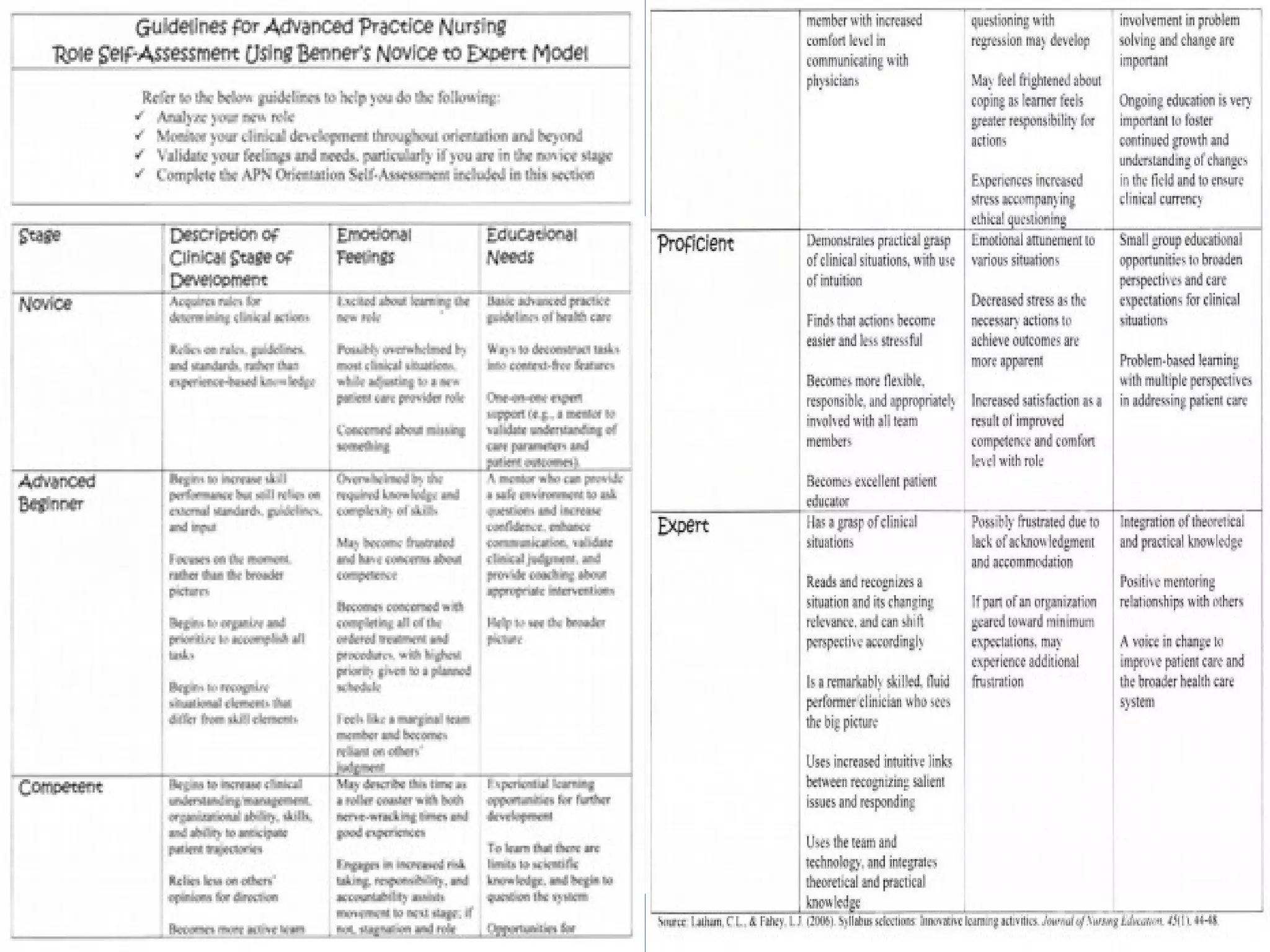
Dr. Benner categorized nursing into 5 levels 
of capabilities: novice, advanced beginner, 
competent, proficient, and expert. 
She believed experience in the clinical setting 
is key to nursing because it allows a nurse to 
continuously expand their knowledge base 
and to provide holistic, competent care to the 
patient. 
Her research was aimed at discovering if 
there were distinguishable, characteristic 
differences in the novice’s and expert’s 
descriptions of the same clinical incident.
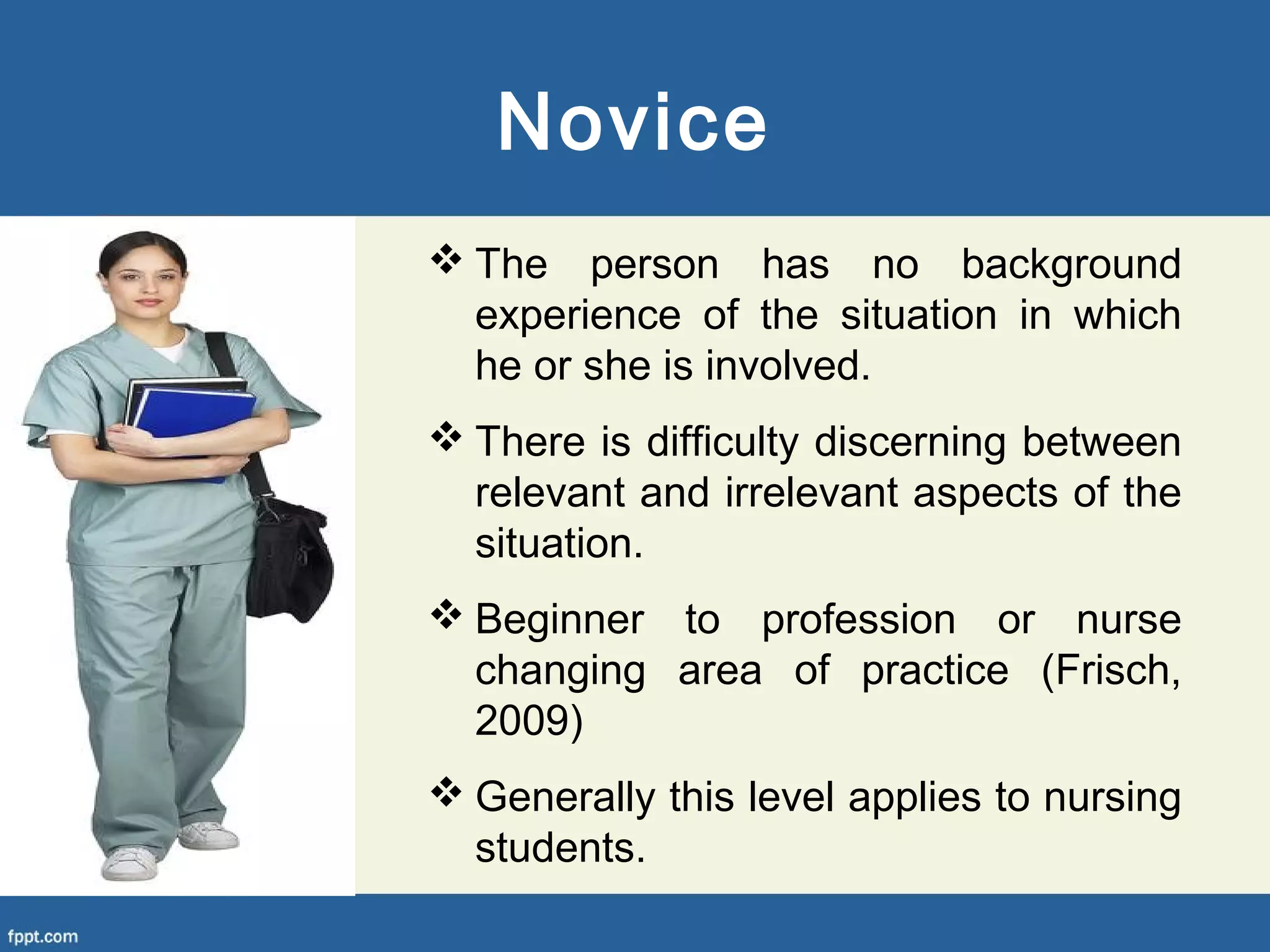
Novice 
The person has no background 
experience of the situation in which 
he or she is involved. 
There is difficulty discerning between 
relevant and irrelevant aspects of the 
situation. 
Beginner to profession or nurse 
changing area of practice (Frisch, 
2009) 
Generally this level applies to nursing 
students.
Novice 
These inexperienced nurses function at the 
level of instruction from nursing school. They 
are unable to make the leap from the classroom 
lecture to individual patients. Often, they apply 
rules learned in nursing school to all patients 
and are unable to discern individual patient 
needs. These nurses are usually new 
graduates, or those nurses who return to the 
workplace after a long absence and are re-educated 
in refresher programs.
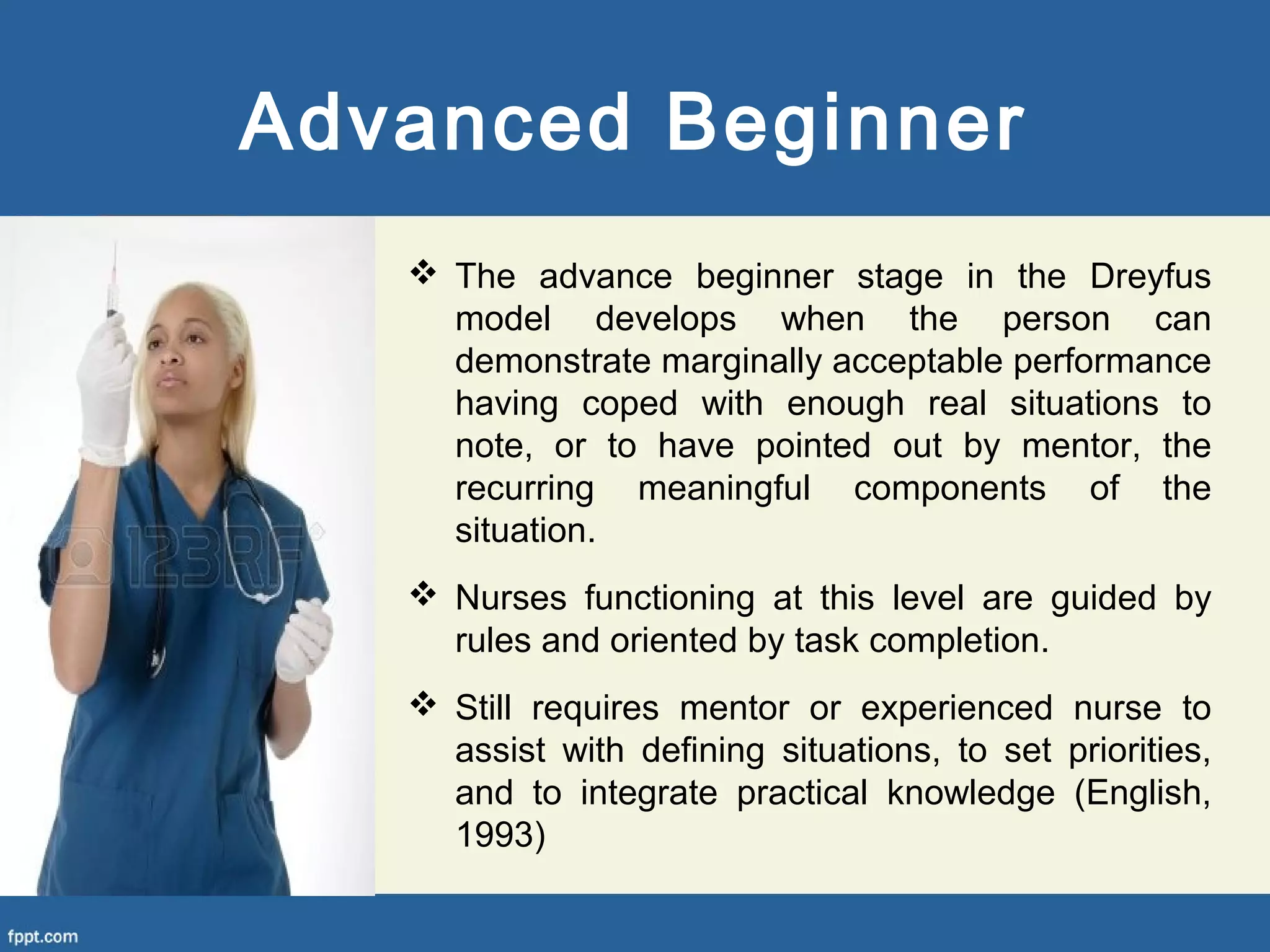
Advanced Beginner 
 The advance beginner stage in the Dreyfus 
model develops when the person can 
demonstrate marginally acceptable performance 
having coped with enough real situations to 
note, or to have pointed out by mentor, the 
recurring meaningful components of the 
situation. 
 Nurses functioning at this level are guided by 
rules and oriented by task completion. 
 Still requires mentor or experienced nurse to 
assist with defining situations, to set priorities, 
and to integrate practical knowledge (English, 
1993)
Competent 
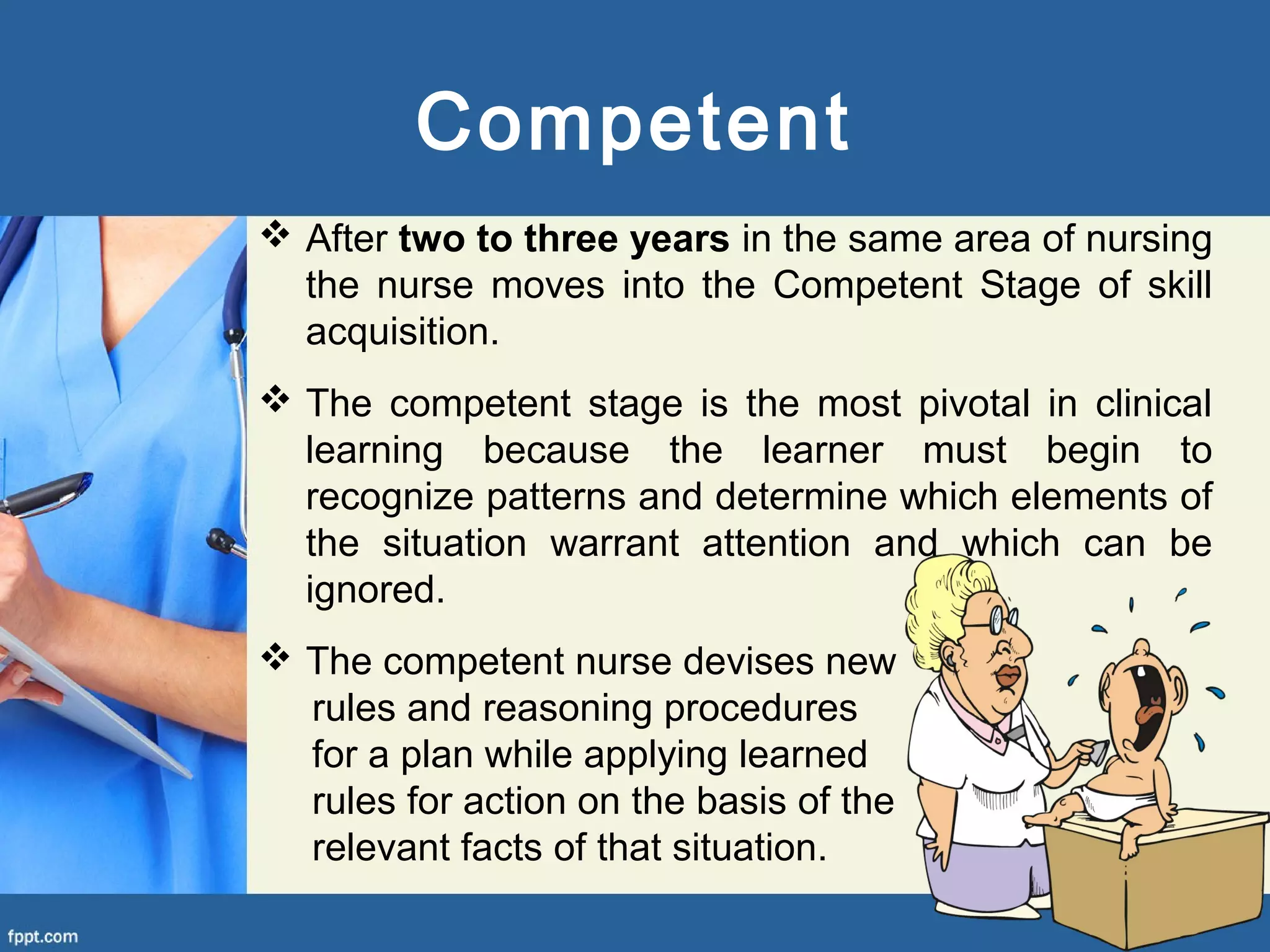
 After two to three years in the same area of nursing 
the nurse moves into the Competent Stage of skill 
acquisition. 
 The competent stage is the most pivotal in clinical 
learning because the learner must begin to 
recognize patterns and determine which elements of 
the situation warrant attention and which can be 
ignored. 
 The competent nurse devises new 
rules and reasoning procedures 
for a plan while applying learned 
rules for action on the basis of the 
relevant facts of that situation.
Proficient 
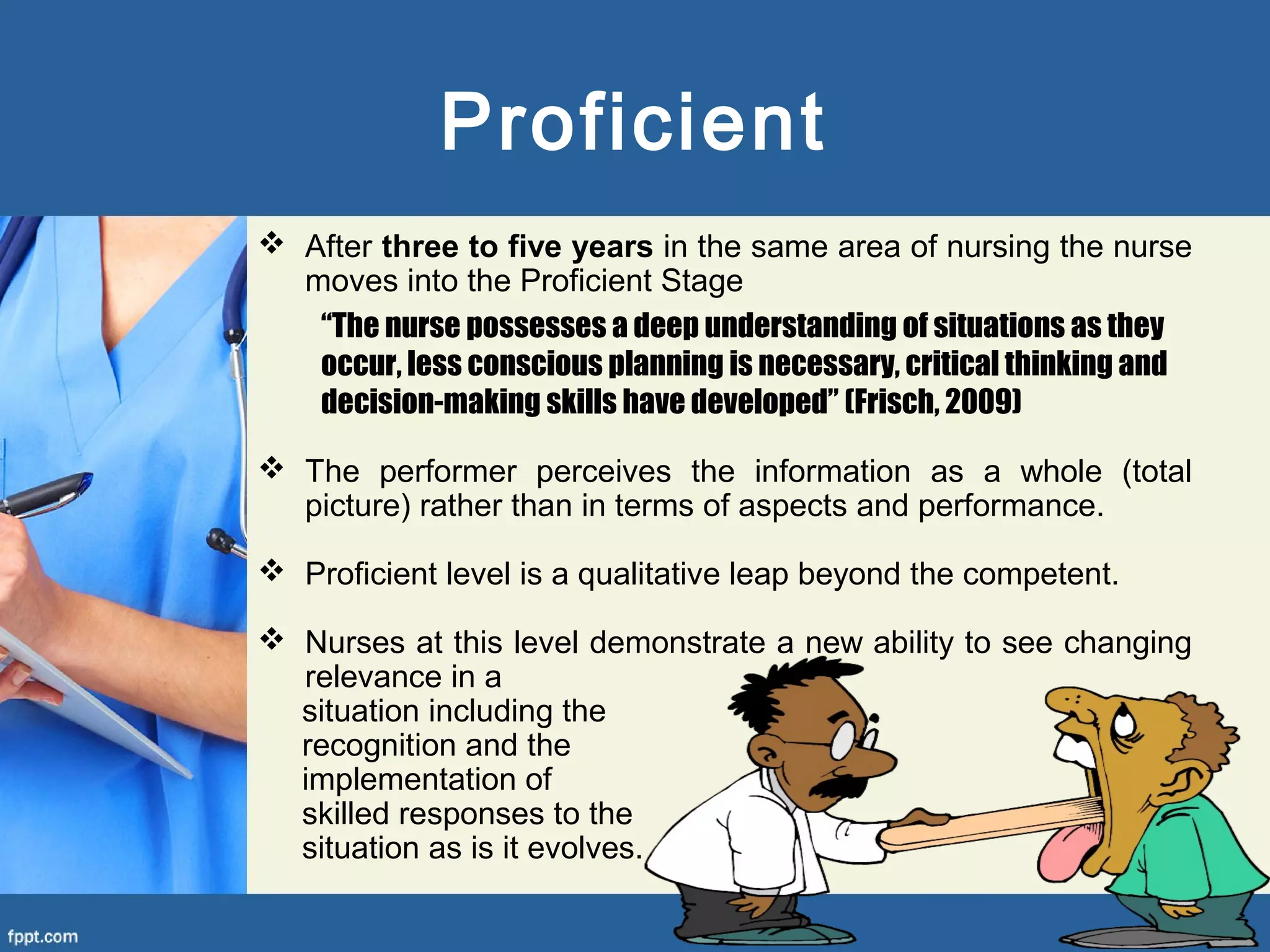
 After three to five years in the same area of nursing the nurse 
moves into the Proficient Stage 
“The nurse possesses a deep understanding of situations as they 
occur, less conscious planning is necessary, critical thinking and 
decision-making skills have developed” (Frisch, 2009) 
 The performer perceives the information as a whole (total 
picture) rather than in terms of aspects and performance. 
 Proficient level is a qualitative leap beyond the competent. 
 Nurses at this level demonstrate a new ability to see changing 
relevance in a 
situation including the 
recognition and the 
implementation of 
skilled responses to the 
situation as is it evolves.
Expert 
 This stage occurs after five years or greater in the same area 
of nursing (experienced nurses changing areas of nursing 
practice may progress more quickly through the five stages) 
 The expert performer no longer relies on an analytic principle 
(rule, guideline, maxim) to connect her or his understanding of 
the situation to an appropriate action. 
 The expert nurse, with an enormous 
background of experience, now has an 
intuitive grasp of each situation and 
zeroes in on the accurate region of the 
problem without wasteful consideration 
of a large range of unfruitful, alternative 
diagnoses and solutions. 
 The expert operates from a deep understanding 
of the total situation.
Benner’s Original Research 
GGooaall:: 
– Compare Novice & Expert Nurse’s descriptions and 
responses to the same clinical situations 
PPaarrttiicciippaannttss:: 
– 21 nurse preceptors & 21 new graduate nurses 
– 51 experienced nurses 
– 11 newly graduated nurses 
– 5 senior nursing students 
CCoolllleeccttiioonn ooff RReesseeaarrcchh:: 
– Interviews with narrative accounts of situations 
– Observation of behaviors in clinical settings (Benner, 
1984)
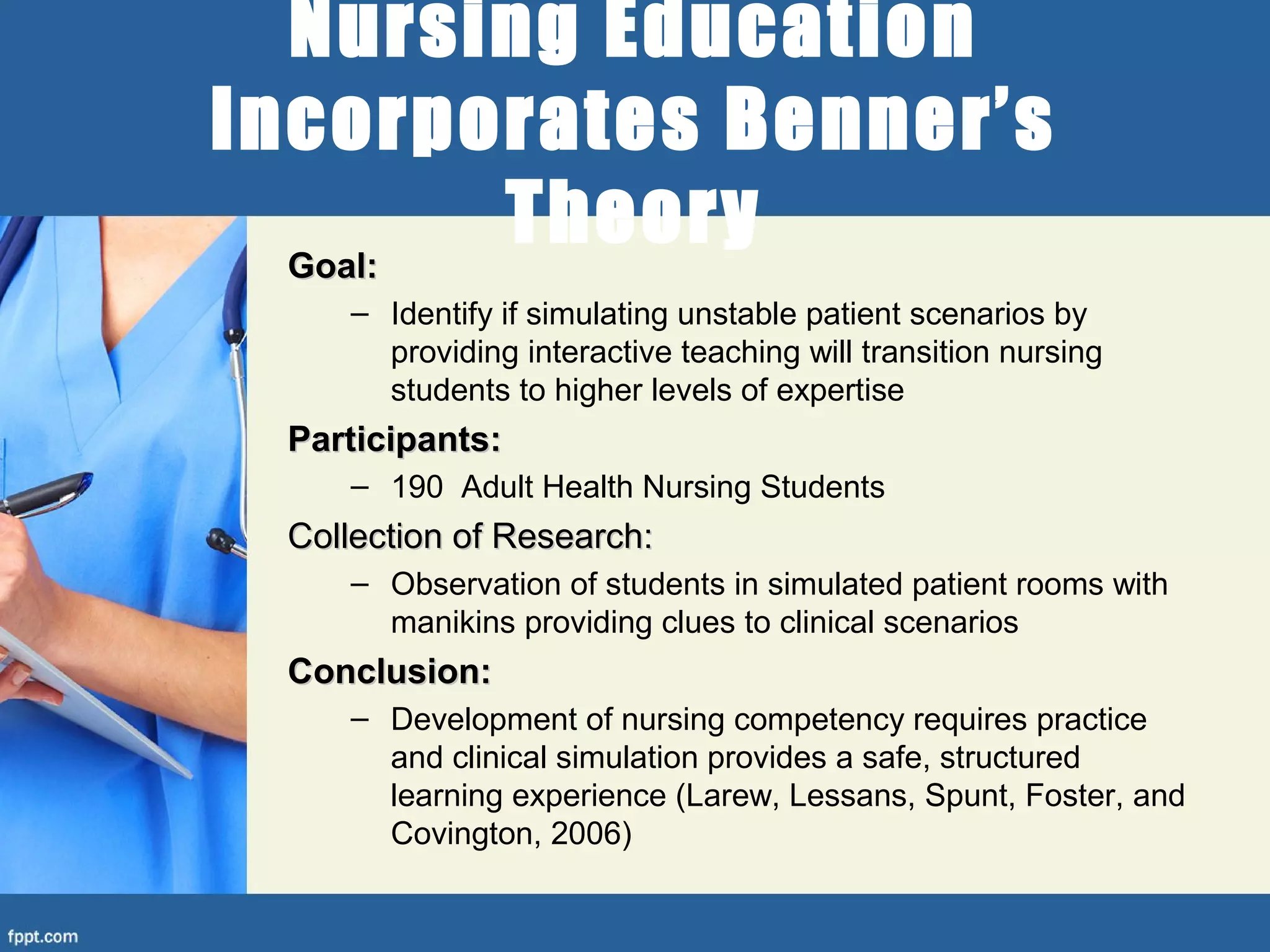
Nursing Education 
Incorporates Benner’s 
Theory 
GGooaall:: 
– Identify if simulating unstable patient scenarios by 
providing interactive teaching will transition nursing 
students to higher levels of expertise 
PPaarrttiicciippaannttss:: 
– 190 Adult Health Nursing Students 
CCoolllleeccttiioonn ooff RReesseeaarrcchh:: 
– Observation of students in simulated patient rooms with 
manikins providing clues to clinical scenarios 
CCoonncclluussiioonn:: 
– Development of nursing competency requires practice 
and clinical simulation provides a safe, structured 
learning experience (Larew, Lessans, Spunt, Foster, and 
Covington, 2006)
Nursing Application 
of Benner’s Theory 
Nursing applies Benner’s Theory through: 
•Nursing school curriculum 
•Building clinical ladders for nurses (Frisch, 2009) 
•Developing mentorship programs 
– Preceptors for student nurses 
– Mentors for newly graduated nurses (Dracup and 
Bryan- Brown, 2004) 
•Development of the Clinical Simulation 
Protocol (Larew et al., 2006)
Four Domains of Nursing 
Paradigm 
1. Client/Person 
2. Health 
3. Environment/Situation 
4. Nursing
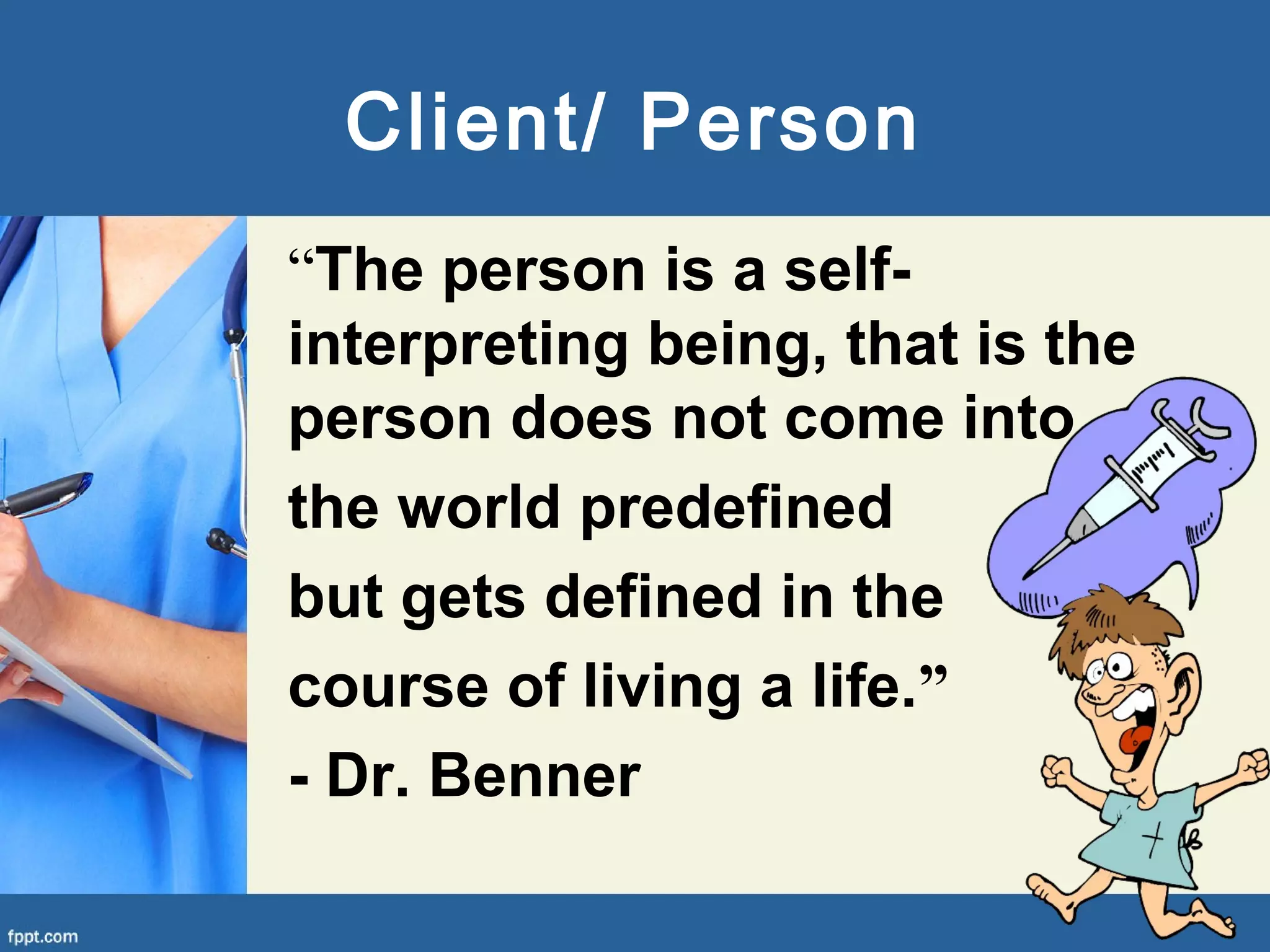
Client/ Person 
“The person is a self-interpreting 
being, that is the 
person does not come into 
the world predefined 
but gets defined in the 
course of living a life.” 
- Dr. Benner
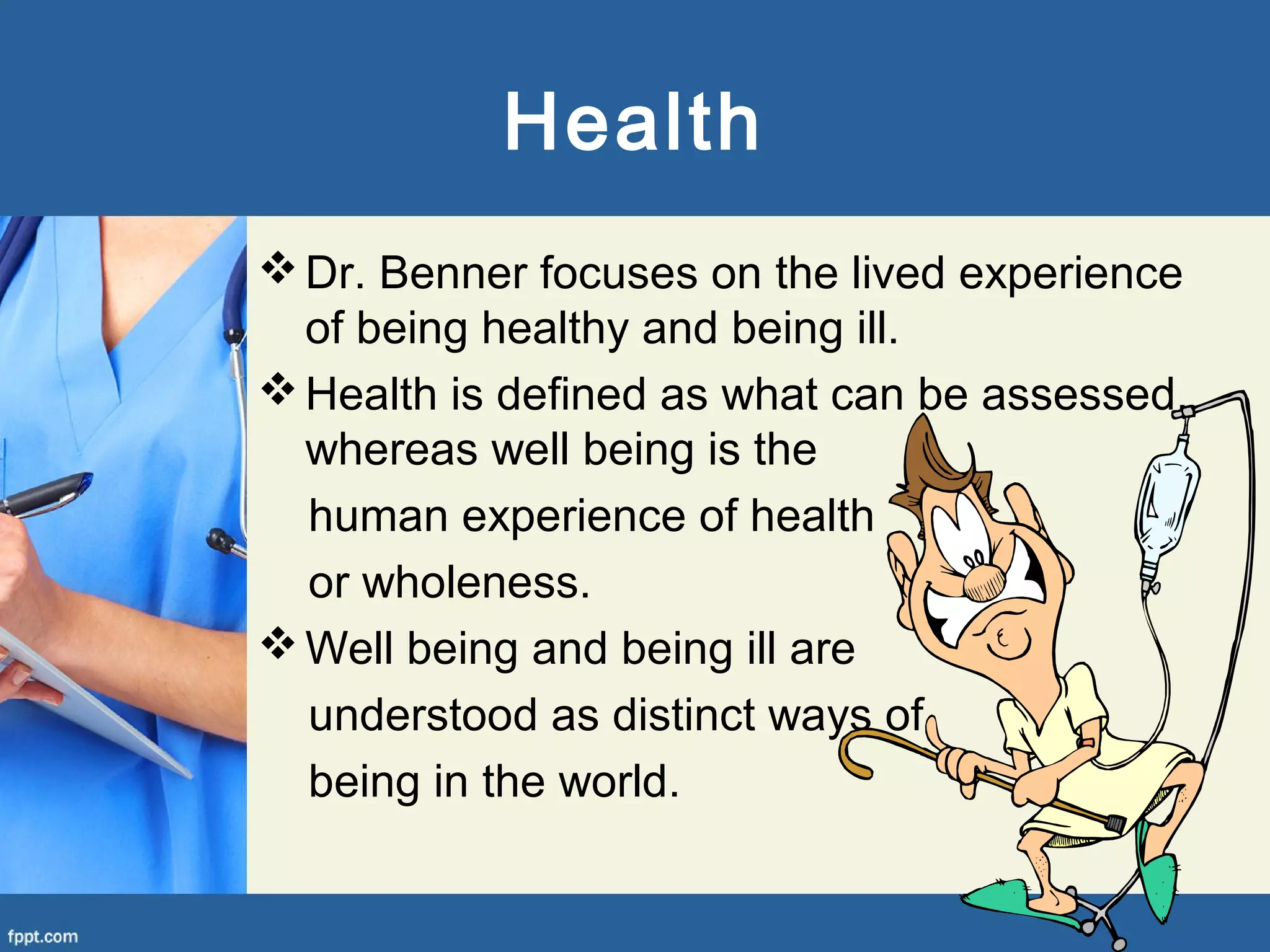
Health 
Dr. Benner focuses on the lived experience 
of being healthy and being ill. 
Health is defined as what can be assessed, 
whereas well being is the 
human experience of health 
or wholeness. 
Well being and being ill are 
understood as distinct ways of 
being in the world.
Environment/Situation 
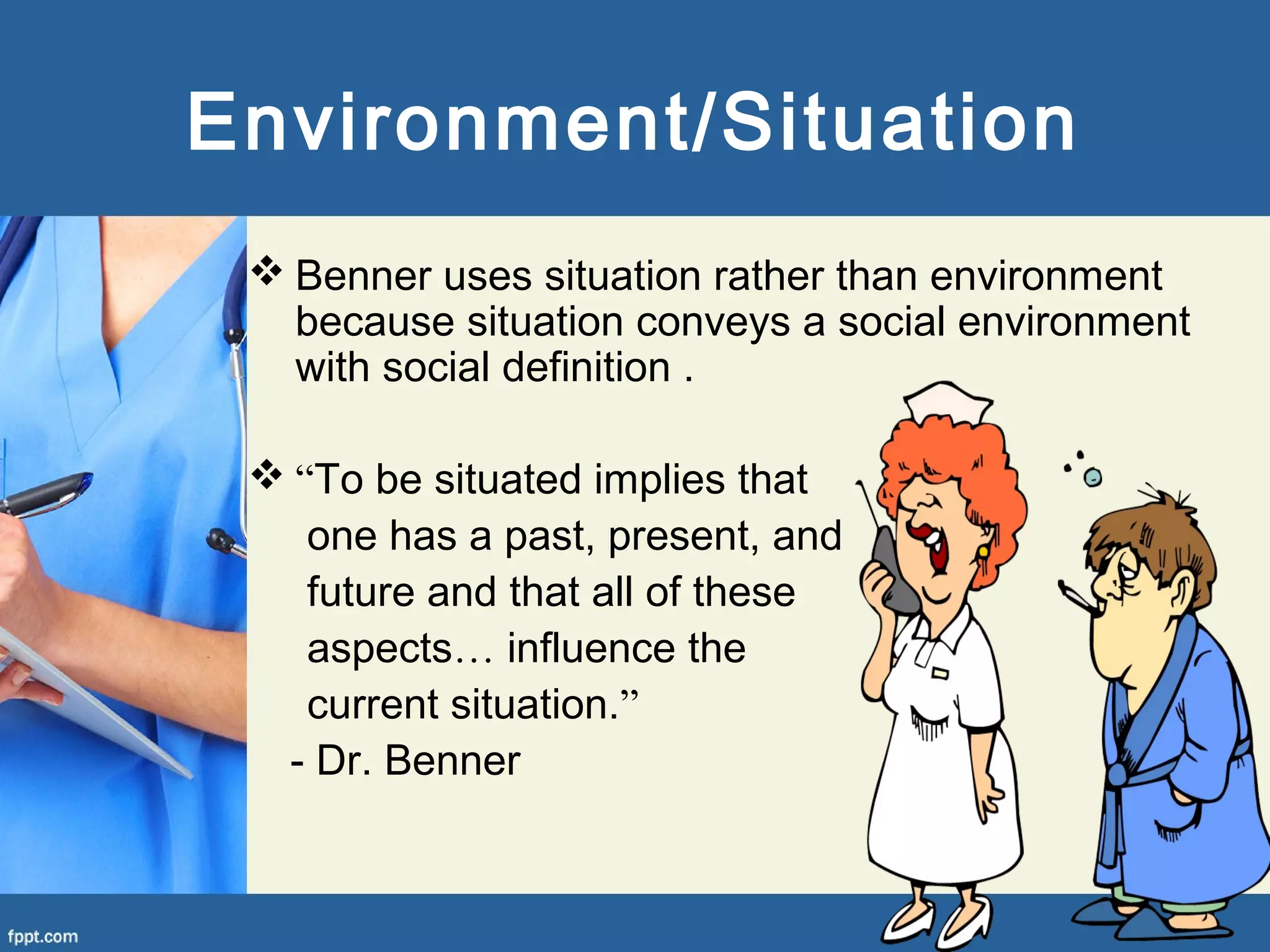
Benner uses situation rather than environment 
because situation conveys a social environment 
with social definition . 
“To be situated implies that 
one has a past, present, and 
future and that all of these 
aspects… influence the 
current situation.” 
- Dr. Benner
Nursing 
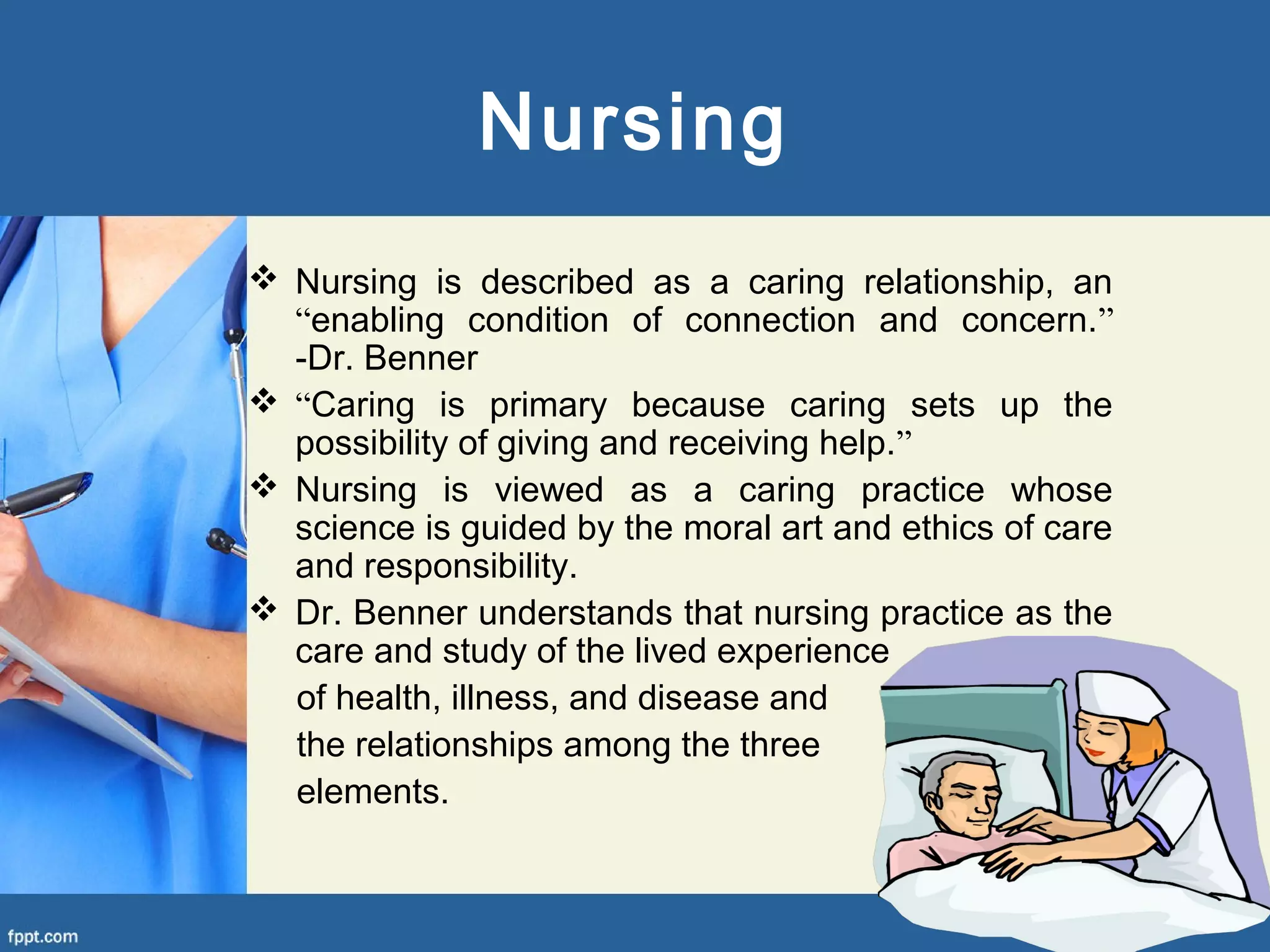
 Nursing is described as a caring relationship, an 
“enabling condition of connection and concern.” 
-Dr. Benner 
 “Caring is primary because caring sets up the 
possibility of giving and receiving help.” 
 Nursing is viewed as a caring practice whose 
science is guided by the moral art and ethics of care 
and responsibility. 
 Dr. Benner understands that nursing practice as the 
care and study of the lived experience 
of health, illness, and disease and 
the relationships among the three 
elements.
MMooddeerrnn TThheeoorriissttss 
Benner is a relatively 
modern theorist, with her 
work having been done 
in the early 1980’s. 
Since that time health 
care has seen the 
advent of DRG’s, 
managed care, an 
increase in the acuity of 
patients in the hospital 
related to early 
discharge and bounce 
back admissions.
HHoossppiittaall SSuurrvviivvaall 
Her theory of expert nurses is 
critical today as the profession 
begins to realize the aging of 
the members of its workforce 
and the increasing age of the 
population who will require 
more nursing services. Her 
theory is applicable today, as it 
was at its publication, and 
provides us with a foundation 
to use for assigning clinical 
competence, a tool to use to 
assess competence in the staff 
nurse.
What can Nurse Leaders do? 
Nurse leaders can help address 
the issues of nursing shortage and 
staff retention by supporting new graduate nurses by: 
• Advocating for transition or residency programs to 
competency, confidence & satisfaction of new RNs 
• Maintaining a healthy working environment 
 Not using novice RNs to cover for staffing shortage 
before the end of orientation period 
 Zero tolerance for lateral violence or bullying 
• Supporting experienced RNs who are serving as 
preceptors and mentors for novice RNs
Shaping our Future Nurse 
Leaders 
• New graduate nurses are the future employee 
pool 
• Job satisfaction & retention are greatly influenced 
by the quality of orientation and support received 
by the new graduate nurse. 
• A positive experience will encourage the now 
proficient nurse to mentor novice nurses & give 
them the same positive experience he/she had 
during the transition period. 
The mediocre teacher tells. The good 
teacher explains. The superior teacher 
demonstrates. The great teacher inspires. 
- William Arthur 
Ward
Patricia Benner (Novice to Expert Theory)

Patricia Benner (Novice to Expert Theory)

  • 1.
    University of Bohol Graduate School & Professional Studies Department Tagbilaran City, Bohol, Philippines PATRICIA BENNER Novice-Expert Model Mary Ann Tejano Adiong, RN, UUSSRRNN -- MMaasstteerraanndd
  • 2.
    Patricia Benner, RN,PhD, FAAN, FRCN
  • 3.
    Benner : AsAuthor Dr. Benner is the author of books including: 1.From Novice to Expert 2.The Primacy of Caring 3.Interpretive Phenomenology: Embodiment, Caring and Ethics in Health and Illness 4. The Crisis of Care 5. Expertise in Nursing Practice: Caring, Clinical Judgment, and Ethics 6. Caregiving 7. Clinical Wisdom and Interventions in Critical Care: A Thinking-In-Action Approach.
  • 4.
     Is aninternationally noted researcher and lecturer on health, stress and coping, skill acquisition and ethics.  Recently elected an honorary fellow of the Royal College of Nursing.  Staff nurse in the areas of medical-surgical, emergency room, coronary care, intensive care units and home care.  Currently, her research includes the study of nursing practice in intensive care units and nursing ethics.
  • 5.
    An Influential Nursein the Development of the Profession of Nursing Patricia Benner’s research and theory work provides the profession of nursing with what we now know as the Novice to Expert model, also known as Benner’s Stages of Clinical Competence. Benner’s work as applied to the nursing profession is adapted from the Dreyfus Model of Skill Acquisition.
  • 6.
    SSkkiillll AAccqquuiissiittiioonn “Theutility of the concept of skill acquisition lies in helping the teacher understand how to assist the learner in advancing to the next level” (McClure, 2005)
  • 7.
    The Dreyfus MMooddeellooff SSkkiillll AAccqquuiissiittiioonn
  • 8.
    Dr. Benner categorizednursing into 5 levels of capabilities: novice, advanced beginner, competent, proficient, and expert. She believed experience in the clinical setting is key to nursing because it allows a nurse to continuously expand their knowledge base and to provide holistic, competent care to the patient. Her research was aimed at discovering if there were distinguishable, characteristic differences in the novice’s and expert’s descriptions of the same clinical incident.
  • 9.
    Novice The personhas no background experience of the situation in which he or she is involved. There is difficulty discerning between relevant and irrelevant aspects of the situation. Beginner to profession or nurse changing area of practice (Frisch, 2009) Generally this level applies to nursing students.
  • 10.
    Novice These inexperiencednurses function at the level of instruction from nursing school. They are unable to make the leap from the classroom lecture to individual patients. Often, they apply rules learned in nursing school to all patients and are unable to discern individual patient needs. These nurses are usually new graduates, or those nurses who return to the workplace after a long absence and are re-educated in refresher programs.
  • 11.
    Advanced Beginner The advance beginner stage in the Dreyfus model develops when the person can demonstrate marginally acceptable performance having coped with enough real situations to note, or to have pointed out by mentor, the recurring meaningful components of the situation.  Nurses functioning at this level are guided by rules and oriented by task completion.  Still requires mentor or experienced nurse to assist with defining situations, to set priorities, and to integrate practical knowledge (English, 1993)
  • 12.
    Competent  Aftertwo to three years in the same area of nursing the nurse moves into the Competent Stage of skill acquisition.  The competent stage is the most pivotal in clinical learning because the learner must begin to recognize patterns and determine which elements of the situation warrant attention and which can be ignored.  The competent nurse devises new rules and reasoning procedures for a plan while applying learned rules for action on the basis of the relevant facts of that situation.
  • 13.
    Proficient  Afterthree to five years in the same area of nursing the nurse moves into the Proficient Stage “The nurse possesses a deep understanding of situations as they occur, less conscious planning is necessary, critical thinking and decision-making skills have developed” (Frisch, 2009)  The performer perceives the information as a whole (total picture) rather than in terms of aspects and performance.  Proficient level is a qualitative leap beyond the competent.  Nurses at this level demonstrate a new ability to see changing relevance in a situation including the recognition and the implementation of skilled responses to the situation as is it evolves.
  • 14.
    Expert  Thisstage occurs after five years or greater in the same area of nursing (experienced nurses changing areas of nursing practice may progress more quickly through the five stages)  The expert performer no longer relies on an analytic principle (rule, guideline, maxim) to connect her or his understanding of the situation to an appropriate action.  The expert nurse, with an enormous background of experience, now has an intuitive grasp of each situation and zeroes in on the accurate region of the problem without wasteful consideration of a large range of unfruitful, alternative diagnoses and solutions.  The expert operates from a deep understanding of the total situation.
  • 17.
    Benner’s Original Research GGooaall:: – Compare Novice & Expert Nurse’s descriptions and responses to the same clinical situations PPaarrttiicciippaannttss:: – 21 nurse preceptors & 21 new graduate nurses – 51 experienced nurses – 11 newly graduated nurses – 5 senior nursing students CCoolllleeccttiioonn ooff RReesseeaarrcchh:: – Interviews with narrative accounts of situations – Observation of behaviors in clinical settings (Benner, 1984)
  • 18.
    Nursing Education IncorporatesBenner’s Theory GGooaall:: – Identify if simulating unstable patient scenarios by providing interactive teaching will transition nursing students to higher levels of expertise PPaarrttiicciippaannttss:: – 190 Adult Health Nursing Students CCoolllleeccttiioonn ooff RReesseeaarrcchh:: – Observation of students in simulated patient rooms with manikins providing clues to clinical scenarios CCoonncclluussiioonn:: – Development of nursing competency requires practice and clinical simulation provides a safe, structured learning experience (Larew, Lessans, Spunt, Foster, and Covington, 2006)
  • 19.
    Nursing Application ofBenner’s Theory Nursing applies Benner’s Theory through: •Nursing school curriculum •Building clinical ladders for nurses (Frisch, 2009) •Developing mentorship programs – Preceptors for student nurses – Mentors for newly graduated nurses (Dracup and Bryan- Brown, 2004) •Development of the Clinical Simulation Protocol (Larew et al., 2006)
  • 20.
    Four Domains ofNursing Paradigm 1. Client/Person 2. Health 3. Environment/Situation 4. Nursing
  • 21.
    Client/ Person “Theperson is a self-interpreting being, that is the person does not come into the world predefined but gets defined in the course of living a life.” - Dr. Benner
  • 22.
    Health Dr. Bennerfocuses on the lived experience of being healthy and being ill. Health is defined as what can be assessed, whereas well being is the human experience of health or wholeness. Well being and being ill are understood as distinct ways of being in the world.
  • 23.
    Environment/Situation Benner usessituation rather than environment because situation conveys a social environment with social definition . “To be situated implies that one has a past, present, and future and that all of these aspects… influence the current situation.” - Dr. Benner
  • 24.
    Nursing  Nursingis described as a caring relationship, an “enabling condition of connection and concern.” -Dr. Benner  “Caring is primary because caring sets up the possibility of giving and receiving help.”  Nursing is viewed as a caring practice whose science is guided by the moral art and ethics of care and responsibility.  Dr. Benner understands that nursing practice as the care and study of the lived experience of health, illness, and disease and the relationships among the three elements.
  • 25.
    MMooddeerrnn TThheeoorriissttss Benneris a relatively modern theorist, with her work having been done in the early 1980’s. Since that time health care has seen the advent of DRG’s, managed care, an increase in the acuity of patients in the hospital related to early discharge and bounce back admissions.
  • 26.
    HHoossppiittaall SSuurrvviivvaall Hertheory of expert nurses is critical today as the profession begins to realize the aging of the members of its workforce and the increasing age of the population who will require more nursing services. Her theory is applicable today, as it was at its publication, and provides us with a foundation to use for assigning clinical competence, a tool to use to assess competence in the staff nurse.
  • 27.
    What can NurseLeaders do? Nurse leaders can help address the issues of nursing shortage and staff retention by supporting new graduate nurses by: • Advocating for transition or residency programs to competency, confidence & satisfaction of new RNs • Maintaining a healthy working environment  Not using novice RNs to cover for staffing shortage before the end of orientation period  Zero tolerance for lateral violence or bullying • Supporting experienced RNs who are serving as preceptors and mentors for novice RNs
  • 28.
    Shaping our FutureNurse Leaders • New graduate nurses are the future employee pool • Job satisfaction & retention are greatly influenced by the quality of orientation and support received by the new graduate nurse. • A positive experience will encourage the now proficient nurse to mentor novice nurses & give them the same positive experience he/she had during the transition period. The mediocre teacher tells. The good teacher explains. The superior teacher demonstrates. The great teacher inspires. - William Arthur Ward