National Institute of Technology Andhra Pradesh
K-Mean Clustering
What is clustering?
● Clustering is the classification of objects into
different groups, or more precisely, the
partitioning of a data set into subsets
(clusters), so that the data in each subset
(ideally) share some common trait - often
according to some defined distance measure.
Distance measures:
●Distance measure will determine how the similarity of two elements
is calculated and it will influence the shape of the clusters.
They include:
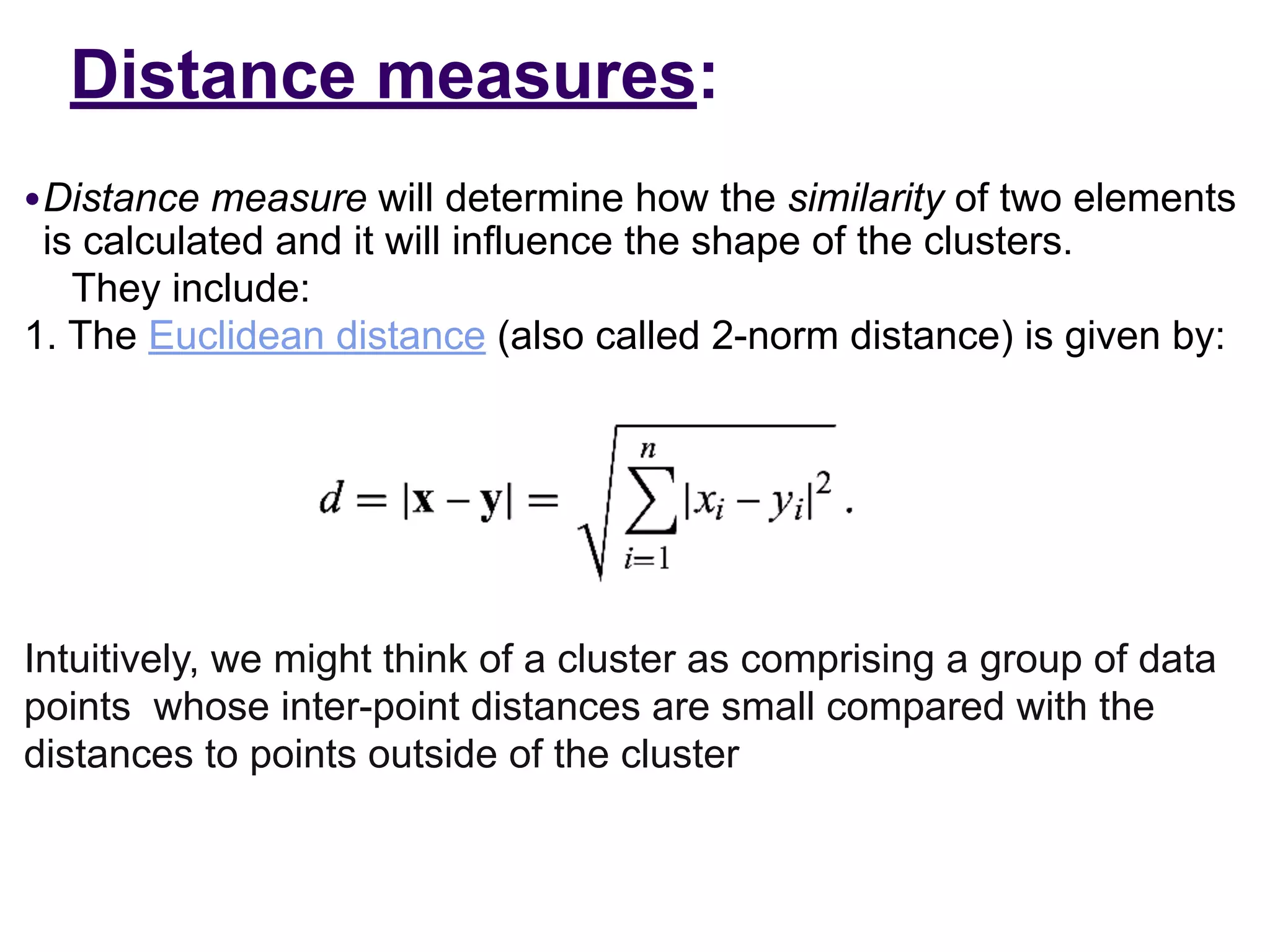
1. The Euclidean distance (also called 2-norm distance) is given by:
Intuitively, we might think of a cluster as comprising a group of data
points whose inter-point distances are small compared with the
distances to points outside of the cluster
K-mean clustering:
• K-mean clustering is a Partitional type clustering in which
algorithms determine all clusters at once.
• The k-means algorithm is an algorithm to cluster n
objects based on attributes into k partitions, where k ≤ n.
• It is similar to the expectation-maximization algorithm for
mixtures of Gaussians in that they both attempt to
fi
nd
the centers of natural clusters in the data.
• It assumes that the object attributes form a vector space.
● For each data point Xn, we introduce a corresponding
set of binary indictor variables rnk ∈ {0,1}, where
k=1,…..,K describing which of the K clusters the data
point Xn is assigned to,
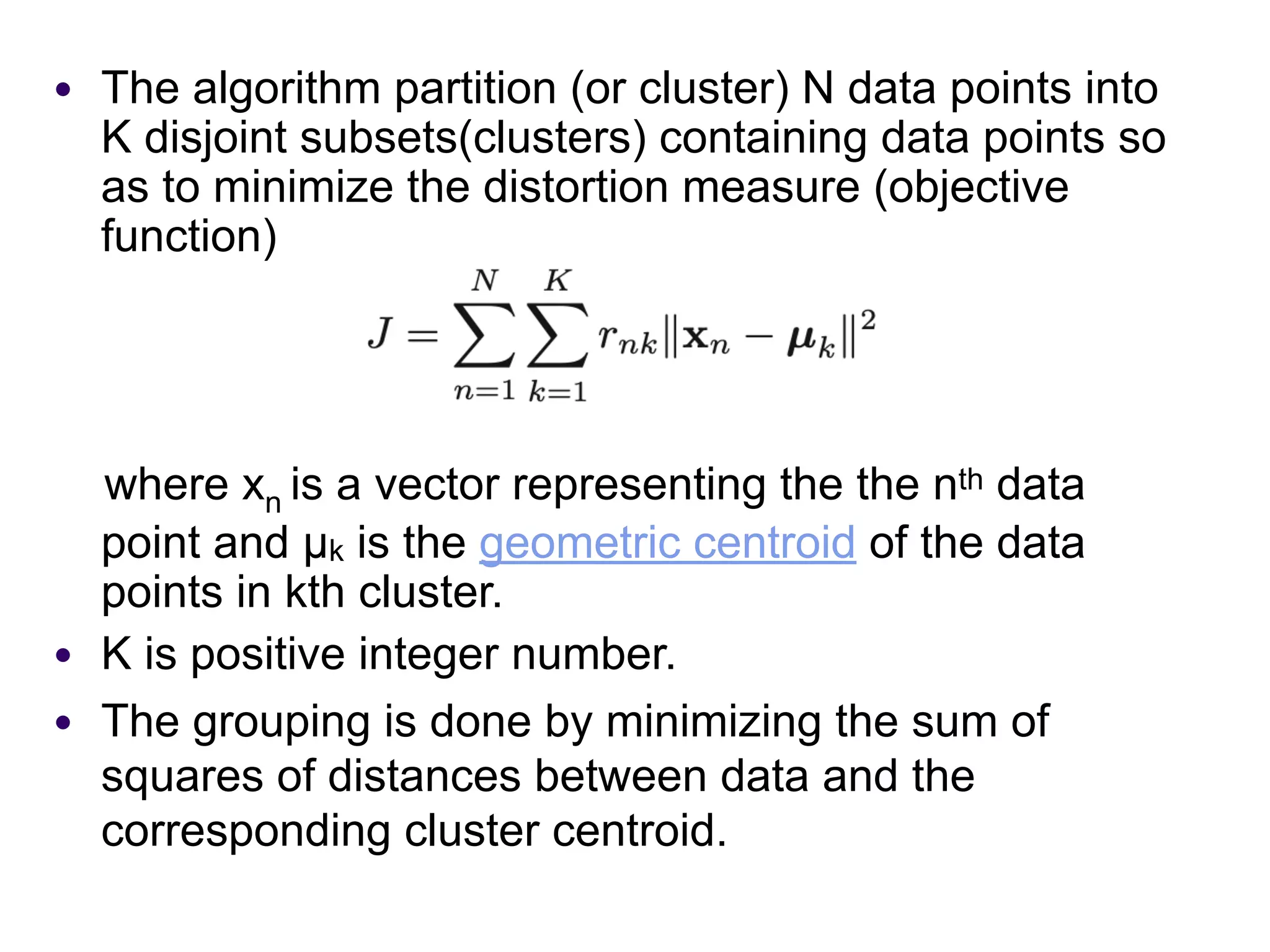
● The algorithm partition (or cluster) N data points into
K disjoint subsets(clusters) containing data points so
as to minimize the distortion measure (objective
function)
where xn is a vector representing the the nth data
point and µk is the geometric centroid of the data
points in kth cluster.
● K is positive integer number.
● The grouping is done by minimizing the sum of
squares of distances between data and the
corresponding cluster centroid.
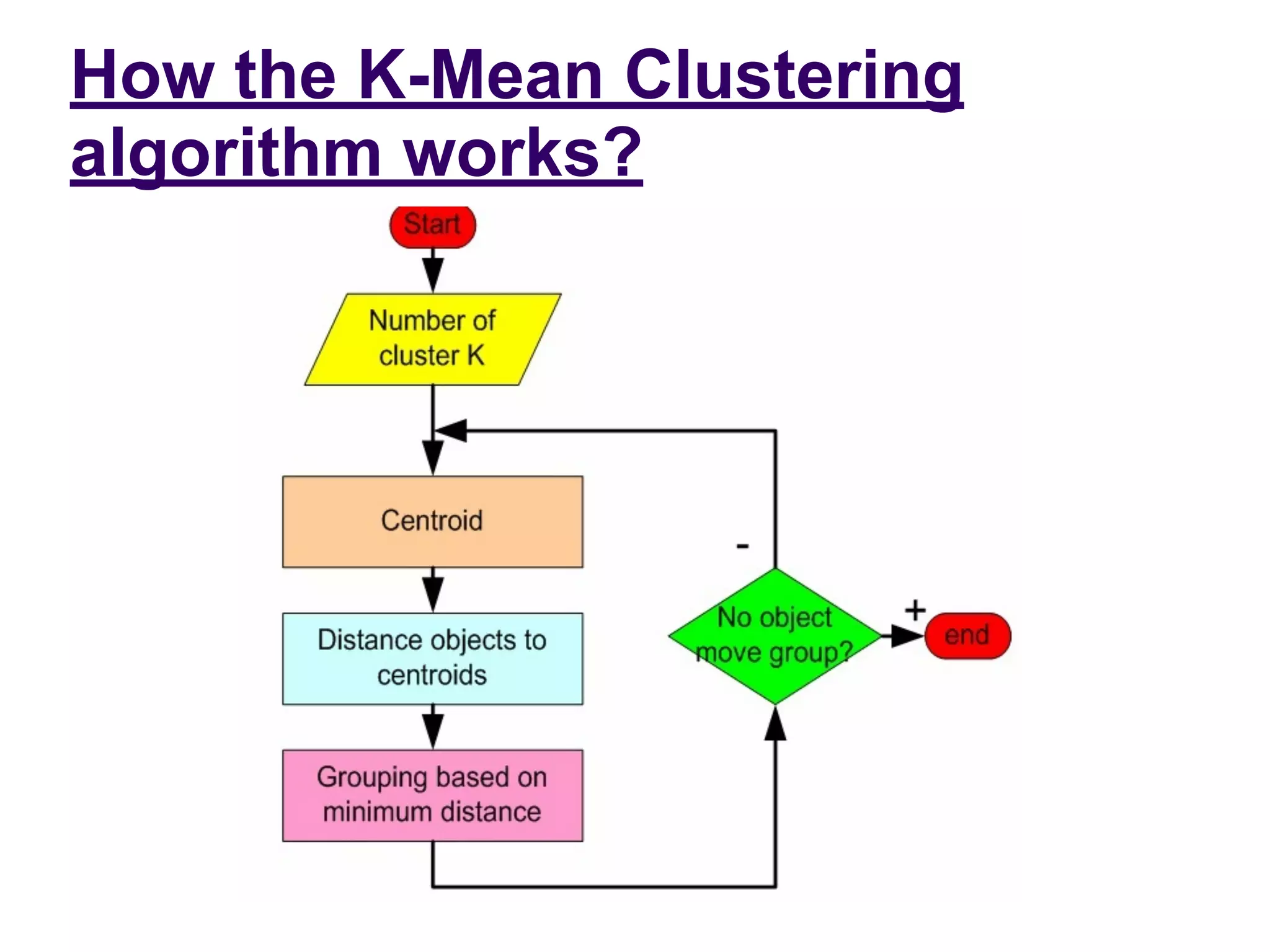
How the K-Mean Clustering
algorithm works?
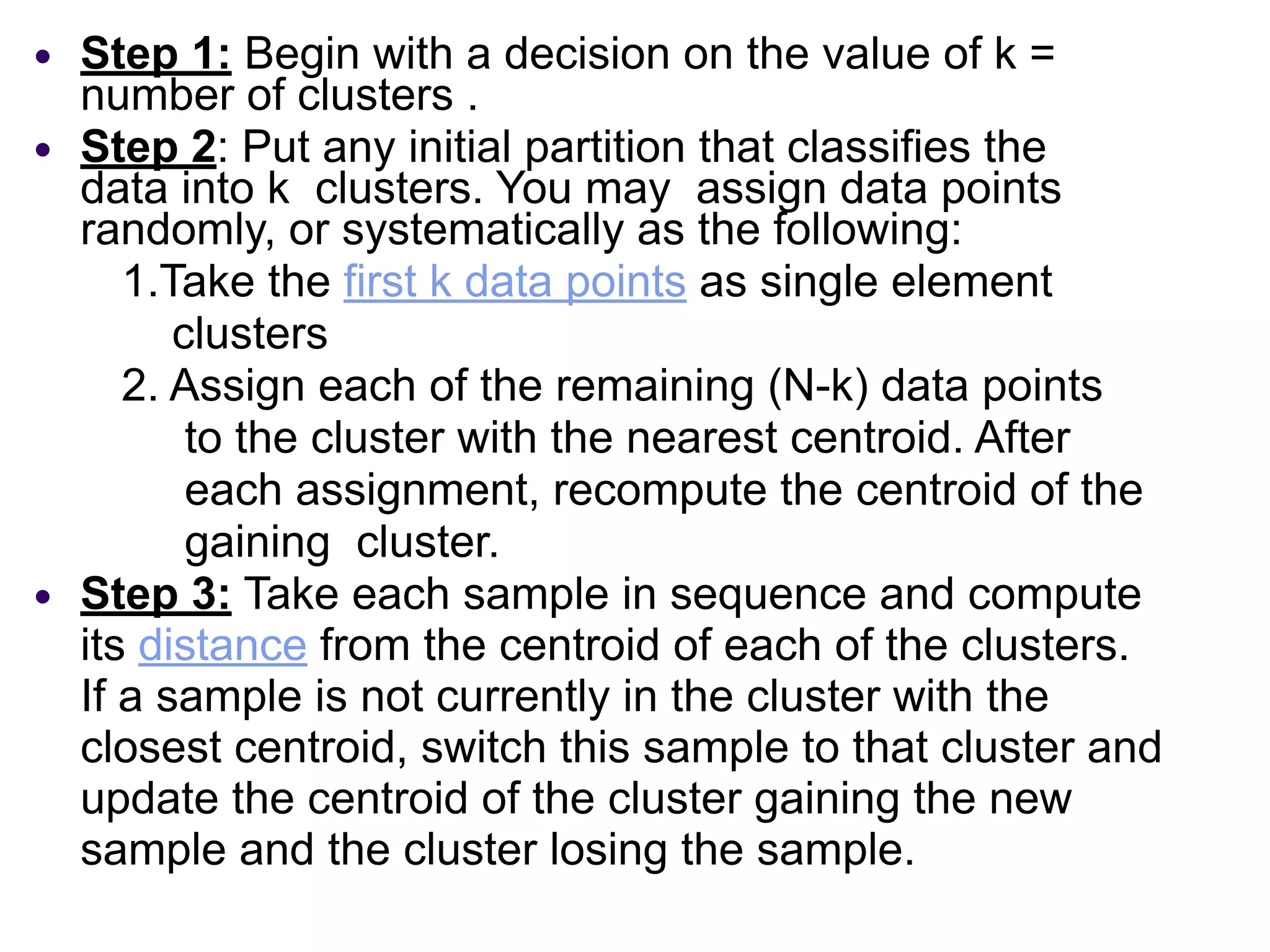
● Step 1: Begin with a decision on the value of k =
number of clusters .
● Step 2: Put any initial partition that classifies the
data into k clusters. You may assign data points
randomly, or systematically as the following:
1.Take the first k data points as single element
clusters
2. Assign each of the remaining (N-k) data points
to the cluster with the nearest centroid. After
each assignment, recompute the centroid of the
gaining cluster.
● Step 3: Take each sample in sequence and compute
its distance from the centroid of each of the clusters.
If a sample is not currently in the cluster with the
closest centroid, switch this sample to that cluster and
update the centroid of the cluster gaining the new
sample and the cluster losing the sample.
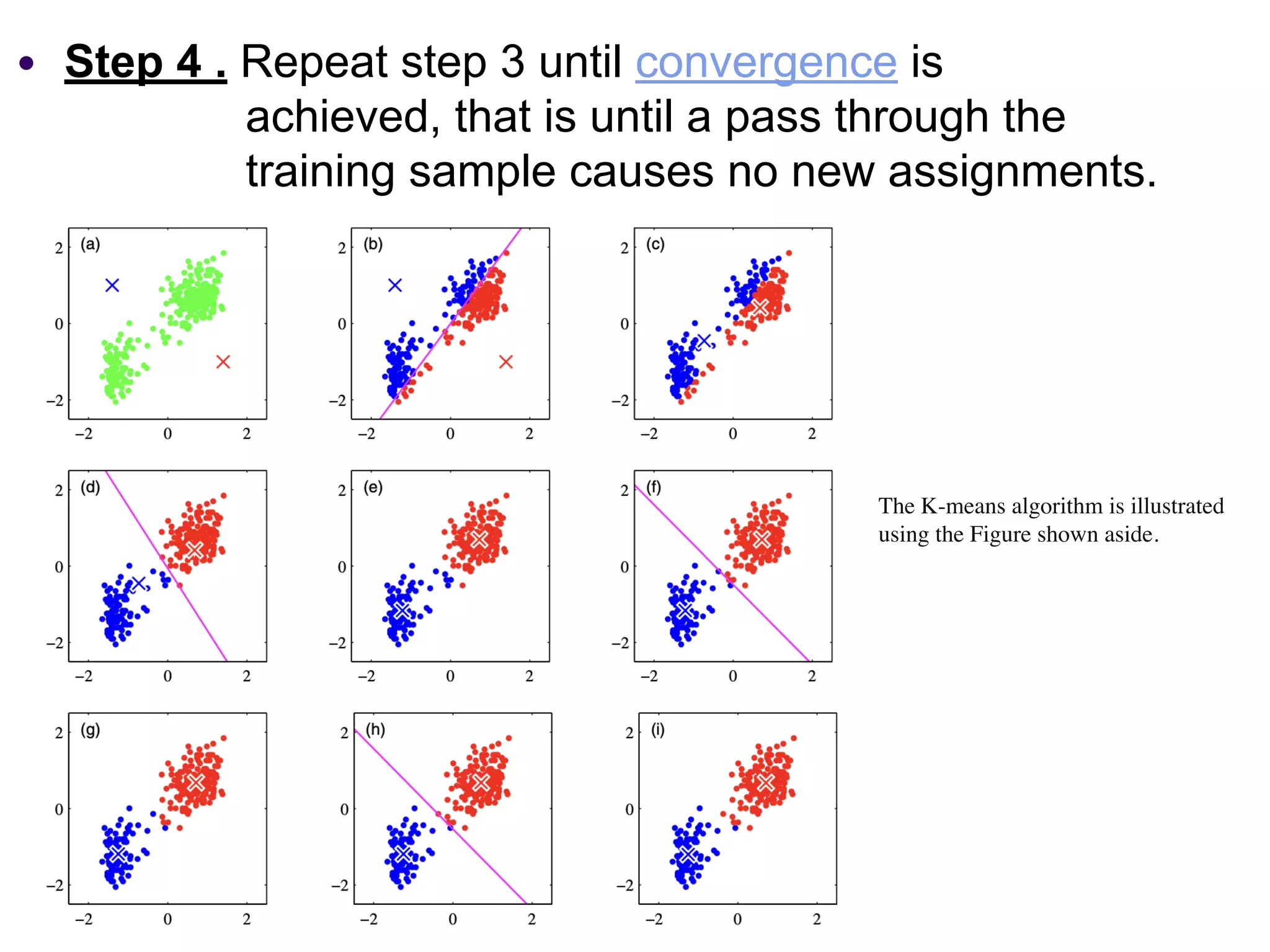
● Step 4 . Repeat step 3 until convergence is
achieved, that is until a pass through the
training sample causes no new assignments.
The K-means algorithm is illustrated
using the Figure shown aside.
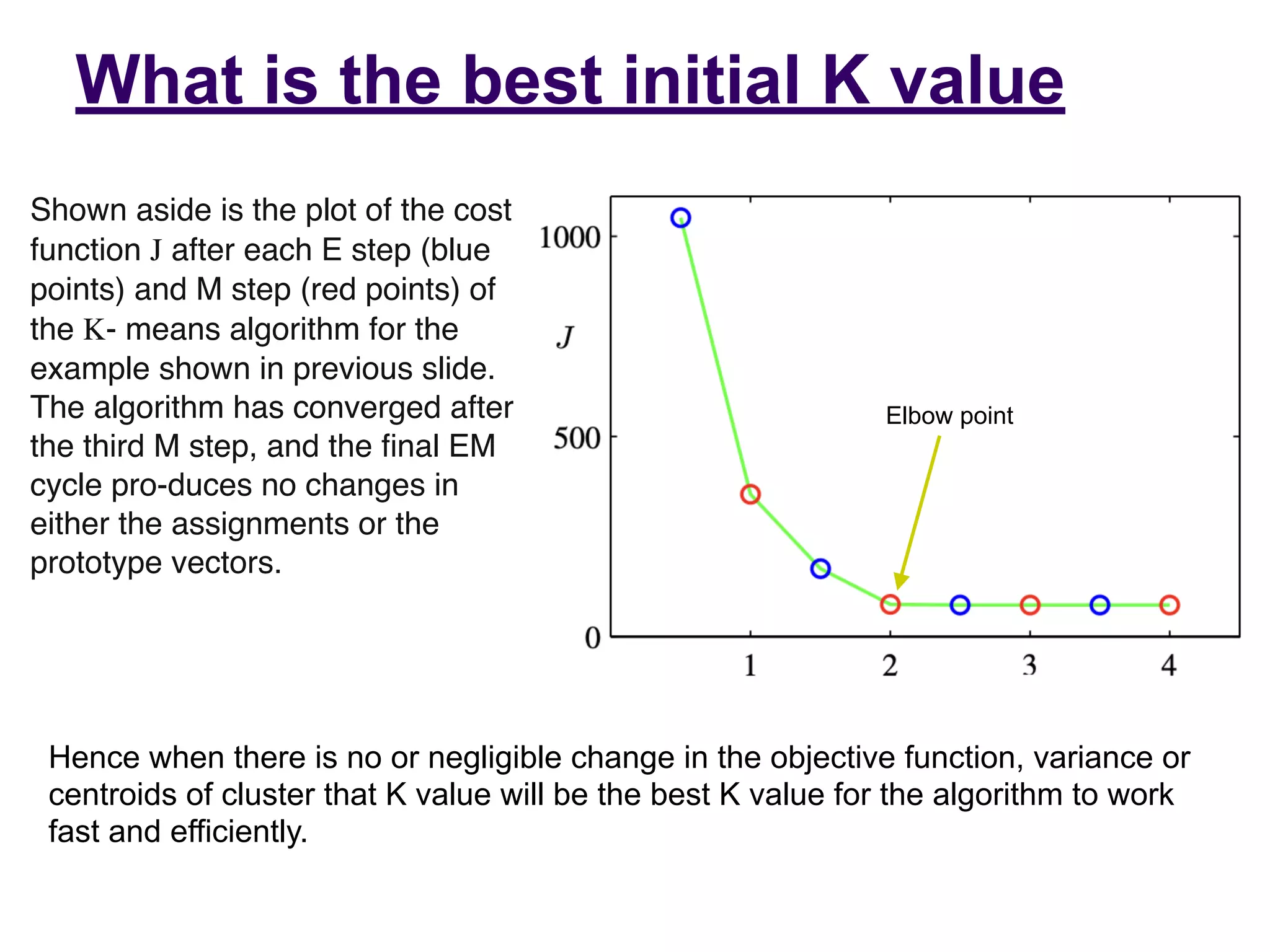
What is the best initial K value
Elbow point
Shown aside is the plot of the cost
function J after each E step (blue
points) and M step (red points) of
the K- means algorithm for the
example shown in previous slide.
The algorithm has converged after
the third M step, and the
fi
nal EM
cycle pro-duces no changes in
either the assignments or the
prototype vectors.
Hence when there is no or negligible change in the objective function, variance or
centroids of cluster that K value will be the best K value for the algorithm to work
fast and efficiently.
Weaknesses of K-Mean Clustering
1. When the numbers of data are not so many, initial
grouping will determine the cluster significantly.
2. The number of cluster, K, must be determined before
hand. Its disadvantage is that it does not yield the same
result with each run, since the resulting clusters depend
on the initial random assignments.
3. We never know the real cluster, using the same data,
because if it is inputted in a different order it may produce
different cluster if the number of data is few.
4. It is sensitive to initial condition. Different initial condition
may produce different result of cluster. The algorithm may
be trapped in the local optimum.
Applications of K-Mean
Clustering
● It is relatively efficient and fast. It computes result at O(kn),
where n is number of objects or points and k is number of
clusters.
● k-means clustering can be applied to machine learning or
data mining
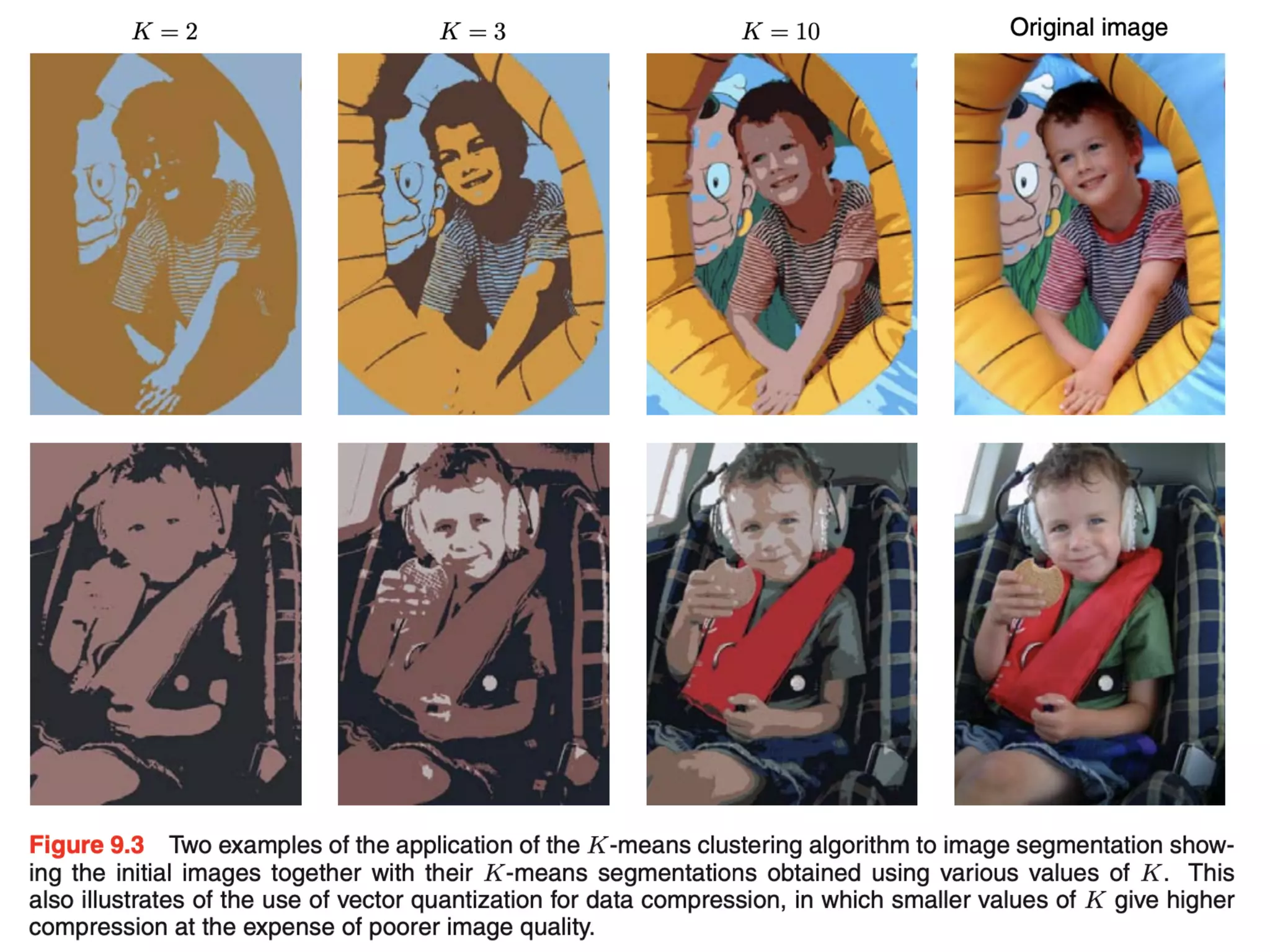
• It can be used in Image Segmentation.(example of image
segmentation is as follows)
• Each pixel in an image is a point in a 3-dimensional space
comprising the intensities of the red, blue, and green
channels, and our segmentation algorithm simply treats
each pixel in the image as a separate data point. Note that
strictly this space is not Euclidean because the channel
intensities are bounded by the interval [0, 1].
•
CONCLUSION
● K-means algorithm is useful for undirected
knowledge discovery and is relatively simple.
● K-means has found wide spread usage in lot of
fields, ranging from unsupervised learning of
neural network, Pattern recognitions,
Classification analysis, Artificial intelligence,
image processing, machine vision, and many
others.
Thank You

k-mean-clustering.pdf

  • 1.
    National Institute ofTechnology Andhra Pradesh K-Mean Clustering
  • 2.
    What is clustering? ●Clustering is the classification of objects into different groups, or more precisely, the partitioning of a data set into subsets (clusters), so that the data in each subset (ideally) share some common trait - often according to some defined distance measure.
  • 3.
    Distance measures: ●Distance measurewill determine how the similarity of two elements is calculated and it will influence the shape of the clusters. They include: 1. The Euclidean distance (also called 2-norm distance) is given by: Intuitively, we might think of a cluster as comprising a group of data points whose inter-point distances are small compared with the distances to points outside of the cluster
  • 4.
    K-mean clustering: • K-meanclustering is a Partitional type clustering in which algorithms determine all clusters at once. • The k-means algorithm is an algorithm to cluster n objects based on attributes into k partitions, where k ≤ n. • It is similar to the expectation-maximization algorithm for mixtures of Gaussians in that they both attempt to fi nd the centers of natural clusters in the data. • It assumes that the object attributes form a vector space. ● For each data point Xn, we introduce a corresponding set of binary indictor variables rnk ∈ {0,1}, where k=1,…..,K describing which of the K clusters the data point Xn is assigned to,
  • 5.
    ● The algorithmpartition (or cluster) N data points into K disjoint subsets(clusters) containing data points so as to minimize the distortion measure (objective function) where xn is a vector representing the the nth data point and µk is the geometric centroid of the data points in kth cluster. ● K is positive integer number. ● The grouping is done by minimizing the sum of squares of distances between data and the corresponding cluster centroid.
  • 6.
    How the K-MeanClustering algorithm works?
  • 7.
    ● Step 1:Begin with a decision on the value of k = number of clusters . ● Step 2: Put any initial partition that classifies the data into k clusters. You may assign data points randomly, or systematically as the following: 1.Take the first k data points as single element clusters 2. Assign each of the remaining (N-k) data points to the cluster with the nearest centroid. After each assignment, recompute the centroid of the gaining cluster. ● Step 3: Take each sample in sequence and compute its distance from the centroid of each of the clusters. If a sample is not currently in the cluster with the closest centroid, switch this sample to that cluster and update the centroid of the cluster gaining the new sample and the cluster losing the sample.
  • 8.
    ● Step 4. Repeat step 3 until convergence is achieved, that is until a pass through the training sample causes no new assignments. The K-means algorithm is illustrated using the Figure shown aside.
  • 9.
    What is thebest initial K value Elbow point Shown aside is the plot of the cost function J after each E step (blue points) and M step (red points) of the K- means algorithm for the example shown in previous slide. The algorithm has converged after the third M step, and the fi nal EM cycle pro-duces no changes in either the assignments or the prototype vectors. Hence when there is no or negligible change in the objective function, variance or centroids of cluster that K value will be the best K value for the algorithm to work fast and efficiently.
  • 10.
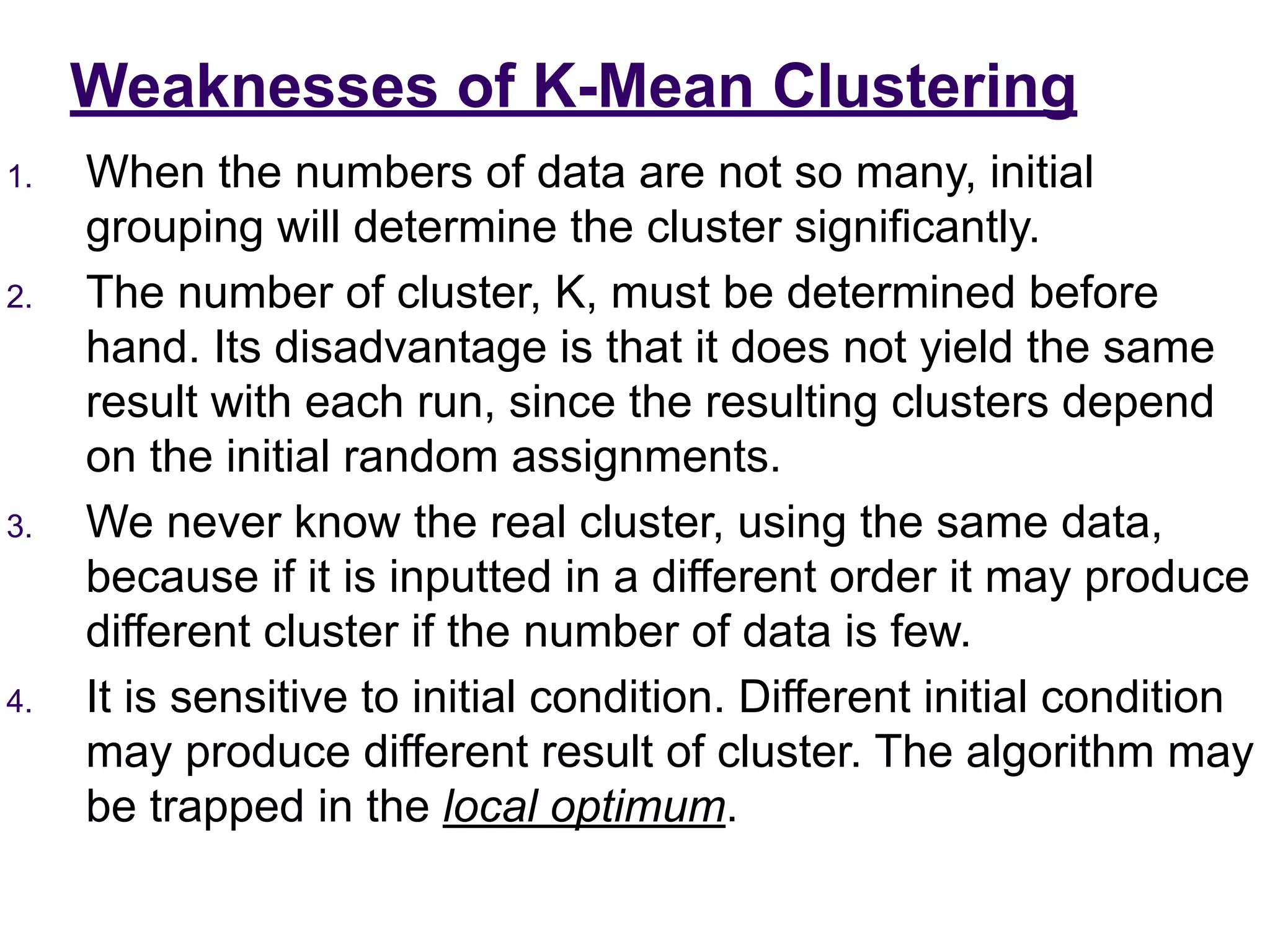
    Weaknesses of K-MeanClustering 1. When the numbers of data are not so many, initial grouping will determine the cluster significantly. 2. The number of cluster, K, must be determined before hand. Its disadvantage is that it does not yield the same result with each run, since the resulting clusters depend on the initial random assignments. 3. We never know the real cluster, using the same data, because if it is inputted in a different order it may produce different cluster if the number of data is few. 4. It is sensitive to initial condition. Different initial condition may produce different result of cluster. The algorithm may be trapped in the local optimum.
  • 11.
    Applications of K-Mean Clustering ●It is relatively efficient and fast. It computes result at O(kn), where n is number of objects or points and k is number of clusters. ● k-means clustering can be applied to machine learning or data mining • It can be used in Image Segmentation.(example of image segmentation is as follows) • Each pixel in an image is a point in a 3-dimensional space comprising the intensities of the red, blue, and green channels, and our segmentation algorithm simply treats each pixel in the image as a separate data point. Note that strictly this space is not Euclidean because the channel intensities are bounded by the interval [0, 1]. •
  • 13.
    CONCLUSION ● K-means algorithmis useful for undirected knowledge discovery and is relatively simple. ● K-means has found wide spread usage in lot of fields, ranging from unsupervised learning of neural network, Pattern recognitions, Classification analysis, Artificial intelligence, image processing, machine vision, and many others.
  • 14.