Clustering
Model based techniques and Handling
high dimensional data
1
2
Model-Based Clustering Methods
 Attempt to optimize the fit between the data and some mathematical
model
 Assumption: Data are generated by a mixture of underlying probability
distributions
 Techniques
 Expectation-Maximization
 Conceptual Clustering
 Neural Networks Approach
Expectation Maximization
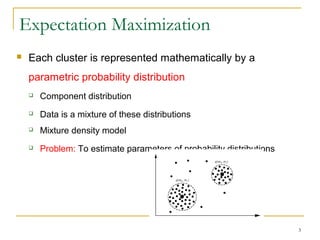
 Each cluster is represented mathematically by a
parametric probability distribution
 Component distribution
 Data is a mixture of these distributions
 Mixture density model
 Problem: To estimate parameters of probability distributions
3
Expectation Maximization
 Iterative Refinement Algorithm – used to find parameter
estimates
 Extension of k-means
 Assigns an object to a cluster according to a weight representing
probability of membership
 Initial estimate of parameters
 Iteratively reassigns scores
4
Expectation Maximization
 Initial guess for parameters; randomly select k objects to
represent cluster means or centers
 Iteratively refine parameters / clusters
 Expectation Step
 Assign each object xi to cluster Ck with probability
where
 Maximization Step
 Re-estimate model parameters
 Simple and easy to implement
 Complexity depends on features, objects and iterations
5
6
Conceptual Clustering
 Conceptual clustering
 A form of clustering in machine learning
 Produces a classification scheme for a set of unlabeled objects
 Finds characteristic description for each concept (class)
 COBWEB
 A popular and simple method of incremental conceptual learning
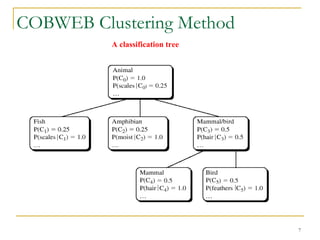
 Creates a hierarchical clustering in the form of a classification tree
 Each node refers to a concept and contains a probabilistic description
of that concept
7
COBWEB Clustering Method
A classification tree
COBWEB
 Classification tree
 Each node – Concept and its probabilistic distribution
(Summary of objects under that node)
 Description – Conditional probabilities P(Ai=vij / Ck)
 Sibling nodes at given level form a partition
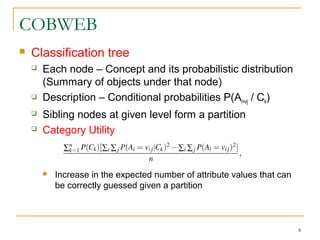
 Category Utility
 Increase in the expected number of attribute values that can
be correctly guessed given a partition
8
COBWEB
 Category Utility rewards:
 Intra-class similarity P(Ai=vij|Ck)
 High value indicates many class members share this attribute-value
pair
 Inter-class dissimilarity P(Ck|Ai=vij)
 High values – fewer objects in different classes share this attribute-
value
 Placement of new objects
 Descend tree
 Identify best host
 Temporarily place object in each node and compute CU of resulting
partition
 Placement with highest CU is chosen
 COBWEB may also forms new nodes if object does not fit into the
existing tree
9
COBWEB
 COBWEB is sensitive to order of records
 Additional operations
 Merging and Splitting
 Two best hosts are considered for merging
 Best host is considered for splitting
 Limitations
 The assumption that the attributes are independent of each
other is often too strong because correlation may exist
 Not suitable for clustering large database data
 CLASSIT - an extension of COBWEB for incremental clustering of
continuous data
10
Neural Network Approach
 Represent each cluster as an exemplar, acting as a “prototype” of
the cluster
 New objects are distributed to the cluster whose exemplar is the
most similar according to some distance measure
 Self Organizing Map
 Competitive learning
 Involves a hierarchical architecture of several units (neurons)
 Neurons compete in a “winner-takes-all” fashion for the object currently
being presented
 Organization of units – forms a feature map
 Web Document Clustering
11
Kohenen SOM
12
Clustering High-Dimensional data
 As dimensionality increases
 number of irrelevant dimensions may produce noise and mask real clusters
 data becomes sparse
 Distance measures –meaningless
 Feature transformation methods
 PCA, SVD – Summarize data by creating linear combinations of attributes
 But do not remove any attributes; transformed attributes – complex to
interpret
 Feature Selection methods
 Most relevant set of attributes with respect to class labels
 Entropy Analysis
 Subspace Clustering – searches for groups of clusters within different
subspaces of the same data set
13
CLIQUE: CLustering In QUest
 Dimension growth subspace clustering
 Starts at 1-D and grows upwards to higher dimensions
 Partitions each dimension – grids – determines whether
cell is dense
 CLIQUE
 Determines sparse and crowded units
 Dense unit – fraction of data points > threshold
 Cluster – maximal set of connected dense units
14
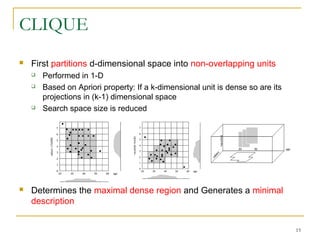
CLIQUE
 First partitions d-dimensional space into non-overlapping units
 Performed in 1-D
 Based on Apriori property: If a k-dimensional unit is dense so are its
projections in (k-1) dimensional space
 Search space size is reduced
 Determines the maximal dense region and Generates a minimal
description
15
CLIQUE
 Finds subspace of highest dimension
 Insensitive to order of inputs
 Performance depends on grid size and density threshold
 Difficult to determine across all dimensions
 Several lower dimensional subspaces will have to be
processed
 Can use adaptive strategy
16
PROCLUS – PROjected CLUStering
 Dimension-reduction Subspace Clustering technique
 Finds initial approximation of clusters in high dimensional
space
 Avoids generation of large number of overlapped
clusters of lower dimensionality
 Finds best set of medoids by hill-climbing process
(Similar to CLARANS)
 Manhattan Segmental distance measure
17
PROCLUS
 Initialization phase
 Greedy algorithm to select a set of initial medoids that are far
apart
 Iteration Phase
 Selects a random set of k-medoids
 Replaces bad medoids
 For each medoid a set of dimensions is chosen whose average
distances are small
 Refinement Phase
 Computes new dimensions for each medoid based on clusters
found, reasigns points to medoids and removes outliers
18
Frequent Pattern based Clustering
 Frequent patterns may also form clusters
 Instead of growing clusters dimension by dimension sets
of frequent itemsets are determined
 Two common technqiues
 Frequent term-based text Clustering
 Clustering by Pattern similarity
19
Frequent-term based text clustering
 Text documents are clustered based on frequent terms
they contain
 Documents – terms
 Dimensionality is very high
 Frequent term based analysis
 Well selected subset of set of all frequent terms must be
discovered
 Fi – Set of frequent term sets
 Cov(Fi) – set of documents covered by Fi
 ∑i=1 k
cov(Fi) = D and overlap between Fi and Fj must be
minimized
 Description of clusters – their frequent term sets
20
Clustering by Pattern Similarity
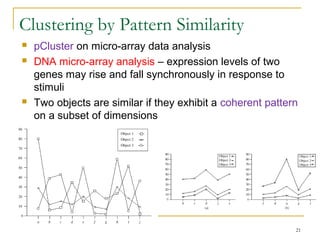
 pCluster on micro-array data analysis
 DNA micro-array analysis – expression levels of two
genes may rise and fall synchronously in response to
stimuli
 Two objects are similar if they exhibit a coherent pattern
on a subset of dimensions
21
pCluster
 Shift Pattern discovery
 Euclidean distance – not suitable
 Derive new attributes
 Bi-Clustering based on mean squared residue score
 pCluster
 Objects –x, y; attributes – a, b
 A pair (O,T) forms a δ-pCluster if for any 2 x 2 matrix X in (O, T)
pScore(X) <= δ
 Each pair of objects and their features must satisfy threshold
22
pCluster
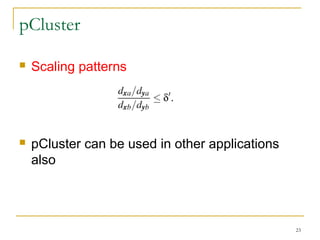
 Scaling patterns
 pCluster can be used in other applications
also
23

3.5 model based clustering

  • 1.
    Clustering Model based techniquesand Handling high dimensional data 1
  • 2.
    2 Model-Based Clustering Methods Attempt to optimize the fit between the data and some mathematical model  Assumption: Data are generated by a mixture of underlying probability distributions  Techniques  Expectation-Maximization  Conceptual Clustering  Neural Networks Approach
  • 3.
    Expectation Maximization  Eachcluster is represented mathematically by a parametric probability distribution  Component distribution  Data is a mixture of these distributions  Mixture density model  Problem: To estimate parameters of probability distributions 3
  • 4.
    Expectation Maximization  IterativeRefinement Algorithm – used to find parameter estimates  Extension of k-means  Assigns an object to a cluster according to a weight representing probability of membership  Initial estimate of parameters  Iteratively reassigns scores 4
  • 5.
    Expectation Maximization  Initialguess for parameters; randomly select k objects to represent cluster means or centers  Iteratively refine parameters / clusters  Expectation Step  Assign each object xi to cluster Ck with probability where  Maximization Step  Re-estimate model parameters  Simple and easy to implement  Complexity depends on features, objects and iterations 5
  • 6.
    6 Conceptual Clustering  Conceptualclustering  A form of clustering in machine learning  Produces a classification scheme for a set of unlabeled objects  Finds characteristic description for each concept (class)  COBWEB  A popular and simple method of incremental conceptual learning  Creates a hierarchical clustering in the form of a classification tree  Each node refers to a concept and contains a probabilistic description of that concept
  • 7.
    7 COBWEB Clustering Method Aclassification tree
  • 8.
    COBWEB  Classification tree Each node – Concept and its probabilistic distribution (Summary of objects under that node)  Description – Conditional probabilities P(Ai=vij / Ck)  Sibling nodes at given level form a partition  Category Utility  Increase in the expected number of attribute values that can be correctly guessed given a partition 8
  • 9.
    COBWEB  Category Utilityrewards:  Intra-class similarity P(Ai=vij|Ck)  High value indicates many class members share this attribute-value pair  Inter-class dissimilarity P(Ck|Ai=vij)  High values – fewer objects in different classes share this attribute- value  Placement of new objects  Descend tree  Identify best host  Temporarily place object in each node and compute CU of resulting partition  Placement with highest CU is chosen  COBWEB may also forms new nodes if object does not fit into the existing tree 9
  • 10.
    COBWEB  COBWEB issensitive to order of records  Additional operations  Merging and Splitting  Two best hosts are considered for merging  Best host is considered for splitting  Limitations  The assumption that the attributes are independent of each other is often too strong because correlation may exist  Not suitable for clustering large database data  CLASSIT - an extension of COBWEB for incremental clustering of continuous data 10
  • 11.
    Neural Network Approach Represent each cluster as an exemplar, acting as a “prototype” of the cluster  New objects are distributed to the cluster whose exemplar is the most similar according to some distance measure  Self Organizing Map  Competitive learning  Involves a hierarchical architecture of several units (neurons)  Neurons compete in a “winner-takes-all” fashion for the object currently being presented  Organization of units – forms a feature map  Web Document Clustering 11
  • 12.
  • 13.
    Clustering High-Dimensional data As dimensionality increases  number of irrelevant dimensions may produce noise and mask real clusters  data becomes sparse  Distance measures –meaningless  Feature transformation methods  PCA, SVD – Summarize data by creating linear combinations of attributes  But do not remove any attributes; transformed attributes – complex to interpret  Feature Selection methods  Most relevant set of attributes with respect to class labels  Entropy Analysis  Subspace Clustering – searches for groups of clusters within different subspaces of the same data set 13
  • 14.
    CLIQUE: CLustering InQUest  Dimension growth subspace clustering  Starts at 1-D and grows upwards to higher dimensions  Partitions each dimension – grids – determines whether cell is dense  CLIQUE  Determines sparse and crowded units  Dense unit – fraction of data points > threshold  Cluster – maximal set of connected dense units 14
  • 15.
    CLIQUE  First partitionsd-dimensional space into non-overlapping units  Performed in 1-D  Based on Apriori property: If a k-dimensional unit is dense so are its projections in (k-1) dimensional space  Search space size is reduced  Determines the maximal dense region and Generates a minimal description 15
  • 16.
    CLIQUE  Finds subspaceof highest dimension  Insensitive to order of inputs  Performance depends on grid size and density threshold  Difficult to determine across all dimensions  Several lower dimensional subspaces will have to be processed  Can use adaptive strategy 16
  • 17.
    PROCLUS – PROjectedCLUStering  Dimension-reduction Subspace Clustering technique  Finds initial approximation of clusters in high dimensional space  Avoids generation of large number of overlapped clusters of lower dimensionality  Finds best set of medoids by hill-climbing process (Similar to CLARANS)  Manhattan Segmental distance measure 17
  • 18.
    PROCLUS  Initialization phase Greedy algorithm to select a set of initial medoids that are far apart  Iteration Phase  Selects a random set of k-medoids  Replaces bad medoids  For each medoid a set of dimensions is chosen whose average distances are small  Refinement Phase  Computes new dimensions for each medoid based on clusters found, reasigns points to medoids and removes outliers 18
  • 19.
    Frequent Pattern basedClustering  Frequent patterns may also form clusters  Instead of growing clusters dimension by dimension sets of frequent itemsets are determined  Two common technqiues  Frequent term-based text Clustering  Clustering by Pattern similarity 19
  • 20.
    Frequent-term based textclustering  Text documents are clustered based on frequent terms they contain  Documents – terms  Dimensionality is very high  Frequent term based analysis  Well selected subset of set of all frequent terms must be discovered  Fi – Set of frequent term sets  Cov(Fi) – set of documents covered by Fi  ∑i=1 k cov(Fi) = D and overlap between Fi and Fj must be minimized  Description of clusters – their frequent term sets 20
  • 21.
    Clustering by PatternSimilarity  pCluster on micro-array data analysis  DNA micro-array analysis – expression levels of two genes may rise and fall synchronously in response to stimuli  Two objects are similar if they exhibit a coherent pattern on a subset of dimensions 21
  • 22.
    pCluster  Shift Patterndiscovery  Euclidean distance – not suitable  Derive new attributes  Bi-Clustering based on mean squared residue score  pCluster  Objects –x, y; attributes – a, b  A pair (O,T) forms a δ-pCluster if for any 2 x 2 matrix X in (O, T) pScore(X) <= δ  Each pair of objects and their features must satisfy threshold 22
  • 23.
    pCluster  Scaling patterns pCluster can be used in other applications also 23