Clustering Analysis -
Partitioning method
Presented by-kamalakshi Deshmukh
M.E(Comp)
Roll No-ME101
Guided by- Prof.Harmeet kaur khanuja
Marathwada Mitra Mandal College of Engineering(MMCOE) PUNE
Cluster Analysis 1-04-2017 1
What is Cluster Analysis?
 Cluster: a collection of data objects
 Similar to one another within the same cluster
 Dissimilar to the objects in other clusters
 Cluster analysis
 Grouping a set of data objects into clusters
 Clustering is unsupervised classification: no predefined
classes
Cluster Analysis 1-04-2017 2
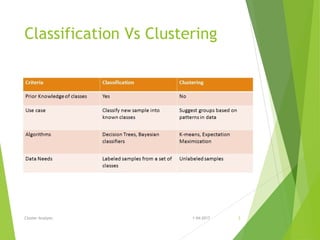
Classification Vs Clustering
Cluster Analysis 1-04-2017 3
Requirements of Clustering in Data
Mining
 Scalability
 Ability to deal with different types of attributes
 Discovery of clusters with arbitrary shape
 Minimal requirements for domain knowledge to determine input
parameters
 Able to deal with noise and outliers
 Insensitive to order of input records
 High dimensionality
 Incorporation of user-specified constraints
 Interpretability and usability
Cluster Analysis 1-04-2017 4
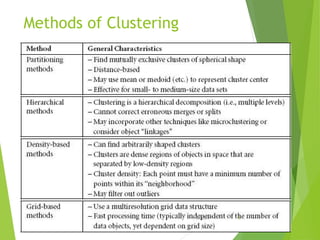
Methods of Clustering
Cluster Analysis 1-04-2017 5
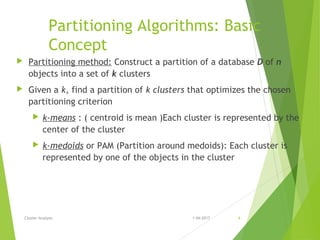
Partitioning Algorithms: Basic
Concept
 Partitioning method: Construct a partition of a database D of n
objects into a set of k clusters
 Given a k, find a partition of k clusters that optimizes the chosen
partitioning criterion
 k-means : ( centroid is mean )Each cluster is represented by the
center of the cluster
 k-medoids or PAM (Partition around medoids): Each cluster is
represented by one of the objects in the cluster
Cluster Analysis 1-04-2017 6
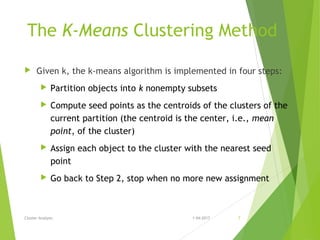
The K-Means Clustering Method
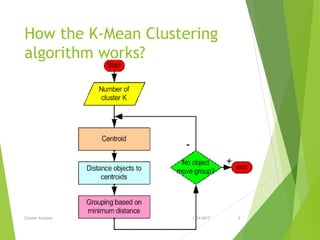
 Given k, the k-means algorithm is implemented in four steps:
 Partition objects into k nonempty subsets
 Compute seed points as the centroids of the clusters of the
current partition (the centroid is the center, i.e., mean
point, of the cluster)
 Assign each object to the cluster with the nearest seed
point
 Go back to Step 2, stop when no more new assignment
Cluster Analysis 1-04-2017 7
How the K-Mean Clustering
algorithm works?
1-04-2017Cluster Analysis 8
Comments on the K-Means Method
 Strength: Relatively efficient: O(tkn), where n is #
objects, k is # clusters, and t is # iterations. Normally,
k, t << n.
 Weakness
 Applicable only when mean is defined
 Need to specify k, the number of clusters, in advance
 Unable to handle noisy data and outliers
Cluster Analysis 1-04-2017 9
What is the problem of k-Means
Method?
 The k-means algorithm is sensitive to outliers !
 Since an object with an extremely large value may substantially distort the
distribution of the data.
 K-Medoids: Instead of taking the mean value of the object in a cluster as a
reference point, medoids can be used, which is the most centrally located
object in a cluster.
Cluster Analysis 1-04-2017 10
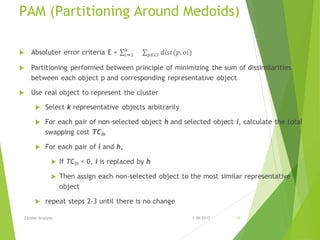
PAM (Partitioning Around Medoids)
1-04-2017Cluster Analysis 11
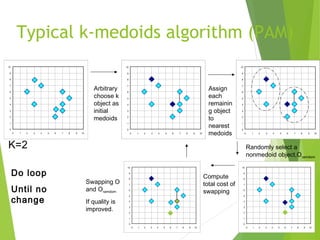
Typical k-medoids algorithm (PAM)
0
1
2
3
4
5
6
7
8
9
10
0 1 2 3 4 5 6 7 8 9 10
0
1
2
3
4
5
6
7
8
9
10
0 1 2 3 4 5 6 7 8 9 10
K=2
Arbitrary
choose k
object as
initial
medoids
0
1
2
3
4
5
6
7
8
9
10
0 1 2 3 4 5 6 7 8 9 10
Assign
each
remainin
g object
to
nearest
medoids
Randomly select a
nonmedoid object,Oramdom
Compute
total cost of
swapping
0
1
2
3
4
5
6
7
8
9
10
0 1 2 3 4 5 6 7 8 9 10
Swapping O
and Oramdom
If quality is
improved.
Do loop
Until no
change
0
1
2
3
4
5
6
7
8
9
10
0 1 2 3 4 5 6 7 8 9 10
What is the problem with PAM?
 Pam is more robust than k-means in the presence of noise and outliers
because a medoid is less influenced by outliers or other extreme values
than a mean
 Pam works efficiently for small data sets but does not scale well for
large data sets.
 O(k(n-k)2
) for each iteration
where n is number of data elements ,k is number of clusters
 Sampling based method,
CLARA(Clustering LARge Applications) of sample size s, O(ks2+k(n-k))
CLARANS : Randomized re-sampling improving efficiency+quality
1-04-2017Cluster Analysis 13
CLARA (Clustering Large Applications)
It draws multiple samples of the data set, applies PAM on each sample,
and gives the best clustering as the output
Strength: deals with larger data sets than PAM
Weakness:
 Efficiency depends on the sample size
 A good clustering based on samples will not necessarily represent a
good clustering of the whole data set if the sample is biased
1-04-2017Cluster Analysis 14
Examples of Clustering
Applications
 Marketing: Help marketers discover distinct groups in their customer bases,
and then use this knowledge to develop targeted marketing programs
 Land use: Identification of areas of similar land use in an earth observation
database
 Insurance: Identifying groups of motor insurance policy holders with a high
average claim cost
 City-planning: Identifying groups of houses according to their house type,
value, and geographical location
 Earth-quake studies: Observed earth quake epicenters should be clustered
along continent faults
1-04-2017Cluster Analysis 15
References
 Books
1. Data mining concepts and techniques, Jawai Han,
Michelline Kamber, Jiran Pie, Morgan Kaufmann
Publishers, 3rd Edition.
 Weblinks
1. http://stackoverflow.com/questions/5064928/difference-between-classificatio
2. https://en.wikipedia.org/wiki/Cluster_analysis
1-04-2017Cluster Analysis 16
Thank you!
1-04-2017Cluster Analysis 17

Cluster analysis

  • 1.
    Clustering Analysis - Partitioningmethod Presented by-kamalakshi Deshmukh M.E(Comp) Roll No-ME101 Guided by- Prof.Harmeet kaur khanuja Marathwada Mitra Mandal College of Engineering(MMCOE) PUNE Cluster Analysis 1-04-2017 1
  • 2.
    What is ClusterAnalysis?  Cluster: a collection of data objects  Similar to one another within the same cluster  Dissimilar to the objects in other clusters  Cluster analysis  Grouping a set of data objects into clusters  Clustering is unsupervised classification: no predefined classes Cluster Analysis 1-04-2017 2
  • 3.
  • 4.
    Requirements of Clusteringin Data Mining  Scalability  Ability to deal with different types of attributes  Discovery of clusters with arbitrary shape  Minimal requirements for domain knowledge to determine input parameters  Able to deal with noise and outliers  Insensitive to order of input records  High dimensionality  Incorporation of user-specified constraints  Interpretability and usability Cluster Analysis 1-04-2017 4
  • 5.
    Methods of Clustering ClusterAnalysis 1-04-2017 5
  • 6.
    Partitioning Algorithms: Basic Concept Partitioning method: Construct a partition of a database D of n objects into a set of k clusters  Given a k, find a partition of k clusters that optimizes the chosen partitioning criterion  k-means : ( centroid is mean )Each cluster is represented by the center of the cluster  k-medoids or PAM (Partition around medoids): Each cluster is represented by one of the objects in the cluster Cluster Analysis 1-04-2017 6
  • 7.
    The K-Means ClusteringMethod  Given k, the k-means algorithm is implemented in four steps:  Partition objects into k nonempty subsets  Compute seed points as the centroids of the clusters of the current partition (the centroid is the center, i.e., mean point, of the cluster)  Assign each object to the cluster with the nearest seed point  Go back to Step 2, stop when no more new assignment Cluster Analysis 1-04-2017 7
  • 8.
    How the K-MeanClustering algorithm works? 1-04-2017Cluster Analysis 8
  • 9.
    Comments on theK-Means Method  Strength: Relatively efficient: O(tkn), where n is # objects, k is # clusters, and t is # iterations. Normally, k, t << n.  Weakness  Applicable only when mean is defined  Need to specify k, the number of clusters, in advance  Unable to handle noisy data and outliers Cluster Analysis 1-04-2017 9
  • 10.
    What is theproblem of k-Means Method?  The k-means algorithm is sensitive to outliers !  Since an object with an extremely large value may substantially distort the distribution of the data.  K-Medoids: Instead of taking the mean value of the object in a cluster as a reference point, medoids can be used, which is the most centrally located object in a cluster. Cluster Analysis 1-04-2017 10
  • 11.
    PAM (Partitioning AroundMedoids) 1-04-2017Cluster Analysis 11
  • 12.
    Typical k-medoids algorithm(PAM) 0 1 2 3 4 5 6 7 8 9 10 0 1 2 3 4 5 6 7 8 9 10 0 1 2 3 4 5 6 7 8 9 10 0 1 2 3 4 5 6 7 8 9 10 K=2 Arbitrary choose k object as initial medoids 0 1 2 3 4 5 6 7 8 9 10 0 1 2 3 4 5 6 7 8 9 10 Assign each remainin g object to nearest medoids Randomly select a nonmedoid object,Oramdom Compute total cost of swapping 0 1 2 3 4 5 6 7 8 9 10 0 1 2 3 4 5 6 7 8 9 10 Swapping O and Oramdom If quality is improved. Do loop Until no change 0 1 2 3 4 5 6 7 8 9 10 0 1 2 3 4 5 6 7 8 9 10
  • 13.
    What is theproblem with PAM?  Pam is more robust than k-means in the presence of noise and outliers because a medoid is less influenced by outliers or other extreme values than a mean  Pam works efficiently for small data sets but does not scale well for large data sets.  O(k(n-k)2 ) for each iteration where n is number of data elements ,k is number of clusters  Sampling based method, CLARA(Clustering LARge Applications) of sample size s, O(ks2+k(n-k)) CLARANS : Randomized re-sampling improving efficiency+quality 1-04-2017Cluster Analysis 13
  • 14.
    CLARA (Clustering LargeApplications) It draws multiple samples of the data set, applies PAM on each sample, and gives the best clustering as the output Strength: deals with larger data sets than PAM Weakness:  Efficiency depends on the sample size  A good clustering based on samples will not necessarily represent a good clustering of the whole data set if the sample is biased 1-04-2017Cluster Analysis 14
  • 15.
    Examples of Clustering Applications Marketing: Help marketers discover distinct groups in their customer bases, and then use this knowledge to develop targeted marketing programs  Land use: Identification of areas of similar land use in an earth observation database  Insurance: Identifying groups of motor insurance policy holders with a high average claim cost  City-planning: Identifying groups of houses according to their house type, value, and geographical location  Earth-quake studies: Observed earth quake epicenters should be clustered along continent faults 1-04-2017Cluster Analysis 15
  • 16.
    References  Books 1. Datamining concepts and techniques, Jawai Han, Michelline Kamber, Jiran Pie, Morgan Kaufmann Publishers, 3rd Edition.  Weblinks 1. http://stackoverflow.com/questions/5064928/difference-between-classificatio 2. https://en.wikipedia.org/wiki/Cluster_analysis 1-04-2017Cluster Analysis 16
  • 17.