Arun K. Joshi, Ravi P. Singh & Govindan Velu
CIMMYT
Zn and Fe rich wheat in developing
countries of Asia; where we are!
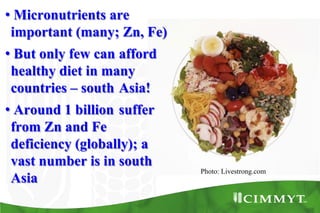
• Micronutrients are
important (many; Zn, Fe)
• But only few can afford
healthy diet in many
countries – south Asia!
• Around 1 billion suffer
from Zn and Fe
deficiency (globally); a
vast number is in south
Asia
Photo: Livestrong.com
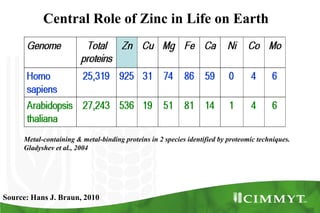
Metal-containing & metal-binding proteins in 2 species identified by proteomic techniques.
Gladyshev et al., 2004
Central Role of Zinc in Life on Earth
Source: Hans J. Braun, 2010
Source: Ivan Ortiz-Monasterio
• Wheat means - a 5th of humanity’s food, and is first as
a source of protein.
• It is an especially critical “staff of life” for the
approximately 1.2 billion “wheat dependent” to 2.5
billion “wheat consuming” poor—men, women and
children who live on less than USD 2 per day—and
approximately 30 million poor wheat producers and
their families.
• Demand for wheat in the developing world is projected
to increase 60% by 2050.
Source: WHEAT, CIMMYT, 2011
Wheat is important
Source: Ivan Ortiz-Monasterio
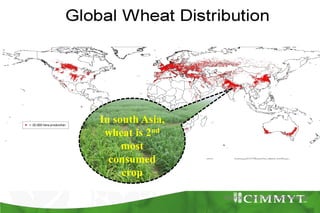
In south Asia,
wheat is 2nd
most
consumed
crop
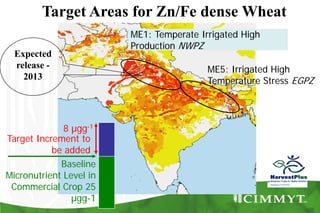
Target Areas for Zn/Fe dense Wheat
Baseline
Micronutrient Level in
Commercial Crop 25
µgg-1
Target Increment to
be added
8 µgg-1
Wolfgang H PFEIFFER
ME1: Temperate Irrigated High
Production NWPZ
ME5: Irrigated High
Temperature Stress EGPZ
Expected
release -
2013
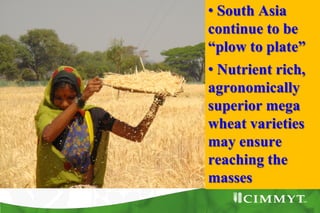
• South Asia
continue to be
“plow to plate”
• Nutrient rich,
agronomically
superior mega
wheat varieties
may ensure
reaching the
masses
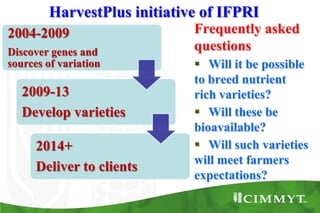
2004-2009
Discover genes and
sources of variation
2009-13
Develop varieties
2014+
Deliver to clients
Frequently asked
questions
 Will it be possible
to breed nutrient
rich varieties?
 Will these be
bioavailable?
 Will such varieties
will meet farmers
expectations?
HarvestPlus initiative of IFPRI
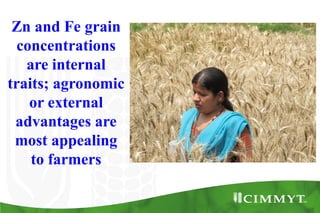
Zn and Fe grain
concentrations
are internal
traits; agronomic
or external
advantages are
most appealing
to farmers
The progress....
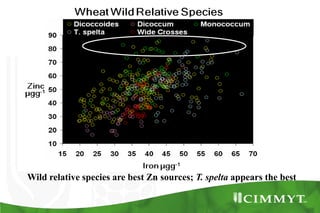
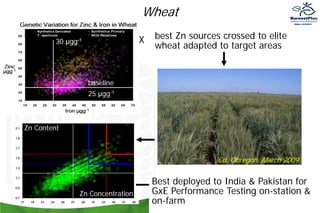
Wild relative species are best Zn sources; T. spelta appears the best
Wheat
30 μgg-1
best Zn sources crossed to elite
wheat adapted to target areas
X
baseline
25 μgg-1
Cd. Obregon, March 2009
Zn Content
Zn Concentration
Best deployed to India & Pakistan for
GxE Performance Testing on-station &
on-farm
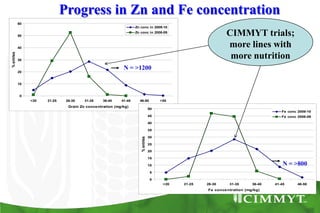
N = >1200
N =
>800
0
10
20
30
40
50
60
<20 21-25 26-30 31-35 36-40 41-45 46-50 >55
Grain Zn concentration (mg/kg)
%entries
Zn conc in 2009-10
Zn conc in 2008-09
Progress in Zn and Fe concentration
0
5
10
15
20
25
30
35
40
45
50
<20 21-25 26-30 31-35 36-40 41-45 46-50
Fe concentration (mg/kg)
%entries
Fe conc 2009-10
Fe conc 2008-09
N = >1200
N = >800
CIMMYT trials;
more lines with
more nutrition
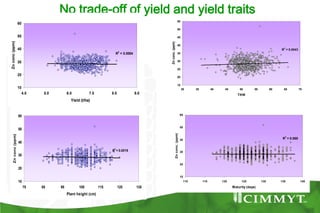
R2
= 0.069
10
20
30
40
50
60
110 115 120 125 130 135 140
Maturity (days)
Znconc.(ppm)
No trade-off of yield and yield traits
R2
= 0.0004
10
20
30
40
50
60
4.0 5.0 6.0 7.0 8.0 9.0
Yield (t/ha)
Znconc(ppm)
R
2
= 0.0043
15
20
25
30
35
40
45
50
55
30 35 40 45 50 55 60 65 70
TKW
Znconc.(ppm)
R
2
= 0.0019
10
20
30
40
50
60
75 85 95 105 115 125 135
Plant height (cm)
Znconc(ppm)
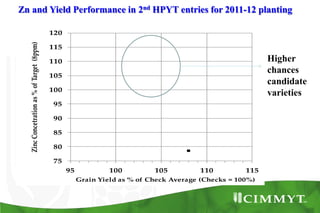
Zn and Yield Performance in 2nd HPYT entries for 2011-12 planting
75
80
85
90
95
100
105
110
115
120
95 100 105 110 115
ZincConcetrationas%ofTarget(8ppm)
Grain Yield as % of Check Average (Checks = 100%)
Higher
chances
candidate
varieties
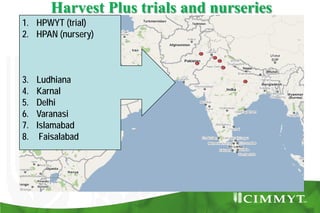
Harvest Plus trials and nurseries
1. HPWYT (trial)
2. HPAN (nursery)
3. Ludhiana
4. Karnal
5. Delhi
6. Varanasi
7. Islamabad
8. Faisalabad
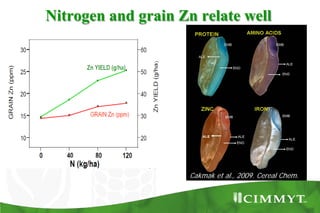
Nitrogen and grain Zn relate well
Cakmak et al., 2009. Cereal Chem.
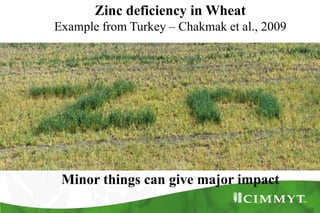
Zinc deficiency in Wheat
Example from Turkey – Chakmak et al., 2009
Minor things can give major impact
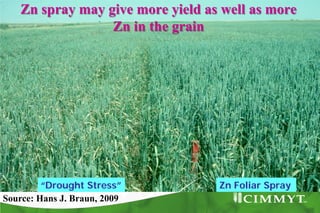
“Drought Stress” Zn Foliar Spray
Source: Hans J. Braun, 2009
Zn spray may give more yield as well as more
Zn in the grain
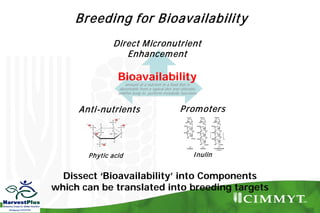
Breeding for Bioavailability
InulinPhytic acid
++
O
OO P
O
H O
OO P
O
O
OO P
O
O
O OP
O
O
OHO P
O
O
OO P
O H
H
H H
H
1
2
34
5
6
++
++
Mg
++
Fe
Ca
Ca
Zn
++
O
OO P
O
H O
OO P
O
O
OO P
O
O
O OPP
O
O
OHO PP
O
O
OOO P
O H
H
H H
H
1
2
34
5
6
++
++
Mg
++
Fe
Ca
Ca
Zn
++
Bioavailability
amount of a nutrient in a food that is
absorbable from a typical diet and utilizable
whithin body to perform metabolic functions
Anti-nutrients Promoters
Wolfgang H PFEIFFER
Dissect ‘Bioavailability’ into Components
which can be translated into breeding targets
Direct Micronutrient
Enhancement
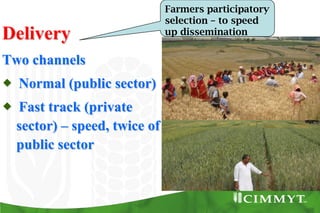
Delivery
Two channels
 Normal (public sector)
 Fast track (private
sector) – speed, twice of
public sector
Farmers participatory
selection – to speed
up dissemination
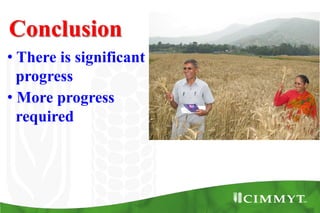
Conclusion
• There is significant
progress
• More progress
required
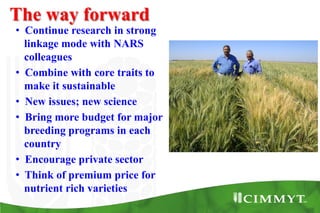
The way forward
• Continue research in strong
linkage mode with NARS
colleagues
• Combine with core traits to
make it sustainable
• New issues; new science
• Bring more budget for major
breeding programs in each
country
• Encourage private sector
• Think of premium price for
nutrient rich varieties
Thanks to all..

Bio-fortification options/success story - wheat

  • 1.
    Arun K. Joshi,Ravi P. Singh & Govindan Velu CIMMYT Zn and Fe rich wheat in developing countries of Asia; where we are!
  • 2.
    • Micronutrients are important(many; Zn, Fe) • But only few can afford healthy diet in many countries – south Asia! • Around 1 billion suffer from Zn and Fe deficiency (globally); a vast number is in south Asia Photo: Livestrong.com
  • 3.
    Metal-containing & metal-bindingproteins in 2 species identified by proteomic techniques. Gladyshev et al., 2004 Central Role of Zinc in Life on Earth Source: Hans J. Braun, 2010
  • 4.
    Source: Ivan Ortiz-Monasterio •Wheat means - a 5th of humanity’s food, and is first as a source of protein. • It is an especially critical “staff of life” for the approximately 1.2 billion “wheat dependent” to 2.5 billion “wheat consuming” poor—men, women and children who live on less than USD 2 per day—and approximately 30 million poor wheat producers and their families. • Demand for wheat in the developing world is projected to increase 60% by 2050. Source: WHEAT, CIMMYT, 2011 Wheat is important
  • 5.
    Source: Ivan Ortiz-Monasterio Insouth Asia, wheat is 2nd most consumed crop
  • 6.
    Target Areas forZn/Fe dense Wheat Baseline Micronutrient Level in Commercial Crop 25 µgg-1 Target Increment to be added 8 µgg-1 Wolfgang H PFEIFFER ME1: Temperate Irrigated High Production NWPZ ME5: Irrigated High Temperature Stress EGPZ Expected release - 2013
  • 7.
    • South Asia continueto be “plow to plate” • Nutrient rich, agronomically superior mega wheat varieties may ensure reaching the masses
  • 8.
    2004-2009 Discover genes and sourcesof variation 2009-13 Develop varieties 2014+ Deliver to clients Frequently asked questions  Will it be possible to breed nutrient rich varieties?  Will these be bioavailable?  Will such varieties will meet farmers expectations? HarvestPlus initiative of IFPRI
  • 10.
    Zn and Fegrain concentrations are internal traits; agronomic or external advantages are most appealing to farmers
  • 11.
  • 13.
    Wild relative speciesare best Zn sources; T. spelta appears the best
  • 14.
    Wheat 30 μgg-1 best Znsources crossed to elite wheat adapted to target areas X baseline 25 μgg-1 Cd. Obregon, March 2009 Zn Content Zn Concentration Best deployed to India & Pakistan for GxE Performance Testing on-station & on-farm
  • 15.
    N = >1200 N= >800 0 10 20 30 40 50 60 <20 21-25 26-30 31-35 36-40 41-45 46-50 >55 Grain Zn concentration (mg/kg) %entries Zn conc in 2009-10 Zn conc in 2008-09 Progress in Zn and Fe concentration 0 5 10 15 20 25 30 35 40 45 50 <20 21-25 26-30 31-35 36-40 41-45 46-50 Fe concentration (mg/kg) %entries Fe conc 2009-10 Fe conc 2008-09 N = >1200 N = >800 CIMMYT trials; more lines with more nutrition
  • 16.
    R2 = 0.069 10 20 30 40 50 60 110 115120 125 130 135 140 Maturity (days) Znconc.(ppm) No trade-off of yield and yield traits R2 = 0.0004 10 20 30 40 50 60 4.0 5.0 6.0 7.0 8.0 9.0 Yield (t/ha) Znconc(ppm) R 2 = 0.0043 15 20 25 30 35 40 45 50 55 30 35 40 45 50 55 60 65 70 TKW Znconc.(ppm) R 2 = 0.0019 10 20 30 40 50 60 75 85 95 105 115 125 135 Plant height (cm) Znconc(ppm)
  • 17.
    Zn and YieldPerformance in 2nd HPYT entries for 2011-12 planting 75 80 85 90 95 100 105 110 115 120 95 100 105 110 115 ZincConcetrationas%ofTarget(8ppm) Grain Yield as % of Check Average (Checks = 100%) Higher chances candidate varieties
  • 18.
    Harvest Plus trialsand nurseries 1. HPWYT (trial) 2. HPAN (nursery) 3. Ludhiana 4. Karnal 5. Delhi 6. Varanasi 7. Islamabad 8. Faisalabad
  • 19.
    Nitrogen and grainZn relate well Cakmak et al., 2009. Cereal Chem.
  • 20.
    Zinc deficiency inWheat Example from Turkey – Chakmak et al., 2009 Minor things can give major impact
  • 21.
    “Drought Stress” ZnFoliar Spray Source: Hans J. Braun, 2009 Zn spray may give more yield as well as more Zn in the grain
  • 22.
    Breeding for Bioavailability InulinPhyticacid ++ O OO P O H O OO P O O OO P O O O OP O O OHO P O O OO P O H H H H H 1 2 34 5 6 ++ ++ Mg ++ Fe Ca Ca Zn ++ O OO P O H O OO P O O OO P O O O OPP O O OHO PP O O OOO P O H H H H H 1 2 34 5 6 ++ ++ Mg ++ Fe Ca Ca Zn ++ Bioavailability amount of a nutrient in a food that is absorbable from a typical diet and utilizable whithin body to perform metabolic functions Anti-nutrients Promoters Wolfgang H PFEIFFER Dissect ‘Bioavailability’ into Components which can be translated into breeding targets Direct Micronutrient Enhancement
  • 24.
    Delivery Two channels  Normal(public sector)  Fast track (private sector) – speed, twice of public sector Farmers participatory selection – to speed up dissemination
  • 25.
    Conclusion • There issignificant progress • More progress required
  • 26.
    The way forward •Continue research in strong linkage mode with NARS colleagues • Combine with core traits to make it sustainable • New issues; new science • Bring more budget for major breeding programs in each country • Encourage private sector • Think of premium price for nutrient rich varieties
  • 27.