Downloaded 5,973 times



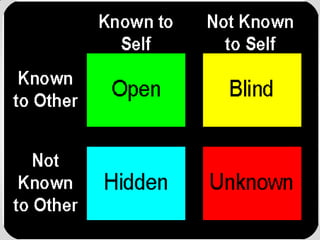




The document provides an overview of the Johari Window model, which was developed in 1955 by psychologists Joseph Luft and Harry Ingham to illustrate self-awareness and understanding between individuals and groups. The model represents information about a person in four quadrants based on what is known to the person and others: open self (known to self and others), blindspot (known to others but not self), facade (known to self but not others), and unknown (unknown to self and others). The document outlines the origins and founders of the model, how it can be used, what each quadrant represents, potential drawbacks, and concludes by inviting questions.


