Johari Window
Organizational Behavior
By
Apurva A. Abhang
MBA 1st Year
What is Johari Window?
• A simple and useful tool for self-awareness, personal
development, group development and understanding
relationships.
• Developed by American psychologists Joseph Luft and Harry
Ingham in the 1950's, calling it 'Johari' after combining their first
names, Joe and Harry.
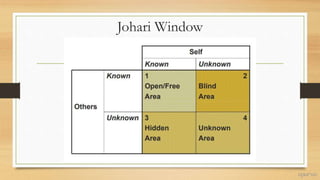
Quadrants of Johari Window
• Based on awareness of motivation, feelings and behavior that
collectively represent an individual with respect to others.
• These 4 quadrants constitute the Johari Window and are:
1. Open Self
2. Blind Self
3. Hidden Self
4. Unknown Self
• Open Self:
The motives, feelings and behaviors about which an individual is aware and
is ready to share with others are represented by open self.
what is known by the person about him/herself and is also known by others.
• Blind Self:
It is the state in which motives, feelings and behavior information is
known to others but the individuals is not aware of them.
what is unknown by the person about him/herself but which others know
• Hidden Self:
This quadrant includes those motives, feelings and behaviors which are
hidden from others but individual himself/herself is aware of them.
what the person knows about him/herself that others do not know
• Unknown Self:
This state where neither others nor the individuals are aware of the
information is represented by this quadrant.
what is unknown by the person about him/herself and is also unknown by others.
Johari Window
Benefits of Johari Window
• The Johari window can be used as a self assessment tool to increase
individuals’ understanding of themselves. This may be an exploration of
the skills they possess – or their personal and professional
characteristics.
• Encourages reflection – enabling individuals and teams to consider
strengths and weaknesses not only from their own point of view but
from their managers’, colleagues’ and customers’ perspectives.
• As well as being used by individuals, the Johari Window can be applied
by a group to identify team skills and characteristics.
Drawbacks
• As compared to other techniques such as SWOT etc., the scope
of Johari Window is quite limited for ascertaining future course
of action.
• Though disclosure is appreciated in groups as it enhances trust, it
may prove hurtful if it does wrong or is inappropriate.
• A positive attitude must be maintained among group members
and individual’s sensitivity must be kept in mind.
Thank You.

Johari Window - Organisational Behaviour

  • 1.
  • 2.
    What is JohariWindow? • A simple and useful tool for self-awareness, personal development, group development and understanding relationships. • Developed by American psychologists Joseph Luft and Harry Ingham in the 1950's, calling it 'Johari' after combining their first names, Joe and Harry.
  • 3.
    Quadrants of JohariWindow • Based on awareness of motivation, feelings and behavior that collectively represent an individual with respect to others. • These 4 quadrants constitute the Johari Window and are: 1. Open Self 2. Blind Self 3. Hidden Self 4. Unknown Self
  • 4.
    • Open Self: Themotives, feelings and behaviors about which an individual is aware and is ready to share with others are represented by open self. what is known by the person about him/herself and is also known by others. • Blind Self: It is the state in which motives, feelings and behavior information is known to others but the individuals is not aware of them. what is unknown by the person about him/herself but which others know
  • 5.
    • Hidden Self: Thisquadrant includes those motives, feelings and behaviors which are hidden from others but individual himself/herself is aware of them. what the person knows about him/herself that others do not know • Unknown Self: This state where neither others nor the individuals are aware of the information is represented by this quadrant. what is unknown by the person about him/herself and is also unknown by others.
  • 6.
  • 7.
    Benefits of JohariWindow • The Johari window can be used as a self assessment tool to increase individuals’ understanding of themselves. This may be an exploration of the skills they possess – or their personal and professional characteristics. • Encourages reflection – enabling individuals and teams to consider strengths and weaknesses not only from their own point of view but from their managers’, colleagues’ and customers’ perspectives. • As well as being used by individuals, the Johari Window can be applied by a group to identify team skills and characteristics.
  • 8.
    Drawbacks • As comparedto other techniques such as SWOT etc., the scope of Johari Window is quite limited for ascertaining future course of action. • Though disclosure is appreciated in groups as it enhances trust, it may prove hurtful if it does wrong or is inappropriate. • A positive attitude must be maintained among group members and individual’s sensitivity must be kept in mind.
  • 9.