FLATPANEL DISPLAYS
Contents
•
•
•
•
•
•
•
•
•

INTRODUCTION
TYPES OF FLAT PANEL DISPLAYS
APPLICATIONS OF FLAT PANEL
DISPLAYS
ADVANTAGES OF FLAT PANEL DISPLAYS
DISADVANTAGES OF
FLAT PANEL DISPLAYS
HOW FLAT PANEL WORK AND MANUFACTURED
DIFFERENCE BETWEEN FLAT PANEL DISPLAYS AND
CRT
INTRODUCTION
• The first ever flat panel display was invented in
1964 at the University of Illinois.
• Flat panel displays also called Flat Screen.
• It encompass a growing number of electronic
visual display technologies.
• It enables much lighter and thinner than
traditional television set and video displays that
use cathode ray tubes (CRT).
• These are usually less than 100 mm (4 inches)
thick.
Types
• VOLATILE FLAT PANEL DISPLAYS
• STATIC FLAT PANEL DISPLAYS
Volatile Flat Panel Displays
• Volatile displays require that pixels be periodically
refreshed.
• This refresh typically occurs many times a second.
• Some examples of volatile flat panel displays :• Light-emitting diode displays (LED)
• Liquid crystal displays (LCDs)
• Organic light-emitting diode (OLED)
• Plasma displays
STATIC FLAT PANEL DISPLAYS
• These rely on materials whose color states
are bistable.
• This results in a much more energy-efficient
display.
• These require slow refresh rates.
Other Different types of flat panel
displays
•
•
•
•

Liquid crystal display (LCD)
Plasma display panel (PDP)
Light emitting diode (LED) display
Organic light emitting diodes (OLEDs)
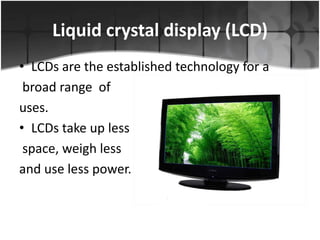
Liquid crystal display (LCD)
• LCDs are the established technology for a
broad range of
uses.
• LCDs take up less
space, weigh less
and use less power.
Plasma display panel (PDP)
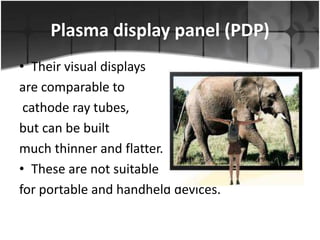
• Their visual displays
are comparable to
cathode ray tubes,
but can be built
much thinner and flatter.
• These are not suitable
for portable and handheld devices.
Light emitting diode (LED) display
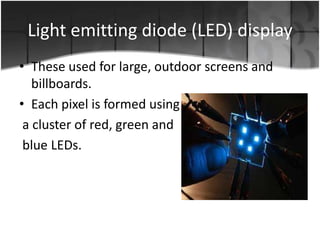
• These used for large, outdoor screens and
billboards.
• Each pixel is formed using
a cluster of red, green and
blue LEDs.
Organic light emitting diodes (OLEDs)
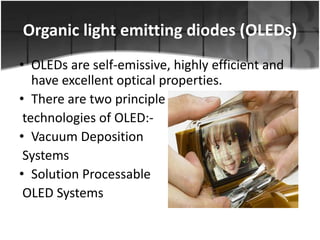
• OLEDs are self-emissive, highly efficient and
have excellent optical properties.
• There are two principle
technologies of OLED:• Vacuum Deposition
Systems
• Solution Processable
OLED Systems
APPLICATIONS OF FLAT PANEL
DISPLAYS
•

Laptops

• Televisions
•

Cellular phones

•

Digital cameras

•

Camcorders

•

Compact cameras

•

Pocket video camera
ADVANTAGES OF FLAT PANEL
DISPLAYS
• Space Saving
• Display size
• Power consumption
DISADVANTAGES OF FLATPANEL
DISPLAY
•
•
•
•

Durability
Color
Viewing Angle
Price
Working
•
•
•
•

Liquid crystals
Passive LCDs
Active matrix LCDs
Colored LCDs
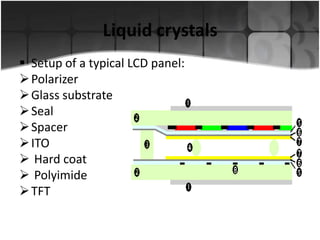
Liquid crystals
 Setup of a typical LCD panel:
 Polarizer
 Glass substrate
 Seal
 Spacer
 ITO
 Hard coat
 Polyimide
 TFT
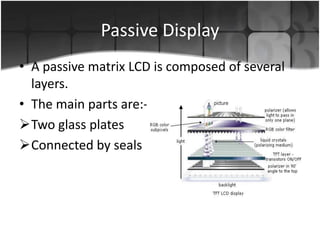
Passive Display
• A passive matrix LCD is composed of several
layers.
• The main parts are:Two glass plates
Connected by seals
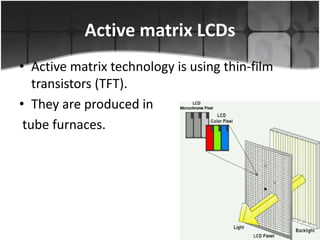
Active matrix LCDs
• Active matrix technology is using thin-film
transistors (TFT).
• They are produced in
tube furnaces.
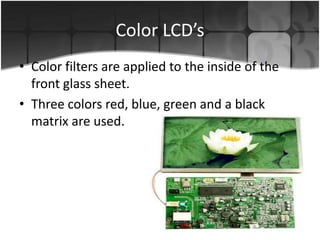
Color LCD’s
• Color filters are applied to the inside of the
front glass sheet.
• Three colors red, blue, green and a black
matrix are used.
How LCD’s are manufactured?
• The rear glass plates are the substrate for the
TFT production in case of active matrix LCDs.
• The front glass plate wears the color filter
layers, same as the rear glass plate ITO, hard
coat and polyimide and the sealing.
• The singularized displays are filled with liquid
crystal liquid and the opening in the seal is
closed.
DIFFERENCE BETWEEN FLAT PANEL
DISPLAYS AND CRT?
•
•
•
•

Resolution & Viewing Quality
Refresh Rate
Physical Size
Price
Flat panel

Flat panel

  • 1.
  • 2.
    Contents • • • • • • • • • INTRODUCTION TYPES OF FLATPANEL DISPLAYS APPLICATIONS OF FLAT PANEL DISPLAYS ADVANTAGES OF FLAT PANEL DISPLAYS DISADVANTAGES OF FLAT PANEL DISPLAYS HOW FLAT PANEL WORK AND MANUFACTURED DIFFERENCE BETWEEN FLAT PANEL DISPLAYS AND CRT
  • 3.
    INTRODUCTION • The firstever flat panel display was invented in 1964 at the University of Illinois. • Flat panel displays also called Flat Screen. • It encompass a growing number of electronic visual display technologies. • It enables much lighter and thinner than traditional television set and video displays that use cathode ray tubes (CRT). • These are usually less than 100 mm (4 inches) thick.
  • 4.
    Types • VOLATILE FLATPANEL DISPLAYS • STATIC FLAT PANEL DISPLAYS
  • 5.
    Volatile Flat PanelDisplays • Volatile displays require that pixels be periodically refreshed. • This refresh typically occurs many times a second. • Some examples of volatile flat panel displays :• Light-emitting diode displays (LED) • Liquid crystal displays (LCDs) • Organic light-emitting diode (OLED) • Plasma displays
  • 6.
    STATIC FLAT PANELDISPLAYS • These rely on materials whose color states are bistable. • This results in a much more energy-efficient display. • These require slow refresh rates.
  • 7.
    Other Different typesof flat panel displays • • • • Liquid crystal display (LCD) Plasma display panel (PDP) Light emitting diode (LED) display Organic light emitting diodes (OLEDs)
  • 8.
    Liquid crystal display(LCD) • LCDs are the established technology for a broad range of uses. • LCDs take up less space, weigh less and use less power.
  • 9.
    Plasma display panel(PDP) • Their visual displays are comparable to cathode ray tubes, but can be built much thinner and flatter. • These are not suitable for portable and handheld devices.
  • 10.
    Light emitting diode(LED) display • These used for large, outdoor screens and billboards. • Each pixel is formed using a cluster of red, green and blue LEDs.
  • 11.
    Organic light emittingdiodes (OLEDs) • OLEDs are self-emissive, highly efficient and have excellent optical properties. • There are two principle technologies of OLED:• Vacuum Deposition Systems • Solution Processable OLED Systems
  • 12.
    APPLICATIONS OF FLATPANEL DISPLAYS • Laptops • Televisions • Cellular phones • Digital cameras • Camcorders • Compact cameras • Pocket video camera
  • 13.
    ADVANTAGES OF FLATPANEL DISPLAYS • Space Saving • Display size • Power consumption
  • 14.
  • 15.
  • 16.
    Liquid crystals  Setupof a typical LCD panel:  Polarizer  Glass substrate  Seal  Spacer  ITO  Hard coat  Polyimide  TFT
  • 17.
    Passive Display • Apassive matrix LCD is composed of several layers. • The main parts are:Two glass plates Connected by seals
  • 18.
    Active matrix LCDs •Active matrix technology is using thin-film transistors (TFT). • They are produced in tube furnaces.
  • 19.
    Color LCD’s • Colorfilters are applied to the inside of the front glass sheet. • Three colors red, blue, green and a black matrix are used.
  • 20.
    How LCD’s aremanufactured? • The rear glass plates are the substrate for the TFT production in case of active matrix LCDs. • The front glass plate wears the color filter layers, same as the rear glass plate ITO, hard coat and polyimide and the sealing. • The singularized displays are filled with liquid crystal liquid and the opening in the seal is closed.
  • 21.
    DIFFERENCE BETWEEN FLATPANEL DISPLAYS AND CRT? • • • • Resolution & Viewing Quality Refresh Rate Physical Size Price