Johari Window
Content
• What is Johari Window ?
• Founders
• Formation of Name
• Influence of Model
• Use of Johari Window
• What model represents
• Areas of Model
• Drawbacks of Model
Johari Window
A model for self- awareness, personal
development, group development and
understanding relationship.
Founders
• The Johari Window model was devised by American
psychologists Joseph Luft and Harry Ingham in 1955, while
researching group dynamics at the University of California
LosAngeles.
• The model was first published in the Proceedings of the
Western Training Laboratory in Group Development by UCLA
Extension Office in 1955, and was later expanded by Joseph
Luft.
Formation of Name
• Luft and Ingham called their Johari Window model 'Johari'
after combining their first names, Joe and Harry. In early
publications the word appears as 'JoHari'.
Influence
 Today the Johari Window modelis
especially relevant due to
modern emphasis on, and influence of
• soft skills
• behaviour
• empathy
• cooperation
• inter-group development
• interpersonal development.
Use of Johari Model
• The Johari Window soon became a widely used model for
understanding and training self-awareness, personal
development, improving communications, interpersonal
relationships, group dynamics, team development and inter-
group relationships.
What actually Model Represents
• The Johari Window model is also referred to as a
'disclosure/feedback model of self awareness', and by some
people an 'information processing tool'.
• The Johari Window actually represents information - feelings,
experience, views, attitudes, skills, intentions, motivation, etc -
within or about a person - in relation to their group, from four
perspectives.
Areas of Model
• The four Johari Window perspectives are called 'regions' or
'areas' or 'quadrants'. Each of these regions contains and
represents the information - feelings, motivation, etc – known
about the person, in terms of whether the information is known
or unknown by the person, and whether the information is
known or unknown by others in the group.
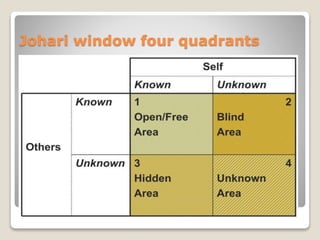
Johari window four quadrants
1.what is known by the person about him/herself and is also
known by others - open area, open self, free area, free self, or 'the
arena‘.
2.what is unknown by the person about him/herself but which
others know - blind area, blind self, or 'blindspot‘.
3.what the person knows about him/herself that others do not
know - hidden area, hidden self, avoided area, avoided self or
'facade‘.
4.what is unknown by the person about him/herself and is also
unknown by others - unknown area or unknown self.
Johari window four quadrants
Johari quadrant 1
• Johari region 1 is also known as the 'area of free activity'. This
is the information about the person - behaviour, attitude,
feelings, emotion, knowledge, experience, skills, views, etc -
known by the person ('the self') and known by the group
('others').
Johari quadrant 2
• Johari region 2 is what is known about a person by others in
the group, but is unknown by the person him/herself.
Johari quadrant 3
•what is known to ourselves but kept hidden from, and
therefore unknown to others.
Johari quadrant 4
• It contains information, feelings, talent
abilities, aptitudes, experiences etc, that are unknown to the
person him/herself and unknown to others in the group.
Unknown factors
•an ability that is under-estimated or un-tried through lack of
opportunity, encouragement, confidence or training.
•a natural ability or aptitude that a person doesn't realise they
possess
• a fear or aversion that a person does not know they have
• an unknown illness
• repressed or subconscious feelings
• conditioned behaviour or attitudes from childhood
Drawbacks of Johari window
• Some thing are perhaps better not to Communicated (like
mental or health problem)
• Some people may pass on the information they received
further then we desire.
• Some people may react negatively.
• Using johari window is useless exercise if it is not linked to
the activities that reinforce positive behavior or that correct
negative behavior.
• Some cultures have a very open and accepting approach to
feedback and others do not.
• Some people take personal feedback offensively.

17841186.ppt

  • 1.
  • 2.
    Content • What isJohari Window ? • Founders • Formation of Name • Influence of Model • Use of Johari Window • What model represents • Areas of Model • Drawbacks of Model
  • 3.
    Johari Window A modelfor self- awareness, personal development, group development and understanding relationship.
  • 4.
    Founders • The JohariWindow model was devised by American psychologists Joseph Luft and Harry Ingham in 1955, while researching group dynamics at the University of California LosAngeles. • The model was first published in the Proceedings of the Western Training Laboratory in Group Development by UCLA Extension Office in 1955, and was later expanded by Joseph Luft.
  • 5.
    Formation of Name •Luft and Ingham called their Johari Window model 'Johari' after combining their first names, Joe and Harry. In early publications the word appears as 'JoHari'.
  • 6.
    Influence  Today theJohari Window modelis especially relevant due to modern emphasis on, and influence of • soft skills • behaviour • empathy • cooperation • inter-group development • interpersonal development.
  • 7.
    Use of JohariModel • The Johari Window soon became a widely used model for understanding and training self-awareness, personal development, improving communications, interpersonal relationships, group dynamics, team development and inter- group relationships.
  • 8.
    What actually ModelRepresents • The Johari Window model is also referred to as a 'disclosure/feedback model of self awareness', and by some people an 'information processing tool'. • The Johari Window actually represents information - feelings, experience, views, attitudes, skills, intentions, motivation, etc - within or about a person - in relation to their group, from four perspectives.
  • 9.
    Areas of Model •The four Johari Window perspectives are called 'regions' or 'areas' or 'quadrants'. Each of these regions contains and represents the information - feelings, motivation, etc – known about the person, in terms of whether the information is known or unknown by the person, and whether the information is known or unknown by others in the group.
  • 10.
    Johari window fourquadrants 1.what is known by the person about him/herself and is also known by others - open area, open self, free area, free self, or 'the arena‘. 2.what is unknown by the person about him/herself but which others know - blind area, blind self, or 'blindspot‘. 3.what the person knows about him/herself that others do not know - hidden area, hidden self, avoided area, avoided self or 'facade‘. 4.what is unknown by the person about him/herself and is also unknown by others - unknown area or unknown self.
  • 11.
  • 12.
    Johari quadrant 1 •Johari region 1 is also known as the 'area of free activity'. This is the information about the person - behaviour, attitude, feelings, emotion, knowledge, experience, skills, views, etc - known by the person ('the self') and known by the group ('others').
  • 13.
    Johari quadrant 2 •Johari region 2 is what is known about a person by others in the group, but is unknown by the person him/herself.
  • 14.
    Johari quadrant 3 •whatis known to ourselves but kept hidden from, and therefore unknown to others.
  • 15.
    Johari quadrant 4 •It contains information, feelings, talent abilities, aptitudes, experiences etc, that are unknown to the person him/herself and unknown to others in the group.
  • 16.
    Unknown factors •an abilitythat is under-estimated or un-tried through lack of opportunity, encouragement, confidence or training. •a natural ability or aptitude that a person doesn't realise they possess • a fear or aversion that a person does not know they have • an unknown illness • repressed or subconscious feelings • conditioned behaviour or attitudes from childhood
  • 17.
    Drawbacks of Johariwindow • Some thing are perhaps better not to Communicated (like mental or health problem) • Some people may pass on the information they received further then we desire. • Some people may react negatively. • Using johari window is useless exercise if it is not linked to the activities that reinforce positive behavior or that correct negative behavior. • Some cultures have a very open and accepting approach to feedback and others do not. • Some people take personal feedback offensively.