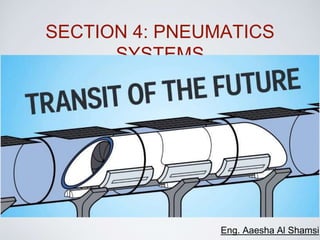
SECTION 4: PNEUMATICS
SYSTEMS
Eng. Aaesha Al Shamsi
1. List and stat the purpose of the main
components of pneumatic system.
2. Understand the developments of applications
in pneumatic system in the last century.
3. Be familiar with innovation of pneumatic
LEARNING OUTCOMES
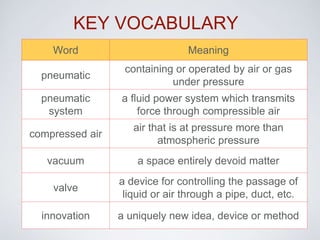
KEY VOCABULARY
Word Meaning
pneumatic
containing or operated by air or gas
under pressure
pneumatic
system
a fluid power system which transmits
force through compressible air
compressed air
air that is at pressure more than
atmospheric pressure
vacuum a space entirely devoid matter
valve
a device for controlling the passage of
liquid or air through a pipe, duct, etc.
innovation a uniquely new idea, device or method
Air is all around us even though we can’t see or feel it. Air
presses on our bodies with a great force. We don’t feel this
because the air inside our bodies is pushing back equally
hard. Air pressure is know as pneumatics and is very
important.
Air pressure
PNEUMATICS - DEFINITION
• The study of pneumatics deals with system operation
with air to impart power or to control power.
• The term pneumatics is derived from the Greek word
pneuma, meaning wind or breath.
• Pneumatic power is the power that is transmitted by
pressurized/compressed air.
A BRIEF HISTORY OF PNEUMATICS
Most of the modern machinery we see today uses
some type of pneumatics to make it function.
Emirates Airbus A380
(jet engine)
New York City
pneumatic mail system
1897
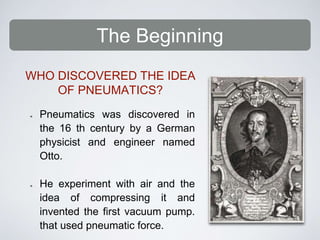
Pneumatics was discovered in
the 16 th century by a German
physicist and engineer named
Otto.
He experiment with air and the
idea of compressing it and
invented the first vacuum pump.
that used pneumatic force.
WHO DISCOVERED THE IDEA
OF PNEUMATICS?
The Beginning
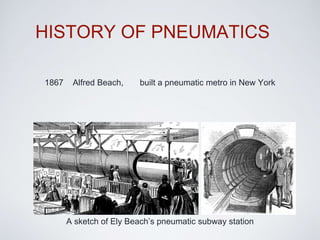
HISTORY OF PNEUMATICS
A sketch of Ely Beach’s pneumatic subway station
1867 Alfred Beach, built a pneumatic metro in New York
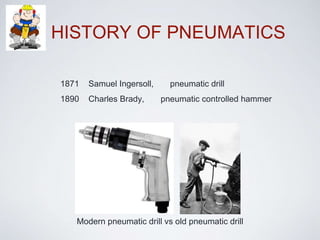
HISTORY OF PNEUMATICS
Modern pneumatic drill vs old pneumatic drill
1871 Samuel Ingersoll, pneumatic drill
1890 Charles Brady, pneumatic controlled hammer
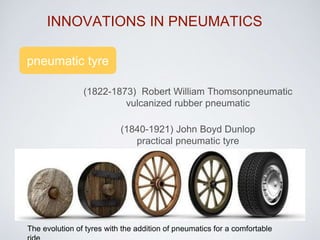
INNOVATIONS IN PNEUMATICS
pneumatic tyre
(1822-1873) Robert William Thomsonpneumatic
vulcanized rubber pneumatic
(1840-1921) John Boyd Dunlop
practical pneumatic tyre
The evolution of tyres with the addition of pneumatics for a comfortable
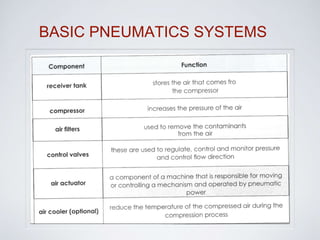
BASIC PNEUMATICS SYSTEMS
trent 700 pneumatic turbofan jet engine
1900s first jet engine
BASIC PNEUMATICS SYSTEMS
COMPARISON OF ELECTRICAL,
HYDRAULIC AND PNEUMATIC SYSTEMS
Power Systems
Hydraulic Electrical
Pneumatic
COMPARISON OF ELECTRICAL,
HYDRAULIC AND PNEUMATIC SYSTEMS
COMPARISON OF ELECTRICAL,
HYDRAULIC AND PNEUMATIC SYSTEMS
Pneumatic transport
Dubai to Abu Dhabi in 12 minutes
INNOVATION AND THE FUTURE OF
PNEUMATICS
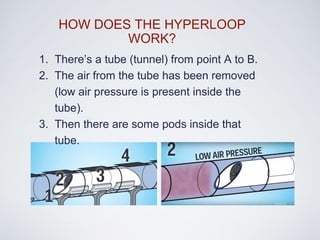
HOW DOES THE HYPERLOOP
WORK?
1. There’s a tube (tunnel) from point A to B.
2. The air from the tube has been removed
(low air pressure is present inside the
tube).
3. Then there are some pods inside that
tube.
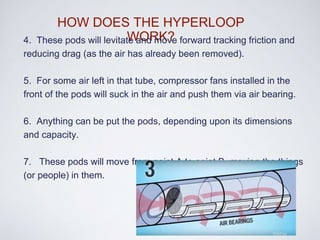
HOW DOES THE HYPERLOOP
WORK?4. These pods will levitate and move forward tracking friction and
reducing drag (as the air has already been removed).
5. For some air left in that tube, compressor fans installed in the
front of the pods will suck in the air and push them via air bearing.
6. Anything can be put the pods, depending upon its dimensions
and capacity.
7. These pods will move from point A to point B, moving the things
(or people) in them.

12 a pneumatic systems

  • 1.
  • 2.
    1. List andstat the purpose of the main components of pneumatic system. 2. Understand the developments of applications in pneumatic system in the last century. 3. Be familiar with innovation of pneumatic LEARNING OUTCOMES
  • 3.
    KEY VOCABULARY Word Meaning pneumatic containingor operated by air or gas under pressure pneumatic system a fluid power system which transmits force through compressible air compressed air air that is at pressure more than atmospheric pressure vacuum a space entirely devoid matter valve a device for controlling the passage of liquid or air through a pipe, duct, etc. innovation a uniquely new idea, device or method
  • 4.
    Air is allaround us even though we can’t see or feel it. Air presses on our bodies with a great force. We don’t feel this because the air inside our bodies is pushing back equally hard. Air pressure is know as pneumatics and is very important. Air pressure
  • 5.
    PNEUMATICS - DEFINITION •The study of pneumatics deals with system operation with air to impart power or to control power. • The term pneumatics is derived from the Greek word pneuma, meaning wind or breath. • Pneumatic power is the power that is transmitted by pressurized/compressed air.
  • 6.
    A BRIEF HISTORYOF PNEUMATICS Most of the modern machinery we see today uses some type of pneumatics to make it function. Emirates Airbus A380 (jet engine) New York City pneumatic mail system 1897
  • 7.
    Pneumatics was discoveredin the 16 th century by a German physicist and engineer named Otto. He experiment with air and the idea of compressing it and invented the first vacuum pump. that used pneumatic force. WHO DISCOVERED THE IDEA OF PNEUMATICS? The Beginning
  • 8.
    HISTORY OF PNEUMATICS Asketch of Ely Beach’s pneumatic subway station 1867 Alfred Beach, built a pneumatic metro in New York
  • 9.
    HISTORY OF PNEUMATICS Modernpneumatic drill vs old pneumatic drill 1871 Samuel Ingersoll, pneumatic drill 1890 Charles Brady, pneumatic controlled hammer
  • 10.
    INNOVATIONS IN PNEUMATICS pneumatictyre (1822-1873) Robert William Thomsonpneumatic vulcanized rubber pneumatic (1840-1921) John Boyd Dunlop practical pneumatic tyre The evolution of tyres with the addition of pneumatics for a comfortable
  • 11.
    BASIC PNEUMATICS SYSTEMS trent700 pneumatic turbofan jet engine 1900s first jet engine
  • 12.
  • 13.
  • 14.
    COMPARISON OF ELECTRICAL, HYDRAULICAND PNEUMATIC SYSTEMS Power Systems Hydraulic Electrical Pneumatic
  • 15.
  • 16.
  • 17.
    Pneumatic transport Dubai toAbu Dhabi in 12 minutes INNOVATION AND THE FUTURE OF PNEUMATICS
  • 18.
    HOW DOES THEHYPERLOOP WORK? 1. There’s a tube (tunnel) from point A to B. 2. The air from the tube has been removed (low air pressure is present inside the tube). 3. Then there are some pods inside that tube.
  • 19.
    HOW DOES THEHYPERLOOP WORK?4. These pods will levitate and move forward tracking friction and reducing drag (as the air has already been removed). 5. For some air left in that tube, compressor fans installed in the front of the pods will suck in the air and push them via air bearing. 6. Anything can be put the pods, depending upon its dimensions and capacity. 7. These pods will move from point A to point B, moving the things (or people) in them.