
1
CONTENTS
 Quality
 Objectives of Quality
 Gap model of Quality
 Quality Dimensions
 Quality Oriented Process
 Quality Planning
 Quality Control
 Quality Improvements
 6 Steps of Quality Planning
and Control
 Basic Terminologies
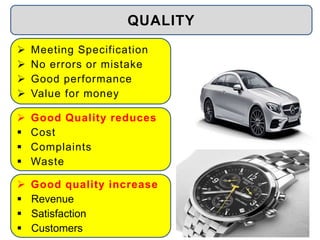
 Meeting Specification
 No errors or mistake
 Good performance
 Value for money
QUALITY
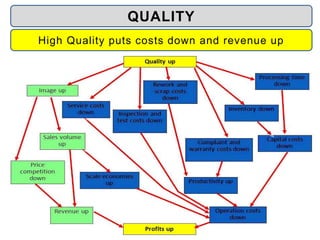
 Good Quality reduces
 Cost
 Complaints
 Waste
 Good quality increase
 Revenue
 Satisfaction
 Customers
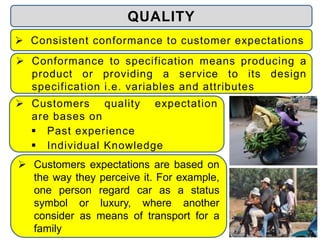
 Customers expectations are based on
the way they perceive it. For example,
one person regard car as a status
symbol or luxury, where another
consider as means of transport for a
family
 Consistent conformance to customer expectations
 Customers quality expectation
are bases on
 Past experience
 Individual Knowledge
QUALITY
 Conformance to specification means producing a
product or providing a service to its design
specification i.e. variables and attributes
QUALITY
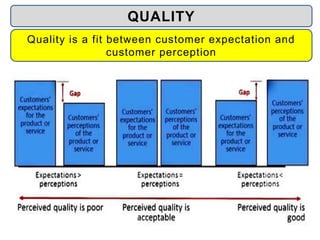
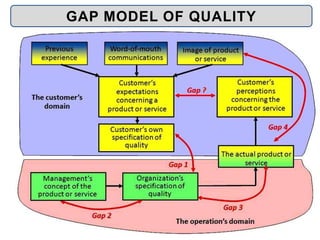
Quality is a fit between customer expectation and
customer perception
QUALITY
High Quality puts costs down and revenue up
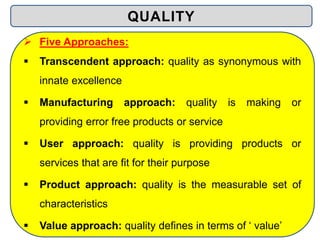
 Five Approaches:
 Transcendent approach: quality as synonymous with
innate excellence
 Manufacturing approach: quality is making or
providing error free products or service
 User approach: quality is providing products or
services that are fit for their purpose
 Product approach: quality is the measurable set of
characteristics
 Value approach: quality defines in terms of ‘ value’
QUALITY
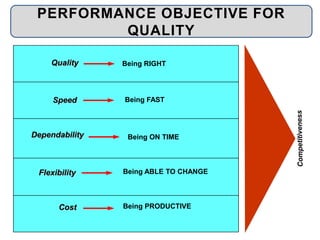
Being RIGHT
Being FAST
Being ON TIME
Being ABLE TO CHANGE
Being PRODUCTIVE
Quality
Speed
Dependability
Flexibility
Cost
PERFORMANCE OBJECTIVE FOR
QUALITY
GAP MODEL OF QUALITY
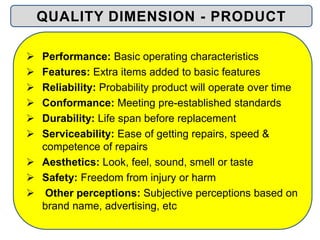
 Performance: Basic operating characteristics
 Features: Extra items added to basic features
 Reliability: Probability product will operate over time
 Conformance: Meeting pre-established standards
 Durability: Life span before replacement
 Serviceability: Ease of getting repairs, speed &
competence of repairs
 Aesthetics: Look, feel, sound, smell or taste
 Safety: Freedom from injury or harm
 Other perceptions: Subjective perceptions based on
brand name, advertising, etc
QUALITY DIMENSION - PRODUCT
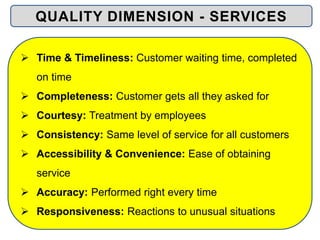
 Time & Timeliness: Customer waiting time, completed
on time
 Completeness: Customer gets all they asked for
 Courtesy: Treatment by employees
 Consistency: Same level of service for all customers
 Accessibility & Convenience: Ease of obtaining
service
 Accuracy: Performed right every time
 Responsiveness: Reactions to unusual situations
QUALITY DIMENSION - SERVICES
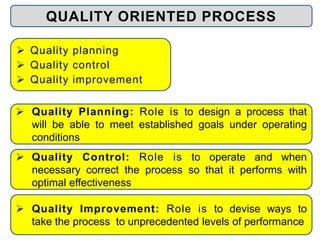
QUALITY ORIENTED PROCESS
 Quality planning
 Quality control
 Quality improvement
 Quality Planning: Role is to design a process that
will be able to meet established goals under operating
conditions
 Quality Control: Role is to operate and when
necessary correct the process so that it performs with
optimal effectiveness
 Quality Improvement: Role is to devise ways to
take the process to unprecedented levels of performance
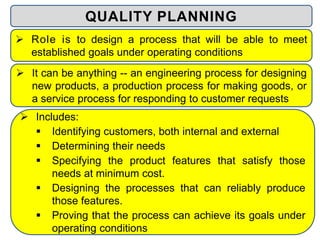
 Includes:
 Identifying customers, both internal and external
 Determining their needs
 Specifying the product features that satisfy those
needs at minimum cost.
 Designing the processes that can reliably produce
those features.
 Proving that the process can achieve its goals under
operating conditions
QUALITY PLANNING
 Role is to design a process that will be able to meet
established goals under operating conditions
 It can be anything -- an engineering process for designing
new products, a production process for making goods, or
a service process for responding to customer requests
 Process of Quality Control involves
 Choosing control subjects
 Choosing units of measurement
 Establishing a measurement procedure
 Measuring
 Interpreting differences between measurement and
goal.
 Taking action to correct significant differences
QUALITY CONTROL
 Role is to operate and when necessary correct the
process so that it performs with optimal effectiveness
 The steps in Quality Improvement
 Prove the need for improvement
 Identify specific projects for improvement
 Organize to guide the projects
 Organize for diagnosis -- discovery of causes
 Diagnose the causes
 Provide remedies
 Prove that the remedies are effective under
operating conditions
 Provide for control to maintain the gains
 Objective is to reduce chronic waste to a much lower level
QUALITY IMPROVEMENT
1- Define quality characteristics of product or service
2- Decide how to measure each quality characteristic
3- Set quality standard for each quality characteristic
4- Control against these standard
5- Find the correct causes of poor quality
6- Continue to make improvement
STEPS OF QUALITY PLANNING
AND CONTROL
 Functionality: How to well the product or service does
the job for which it was intended
 Appearance: Aesthetic appeal, look, feel, sound and
smell of the product or service
 Reliability: Consistency of performance of the product
or service over time
 Durability : Total useful life of the product or service
 Recovery: The ease with which problems with the
product or service can be rectified or resolved
 Contact : The nature of the person-to-person contacts
that take place
1- QUALITY CHARACTERISTICS OF
PRODUCT OR SERVICES
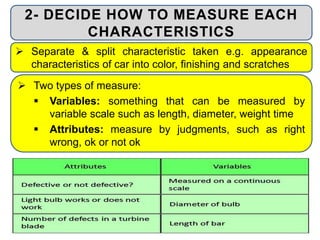
 Two types of measure:
 Variables: something that can be measured by
variable scale such as length, diameter, weight time
 Attributes: measure by judgments, such as right
wrong, ok or not ok
2- DECIDE HOW TO MEASURE EACH
CHARACTERISTICS
 Separate & split characteristic taken e.g. appearance
characteristics of car into color, finishing and scratches
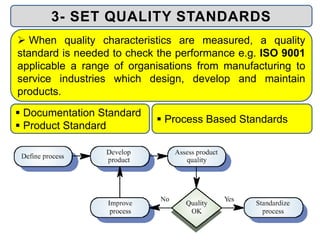
 When quality characteristics are measured, a quality
standard is needed to check the performance e.g. ISO 9001
applicable a range of organisations from manufacturing to
service industries which design, develop and maintain
products.
3- SET QUALITY STANDARDS
 Documentation Standard
 Product Standard
 Process Based Standards
 Depends on three decisions:
 Where in the operation should they check, that is
conforming to the standards e.g. at start of process,
during the process and after the process
 Should they check every single product and service
or a sample. Checking every single product is ideal
but not advice able e.g. Doctor cannot check all the
blood of patient or customer cannot check in to all
the restaurants etc
 How should the checks be performed. Depends on
type of product and customer
4- QUALITY STANDARDS CONTROL
 After setting up appropriate standards, operation will check
the products or services to conform to those standards
5- FINDING CORRECT CAUSE OF
POOR QUALITY
 Implement the total quality management tools and
techniques to find out correct poor quality
 Quality Planning
 Quality Control
 Quality Management
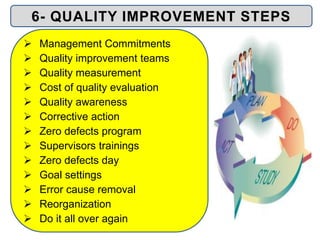
6- QUALITY IMPROVEMENT STEPS
 Management Commitments
 Quality improvement teams
 Quality measurement
 Cost of quality evaluation
 Quality awareness
 Corrective action
 Zero defects program
 Supervisors trainings
 Zero defects day
 Goal settings
 Error cause removal
 Reorganization
 Do it all over again
BASIC TERMINOLOGIES
Difference b/w quality control and
quality assurance
 Quality control and quality assurance are the part of
quality management focused on fulfilling quality
requirements and providing confidence that quality
requirements are fulfilled respectively
Inspection
 Process of measuring, examining and testing to gauge
one or more characteristics of a product or service and
the comparison of these with the specified requirements
to determine conformity
BASIC TERMINOLOGIES
Fit
 Degree of tightness and looseness between two mating
parts
Tolerance
 Deviation from a specified dimension or acceptable limit
or limits of variation
 Limits are type of tolerance that specifies lower and upper
deviations
 Dimensions, properties, conditions have variations
without significantly affecting function of systems or
machines
 Variation beyond tolerance is noncompliant, rejected or
exceeding tolerance
BASIC TERMINOLOGIES
Allowance
 Planned deviation between an actual dimension and a
nominal or theoretical dimension, or between an
intermediate stage dimension and an intended final
dimension
 Outer dimensions such as length of bar may be cut
intentionally oversize or inner dimensions such as
diameter of a hole may be cut intentionally undersize to
allow for a predictable dimensional change following
future cutting, grinding or heat treatment operations
 Hole may be drilled undersize to allow for material that
will be removed by subsequent reaming
Quality planning and control

Quality planning and control

  • 1.
  • 2.
    CONTENTS  Quality  Objectivesof Quality  Gap model of Quality  Quality Dimensions  Quality Oriented Process  Quality Planning  Quality Control  Quality Improvements  6 Steps of Quality Planning and Control  Basic Terminologies
  • 3.
     Meeting Specification No errors or mistake  Good performance  Value for money QUALITY  Good Quality reduces  Cost  Complaints  Waste  Good quality increase  Revenue  Satisfaction  Customers
  • 4.
     Customers expectationsare based on the way they perceive it. For example, one person regard car as a status symbol or luxury, where another consider as means of transport for a family  Consistent conformance to customer expectations  Customers quality expectation are bases on  Past experience  Individual Knowledge QUALITY  Conformance to specification means producing a product or providing a service to its design specification i.e. variables and attributes
  • 5.
    QUALITY Quality is afit between customer expectation and customer perception
  • 6.
    QUALITY High Quality putscosts down and revenue up
  • 7.
     Five Approaches: Transcendent approach: quality as synonymous with innate excellence  Manufacturing approach: quality is making or providing error free products or service  User approach: quality is providing products or services that are fit for their purpose  Product approach: quality is the measurable set of characteristics  Value approach: quality defines in terms of ‘ value’ QUALITY
  • 8.
    Being RIGHT Being FAST BeingON TIME Being ABLE TO CHANGE Being PRODUCTIVE Quality Speed Dependability Flexibility Cost PERFORMANCE OBJECTIVE FOR QUALITY
  • 9.
    GAP MODEL OFQUALITY
  • 10.
     Performance: Basicoperating characteristics  Features: Extra items added to basic features  Reliability: Probability product will operate over time  Conformance: Meeting pre-established standards  Durability: Life span before replacement  Serviceability: Ease of getting repairs, speed & competence of repairs  Aesthetics: Look, feel, sound, smell or taste  Safety: Freedom from injury or harm  Other perceptions: Subjective perceptions based on brand name, advertising, etc QUALITY DIMENSION - PRODUCT
  • 11.
     Time &Timeliness: Customer waiting time, completed on time  Completeness: Customer gets all they asked for  Courtesy: Treatment by employees  Consistency: Same level of service for all customers  Accessibility & Convenience: Ease of obtaining service  Accuracy: Performed right every time  Responsiveness: Reactions to unusual situations QUALITY DIMENSION - SERVICES
  • 12.
    QUALITY ORIENTED PROCESS Quality planning  Quality control  Quality improvement  Quality Planning: Role is to design a process that will be able to meet established goals under operating conditions  Quality Control: Role is to operate and when necessary correct the process so that it performs with optimal effectiveness  Quality Improvement: Role is to devise ways to take the process to unprecedented levels of performance
  • 13.
     Includes:  Identifyingcustomers, both internal and external  Determining their needs  Specifying the product features that satisfy those needs at minimum cost.  Designing the processes that can reliably produce those features.  Proving that the process can achieve its goals under operating conditions QUALITY PLANNING  Role is to design a process that will be able to meet established goals under operating conditions  It can be anything -- an engineering process for designing new products, a production process for making goods, or a service process for responding to customer requests
  • 14.
     Process ofQuality Control involves  Choosing control subjects  Choosing units of measurement  Establishing a measurement procedure  Measuring  Interpreting differences between measurement and goal.  Taking action to correct significant differences QUALITY CONTROL  Role is to operate and when necessary correct the process so that it performs with optimal effectiveness
  • 15.
     The stepsin Quality Improvement  Prove the need for improvement  Identify specific projects for improvement  Organize to guide the projects  Organize for diagnosis -- discovery of causes  Diagnose the causes  Provide remedies  Prove that the remedies are effective under operating conditions  Provide for control to maintain the gains  Objective is to reduce chronic waste to a much lower level QUALITY IMPROVEMENT
  • 16.
    1- Define qualitycharacteristics of product or service 2- Decide how to measure each quality characteristic 3- Set quality standard for each quality characteristic 4- Control against these standard 5- Find the correct causes of poor quality 6- Continue to make improvement STEPS OF QUALITY PLANNING AND CONTROL
  • 17.
     Functionality: Howto well the product or service does the job for which it was intended  Appearance: Aesthetic appeal, look, feel, sound and smell of the product or service  Reliability: Consistency of performance of the product or service over time  Durability : Total useful life of the product or service  Recovery: The ease with which problems with the product or service can be rectified or resolved  Contact : The nature of the person-to-person contacts that take place 1- QUALITY CHARACTERISTICS OF PRODUCT OR SERVICES
  • 18.
     Two typesof measure:  Variables: something that can be measured by variable scale such as length, diameter, weight time  Attributes: measure by judgments, such as right wrong, ok or not ok 2- DECIDE HOW TO MEASURE EACH CHARACTERISTICS  Separate & split characteristic taken e.g. appearance characteristics of car into color, finishing and scratches
  • 19.
     When qualitycharacteristics are measured, a quality standard is needed to check the performance e.g. ISO 9001 applicable a range of organisations from manufacturing to service industries which design, develop and maintain products. 3- SET QUALITY STANDARDS  Documentation Standard  Product Standard  Process Based Standards
  • 20.
     Depends onthree decisions:  Where in the operation should they check, that is conforming to the standards e.g. at start of process, during the process and after the process  Should they check every single product and service or a sample. Checking every single product is ideal but not advice able e.g. Doctor cannot check all the blood of patient or customer cannot check in to all the restaurants etc  How should the checks be performed. Depends on type of product and customer 4- QUALITY STANDARDS CONTROL  After setting up appropriate standards, operation will check the products or services to conform to those standards
  • 21.
    5- FINDING CORRECTCAUSE OF POOR QUALITY  Implement the total quality management tools and techniques to find out correct poor quality  Quality Planning  Quality Control  Quality Management
  • 22.
    6- QUALITY IMPROVEMENTSTEPS  Management Commitments  Quality improvement teams  Quality measurement  Cost of quality evaluation  Quality awareness  Corrective action  Zero defects program  Supervisors trainings  Zero defects day  Goal settings  Error cause removal  Reorganization  Do it all over again
  • 23.
    BASIC TERMINOLOGIES Difference b/wquality control and quality assurance  Quality control and quality assurance are the part of quality management focused on fulfilling quality requirements and providing confidence that quality requirements are fulfilled respectively Inspection  Process of measuring, examining and testing to gauge one or more characteristics of a product or service and the comparison of these with the specified requirements to determine conformity
  • 24.
    BASIC TERMINOLOGIES Fit  Degreeof tightness and looseness between two mating parts Tolerance  Deviation from a specified dimension or acceptable limit or limits of variation  Limits are type of tolerance that specifies lower and upper deviations  Dimensions, properties, conditions have variations without significantly affecting function of systems or machines  Variation beyond tolerance is noncompliant, rejected or exceeding tolerance
  • 25.
    BASIC TERMINOLOGIES Allowance  Planneddeviation between an actual dimension and a nominal or theoretical dimension, or between an intermediate stage dimension and an intended final dimension  Outer dimensions such as length of bar may be cut intentionally oversize or inner dimensions such as diameter of a hole may be cut intentionally undersize to allow for a predictable dimensional change following future cutting, grinding or heat treatment operations  Hole may be drilled undersize to allow for material that will be removed by subsequent reaming