Introduction to Quality Engineering
 Quality Engineering focuses on ensuring products and processes meet
customer expectations.
 Quality Engineering develops a mindset of prevention over correction, and
empowers engineers to design better systems, reduce costs, and improve
user satisfaction.
 Combines statistical methods, process control, and continuous improvement.
Quality
Degree to which product meets certain requirements or customer expectations
at the time of delivery.
Quality Engineering
Introduction to Quality Engineering
Purpose of studying QE
Ensure Customer Satisfaction
Improve Process Efficiency
Minimize Defects and Variability
Apply Data-Driven Decision Making
Design Quality into Products (Design for Quality)
Facilitate Continuous Improvement
Ensure Compliance and Standards Adherence
Enhance Career Opportunities
Introduction to Quality Engineering
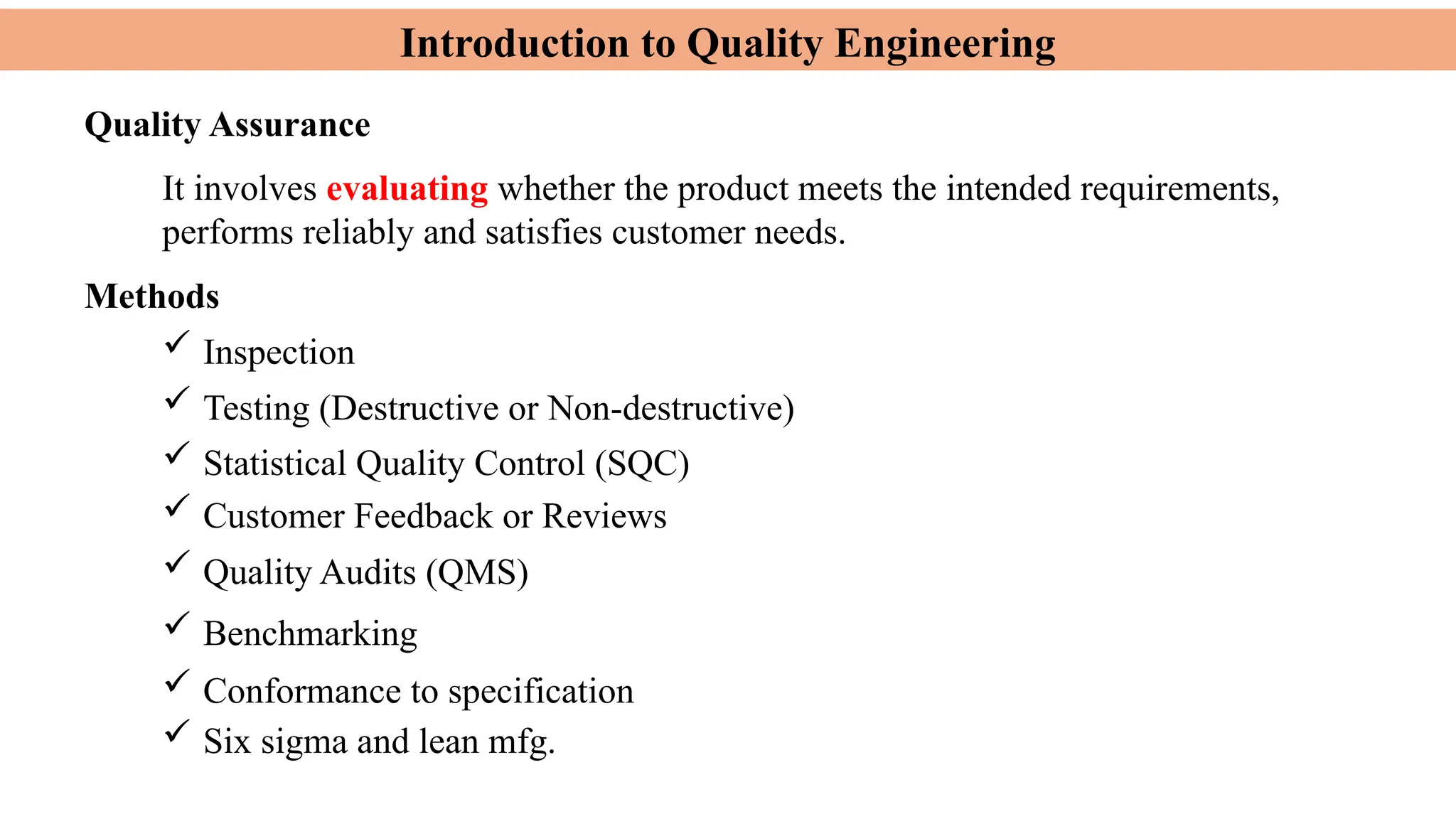
Quality Assurance
It involves evaluating whether the product meets the intended requirements,
performs reliably and satisfies customer needs.
Methods
 Inspection
 Testing (Destructive or Non-destructive)
 Statistical Quality Control (SQC)
 Customer Feedback or Reviews
 Quality Audits (QMS)
 Benchmarking
 Conformance to specification
 Six sigma and lean mfg.
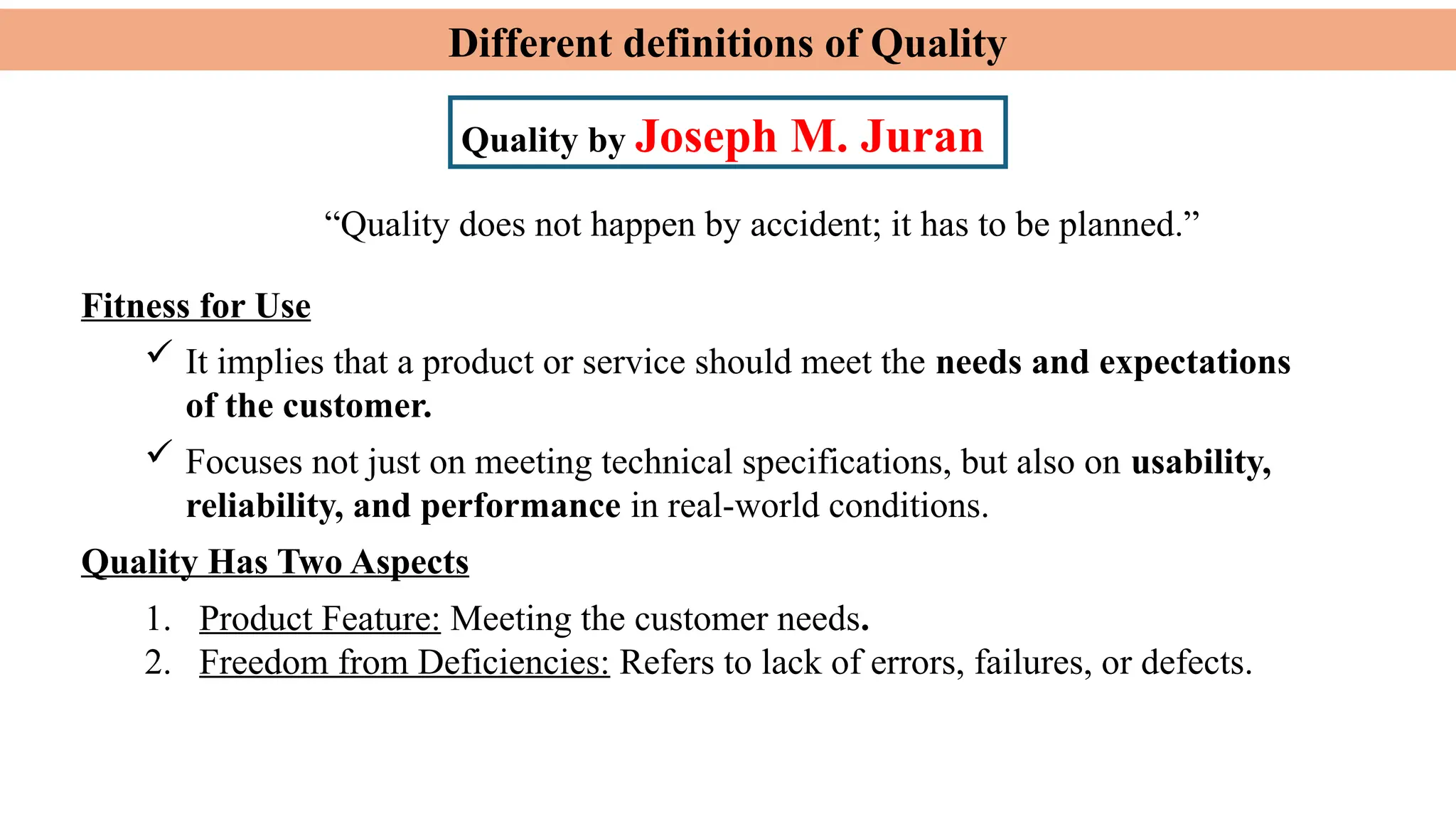
Different definitions of Quality
Quality by Joseph M. Juran
Fitness for Use
 It implies that a product or service should meet the needs and expectations
of the customer.
 Focuses not just on meeting technical specifications, but also on usability,
reliability, and performance in real-world conditions.
Quality Has Two Aspects
1. Product Feature: Meeting the customer needs.
2. Freedom from Deficiencies: Refers to lack of errors, failures, or defects.
“Quality does not happen by accident; it has to be planned.”
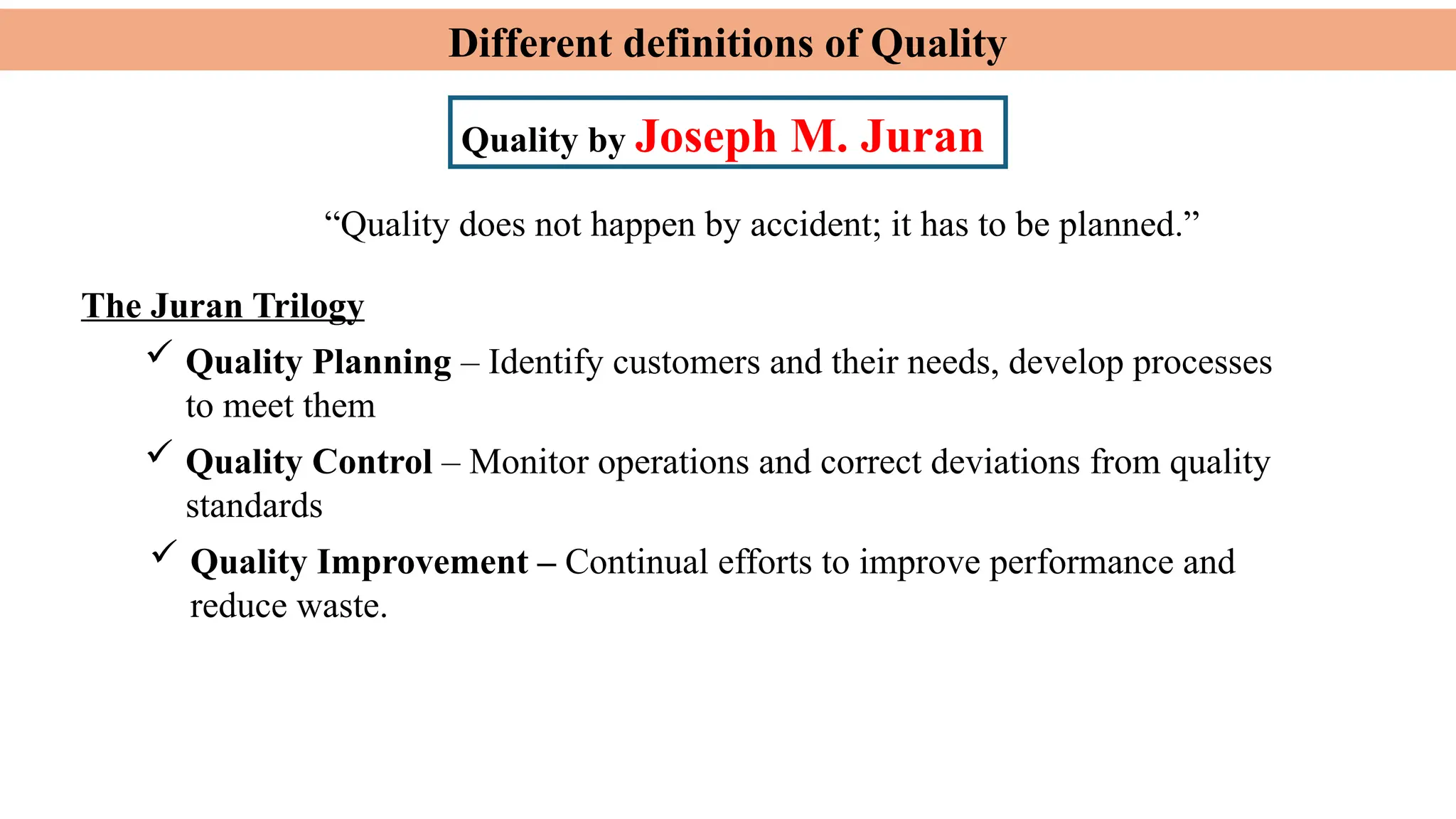
Different definitions of Quality
Quality by Joseph M. Juran
The Juran Trilogy
 Quality Planning – Identify customers and their needs, develop processes
to meet them
 Quality Control – Monitor operations and correct deviations from quality
standards
“Quality does not happen by accident; it has to be planned.”
 Quality Improvement – Continual efforts to improve performance and
reduce waste.
Different definitions of Quality
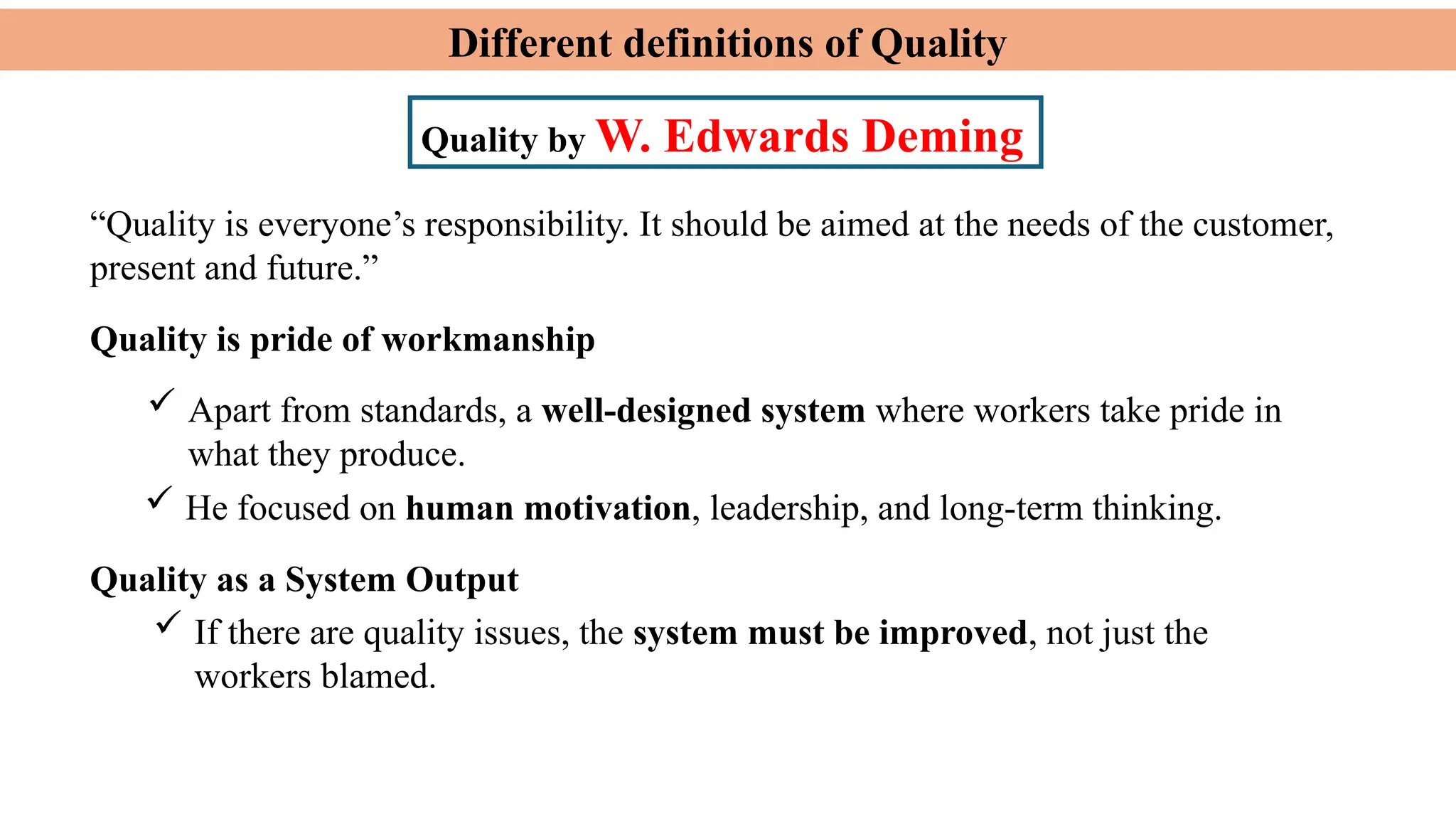
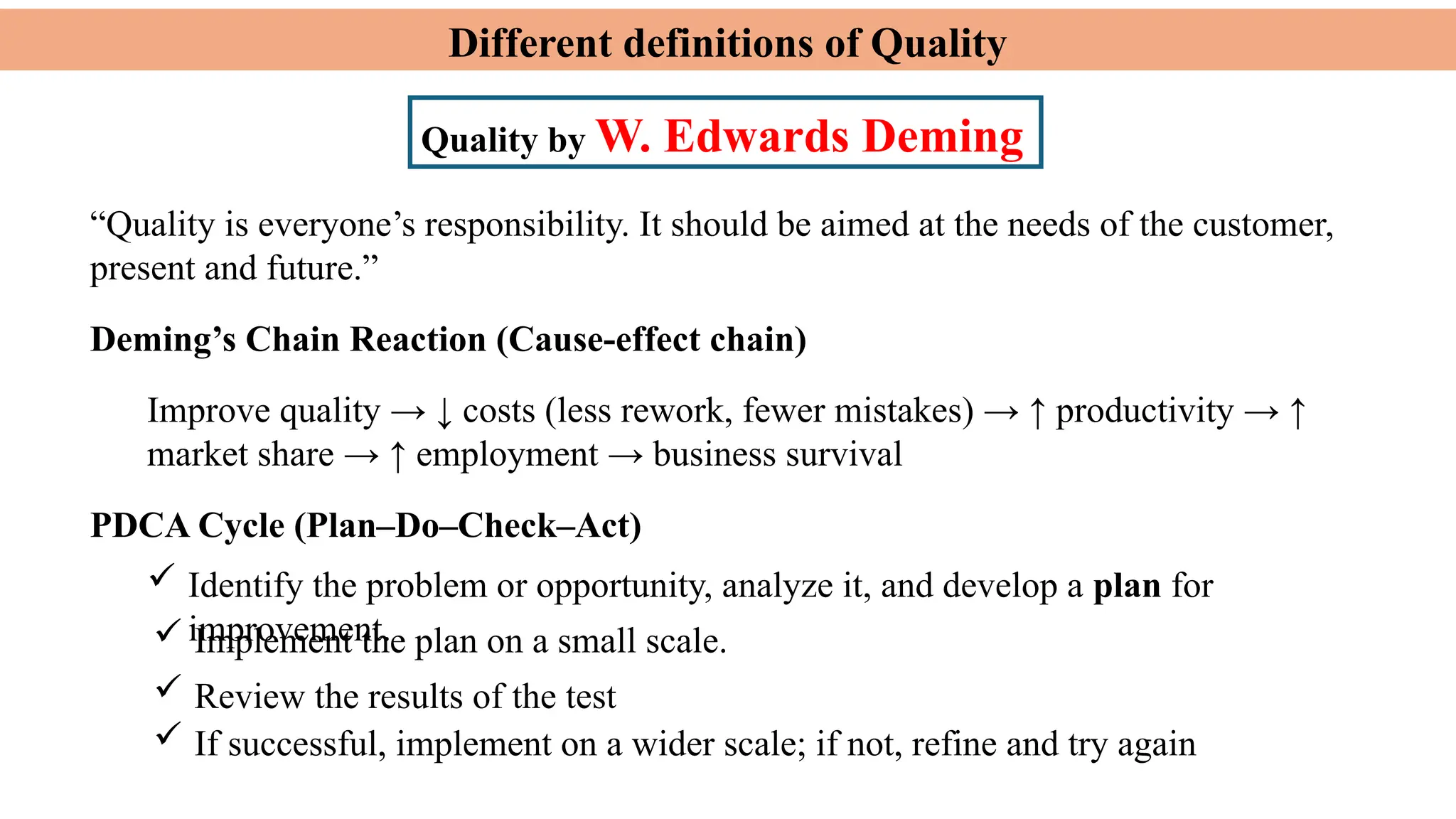
Quality by W. Edwards Deming
Quality is pride of workmanship
 Apart from standards, a well-designed system where workers take pride in
what they produce.
 He focused on human motivation, leadership, and long-term thinking.
 If there are quality issues, the system must be improved, not just the
workers blamed.
“Quality is everyone’s responsibility. It should be aimed at the needs of the customer,
present and future.”
Quality as a System Output
Different definitions of Quality
Quality by W. Edwards Deming
Deming’s Chain Reaction (Cause-effect chain)
Improve quality → ↓ costs (less rework, fewer mistakes) → ↑ productivity → ↑
market share → ↑ employment → business survival
 Identify the problem or opportunity, analyze it, and develop a plan for
improvement.
“Quality is everyone’s responsibility. It should be aimed at the needs of the customer,
present and future.”
PDCA Cycle (Plan–Do–Check–Act)
 Implement the plan on a small scale.
 Review the results of the test
 If successful, implement on a wider scale; if not, refine and try again
Different definitions of Quality
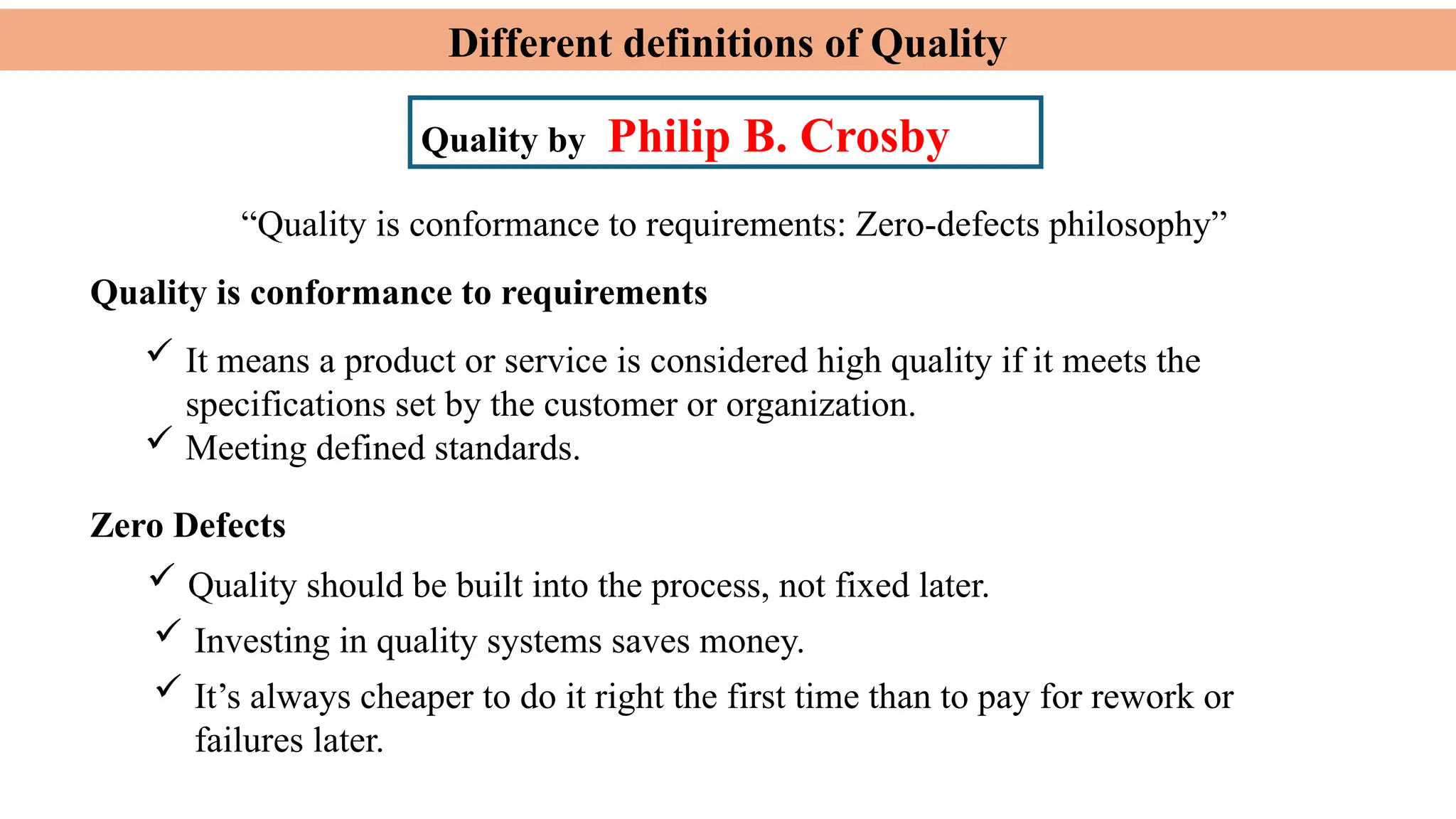
Quality by Philip B. Crosby
Quality is conformance to requirements
 It means a product or service is considered high quality if it meets the
specifications set by the customer or organization.
 Meeting defined standards.
 Quality should be built into the process, not fixed later.
“Quality is conformance to requirements: Zero-defects philosophy”
Zero Defects
 Investing in quality systems saves money.
 It’s always cheaper to do it right the first time than to pay for rework or
failures later.
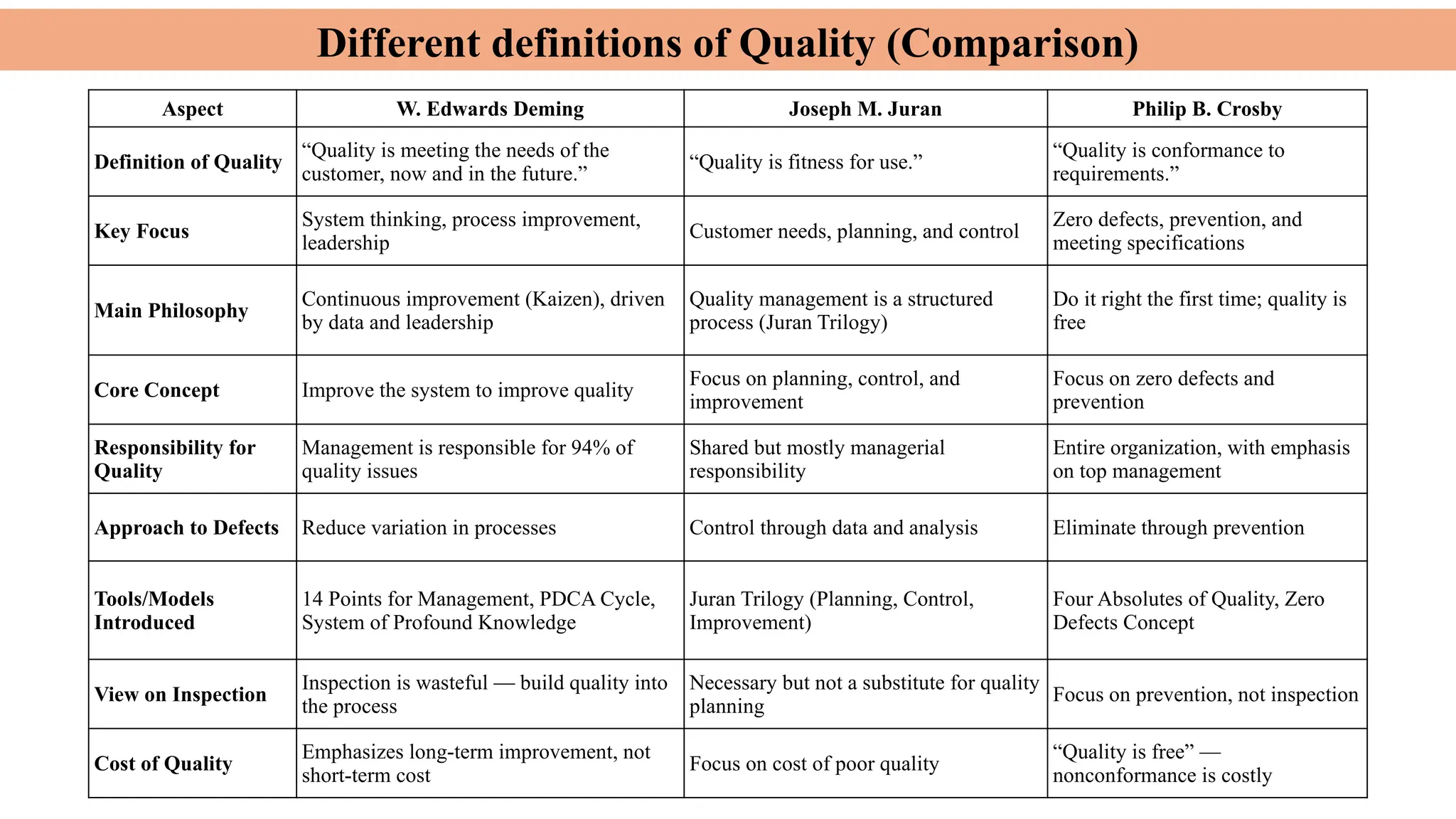
Different definitions of Quality (Comparison)
Aspect W. Edwards Deming Joseph M. Juran Philip B. Crosby
Definition of Quality
“Quality is meeting the needs of the
customer, now and in the future.”
“Quality is fitness for use.”
“Quality is conformance to
requirements.”
Key Focus
System thinking, process improvement,
leadership
Customer needs, planning, and control
Zero defects, prevention, and
meeting specifications
Main Philosophy
Continuous improvement (Kaizen), driven
by data and leadership
Quality management is a structured
process (Juran Trilogy)
Do it right the first time; quality is
free
Core Concept Improve the system to improve quality
Focus on planning, control, and
improvement
Focus on zero defects and
prevention
Responsibility for
Quality
Management is responsible for 94% of
quality issues
Shared but mostly managerial
responsibility
Entire organization, with emphasis
on top management
Approach to Defects Reduce variation in processes Control through data and analysis Eliminate through prevention
Tools/Models
Introduced
14 Points for Management, PDCA Cycle,
System of Profound Knowledge
Juran Trilogy (Planning, Control,
Improvement)
Four Absolutes of Quality, Zero
Defects Concept
View on Inspection
Inspection is wasteful — build quality into
the process
Necessary but not a substitute for quality
planning
Focus on prevention, not inspection
Cost of Quality
Emphasizes long-term improvement, not
short-term cost
Focus on cost of poor quality
“Quality is free” —
nonconformance is costly
Different definitions of Quality
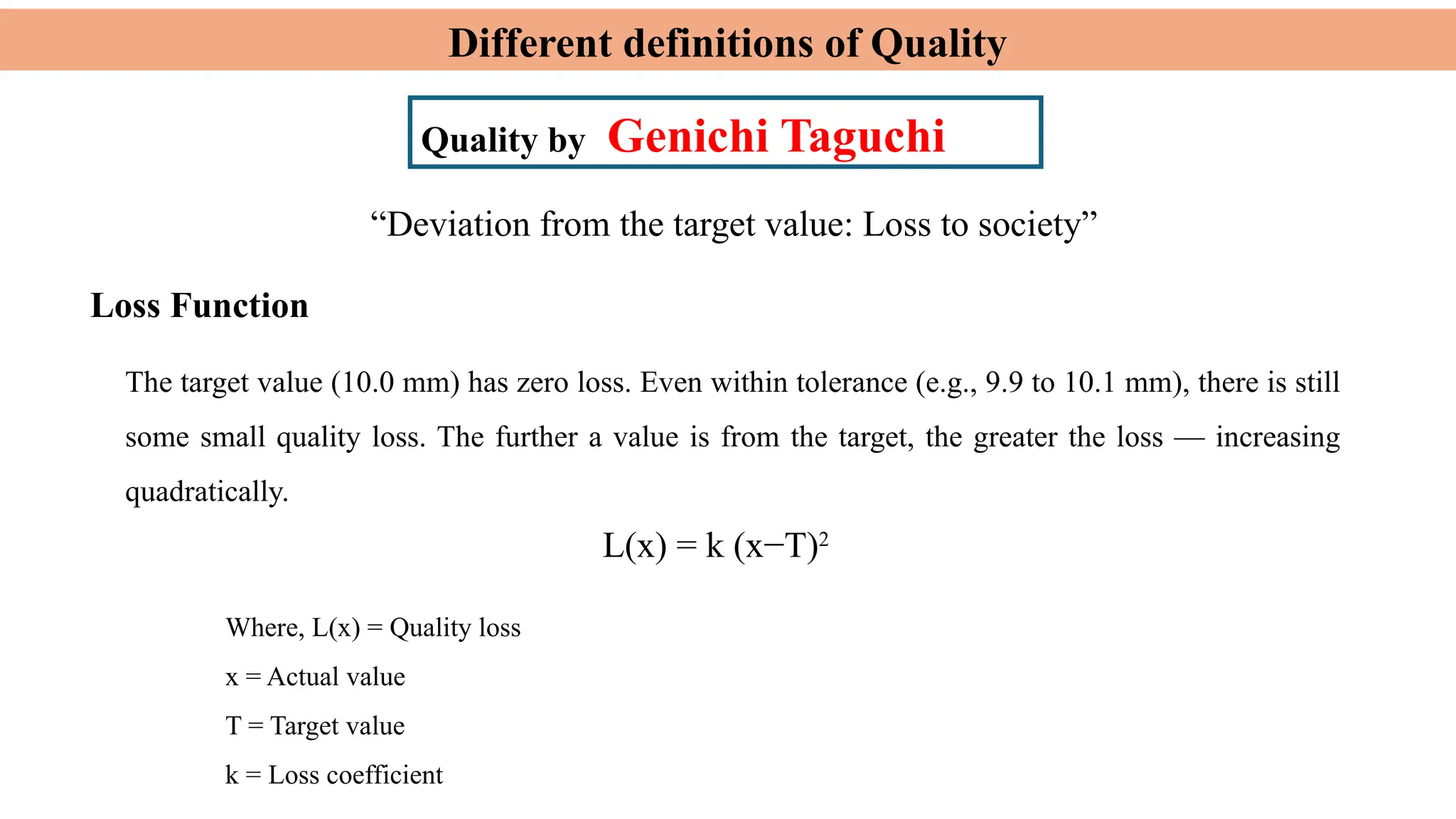
Quality by Genichi Taguchi
Taguchi Loss Function
 Quantifies quality in terms of deviation from the target value, not just
whether it's within limits.
 The greater the deviation from the target, even if still within spec limits, the
greater the "loss to society" (due to poor performance, rework, maintenance,
etc.).
“Deviation from the target value: Loss to society”
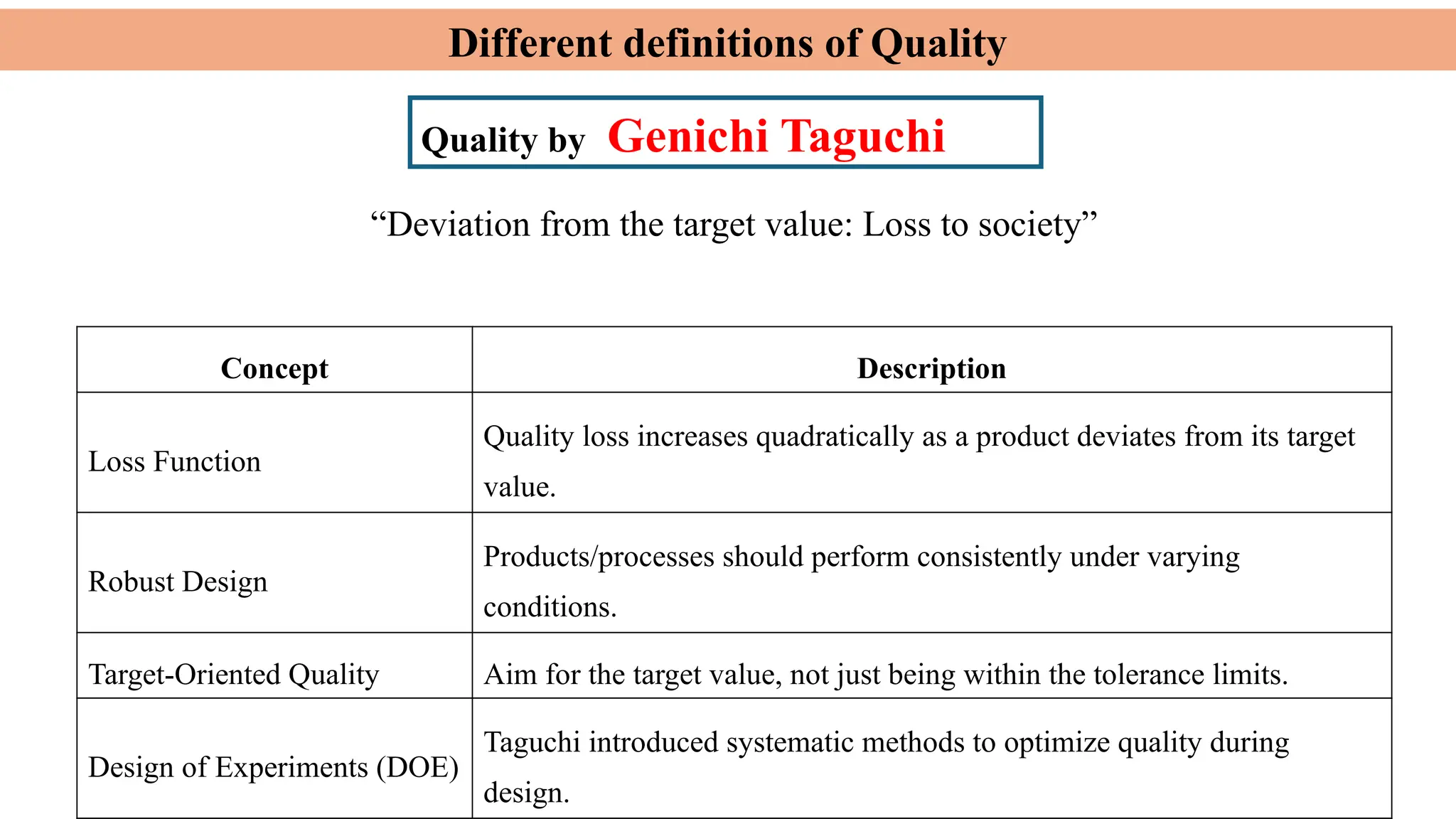
Different definitions of Quality
Quality by Genichi Taguchi
“Deviation from the target value: Loss to society”
Concept Description
Loss Function
Quality loss increases quadratically as a product deviates from its target
value.
Robust Design
Products/processes should perform consistently under varying
conditions.
Target-Oriented Quality Aim for the target value, not just being within the tolerance limits.
Design of Experiments (DOE)
Taguchi introduced systematic methods to optimize quality during
design.
Different definitions of Quality
Quality by Genichi Taguchi
Loss Function
L(x) = k (x−T)2
“Deviation from the target value: Loss to society”
The target value (10.0 mm) has zero loss. Even within tolerance (e.g., 9.9 to 10.1 mm), there is still
some small quality loss. The further a value is from the target, the greater the loss — increasing
quadratically.
Where, L(x) = Quality loss
x = Actual value
T = Target value
k = Loss coefficient
Different definitions of Quality
Quality by Genichi Taguchi
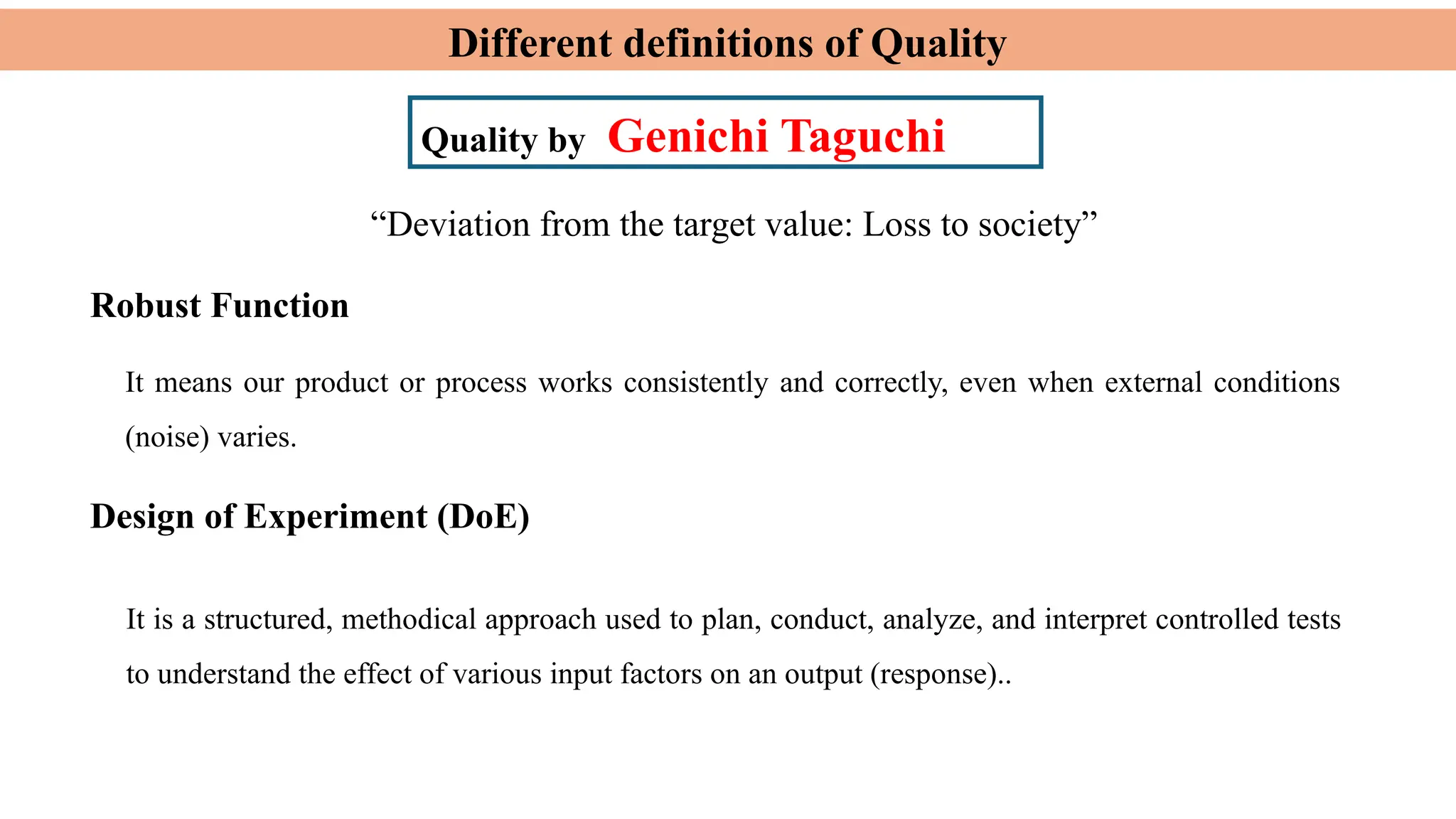
Robust Function
“Deviation from the target value: Loss to society”
It means our product or process works consistently and correctly, even when external conditions
(noise) varies.
Design of Experiment (DoE)
It is a structured, methodical approach used to plan, conduct, analyze, and interpret controlled tests
to understand the effect of various input factors on an output (response)..
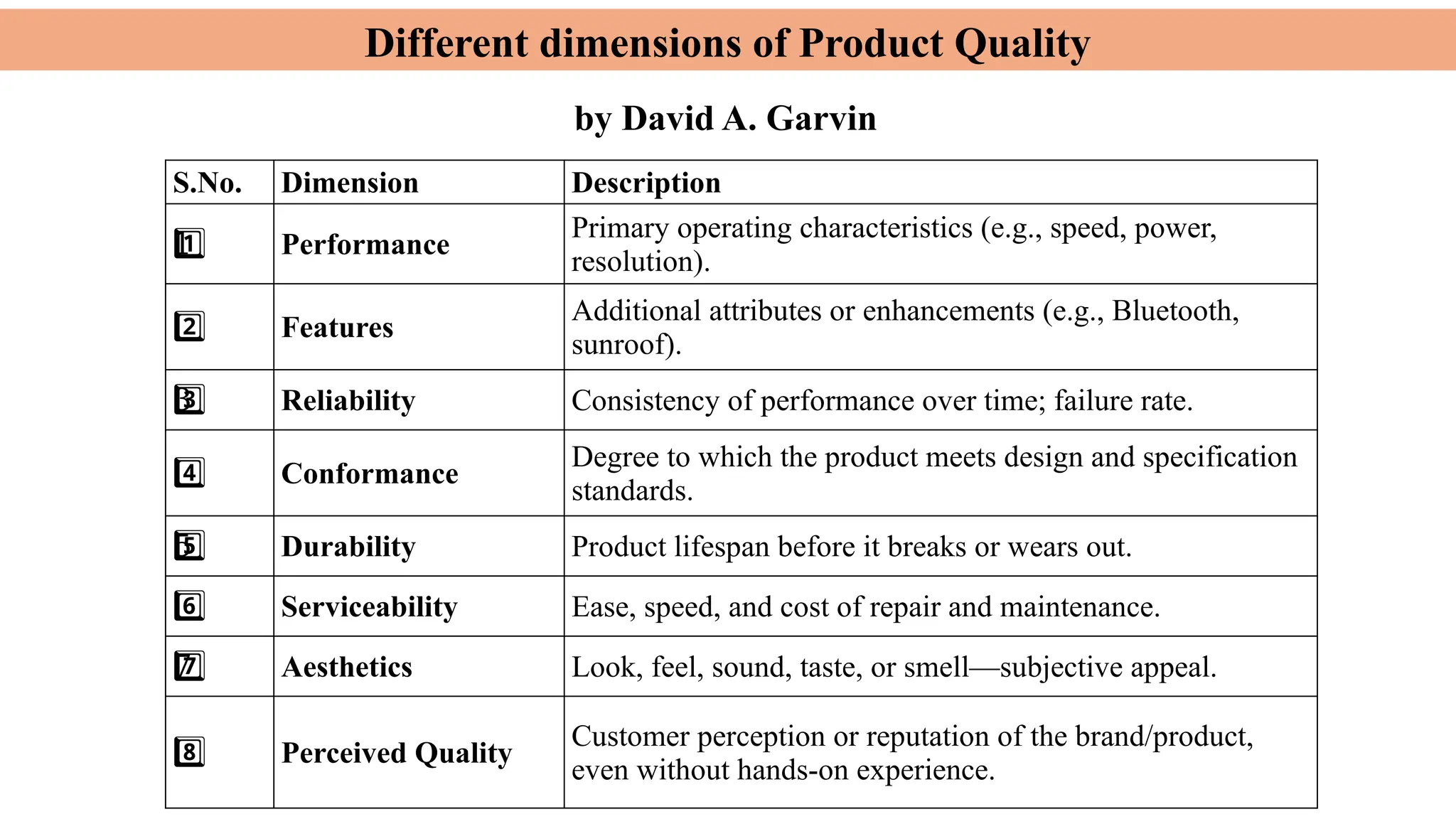
Different dimensions of Product Quality
S.No. Dimension Description
1 ️
1️⃣ Performance
Primary operating characteristics (e.g., speed, power,
resolution).
2️⃣ Features
Additional attributes or enhancements (e.g., Bluetooth,
sunroof).
3 ️
3️⃣ Reliability Consistency of performance over time; failure rate.
4️⃣ Conformance
Degree to which the product meets design and specification
standards.
5 ️
5️⃣ Durability Product lifespan before it breaks or wears out.
6️⃣ Serviceability Ease, speed, and cost of repair and maintenance.
7 ️
7️⃣ Aesthetics Look, feel, sound, taste, or smell—subjective appeal.
8️⃣ Perceived Quality
Customer perception or reputation of the brand/product,
even without hands-on experience.
by David A. Garvin
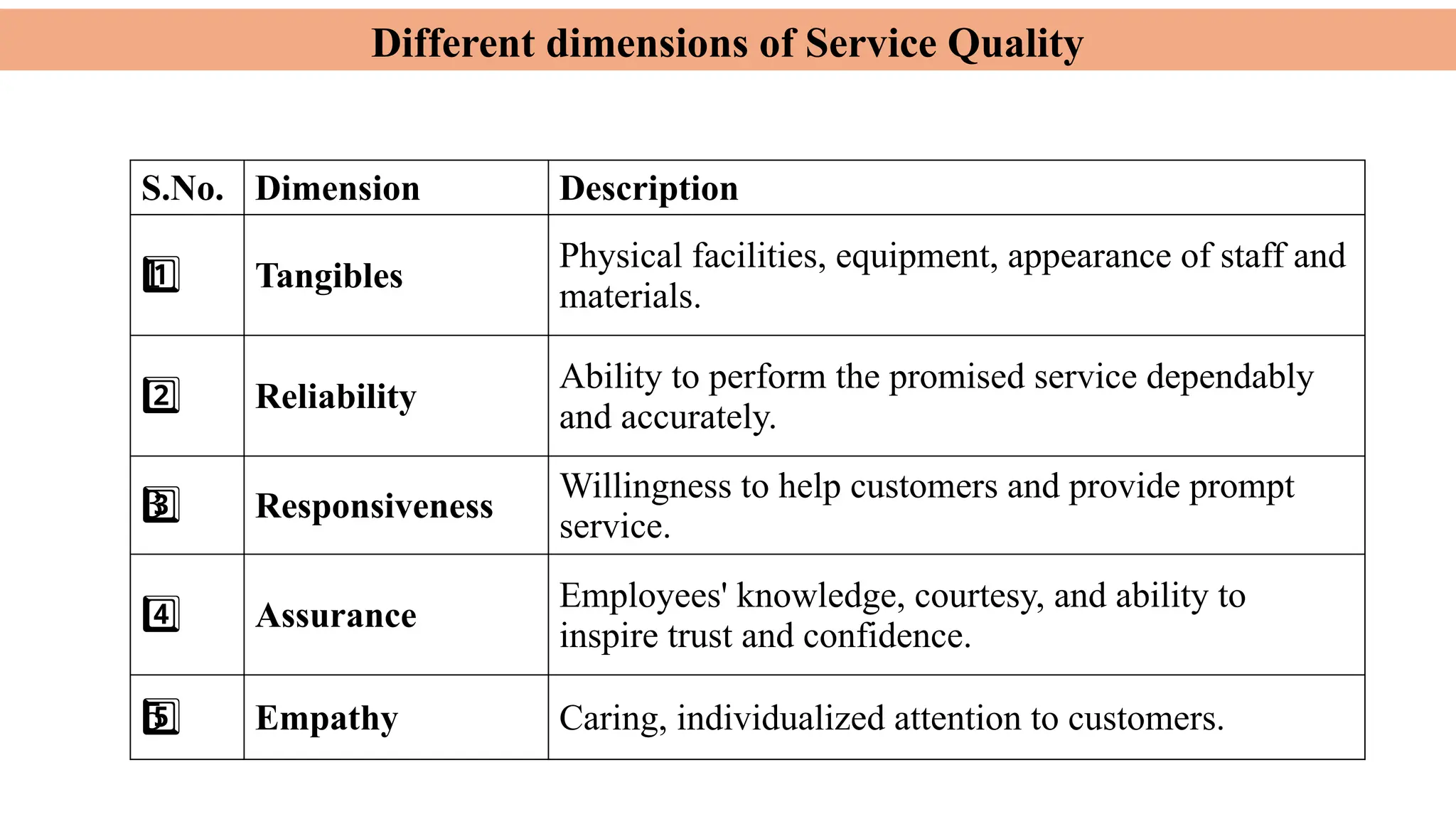
Different dimensions of Service Quality
S.No. Dimension Description
1 ️
1️⃣ Tangibles
Physical facilities, equipment, appearance of staff and
materials.
2️⃣ Reliability
Ability to perform the promised service dependably
and accurately.
3 ️
3️⃣ Responsiveness
Willingness to help customers and provide prompt
service.
4️⃣ Assurance
Employees' knowledge, courtesy, and ability to
inspire trust and confidence.
5 ️
5️⃣ Empathy Caring, individualized attention to customers.
Managing for Quality
Quality Improvement
Six Sigma Projects – Reduce process variation and waste.
Digital Manufacturing Systems – Use of MES (Manufacturing Execution
Systems) for real-time monitoring.
Employee Training – Continuous training programs on GMP, safety, and hygiene.
Conclusions
 Building quality into design reduces long-term risks.
 Digital monitoring and automation enhance reliability.
 Regulatory alignment is essential for global distribution.
 Employee awareness and training are as important as technology.
Case Study: Pfizer
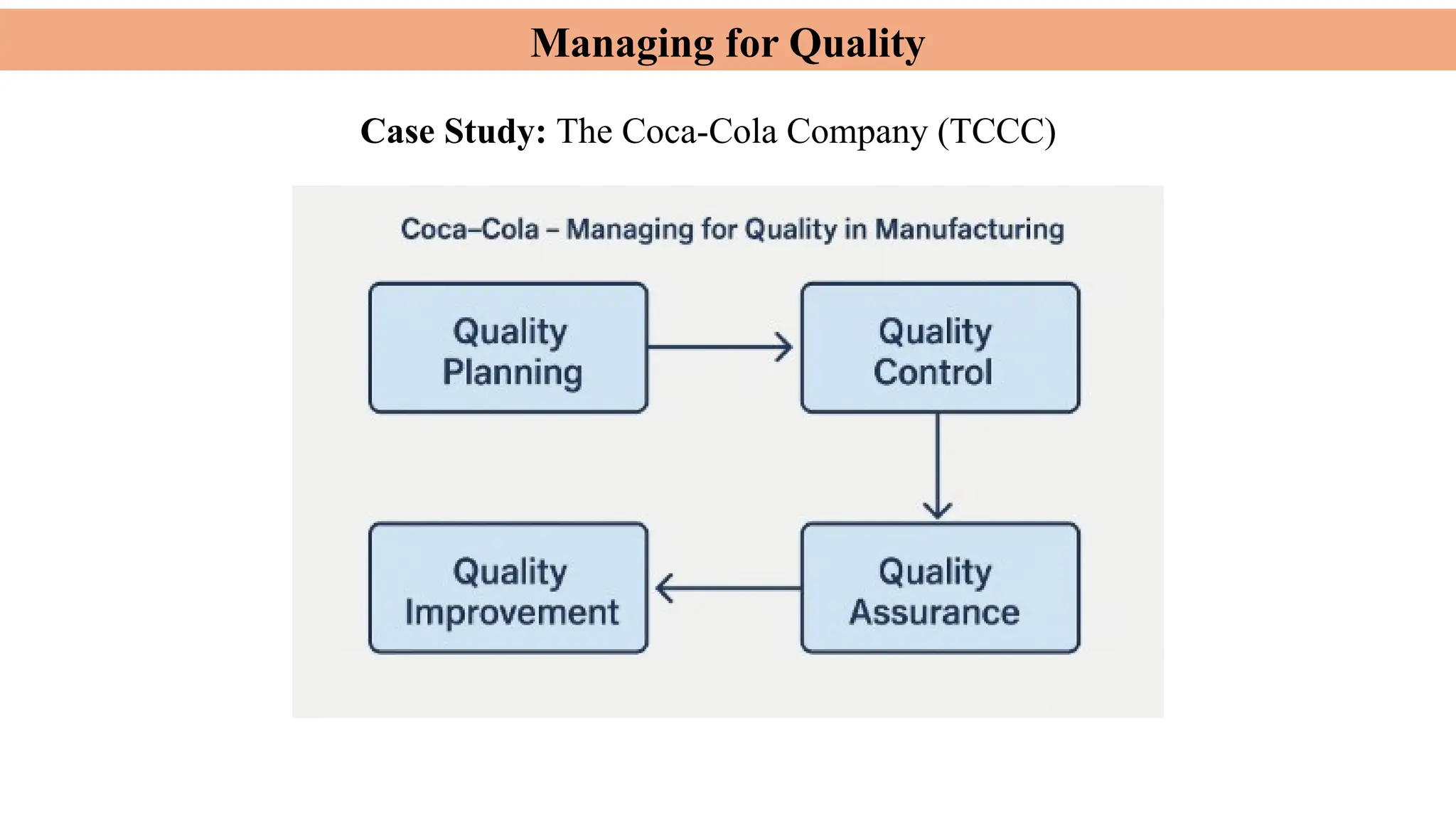
Managing for Quality
It means organizing, leading, and controlling all activities of an organization in a way
that ensures products, services, and processes consistently meet or exceed customer
expectations
Activities in Managing for Quality
What is the quality of FINAL PRODUCT?
What is the quality into every stage of work?
Quality Planning – Identify standards, set objectives, and design processes.
Quality Control – Monitor processes to detect and correct deviations.
Quality Assurance – Build systems that ensure quality is achieved consistently.
Quality Improvement – Implement changes to raise performance levels.
Managing for Quality
Company depends heavily on consistent taste, safety, and quality, no matter where
the product is made.
Case Study: The Coca-Cola Company (TCCC)
TCCC follows the "Right First Time" principle
Their quality management focuses on:
 Customer satisfaction
 Global consistency
 Continuous improvement
 Regulatory compliance
Managing for Quality
Case Study: The Coca-Cola Company (TCCC)
Quality Planning
Global Standards – Coca-Cola has a set of KORE (Coca-Cola Operating
Requirements) that outline safety, quality, and environmental requirements for all
bottling plants worldwide.
Supplier Quality Assurance – All raw materials (water, sugar, flavor
concentrates, CO ) are approved and tested before use.
₂
Process Design – Standardized recipes and manufacturing processes are
documented and digitally controlled.
Managing for Quality
Case Study: The Coca-Cola Company (TCCC)
Quality Control
Incoming Material Inspection – Raw water is purified through multi-stage
filtration and treatment before production.
In-Process Monitoring – Continuous pH, temperature, and sugar-content (Brix)
checks during mixing.
Sensory Evaluation – Trained panels taste samples from every batch to ensure
flavor consistency.
Automated Line Inspection – Vision systems check for fill level, cap seal
integrity, and labeling accuracy.
Managing for Quality
Case Study: The Coca-Cola Company (TCCC)
Quality Assurance
ISO Certifications – Many plants are certified to ISO 9001 (Quality), ISO 22000
(Food Safety), and ISO 14001 (Environment).
HACCP Implementation – Hazards are identified and controlled at each critical
control point (CCP).
Digital Traceability – Each bottle/can has a code for tracing back to its batch,
ingredients, and production line.
Managing for Quality
Case Study: The Coca-Cola Company (TCCC)
Quality Improvement
Six Sigma Projects – Used to reduce defects and variation in processes.
Continuous Training – Employees are trained on hygiene, equipment handling,
and quality procedures.
Customer Feedback Loops – Complaints are logged, analyzed, and lead to
corrective/preventive actions globally.
Managing for Quality
Case Study: The Coca-Cola Company (TCCC)
At a Coca-Cola bottling plant (India)
 Water goes through 8 stages of purification before being mixed with syrup.
 Automated filling machines maintain ±0.5 ml accuracy per bottle.
 Every 30 minutes, a sample bottle is tested for Brix, acidity, carbonation, and
flavor profile.
 Any batch outside set parameters is automatically quarantined until further
testing.
Managing for Quality
Case Study: The Coca-Cola Company (TCCC)

Quality engineering part 1 for engineering undergraduates

  • 1.
    Introduction to QualityEngineering  Quality Engineering focuses on ensuring products and processes meet customer expectations.  Quality Engineering develops a mindset of prevention over correction, and empowers engineers to design better systems, reduce costs, and improve user satisfaction.  Combines statistical methods, process control, and continuous improvement. Quality Degree to which product meets certain requirements or customer expectations at the time of delivery. Quality Engineering
  • 2.
    Introduction to QualityEngineering Purpose of studying QE Ensure Customer Satisfaction Improve Process Efficiency Minimize Defects and Variability Apply Data-Driven Decision Making Design Quality into Products (Design for Quality) Facilitate Continuous Improvement Ensure Compliance and Standards Adherence Enhance Career Opportunities
  • 3.
    Introduction to QualityEngineering Quality Assurance It involves evaluating whether the product meets the intended requirements, performs reliably and satisfies customer needs. Methods  Inspection  Testing (Destructive or Non-destructive)  Statistical Quality Control (SQC)  Customer Feedback or Reviews  Quality Audits (QMS)  Benchmarking  Conformance to specification  Six sigma and lean mfg.
  • 4.
    Different definitions ofQuality Quality by Joseph M. Juran Fitness for Use  It implies that a product or service should meet the needs and expectations of the customer.  Focuses not just on meeting technical specifications, but also on usability, reliability, and performance in real-world conditions. Quality Has Two Aspects 1. Product Feature: Meeting the customer needs. 2. Freedom from Deficiencies: Refers to lack of errors, failures, or defects. “Quality does not happen by accident; it has to be planned.”
  • 5.
    Different definitions ofQuality Quality by Joseph M. Juran The Juran Trilogy  Quality Planning – Identify customers and their needs, develop processes to meet them  Quality Control – Monitor operations and correct deviations from quality standards “Quality does not happen by accident; it has to be planned.”  Quality Improvement – Continual efforts to improve performance and reduce waste.
  • 6.
    Different definitions ofQuality Quality by W. Edwards Deming Quality is pride of workmanship  Apart from standards, a well-designed system where workers take pride in what they produce.  He focused on human motivation, leadership, and long-term thinking.  If there are quality issues, the system must be improved, not just the workers blamed. “Quality is everyone’s responsibility. It should be aimed at the needs of the customer, present and future.” Quality as a System Output
  • 7.
    Different definitions ofQuality Quality by W. Edwards Deming Deming’s Chain Reaction (Cause-effect chain) Improve quality → ↓ costs (less rework, fewer mistakes) → ↑ productivity → ↑ market share → ↑ employment → business survival  Identify the problem or opportunity, analyze it, and develop a plan for improvement. “Quality is everyone’s responsibility. It should be aimed at the needs of the customer, present and future.” PDCA Cycle (Plan–Do–Check–Act)  Implement the plan on a small scale.  Review the results of the test  If successful, implement on a wider scale; if not, refine and try again
  • 8.
    Different definitions ofQuality Quality by Philip B. Crosby Quality is conformance to requirements  It means a product or service is considered high quality if it meets the specifications set by the customer or organization.  Meeting defined standards.  Quality should be built into the process, not fixed later. “Quality is conformance to requirements: Zero-defects philosophy” Zero Defects  Investing in quality systems saves money.  It’s always cheaper to do it right the first time than to pay for rework or failures later.
  • 9.
    Different definitions ofQuality (Comparison) Aspect W. Edwards Deming Joseph M. Juran Philip B. Crosby Definition of Quality “Quality is meeting the needs of the customer, now and in the future.” “Quality is fitness for use.” “Quality is conformance to requirements.” Key Focus System thinking, process improvement, leadership Customer needs, planning, and control Zero defects, prevention, and meeting specifications Main Philosophy Continuous improvement (Kaizen), driven by data and leadership Quality management is a structured process (Juran Trilogy) Do it right the first time; quality is free Core Concept Improve the system to improve quality Focus on planning, control, and improvement Focus on zero defects and prevention Responsibility for Quality Management is responsible for 94% of quality issues Shared but mostly managerial responsibility Entire organization, with emphasis on top management Approach to Defects Reduce variation in processes Control through data and analysis Eliminate through prevention Tools/Models Introduced 14 Points for Management, PDCA Cycle, System of Profound Knowledge Juran Trilogy (Planning, Control, Improvement) Four Absolutes of Quality, Zero Defects Concept View on Inspection Inspection is wasteful — build quality into the process Necessary but not a substitute for quality planning Focus on prevention, not inspection Cost of Quality Emphasizes long-term improvement, not short-term cost Focus on cost of poor quality “Quality is free” — nonconformance is costly
  • 10.
    Different definitions ofQuality Quality by Genichi Taguchi Taguchi Loss Function  Quantifies quality in terms of deviation from the target value, not just whether it's within limits.  The greater the deviation from the target, even if still within spec limits, the greater the "loss to society" (due to poor performance, rework, maintenance, etc.). “Deviation from the target value: Loss to society”
  • 11.
    Different definitions ofQuality Quality by Genichi Taguchi “Deviation from the target value: Loss to society” Concept Description Loss Function Quality loss increases quadratically as a product deviates from its target value. Robust Design Products/processes should perform consistently under varying conditions. Target-Oriented Quality Aim for the target value, not just being within the tolerance limits. Design of Experiments (DOE) Taguchi introduced systematic methods to optimize quality during design.
  • 12.
    Different definitions ofQuality Quality by Genichi Taguchi Loss Function L(x) = k (x−T)2 “Deviation from the target value: Loss to society” The target value (10.0 mm) has zero loss. Even within tolerance (e.g., 9.9 to 10.1 mm), there is still some small quality loss. The further a value is from the target, the greater the loss — increasing quadratically. Where, L(x) = Quality loss x = Actual value T = Target value k = Loss coefficient
  • 13.
    Different definitions ofQuality Quality by Genichi Taguchi Robust Function “Deviation from the target value: Loss to society” It means our product or process works consistently and correctly, even when external conditions (noise) varies. Design of Experiment (DoE) It is a structured, methodical approach used to plan, conduct, analyze, and interpret controlled tests to understand the effect of various input factors on an output (response)..
  • 14.
    Different dimensions ofProduct Quality S.No. Dimension Description 1 ️ 1️⃣ Performance Primary operating characteristics (e.g., speed, power, resolution). 2️⃣ Features Additional attributes or enhancements (e.g., Bluetooth, sunroof). 3 ️ 3️⃣ Reliability Consistency of performance over time; failure rate. 4️⃣ Conformance Degree to which the product meets design and specification standards. 5 ️ 5️⃣ Durability Product lifespan before it breaks or wears out. 6️⃣ Serviceability Ease, speed, and cost of repair and maintenance. 7 ️ 7️⃣ Aesthetics Look, feel, sound, taste, or smell—subjective appeal. 8️⃣ Perceived Quality Customer perception or reputation of the brand/product, even without hands-on experience. by David A. Garvin
  • 15.
    Different dimensions ofService Quality S.No. Dimension Description 1 ️ 1️⃣ Tangibles Physical facilities, equipment, appearance of staff and materials. 2️⃣ Reliability Ability to perform the promised service dependably and accurately. 3 ️ 3️⃣ Responsiveness Willingness to help customers and provide prompt service. 4️⃣ Assurance Employees' knowledge, courtesy, and ability to inspire trust and confidence. 5 ️ 5️⃣ Empathy Caring, individualized attention to customers.
  • 16.
    Managing for Quality QualityImprovement Six Sigma Projects – Reduce process variation and waste. Digital Manufacturing Systems – Use of MES (Manufacturing Execution Systems) for real-time monitoring. Employee Training – Continuous training programs on GMP, safety, and hygiene. Conclusions  Building quality into design reduces long-term risks.  Digital monitoring and automation enhance reliability.  Regulatory alignment is essential for global distribution.  Employee awareness and training are as important as technology. Case Study: Pfizer
  • 17.
    Managing for Quality Itmeans organizing, leading, and controlling all activities of an organization in a way that ensures products, services, and processes consistently meet or exceed customer expectations Activities in Managing for Quality What is the quality of FINAL PRODUCT? What is the quality into every stage of work? Quality Planning – Identify standards, set objectives, and design processes. Quality Control – Monitor processes to detect and correct deviations. Quality Assurance – Build systems that ensure quality is achieved consistently. Quality Improvement – Implement changes to raise performance levels.
  • 18.
    Managing for Quality Companydepends heavily on consistent taste, safety, and quality, no matter where the product is made. Case Study: The Coca-Cola Company (TCCC) TCCC follows the "Right First Time" principle Their quality management focuses on:  Customer satisfaction  Global consistency  Continuous improvement  Regulatory compliance
  • 19.
    Managing for Quality CaseStudy: The Coca-Cola Company (TCCC) Quality Planning Global Standards – Coca-Cola has a set of KORE (Coca-Cola Operating Requirements) that outline safety, quality, and environmental requirements for all bottling plants worldwide. Supplier Quality Assurance – All raw materials (water, sugar, flavor concentrates, CO ) are approved and tested before use. ₂ Process Design – Standardized recipes and manufacturing processes are documented and digitally controlled.
  • 20.
    Managing for Quality CaseStudy: The Coca-Cola Company (TCCC) Quality Control Incoming Material Inspection – Raw water is purified through multi-stage filtration and treatment before production. In-Process Monitoring – Continuous pH, temperature, and sugar-content (Brix) checks during mixing. Sensory Evaluation – Trained panels taste samples from every batch to ensure flavor consistency. Automated Line Inspection – Vision systems check for fill level, cap seal integrity, and labeling accuracy.
  • 21.
    Managing for Quality CaseStudy: The Coca-Cola Company (TCCC) Quality Assurance ISO Certifications – Many plants are certified to ISO 9001 (Quality), ISO 22000 (Food Safety), and ISO 14001 (Environment). HACCP Implementation – Hazards are identified and controlled at each critical control point (CCP). Digital Traceability – Each bottle/can has a code for tracing back to its batch, ingredients, and production line.
  • 22.
    Managing for Quality CaseStudy: The Coca-Cola Company (TCCC) Quality Improvement Six Sigma Projects – Used to reduce defects and variation in processes. Continuous Training – Employees are trained on hygiene, equipment handling, and quality procedures. Customer Feedback Loops – Complaints are logged, analyzed, and lead to corrective/preventive actions globally.
  • 23.
    Managing for Quality CaseStudy: The Coca-Cola Company (TCCC) At a Coca-Cola bottling plant (India)  Water goes through 8 stages of purification before being mixed with syrup.  Automated filling machines maintain ±0.5 ml accuracy per bottle.  Every 30 minutes, a sample bottle is tested for Brix, acidity, carbonation, and flavor profile.  Any batch outside set parameters is automatically quarantined until further testing.
  • 24.
    Managing for Quality CaseStudy: The Coca-Cola Company (TCCC)