
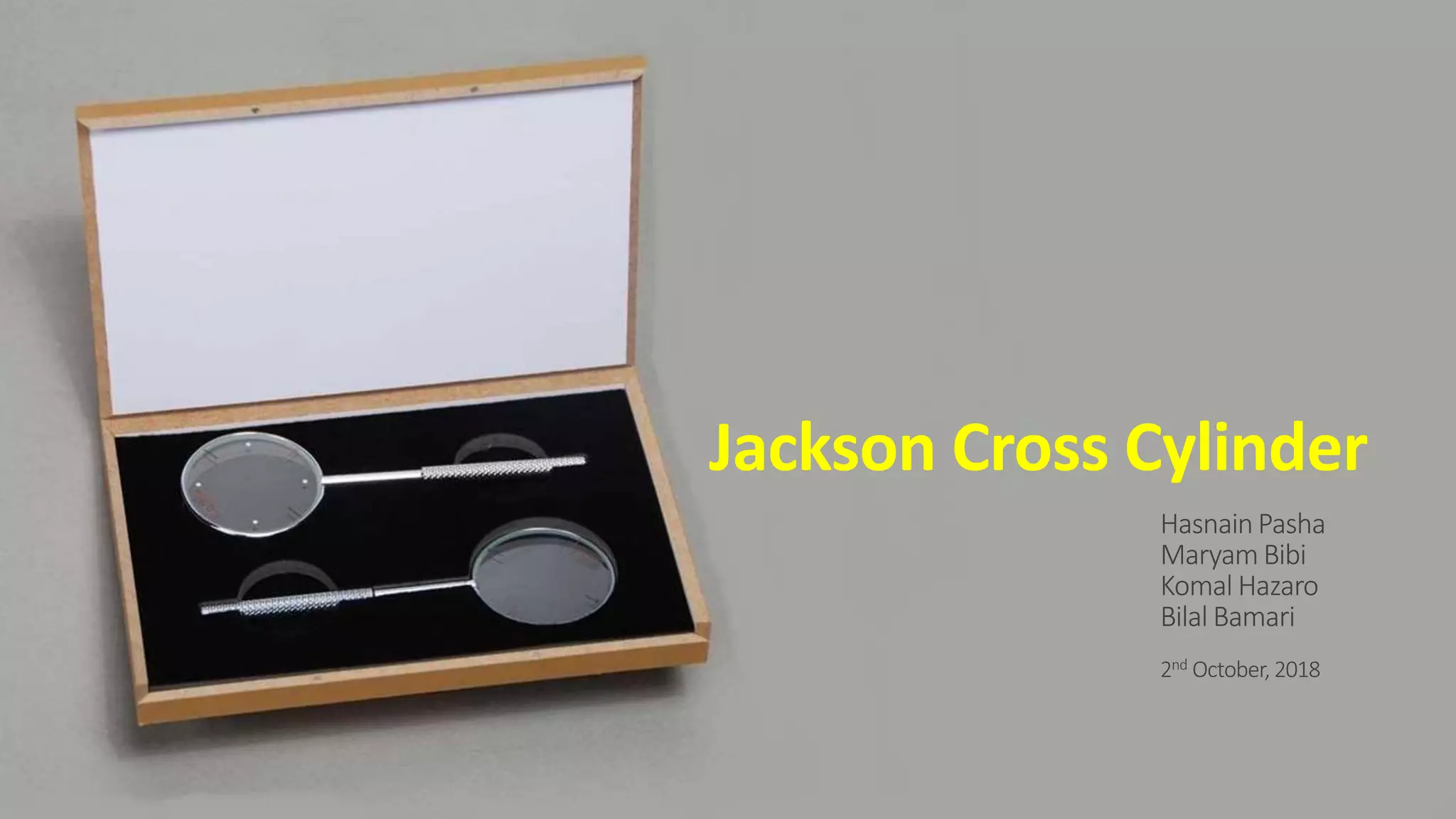



Jackson Cross Cylinder
Hasnain Pasha
Maryam Bibi
Komal Hazaro
Bilal Bamari
2nd October, 2018
@HasnainPashaPK
To understand the optics and uses of
Jackson Cross Cylinder in clinical practice.
Objective
@HasnainPashaPK
Content
• History of JCC
• Definition of JCC
• Anatomy of JCC
• Optical Principle of JCC
• Correcting Astigmatism Subjectively
• Refining CYL Power & Axis
• Correcting Presbyopia
@HasnainPashaPK
Edward Jackson first described the use of a fixed cross cylinder for the
approximation of cylinder power in 1887 and for cylinder axis in 1907.
He was also the first president of the American Academy of
Ophthalmology.
History
@HasnainPashaPK
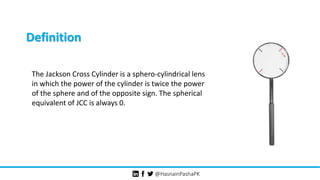
The Jackson Cross Cylinder is a sphero-cylindrical lens
in which the power of the cylinder is twice the power
of the sphere and of the opposite sign. The spherical
equivalent of JCC is always 0.
Definition
@HasnainPashaPK
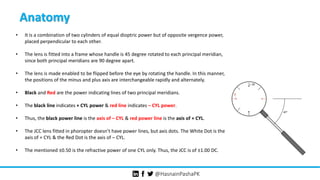
• It is a combination of two cylinders of equal dioptric power but of opposite vergence power,
placed perpendicular to each other.
• The lens is fitted into a frame whose handle is 45 degree rotated to each principal meridian,
since both principal meridians are 90 degree apart.
• The lens is made enabled to be flipped before the eye by rotating the handle. In this manner,
the positions of the minus and plus axis are interchangeable rapidly and alternately.
• Black and Red are the power indicating lines of two principal meridians.
• The black line indicates + CYL power & red line indicates – CYL power.
• Thus, the black power line is the axis of – CYL & red power line is the axis of + CYL.
• The JCC lens fitted in phoropter doesn’t have power lines, but axis dots. The White Dot is the
axis of + CYL & the Red Dot is the axis of – CYL.
• The mentioned ±0.50 is the refractive power of one CYL only. Thus, the JCC is of ±1.00 DC.
Anatomy
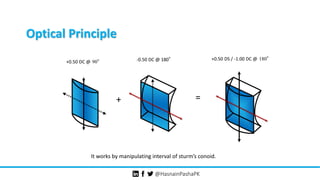
+0.50 DC @ 90°
+ =
+0.50 DS / -1.00 DC @ 180°-0.50 DC @ 180°
JCC(SHARMA IP) @HasnainPashaPK
Optical Principle
It works by manipulating interval of sturm’s conoid.
@HasnainPashaPK
Usage
• To correct astigmatism subjectively.
• To refine the axis and CYL power found in
objective refraction.
• To find out addition power for presbyopes.
@HasnainPashaPK
Correcting Astigmatism subjectively
by using Jackson Cross Cylinder
@HasnainPashaPK
• Distance VA Chart
• Trial frame
• Occluder
• Spherical lenses
• Cylindrical lenses
• JCC
Equipments required
@HasnainPashaPK
• Use ± 0.50 DC JCC when vision is 6/9 or better after spherical correction.
• Use ± 1.00 DC JCC when vision is 6/18 or better after spherical correction.
• Use ± 1.50 DC JCC when vision is 6/24 or worse after spherical correction.
Choosing JCC Power
@HasnainPashaPK
Procedure
• JCC is done monocularly (right eye first) with adjacent eye occluded.
• Before starting JCC, patient’s circle of least confusion must be placed on retina. This can be
achieved by placing monocular spherical correction (Best Vision Sphere) in the trial frame.
• The patient is then given a target on VA chart that they can see easily. The target optotype is
usually 1 or 2 lines obove the vision achieved with BVS.
• Performing JCC can be cut down into three steps.
• To find if patient needs a CYL or not.
• To refine the axis of CYL.
• To refine the power of CYL.
@HasnainPashaPK
1) Finding if patient needs CYL
a. Place the handle of JCC at 45° so that the two principal meridians are at 90° and 180°.
b. Place the handle of JCC at 90° so that the two principal meridians are at 45° and 135°.
• In both settings, give three choices to the patient by flipping and then removing the JCC.
• In first two choices, the positions of + CYL & - CYL axes are interchanged.
• In third choice, the patient is made to see the target optotype without JCC placed over their eyes.
• The patient is then asked to judge which choice is best amongst all. This way, we bracket the 45°arc on which
one of the principal meridian of patient lies. The second step of JCC follows from here.
• If the patient chooses without JCC choice in both settings, we will drop this technique right here because the
patient is not accepting a CYL.
A possible example:
 OD: Accepts – CYL @ 180°
 OS: Accepts no CYL
@HasnainPashaPK
2) Refining CYL Axis
• We have got two techniques to refine the axis, either by using – or by using + CYL.
• In + CYL technique, we’ll chase red power line. And in – CYL technique, we’ll chase black power line.
• Infront of BVS, we’ll place a + CYL if doing + CYL technique or we’ll place a – CYL if doing – CYL technique. The
the power of CYL will be half of the JCC power (equal to the powers of individual CYLs of JCC). E.g. ±0.50 DC if
JCC is of ±1.00 DC (+0.50 DC & -0.50 DC).
1. Align the JCC handle parallel to the axis of CYL that is placed in trial frame.
2. Give three choices, first two by flipping the JCC & third by removing it. If patient chooses one of the first two
choices, rotate CYL by 10° toward the line we are chasing.
3. We will repeat the above step again & again until the choice shows the power line we are chasing, now on
the opposite side as of the side we were proceeding until now, we’ll rotate back the CYL only 5° this time.
4. The end point is when the patient prefers choice 3. The CYL axis is refined now.
A possible example:
 OD: – CYL @ 160°
 OS: Accepts no CYL
@HasnainPashaPK
3) Refining CYL Power
• Align the power lines of JCC parallel to the axis of CYL whose axis was refined in previous step.
• Give three choices, first two by flipping the JCC & third by removing it. If patient prefers one of the
first two choices, see which power line is parallel to the CYL axis.
 If the power line that we are chasing is parallel to the CYL axis, increase respective CYL power in
steps of 0.50 DC. (Because the individual CYLs of the JCC we are using are of ±0.50 DC)
 If the opposite power line is parallel to the CYL axis, decrease respective CYL power in steps of
0.50 DC.
• The end point is when patient sees better with choice 3. The CYL power is refined now.
A possible example:
 OD: – 1.00 @ 160°
 OS: Accepts no CYL
@HasnainPashaPK
Adjusting Sphere
• The JCC helped to constrict the sturm’s conoid but the circle of least confusion is now misplaced
from retina.
• We need to adjust the sphere to bring it back on retina.
• Subtract half of the CYL from the spherical power algebraically. (BVS – ½ CYL)
• The CYL power and axis remains unchanged.
• (Trick: Same signs of BVS & JCC will be subtracted, opposites will be added.)
Examples:
BVS = +2.00 DS
JCC = +1.00 DC @ 160° (+2.00 DS) – (+0.50 DC) = +1.50 DS +1.50 DS / +1.00 DC @ 160°
BVS = -2.00 DS
JCC = -1.00 DC @ 160° (-2.00 DS) – (-0.50 DC) = -1.50 DS -1.50 DS / -1.00 DC @ 160°
BVS = +2.00 DS
JCC = -1.00 DC @ 160° (+2.00 DS) – (-0.50 DC) = +2.50 DS +2.50 DS / -1.00 DC @ 160°
BVS = -2.00 DS
JCC = +1.00 DC @ 160° (-2.00 DS) – (+0.50 DC) = -2.50 DS -2.50 DS / +1.00 DC @ 160°
• In the end, put up the calculated correction in trial frame and see what patient is up to.
@HasnainPashaPK
Refining CYL power & axis found in objective
refraction, using Jackson Cross Cylinder
@HasnainPashaPK
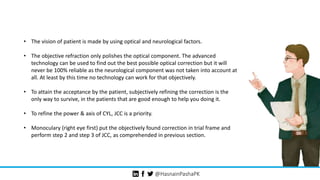
• The vision of patient is made by using optical and neurological factors.
• The objective refraction only polishes the optical component. The advanced
technology can be used to find out the best possible optical correction but it will
never be 100% reliable as the neurological component was not taken into account at
all. At least by this time no technology can work for that objectively.
• To attain the acceptance by the patient, subjectively refining the correction is the
only way to survive, in the patients that are good enough to help you doing it.
• To refine the power & axis of CYL, JCC is a priority.
• Monoculary (right eye first) put the objectively found correction in trial frame and
perform step 2 and step 3 of JCC, as comprehended in previous section.
@HasnainPashaPK
Correcting Presbyopia
by using Jackson Cross Cylinder
@HasnainPashaPK
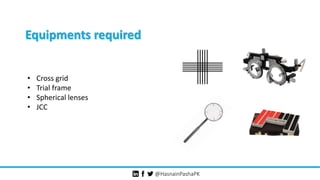
• Cross grid
• Trial frame
• Spherical lenses
• JCC
Equipments required
@HasnainPashaPK
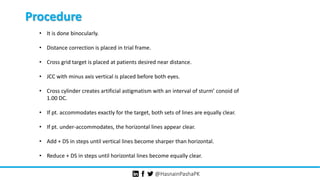
Procedure
• It is done binocularly.
• Distance correction is placed in trial frame.
• Cross grid target is placed at patients desired near distance.
• JCC with minus axis vertical is placed before both eyes.
• Cross cylinder creates artificial astigmatism with an interval of sturm’ conoid of
1.00 DC.
• If pt. accommodates exactly for the target, both sets of lines are equally clear.
• If pt. under-accommodates, the horizontal lines appear clear.
• Add + DS in steps until vertical lines become sharper than horizontal.
• Reduce + DS in steps until horizontal lines become equally clear.
@HasnainPashaPK

Jackson Cross Cylinder

  • 1.
    Jackson Cross Cylinder HasnainPasha Maryam Bibi Komal Hazaro Bilal Bamari 2nd October, 2018
  • 2.
    @HasnainPashaPK To understand theoptics and uses of Jackson Cross Cylinder in clinical practice. Objective
  • 3.
    @HasnainPashaPK Content • History ofJCC • Definition of JCC • Anatomy of JCC • Optical Principle of JCC • Correcting Astigmatism Subjectively • Refining CYL Power & Axis • Correcting Presbyopia
  • 4.
    @HasnainPashaPK Edward Jackson firstdescribed the use of a fixed cross cylinder for the approximation of cylinder power in 1887 and for cylinder axis in 1907. He was also the first president of the American Academy of Ophthalmology. History
  • 5.
    @HasnainPashaPK The Jackson CrossCylinder is a sphero-cylindrical lens in which the power of the cylinder is twice the power of the sphere and of the opposite sign. The spherical equivalent of JCC is always 0. Definition
  • 6.
    @HasnainPashaPK • It isa combination of two cylinders of equal dioptric power but of opposite vergence power, placed perpendicular to each other. • The lens is fitted into a frame whose handle is 45 degree rotated to each principal meridian, since both principal meridians are 90 degree apart. • The lens is made enabled to be flipped before the eye by rotating the handle. In this manner, the positions of the minus and plus axis are interchangeable rapidly and alternately. • Black and Red are the power indicating lines of two principal meridians. • The black line indicates + CYL power & red line indicates – CYL power. • Thus, the black power line is the axis of – CYL & red power line is the axis of + CYL. • The JCC lens fitted in phoropter doesn’t have power lines, but axis dots. The White Dot is the axis of + CYL & the Red Dot is the axis of – CYL. • The mentioned ±0.50 is the refractive power of one CYL only. Thus, the JCC is of ±1.00 DC. Anatomy
  • 7.
    +0.50 DC @90° + = +0.50 DS / -1.00 DC @ 180°-0.50 DC @ 180° JCC(SHARMA IP) @HasnainPashaPK Optical Principle It works by manipulating interval of sturm’s conoid.
  • 8.
    @HasnainPashaPK Usage • To correctastigmatism subjectively. • To refine the axis and CYL power found in objective refraction. • To find out addition power for presbyopes.
  • 9.
  • 10.
    @HasnainPashaPK • Distance VAChart • Trial frame • Occluder • Spherical lenses • Cylindrical lenses • JCC Equipments required
  • 11.
    @HasnainPashaPK • Use ±0.50 DC JCC when vision is 6/9 or better after spherical correction. • Use ± 1.00 DC JCC when vision is 6/18 or better after spherical correction. • Use ± 1.50 DC JCC when vision is 6/24 or worse after spherical correction. Choosing JCC Power
  • 12.
    @HasnainPashaPK Procedure • JCC isdone monocularly (right eye first) with adjacent eye occluded. • Before starting JCC, patient’s circle of least confusion must be placed on retina. This can be achieved by placing monocular spherical correction (Best Vision Sphere) in the trial frame. • The patient is then given a target on VA chart that they can see easily. The target optotype is usually 1 or 2 lines obove the vision achieved with BVS. • Performing JCC can be cut down into three steps. • To find if patient needs a CYL or not. • To refine the axis of CYL. • To refine the power of CYL.
  • 13.
    @HasnainPashaPK 1) Finding ifpatient needs CYL a. Place the handle of JCC at 45° so that the two principal meridians are at 90° and 180°. b. Place the handle of JCC at 90° so that the two principal meridians are at 45° and 135°. • In both settings, give three choices to the patient by flipping and then removing the JCC. • In first two choices, the positions of + CYL & - CYL axes are interchanged. • In third choice, the patient is made to see the target optotype without JCC placed over their eyes. • The patient is then asked to judge which choice is best amongst all. This way, we bracket the 45°arc on which one of the principal meridian of patient lies. The second step of JCC follows from here. • If the patient chooses without JCC choice in both settings, we will drop this technique right here because the patient is not accepting a CYL. A possible example:  OD: Accepts – CYL @ 180°  OS: Accepts no CYL
  • 14.
    @HasnainPashaPK 2) Refining CYLAxis • We have got two techniques to refine the axis, either by using – or by using + CYL. • In + CYL technique, we’ll chase red power line. And in – CYL technique, we’ll chase black power line. • Infront of BVS, we’ll place a + CYL if doing + CYL technique or we’ll place a – CYL if doing – CYL technique. The the power of CYL will be half of the JCC power (equal to the powers of individual CYLs of JCC). E.g. ±0.50 DC if JCC is of ±1.00 DC (+0.50 DC & -0.50 DC). 1. Align the JCC handle parallel to the axis of CYL that is placed in trial frame. 2. Give three choices, first two by flipping the JCC & third by removing it. If patient chooses one of the first two choices, rotate CYL by 10° toward the line we are chasing. 3. We will repeat the above step again & again until the choice shows the power line we are chasing, now on the opposite side as of the side we were proceeding until now, we’ll rotate back the CYL only 5° this time. 4. The end point is when the patient prefers choice 3. The CYL axis is refined now. A possible example:  OD: – CYL @ 160°  OS: Accepts no CYL
  • 15.
    @HasnainPashaPK 3) Refining CYLPower • Align the power lines of JCC parallel to the axis of CYL whose axis was refined in previous step. • Give three choices, first two by flipping the JCC & third by removing it. If patient prefers one of the first two choices, see which power line is parallel to the CYL axis.  If the power line that we are chasing is parallel to the CYL axis, increase respective CYL power in steps of 0.50 DC. (Because the individual CYLs of the JCC we are using are of ±0.50 DC)  If the opposite power line is parallel to the CYL axis, decrease respective CYL power in steps of 0.50 DC. • The end point is when patient sees better with choice 3. The CYL power is refined now. A possible example:  OD: – 1.00 @ 160°  OS: Accepts no CYL
  • 16.
    @HasnainPashaPK Adjusting Sphere • TheJCC helped to constrict the sturm’s conoid but the circle of least confusion is now misplaced from retina. • We need to adjust the sphere to bring it back on retina. • Subtract half of the CYL from the spherical power algebraically. (BVS – ½ CYL) • The CYL power and axis remains unchanged. • (Trick: Same signs of BVS & JCC will be subtracted, opposites will be added.) Examples: BVS = +2.00 DS JCC = +1.00 DC @ 160° (+2.00 DS) – (+0.50 DC) = +1.50 DS +1.50 DS / +1.00 DC @ 160° BVS = -2.00 DS JCC = -1.00 DC @ 160° (-2.00 DS) – (-0.50 DC) = -1.50 DS -1.50 DS / -1.00 DC @ 160° BVS = +2.00 DS JCC = -1.00 DC @ 160° (+2.00 DS) – (-0.50 DC) = +2.50 DS +2.50 DS / -1.00 DC @ 160° BVS = -2.00 DS JCC = +1.00 DC @ 160° (-2.00 DS) – (+0.50 DC) = -2.50 DS -2.50 DS / +1.00 DC @ 160° • In the end, put up the calculated correction in trial frame and see what patient is up to.
  • 17.
    @HasnainPashaPK Refining CYL power& axis found in objective refraction, using Jackson Cross Cylinder
  • 18.
    @HasnainPashaPK • The visionof patient is made by using optical and neurological factors. • The objective refraction only polishes the optical component. The advanced technology can be used to find out the best possible optical correction but it will never be 100% reliable as the neurological component was not taken into account at all. At least by this time no technology can work for that objectively. • To attain the acceptance by the patient, subjectively refining the correction is the only way to survive, in the patients that are good enough to help you doing it. • To refine the power & axis of CYL, JCC is a priority. • Monoculary (right eye first) put the objectively found correction in trial frame and perform step 2 and step 3 of JCC, as comprehended in previous section.
  • 19.
  • 20.
    @HasnainPashaPK • Cross grid •Trial frame • Spherical lenses • JCC Equipments required
  • 21.
    @HasnainPashaPK Procedure • It isdone binocularly. • Distance correction is placed in trial frame. • Cross grid target is placed at patients desired near distance. • JCC with minus axis vertical is placed before both eyes. • Cross cylinder creates artificial astigmatism with an interval of sturm’ conoid of 1.00 DC. • If pt. accommodates exactly for the target, both sets of lines are equally clear. • If pt. under-accommodates, the horizontal lines appear clear. • Add + DS in steps until vertical lines become sharper than horizontal. • Reduce + DS in steps until horizontal lines become equally clear.
  • 22.