Topic:
Cross cell test of accomodation
Submitted to:
Sir Anwer Awan
Submitted by:
• Muhammad Rashid
• Hamza Nadeem
• Sammad Sunny
• Muhammad Ismail
• M. Zeeshan
• Wazeer Sadaqat
• Saqib Abass
• Ahmed kamal
Jackson cross cylinder:
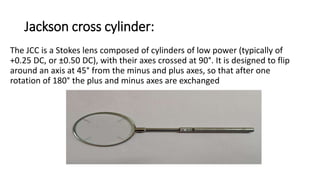
The JCC is a Stokes lens composed of cylinders of low power (typically of
+0.25 DC, or ±0.50 DC), with their axes crossed at 90°. It is designed to flip
around an axis at 45° from the minus and plus axes, so that after one
rotation of 180° the plus and minus axes are exchanged
Optics/ how it is made?
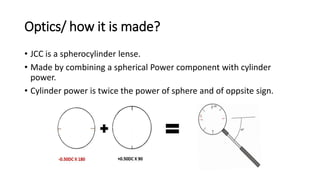
• JCC is a spherocylinder lense.
• Made by combining a spherical Power component with cylinder
power.
• Cylinder power is twice the power of sphere and of oppsite sign.
Example:
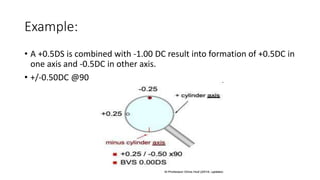
• A +0.5DS is combined with -1.00 DC result into formation of +0.5DC in
one axis and -0.5DC in other axis.
• +/-0.50DC @90
Principle:
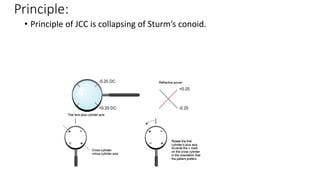
• Principle of JCC is collapsing of Sturm’s conoid.
Uses:
1. Need of cylinder
2. Determination of cylindrical Axis
3. Determination of cylindrical power
4. Presbyopia
5. Accomodation
Presbyopia
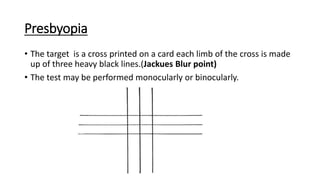
• The target is a cross printed on a card each limb of the cross is made
up of three heavy black lines.(Jackues Blur point)
• The test may be performed monocularly or binocularly.
• The full distance correction is weared by patient.
• The cross target is placed 40 cm in front of the patient.
• A cross cylinder (+ 0.50 D × 180°-0.50 × 90°) is introduced before each
eye.
• In Normal cases:
• If the target is conjugate with the retina (i.e., if the patient can
adequately accommodate to the target), the vertical bar of the cross
will fall as far “behind” the retina as the horizontal bar falls in “front”
of the retina.
• The patient will report equal clarity or blurring of the bars of the
target.
• In presbyopic case:
• If patient is presbyopic, the horizontal bar of the cross will fall closer
to the retina than will the vertical bar; the patient will report that the
horizontal bar is clearer.
• Plus lenses are added until equal clarity (or blurring) is obtained for
both bars of the cross.
• Overcorrection will cause the vertical bar of the cross to be clearer.
Accommodation
• For Normal Patients:
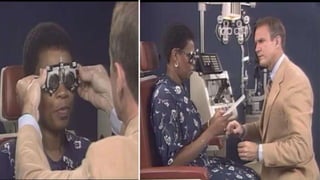
• The patient wears his full-distance correction.
• A 0.25-D or 0.50-D cross cylinder with the minus axis at 90° is placed
before the patient.
• A Jacques blur-point cross is then placed 33 cm from the patient.
• If the patient is not presbyopic, the horizontal and vertical lines will appear
equally clear.
• The card is then slowly moved toward the patient’s eye, and he is asked to
report when the horizontal lines appear blacker than the vertical lines.
• At this point, the amount of accommodation is determined from the
distance between the patient’s eye and the target.
•
• Card is brought closer to the patient’s eye and eyes are forced to
accommodate to keep the lines equally clear. When accommodative
reserve is exhausted, this dual clarity cannot be maintained.
• The lines parallel to the plus axis on the cross cylinder come to lie on or
near the retina.
• Those parallel to the minus axis of the cross cylinder are focused behind
the retina and are less clear.
In presbyopic case:
• A +3D lense is introduced and test is performed again.
• +3 is then subtracted from the final result.
References:
1. Friedman B: The Jackson crossed cylinder. Arch Ophthalmol 24:490, 1940
2. Egan JA: A resume of cross cylinder application and theory. Surv
Ophthalmol 1:513, 1956
3. Jackson E: A trial set of small lenses and a modified trial size frame. Trans
Am Ophthalmol Soc 4:595, 1887
4. Crisp WH: A new cross cylinder test for astigmatic axis. Am J Ophthalmol
26:571, 1942
Is

Cross Cylinder 4th Yr.pptx

  • 1.
    Topic: Cross cell testof accomodation Submitted to: Sir Anwer Awan
  • 2.
    Submitted by: • MuhammadRashid • Hamza Nadeem • Sammad Sunny • Muhammad Ismail • M. Zeeshan • Wazeer Sadaqat • Saqib Abass • Ahmed kamal
  • 3.
    Jackson cross cylinder: TheJCC is a Stokes lens composed of cylinders of low power (typically of +0.25 DC, or ±0.50 DC), with their axes crossed at 90°. It is designed to flip around an axis at 45° from the minus and plus axes, so that after one rotation of 180° the plus and minus axes are exchanged
  • 4.
    Optics/ how itis made? • JCC is a spherocylinder lense. • Made by combining a spherical Power component with cylinder power. • Cylinder power is twice the power of sphere and of oppsite sign.
  • 5.
    Example: • A +0.5DSis combined with -1.00 DC result into formation of +0.5DC in one axis and -0.5DC in other axis. • +/-0.50DC @90
  • 6.
    Principle: • Principle ofJCC is collapsing of Sturm’s conoid.
  • 7.
    Uses: 1. Need ofcylinder 2. Determination of cylindrical Axis 3. Determination of cylindrical power 4. Presbyopia 5. Accomodation
  • 8.
    Presbyopia • The targetis a cross printed on a card each limb of the cross is made up of three heavy black lines.(Jackues Blur point) • The test may be performed monocularly or binocularly.
  • 9.
    • The fulldistance correction is weared by patient. • The cross target is placed 40 cm in front of the patient. • A cross cylinder (+ 0.50 D × 180°-0.50 × 90°) is introduced before each eye. • In Normal cases: • If the target is conjugate with the retina (i.e., if the patient can adequately accommodate to the target), the vertical bar of the cross will fall as far “behind” the retina as the horizontal bar falls in “front” of the retina. • The patient will report equal clarity or blurring of the bars of the target.
  • 10.
    • In presbyopiccase: • If patient is presbyopic, the horizontal bar of the cross will fall closer to the retina than will the vertical bar; the patient will report that the horizontal bar is clearer. • Plus lenses are added until equal clarity (or blurring) is obtained for both bars of the cross. • Overcorrection will cause the vertical bar of the cross to be clearer.
  • 11.
    Accommodation • For NormalPatients: • The patient wears his full-distance correction. • A 0.25-D or 0.50-D cross cylinder with the minus axis at 90° is placed before the patient. • A Jacques blur-point cross is then placed 33 cm from the patient. • If the patient is not presbyopic, the horizontal and vertical lines will appear equally clear. • The card is then slowly moved toward the patient’s eye, and he is asked to report when the horizontal lines appear blacker than the vertical lines. • At this point, the amount of accommodation is determined from the distance between the patient’s eye and the target.
  • 12.
    • • Card isbrought closer to the patient’s eye and eyes are forced to accommodate to keep the lines equally clear. When accommodative reserve is exhausted, this dual clarity cannot be maintained. • The lines parallel to the plus axis on the cross cylinder come to lie on or near the retina. • Those parallel to the minus axis of the cross cylinder are focused behind the retina and are less clear. In presbyopic case: • A +3D lense is introduced and test is performed again. • +3 is then subtracted from the final result.
  • 13.
    References: 1. Friedman B:The Jackson crossed cylinder. Arch Ophthalmol 24:490, 1940 2. Egan JA: A resume of cross cylinder application and theory. Surv Ophthalmol 1:513, 1956 3. Jackson E: A trial set of small lenses and a modified trial size frame. Trans Am Ophthalmol Soc 4:595, 1887 4. Crisp WH: A new cross cylinder test for astigmatic axis. Am J Ophthalmol 26:571, 1942
  • 15.