Jcc
By Avinanda Banerjee
Jackson crossed cylinder ( jcc)
Objective
To understand the optics and proper use of Jackson crossed cylinder in clinical
practice.
Historical perspective
1849 - The original concept of crossed cylinder was described by stokes
1855 - The stokes lens was used in a variation of the present technique by Dennet
Crisp brought it to worldwide attention & it has become known as the jcc
technique.
The present technique designed & described by Dr Edward Jackson for the
determination of cylinder power in 1887 & for axis in 1907.
Introduction
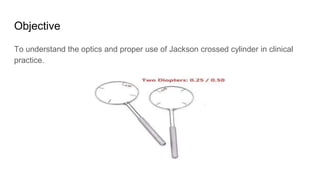
Jcc Jackson crossed cylinder is a combination of two cylinders of equal strength
but of opposite signs placed with their axis at 90° to each other & mounted in a
handle. Jcc is a technique is also called the Flip Cross Technique.
The commonly used cross cylinder are of +/- 0.25 D & +/-0.50 D
The cross cylinder is a sphero cylinder lens in which the power of the
cylinder is twice the power of the sphere & of the opposite sign .
Color code
Principle of jcc
It is designed to flip around an axis at 45° from the minus and plus axes, so that
after one rotation of 180° the plus and minus axes are exchanged
Indications
The Jackson cross cylinder is used to determine corrective lens power and its axis
in patients with astigmatism. It is also used for testing near point of the eye.
Procedure
Best corrected vision with a spherical lens should be identified before using a
Jackson cross cylinder. In case of astigmatism the best vision with a spherical
lens is obtained when the circle of confusion is on the retina.
Detecting Astigmatism
Best corrected vision with a spherical lens should be identified first. The JCC lens
is then placed over spherical lens first with the minus-cylinder axis at 180°, and
then with the axis at 90°. If there is no difference in vision, repeat the test with JCC
lens axis 45° and 135°.If the patient again reports no difference in vision, there is
no astigmatism and if there is improvement in either positions cylindrical lens
should be tried to correct astigmatism
Refinement of axis
Refinement of axis of cylindrical lens in astigmatism correction is done by placing
JCC along with corrective lens with the handle parallel to the axis of corrective
lens in the trial frame.Handle is rotated so that the minus and plus lens in cross
cylinder interchanges. If there is no difference in vision in either position, the axis
of corrective lens is correct and if there is difference in vision, axis should be
rotated to get a clear vision.
Refinement of power
Refinement of power of cylindrical lens in astigmatism correction is done by
placing JCC along with corrective lens with the axis of JCC power parallel to the
axis of corrective lens in the trial frame. Handle is rotated so that the minus and
plus lens in cross cylinder interchanges and if there is no difference in vision in
either position, the power of corrective lens is correct and if there is difference in
vision, power should be adjusted.
Near point of Accommodation
The uniocular and binocular cross cylinder findings at 40 cm give information
about near point of accommodation and near addition needed to correct
presbyopia.
Drawback
Patients can be confused with all the questions
Jcc .pptx

Jcc .pptx

  • 1.
  • 2.
  • 3.
    Objective To understand theoptics and proper use of Jackson crossed cylinder in clinical practice.
  • 4.
    Historical perspective 1849 -The original concept of crossed cylinder was described by stokes 1855 - The stokes lens was used in a variation of the present technique by Dennet Crisp brought it to worldwide attention & it has become known as the jcc technique. The present technique designed & described by Dr Edward Jackson for the determination of cylinder power in 1887 & for axis in 1907.
  • 5.
    Introduction Jcc Jackson crossedcylinder is a combination of two cylinders of equal strength but of opposite signs placed with their axis at 90° to each other & mounted in a handle. Jcc is a technique is also called the Flip Cross Technique. The commonly used cross cylinder are of +/- 0.25 D & +/-0.50 D The cross cylinder is a sphero cylinder lens in which the power of the cylinder is twice the power of the sphere & of the opposite sign .
  • 7.
  • 8.
    Principle of jcc Itis designed to flip around an axis at 45° from the minus and plus axes, so that after one rotation of 180° the plus and minus axes are exchanged
  • 9.
    Indications The Jackson crosscylinder is used to determine corrective lens power and its axis in patients with astigmatism. It is also used for testing near point of the eye.
  • 10.
    Procedure Best corrected visionwith a spherical lens should be identified before using a Jackson cross cylinder. In case of astigmatism the best vision with a spherical lens is obtained when the circle of confusion is on the retina.
  • 11.
    Detecting Astigmatism Best correctedvision with a spherical lens should be identified first. The JCC lens is then placed over spherical lens first with the minus-cylinder axis at 180°, and then with the axis at 90°. If there is no difference in vision, repeat the test with JCC lens axis 45° and 135°.If the patient again reports no difference in vision, there is no astigmatism and if there is improvement in either positions cylindrical lens should be tried to correct astigmatism
  • 12.
    Refinement of axis Refinementof axis of cylindrical lens in astigmatism correction is done by placing JCC along with corrective lens with the handle parallel to the axis of corrective lens in the trial frame.Handle is rotated so that the minus and plus lens in cross cylinder interchanges. If there is no difference in vision in either position, the axis of corrective lens is correct and if there is difference in vision, axis should be rotated to get a clear vision.
  • 13.
    Refinement of power Refinementof power of cylindrical lens in astigmatism correction is done by placing JCC along with corrective lens with the axis of JCC power parallel to the axis of corrective lens in the trial frame. Handle is rotated so that the minus and plus lens in cross cylinder interchanges and if there is no difference in vision in either position, the power of corrective lens is correct and if there is difference in vision, power should be adjusted.
  • 14.
    Near point ofAccommodation The uniocular and binocular cross cylinder findings at 40 cm give information about near point of accommodation and near addition needed to correct presbyopia.
  • 15.
    Drawback Patients can beconfused with all the questions