 Coccidian protozoan
 Obligate parasite


Single-celled
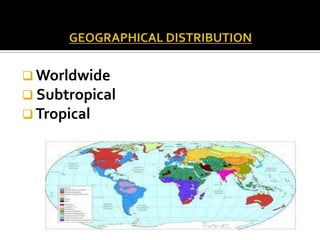
 Worldwide
 Subtropical
 Tropical






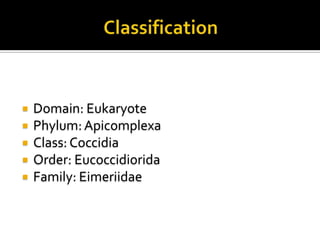
Domain: Eukaryote
Phylum: Apicomplexa
Class: Coccidia
Order: Eucoccidiorida
Family: Eimeriidae


intestinal villus (enterocytes)



lamina propria of the villus
1.
2.

Sexual
Asexual








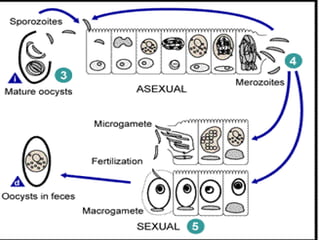
Immature, unsporulated oocyst is excreted through
feces.
Sporoblast divides into two
Each sporoblast develops into a sporocyst with 4
sporozoites, resulting in mature oocysts. The time spent
in stages 1 through 3 is 2-3 days.
Mature oocyst is ingested.
Oocyst bursts. Sporozoites are released and lodge into
the intestinal lining. Sporozoites undergo asexual
reproduction to form merozoites. The merozoites
mature into gametes which undergo fertilization to
produce a new oocyst


Small intestine
Oocyst.
Size:
 20-23 μm long
 10-19 μm wide



Human



Animal
o
o
o

o

.

Transmitted by fecal-oral contamination.
Occurs poor sanitation conditions.
3-14 day incubation period between the
ingestion of an infectious oocyst and onset
of symptoms.
After ingestion, the sporozoites invade in
the small intestine which eventually
destroys these cells.
 Water


contaminated food



Poor sanitation
Acute infection include:
Diarrhea with abdominal pain
 Malabsorption
 Weight loss



Abdominal pain and cramping



Anorexia and weight loss



General malaise



Low fever



Vomiting


Oocysts in the feces



Duodenal biopsy



Enterotest
Typical laboratory analyses include:




Microscopy
Morphologic
comparison
intestinal parasites

 Bench aids for Isospora

with

other


Warn travelers not to visit regions where the
protozoan is endemic


Trimethoprim
(TMP)



Sulfamethoxazole
(SMZ)



Co-trimoxazole

Isospora