The Hook worms
Ancylostoma duodenale & Necator americanus
Lecture by: Maha Gamal Eldein
Introduction
• Ancylostoma duodenale & Necator americanus are nematode worms
• Commonly known as Hookworms.
• Habitat: found in human small intestine.
• They are bloodsucking nematode worms
• Causing the diseases known as hookworm infection, ground itch or tunnel
disease.
• It is soil transmitted infection;(infective stage is larva found in soil)
2
Geographical distribution:
Hookworms are the second most common human worms after
Ascaris lumbricoides, mostly found in tropical and subtropical climate.
A.duodenale found in
• Occurs in the Middle East,
Southern Europe and North
Africa.
N.americanus found in
• Predominates in the America
(North, Central and South
America) and Australia
3
Morphology
(worm& eggs)
4
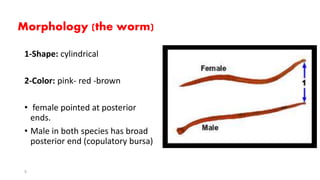
Morphology (the worm)
1-Shape: cylindrical
2-Color: pink- red -brown
• female pointed at posterior
ends.
• Male in both species has broad
posterior end (copulatory bursa)
5
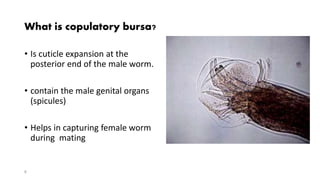
What is copulatory bursa?
• Is cuticle expansion at the
posterior end of the male worm.
• contain the male genital organs
(spicules)
• Helps in capturing female worm
during mating
6
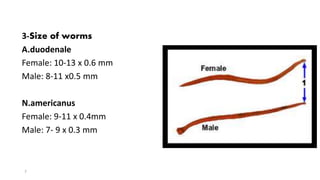
3-Size of worms
A.duodenale
Female: 10-13 x 0.6 mm
Male: 8-11 x0.5 mm
N.americanus
Female: 9-11 x 0.4mm
Male: 7- 9 x 0.3 mm
7
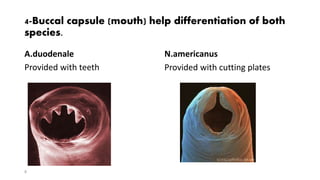
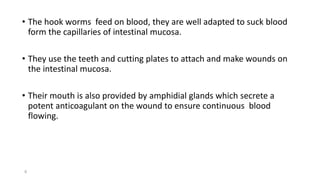
4-Buccal capsule (mouth) help differentiation of both
species.
A.duodenale
Provided with teeth
8
N.americanus
Provided with cutting plates
• The hook worms feed on blood, they are well adapted to suck blood
form the capillaries of intestinal mucosa.
• They use the teeth and cutting plates to attach and make wounds on
the intestinal mucosa.
• Their mouth is also provided by amphidial glands which secrete a
potent anticoagulant on the wound to ensure continuous blood
flowing.
9
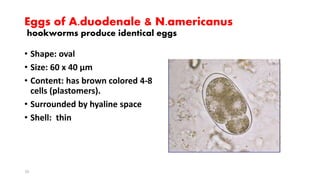
Eggs of A.duodenale & N.americanus
hookworms produce identical eggs
• Shape: oval
• Size: 60 x 40 µm
• Content: has brown colored 4-8
cells (plastomers).
• Surrounded by hyaline space
• Shell: thin
10
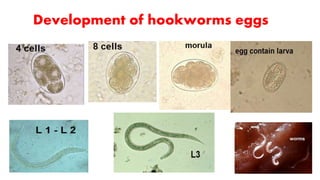
Development of hookworms eggs
11
After 8
hours
How man become infected?
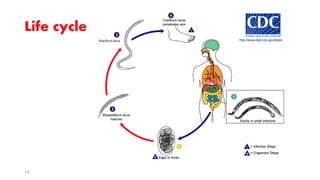
• Man become infected when the infective larval stage (L3) which
found in soil penetrate through the skin.
• The larva enter the blood vessels in the epidermis, reach the heart
then lungs (heart lung migration)
• After 1 week the larva migrate from the lungs through the
bronchial tree, reach the throat then swallowed and enter the
intestine.
12
• In the small intestine the larvae attach to intestinal mucosa, make
wound and feed on blood
• Then grow into adult (male and female) worm in about 5 weeks.
• The mature worms mate . After mating the female worms start laying
eggs.
• Necator americanus produce up to 10 000 eggs per day.
• Ancylostoma duodenale produce up to 30 000 eggs per day.
13
Life cycle
14
How cycle continue?
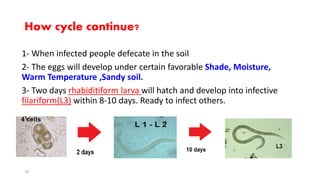
1- When infected people defecate in the soil
2- The eggs will develop under certain favorable Shade, Moisture,
Warm Temperature ,Sandy soil.
3- Two days rhabiditiform larva will hatch and develop into infective
filariform(L3) within 8-10 days. Ready to infect others.
15
Pathology & Symptomatology
1-Cutaneous phase:
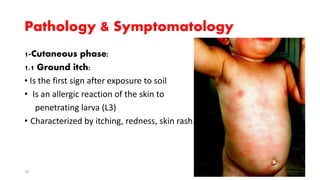
1.1 Ground itch:
• Is the first sign after exposure to soil
• Is an allergic reaction of the skin to
penetrating larva (L3)
• Characterized by itching, redness, skin rash.
16
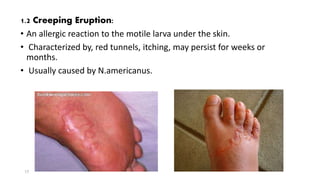
1.2 Creeping Eruption:
• An allergic reaction to the motile larva under the skin.
• Characterized by, red tunnels, itching, may persist for weeks or
months.
• Usually caused by N.americanus.
17
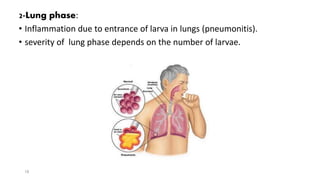
2-Lung phase:
• Inflammation due to entrance of larva in lungs (pneumonitis).
• severity of lung phase depends on the number of larvae.
18
• loss of appetite
• nausea
• stomach or abdominal pain
• vomiting
• weight loss
• Constipation
• diarrhea
• fatigue (tiredness)
• Black stool color
19
3-Intestinal phase:
presence of worms in small intestine will cause the following
Complication of hookworm infection:
• Usually hookworms in human host live for a few years but can live up to
15 years
• The main complication of hookworm is iron deficiency anemia (microcytic
hypochromic), the Hemoglobin level may decrease to 5g/dl or less.
• this occur in chronic infection or heavy infection, due to continuous blood
loss from the wounds made by the worms on the intestine.
20
Complicatios
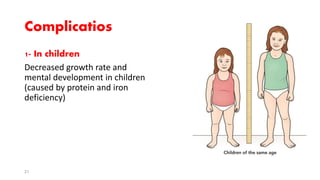
1- In children
Decreased growth rate and
mental development in children
(caused by protein and iron
deficiency)
21
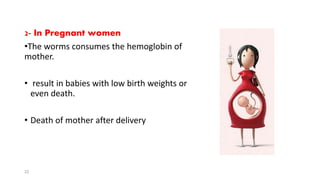
2- In Pregnant women
•The worms consumes the hemoglobin of
mother.
• result in babies with low birth weights or
even death.
• Death of mother after delivery
22
Laboratory Diagnosis
1- what is /are suitable sample/s?
2- what is are suitable diagnostic test/s or technique/s?
3- what is/are the diagnostic stage/s?
23
Summary:
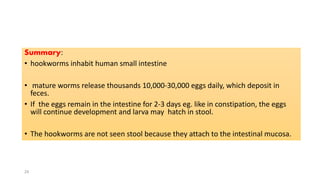
• hookworms inhabit human small intestine
• mature worms release thousands 10,000-30,000 eggs daily, which deposit in
feces.
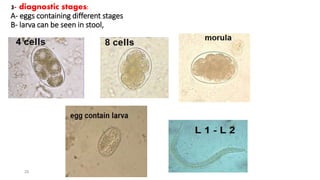
• If the eggs remain in the intestine for 2-3 days eg. like in constipation, the eggs
will continue development and larva may hatch in stool.
• The hookworms are not seen stool because they attach to the intestinal mucosa.
24
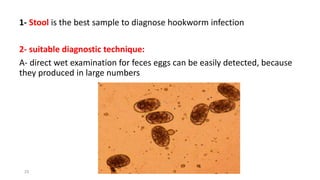
1- Stool is the best sample to diagnose hookworm infection
2- suitable diagnostic technique:
A- direct wet examination for feces eggs can be easily detected, because
they produced in large numbers
25
3- diagnostic stages:
A- eggs containing different stages
B- larva can be seen in stool,
26
After 8
hours
Treatment
Several anthelmintics drugs of choice:
• Pyrantel pamoate
• Mebendozle
• Tetrachloroethylene
• Thiabendazole
• In addition to iron containing supplements
Prognosis
The prognosis is good
27
Prevention & control
• Prevent direct contact with soil
• Prevent contamination of soil with human feces
• Construction of latrines & encouragement of their use.
• Disinfect the soil using aqueous iodine solution to kill the larva.
• Disinfect the night soil before use as fertilizer
28

Hookworms

  • 1.
    The Hook worms Ancylostomaduodenale & Necator americanus Lecture by: Maha Gamal Eldein
  • 2.
    Introduction • Ancylostoma duodenale& Necator americanus are nematode worms • Commonly known as Hookworms. • Habitat: found in human small intestine. • They are bloodsucking nematode worms • Causing the diseases known as hookworm infection, ground itch or tunnel disease. • It is soil transmitted infection;(infective stage is larva found in soil) 2
  • 3.
    Geographical distribution: Hookworms arethe second most common human worms after Ascaris lumbricoides, mostly found in tropical and subtropical climate. A.duodenale found in • Occurs in the Middle East, Southern Europe and North Africa. N.americanus found in • Predominates in the America (North, Central and South America) and Australia 3
  • 4.
  • 5.
    Morphology (the worm) 1-Shape:cylindrical 2-Color: pink- red -brown • female pointed at posterior ends. • Male in both species has broad posterior end (copulatory bursa) 5
  • 6.
    What is copulatorybursa? • Is cuticle expansion at the posterior end of the male worm. • contain the male genital organs (spicules) • Helps in capturing female worm during mating 6
  • 7.
    3-Size of worms A.duodenale Female:10-13 x 0.6 mm Male: 8-11 x0.5 mm N.americanus Female: 9-11 x 0.4mm Male: 7- 9 x 0.3 mm 7
  • 8.
    4-Buccal capsule (mouth)help differentiation of both species. A.duodenale Provided with teeth 8 N.americanus Provided with cutting plates
  • 9.
    • The hookworms feed on blood, they are well adapted to suck blood form the capillaries of intestinal mucosa. • They use the teeth and cutting plates to attach and make wounds on the intestinal mucosa. • Their mouth is also provided by amphidial glands which secrete a potent anticoagulant on the wound to ensure continuous blood flowing. 9
  • 10.
    Eggs of A.duodenale& N.americanus hookworms produce identical eggs • Shape: oval • Size: 60 x 40 µm • Content: has brown colored 4-8 cells (plastomers). • Surrounded by hyaline space • Shell: thin 10
  • 11.
    Development of hookwormseggs 11 After 8 hours
  • 12.
    How man becomeinfected? • Man become infected when the infective larval stage (L3) which found in soil penetrate through the skin. • The larva enter the blood vessels in the epidermis, reach the heart then lungs (heart lung migration) • After 1 week the larva migrate from the lungs through the bronchial tree, reach the throat then swallowed and enter the intestine. 12
  • 13.
    • In thesmall intestine the larvae attach to intestinal mucosa, make wound and feed on blood • Then grow into adult (male and female) worm in about 5 weeks. • The mature worms mate . After mating the female worms start laying eggs. • Necator americanus produce up to 10 000 eggs per day. • Ancylostoma duodenale produce up to 30 000 eggs per day. 13
  • 14.
  • 15.
    How cycle continue? 1-When infected people defecate in the soil 2- The eggs will develop under certain favorable Shade, Moisture, Warm Temperature ,Sandy soil. 3- Two days rhabiditiform larva will hatch and develop into infective filariform(L3) within 8-10 days. Ready to infect others. 15
  • 16.
    Pathology & Symptomatology 1-Cutaneousphase: 1.1 Ground itch: • Is the first sign after exposure to soil • Is an allergic reaction of the skin to penetrating larva (L3) • Characterized by itching, redness, skin rash. 16
  • 17.
    1.2 Creeping Eruption: •An allergic reaction to the motile larva under the skin. • Characterized by, red tunnels, itching, may persist for weeks or months. • Usually caused by N.americanus. 17
  • 18.
    2-Lung phase: • Inflammationdue to entrance of larva in lungs (pneumonitis). • severity of lung phase depends on the number of larvae. 18
  • 19.
    • loss ofappetite • nausea • stomach or abdominal pain • vomiting • weight loss • Constipation • diarrhea • fatigue (tiredness) • Black stool color 19 3-Intestinal phase: presence of worms in small intestine will cause the following
  • 20.
    Complication of hookworminfection: • Usually hookworms in human host live for a few years but can live up to 15 years • The main complication of hookworm is iron deficiency anemia (microcytic hypochromic), the Hemoglobin level may decrease to 5g/dl or less. • this occur in chronic infection or heavy infection, due to continuous blood loss from the wounds made by the worms on the intestine. 20
  • 21.
    Complicatios 1- In children Decreasedgrowth rate and mental development in children (caused by protein and iron deficiency) 21
  • 22.
    2- In Pregnantwomen •The worms consumes the hemoglobin of mother. • result in babies with low birth weights or even death. • Death of mother after delivery 22
  • 23.
    Laboratory Diagnosis 1- whatis /are suitable sample/s? 2- what is are suitable diagnostic test/s or technique/s? 3- what is/are the diagnostic stage/s? 23
  • 24.
    Summary: • hookworms inhabithuman small intestine • mature worms release thousands 10,000-30,000 eggs daily, which deposit in feces. • If the eggs remain in the intestine for 2-3 days eg. like in constipation, the eggs will continue development and larva may hatch in stool. • The hookworms are not seen stool because they attach to the intestinal mucosa. 24
  • 25.
    1- Stool isthe best sample to diagnose hookworm infection 2- suitable diagnostic technique: A- direct wet examination for feces eggs can be easily detected, because they produced in large numbers 25
  • 26.
    3- diagnostic stages: A-eggs containing different stages B- larva can be seen in stool, 26 After 8 hours
  • 27.
    Treatment Several anthelmintics drugsof choice: • Pyrantel pamoate • Mebendozle • Tetrachloroethylene • Thiabendazole • In addition to iron containing supplements Prognosis The prognosis is good 27
  • 28.
    Prevention & control •Prevent direct contact with soil • Prevent contamination of soil with human feces • Construction of latrines & encouragement of their use. • Disinfect the soil using aqueous iodine solution to kill the larva. • Disinfect the night soil before use as fertilizer 28

Editor's Notes