

Eimeria is a genus of Apicomplexan parasites that includes
various species responsible for the poultry form of the disease
coccidiosis. This genus has ~75% of the species within this
family, and it is the most specious of the genera of the
Apicomplexia with 1,700 described species.
The genus is named for the German zoologist Theodor Eimer
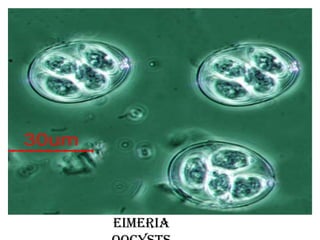
(1843–1898) who discover it.The oocysts of Eimeria steidai were
first seen by the pioneering Dutch microscopist Antoni van
Leeuwenhoek (1632–1723) in the bile of a rabbit in 1674.
Eimeria
•
•
•

•
•
•

•
•

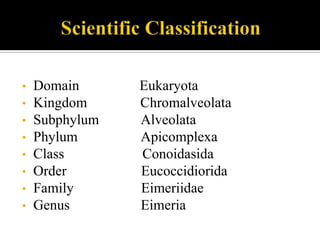
Domain
Kingdom
Subphylum
Phylum
Class
Order
Family
Genus

Eukaryota
Chromalveolata
Alveolata
Apicomplexa
Conoidasida
Eucoccidiorida
Eimeriidae
Eimeria
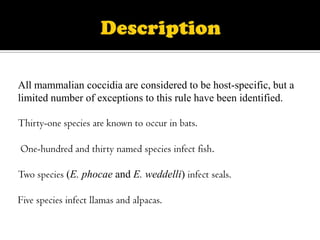
All mammalian coccidia are considered to be host-specific, but a
limited number of exceptions to this rule have been identified.
Thirty-one species are known to occur in bats.
One-hundred and thirty named species infect fish.
Two species (E. phocae and E. weddelli) infect seals.
Five species infect llamas and alpacas.
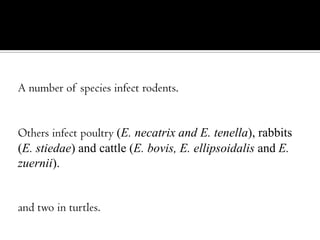
A number of species infect rodents.

Others infect poultry (E. necatrix and E. tenella), rabbits
(E. stiedae) and cattle (E. bovis, E. ellipsoidalis and E.
zuernii).
and two in turtles.
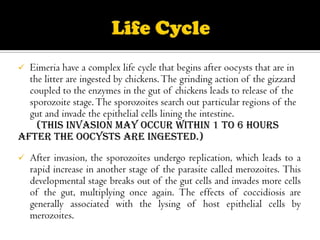
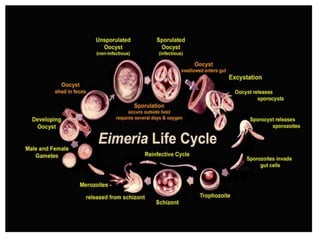
Eimeria have a complex life cycle that begins after oocysts that are in
the litter are ingested by chickens. The grinding action of the gizzard
coupled to the enzymes in the gut of chickens leads to release of the
sporozoite stage. The sporozoites search out particular regions of the
gut and invade the epithelial cells lining the intestine.
(This invasion may occur within 1 to 6 hours
after the oocysts are ingested.)




After invasion, the sporozoites undergo replication, which leads to a
rapid increase in another stage of the parasite called merozoites. This
developmental stage breaks out of the gut cells and invades more cells
of the gut, multiplying once again. The effects of coccidiosis are
generally associated with the lysing of host epithelial cells by
merozoites.
As many as four generations of merozoites may
develop in the gut during an infection. The number of
generations is dependent on the particular species
of Eimeria.


Signal tells merozoites to develop into the sexual stages called
micro- (male) and macro-(female) gametocytes. These develop
into micro- and macrogametes which fuse to form a zygote.
The zygote develops into an oocyst stage that are eventually
released in the feces.



These oocysts are covered by a hard shell, but first must
undergo further development (sporulation) in litter to become
infectious for chickens.
The whole process between oocyst ingestion and
release may take between 4-6 days to complete.
Symptoms of Eimeria infection include
Bloody diarrhea
(due to intestinal epithelium dying off
when a large number of oocysts and
merozoites burst out of the cells).




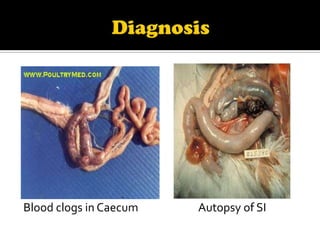
Necrotic tissue clogs the cecum, causing the organ to die.



Birds become fluffy, having blood in droppings.


Autopsy of Small Intestine
(1.Pinpoint hemorrhages can be seen from

outer surface.
2.Intestine when cut refold immediately.
3. Blood in SI & caeca.)


A Polymerase Chain Reaction (PCR) based assay is also done
for the detection, identification and differentiation of
pathogenic species of Eimeria in poultry.



DNA amplification.
Blood clogs in Caecum

Autopsy of SI


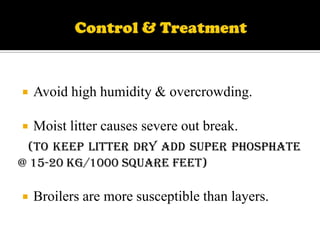
Avoid high humidity & overcrowding.



Moist litter causes severe out break.

(To keep litter dry add super phosphate
@ 15-20 kg/1000 square feet)


Broilers are more susceptible than layers.
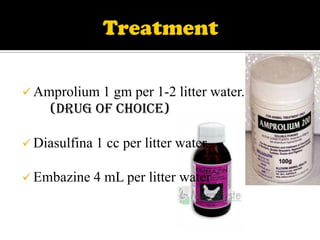
 Amprolium 1

gm per 1-2 litter water.
(Drug of choice)

 Diasulfina

1 cc per litter water.

 Embazine 4

mL per litter water
Eimeria

Eimeria

  • 3.
    Eimeria is agenus of Apicomplexan parasites that includes various species responsible for the poultry form of the disease coccidiosis. This genus has ~75% of the species within this family, and it is the most specious of the genera of the Apicomplexia with 1,700 described species.
  • 4.
    The genus isnamed for the German zoologist Theodor Eimer (1843–1898) who discover it.The oocysts of Eimeria steidai were first seen by the pioneering Dutch microscopist Antoni van Leeuwenhoek (1632–1723) in the bile of a rabbit in 1674.
  • 5.
  • 6.
  • 7.
    All mammalian coccidiaare considered to be host-specific, but a limited number of exceptions to this rule have been identified. Thirty-one species are known to occur in bats. One-hundred and thirty named species infect fish. Two species (E. phocae and E. weddelli) infect seals. Five species infect llamas and alpacas.
  • 8.
    A number ofspecies infect rodents. Others infect poultry (E. necatrix and E. tenella), rabbits (E. stiedae) and cattle (E. bovis, E. ellipsoidalis and E. zuernii). and two in turtles.
  • 9.
    Eimeria have acomplex life cycle that begins after oocysts that are in the litter are ingested by chickens. The grinding action of the gizzard coupled to the enzymes in the gut of chickens leads to release of the sporozoite stage. The sporozoites search out particular regions of the gut and invade the epithelial cells lining the intestine. (This invasion may occur within 1 to 6 hours after the oocysts are ingested.)   After invasion, the sporozoites undergo replication, which leads to a rapid increase in another stage of the parasite called merozoites. This developmental stage breaks out of the gut cells and invades more cells of the gut, multiplying once again. The effects of coccidiosis are generally associated with the lysing of host epithelial cells by merozoites.
  • 10.
    As many asfour generations of merozoites may develop in the gut during an infection. The number of generations is dependent on the particular species of Eimeria.  Signal tells merozoites to develop into the sexual stages called micro- (male) and macro-(female) gametocytes. These develop into micro- and macrogametes which fuse to form a zygote. The zygote develops into an oocyst stage that are eventually released in the feces.  These oocysts are covered by a hard shell, but first must undergo further development (sporulation) in litter to become infectious for chickens. The whole process between oocyst ingestion and release may take between 4-6 days to complete.
  • 12.
    Symptoms of Eimeriainfection include Bloody diarrhea (due to intestinal epithelium dying off when a large number of oocysts and merozoites burst out of the cells).   Necrotic tissue clogs the cecum, causing the organ to die.  Birds become fluffy, having blood in droppings.
  • 13.
     Autopsy of SmallIntestine (1.Pinpoint hemorrhages can be seen from outer surface. 2.Intestine when cut refold immediately. 3. Blood in SI & caeca.)  A Polymerase Chain Reaction (PCR) based assay is also done for the detection, identification and differentiation of pathogenic species of Eimeria in poultry.  DNA amplification.
  • 14.
    Blood clogs inCaecum Autopsy of SI
  • 15.
     Avoid high humidity& overcrowding.  Moist litter causes severe out break. (To keep litter dry add super phosphate @ 15-20 kg/1000 square feet)  Broilers are more susceptible than layers.
  • 16.
     Amprolium 1 gmper 1-2 litter water. (Drug of choice)  Diasulfina 1 cc per litter water.  Embazine 4 mL per litter water