International Organization
for Standardization
ISO
 International organization for standardization.
 It’s an NGO.
 Founded on 23 February 1947.
 Has headquarters in Switzerland.
•HISTORY OF ISO
 Developed as ISA in 1926 in Britain.
 Was disbanded during 2nd world war.
 Was reorganized in 1947.
NEED FOR ISO
1) Isos means equal.
2) To focus more on customers.
3) To increase competition between different
industries producing same product.
4) To enhance working of industries by
standardizing their work.
TYPES OF ISO STANDARDS
1) ISO 9000: Quality management.
2) ISO 14000: Environmental management.
3) ISO 3166: Country codes.
4) ISO 2600: Social responsibility.
5) ISO 50001: Energy management.
6) ISO 31000: Risk management.
7) ISO 22000: Food safety management.
8) ISO 27001: Information security management.
9) ISO 20121: Sustainable events.
ISO 9000: QUALITY
MANAGEMENT SYSTEM
 Defination
 Processes
 Families of ISO 9000
 Policies
 Benefits
WHAT IS QUALITY MANAGEMENT
SYSTEM?
 The collection of business processes focused on
achieving the quality
quality policy.
 It specifies the basic discipline, criteria and the
operations to carry out the implementation of
standards
 Quality management system is required to achieve
the significant product quality
 The quality management system have been useful
for governing the
customer acceptance and the customer
satisfaction
PROCESSES
 Assess requirement
 Plan activity
 Implementation on improved action
 Measurement of results to determine effectiveness
ISO FAMILIES
 ISO 9001
 ISO 9002
 ISO 9003
 ISO 9004
QUALITY POLICY
 Documents developed by the management and the
quality experts
to express the quality objectives
 It helps to provide the satisfaction of customer
along with cost, delivery and service by enterprise
or organization
 It helps to provide the ability to the product or
services to satisfy
stated or implied needs
BENEFITS
 Economical benefits : Results in the improvement
of overall worth
and health of the organization.
 Financial benefits : Results in the improvement of
profit,
improvement of budgetary cost and also helps to
maintain
greater focus on customer requirement.
 Responsive employees.
ISO 14000
Environmental science
THE ISO 14000 SERIES OF
ENVIRONMENTAL MANAGEMENT STANDARDS
 The is a specialised international organisation whose members
are the national standards bodies of 111 countries.
 All standards developed by iso are voluntary.
 ISO14000 is a series of international standards on
environmental management.
 ISO14000 is the first international azttempt to standardize
environment management practices around the world.
 ISO14000 will help integrate the environmental management
systems of companies that trade with each other in all corners of
the world.
SCOPE & STATUS OF ISO 14000
 The first type refers to Organization Standards that
can be used to implement & evaluate the
environmental management system within an
organization . Included are: the ISO14000 series of
EMS standards; the ISO14030 series of standards for
environmental performance evaluation.
INTRODUCTION TO ISO 14001
 ISO 14001 is a powerful management tool that can be
utilized by an organization.
 T he benefits of ISO 14001 are not just applicable to
the organization which adopts it. Adjacent property
owners and environmental groups have the potential
to benefit also.
Te generalized strategic planning process normally
follows the plan,do,check&concepts.
ISO14001 can be integrated into an organization’s
strategic planning process.
ISO 14001 DEFINITIONS
 The definition section of the ISO 14001 standard
provides the foundation of the entire standard. They
need to be implemented.
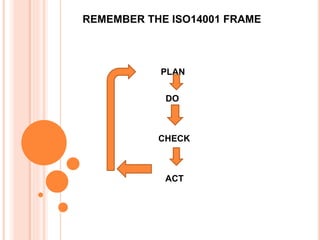
REMEMBER THE ISO14001 FRAME
PLAN
DO
CHECK
ACT
PLAN: Environmental management system
implementation using of ISO14000 guidelines
DO: Conducting life cycle assessment & managing
environmental aspects
CHECK: Conducting audits & evaluating environmental
performance
ACT: Using & maintaining the environmental
management system through continuous improvement
The Plan-Do-Check-Act cycle is the foundation of all ISO
management system standards. The cycle ensures
development,continuous improvement & control of the
management system in question.
CERTIFICATION
 Certification is an useful tool to add creditability, by
demonstrating the product or services that meets
the expectation of customer
 ISO does not perform certification.
 ISO develops International Standards such as ISO
9000 and ISO 14000, but they are not involved in
certification process.
 Certification is performed by external certification
bodies which are independent of ISO management.
 Firms which provide ISO certification to companies
are :
 TNV certification Pvt. Ltd.
 Bargoti Services.
DISPLAYING YOUR ISO CERTIFICATE
 When labelling a product or system as certified to
an ISO Standard ;
 DON’T say: “ISO Certified” or “ISO Certification”
 DO say: “ISO 9001:2008 certification” or “ISO
9001:2008 certified”.
CAN I USE ISO LOGO
 The ISO logo is a registered trademark and cannot
be used by anyone outside ISO, unless authorized.
 If anyone wishes to use the logo they have to
contact certification body that issued the certificate.
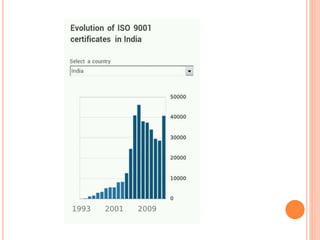
ISO SURVEY
 Every year ISO perform survey of certification to the
management system standards.
 The Survey shows the number of certificates to ISO
Management System given in each country, each
year.
ISO SURVEY 2013
 The 2013 edition shows the comprehensive growth
for all seven ISO management system standards
covered by the survey with a 4% increase in
number of certificates.
 The fluctuation in number of certificates from year
to year is largely due to the variability in response
from individual certification bodies.
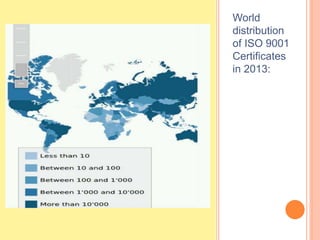
World
distribution
of ISO 9001
Certificates
in 2013:
ADVANTAGES OF ISO SYSTEM:
 More efficient use of resources.
 Increased customer confidence.
 Effective Quality Management control.
 International acceptance.
 Increased transperency and accountabality.
 Access to new markets.
DISADVANTAGES OF STANDARDS:
 The implementation of standards removes the
creative element of program.
 Standards forces to change the methods.
 Reduces the productivity by forcing unnecessary
actions.
 Amount of money spent on paper work for
registration and time required for the process.
MORE INFORMATION
 ISO 9000/ISO 14000 section on ISO Web site:
www.iso.org
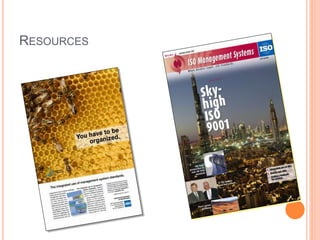
 ISO Management Systems magazine
www.iso.org/ims
 IMS Alerts free electronic newsletter
www.iso.org/imsalerts
RESOURCES

iso info

  • 1.
  • 2.
    ISO  International organizationfor standardization.  It’s an NGO.  Founded on 23 February 1947.  Has headquarters in Switzerland.
  • 3.
    •HISTORY OF ISO Developed as ISA in 1926 in Britain.  Was disbanded during 2nd world war.  Was reorganized in 1947.
  • 4.
    NEED FOR ISO 1)Isos means equal. 2) To focus more on customers. 3) To increase competition between different industries producing same product. 4) To enhance working of industries by standardizing their work.
  • 5.
    TYPES OF ISOSTANDARDS 1) ISO 9000: Quality management. 2) ISO 14000: Environmental management. 3) ISO 3166: Country codes. 4) ISO 2600: Social responsibility. 5) ISO 50001: Energy management. 6) ISO 31000: Risk management. 7) ISO 22000: Food safety management. 8) ISO 27001: Information security management. 9) ISO 20121: Sustainable events.
  • 6.
    ISO 9000: QUALITY MANAGEMENTSYSTEM  Defination  Processes  Families of ISO 9000  Policies  Benefits
  • 7.
    WHAT IS QUALITYMANAGEMENT SYSTEM?  The collection of business processes focused on achieving the quality quality policy.  It specifies the basic discipline, criteria and the operations to carry out the implementation of standards  Quality management system is required to achieve the significant product quality  The quality management system have been useful for governing the customer acceptance and the customer satisfaction
  • 8.
    PROCESSES  Assess requirement Plan activity  Implementation on improved action  Measurement of results to determine effectiveness
  • 9.
    ISO FAMILIES  ISO9001  ISO 9002  ISO 9003  ISO 9004
  • 10.
    QUALITY POLICY  Documentsdeveloped by the management and the quality experts to express the quality objectives  It helps to provide the satisfaction of customer along with cost, delivery and service by enterprise or organization  It helps to provide the ability to the product or services to satisfy stated or implied needs
  • 11.
    BENEFITS  Economical benefits: Results in the improvement of overall worth and health of the organization.  Financial benefits : Results in the improvement of profit, improvement of budgetary cost and also helps to maintain greater focus on customer requirement.  Responsive employees.
  • 13.
  • 14.
    THE ISO 14000SERIES OF ENVIRONMENTAL MANAGEMENT STANDARDS  The is a specialised international organisation whose members are the national standards bodies of 111 countries.  All standards developed by iso are voluntary.  ISO14000 is a series of international standards on environmental management.  ISO14000 is the first international azttempt to standardize environment management practices around the world.  ISO14000 will help integrate the environmental management systems of companies that trade with each other in all corners of the world.
  • 15.
    SCOPE & STATUSOF ISO 14000  The first type refers to Organization Standards that can be used to implement & evaluate the environmental management system within an organization . Included are: the ISO14000 series of EMS standards; the ISO14030 series of standards for environmental performance evaluation.
  • 16.
    INTRODUCTION TO ISO14001  ISO 14001 is a powerful management tool that can be utilized by an organization.  T he benefits of ISO 14001 are not just applicable to the organization which adopts it. Adjacent property owners and environmental groups have the potential to benefit also. Te generalized strategic planning process normally follows the plan,do,check&concepts. ISO14001 can be integrated into an organization’s strategic planning process.
  • 17.
    ISO 14001 DEFINITIONS The definition section of the ISO 14001 standard provides the foundation of the entire standard. They need to be implemented.
  • 18.
    REMEMBER THE ISO14001FRAME PLAN DO CHECK ACT
  • 19.
    PLAN: Environmental managementsystem implementation using of ISO14000 guidelines DO: Conducting life cycle assessment & managing environmental aspects CHECK: Conducting audits & evaluating environmental performance ACT: Using & maintaining the environmental management system through continuous improvement The Plan-Do-Check-Act cycle is the foundation of all ISO management system standards. The cycle ensures development,continuous improvement & control of the management system in question.
  • 20.
    CERTIFICATION  Certification isan useful tool to add creditability, by demonstrating the product or services that meets the expectation of customer  ISO does not perform certification.  ISO develops International Standards such as ISO 9000 and ISO 14000, but they are not involved in certification process.  Certification is performed by external certification bodies which are independent of ISO management.
  • 21.
     Firms whichprovide ISO certification to companies are :  TNV certification Pvt. Ltd.  Bargoti Services.
  • 22.
    DISPLAYING YOUR ISOCERTIFICATE  When labelling a product or system as certified to an ISO Standard ;  DON’T say: “ISO Certified” or “ISO Certification”  DO say: “ISO 9001:2008 certification” or “ISO 9001:2008 certified”.
  • 23.
    CAN I USEISO LOGO  The ISO logo is a registered trademark and cannot be used by anyone outside ISO, unless authorized.  If anyone wishes to use the logo they have to contact certification body that issued the certificate.
  • 24.
    ISO SURVEY  Everyyear ISO perform survey of certification to the management system standards.  The Survey shows the number of certificates to ISO Management System given in each country, each year.
  • 25.
    ISO SURVEY 2013 The 2013 edition shows the comprehensive growth for all seven ISO management system standards covered by the survey with a 4% increase in number of certificates.  The fluctuation in number of certificates from year to year is largely due to the variability in response from individual certification bodies.
  • 26.
  • 28.
    ADVANTAGES OF ISOSYSTEM:  More efficient use of resources.  Increased customer confidence.  Effective Quality Management control.  International acceptance.  Increased transperency and accountabality.  Access to new markets.
  • 29.
    DISADVANTAGES OF STANDARDS: The implementation of standards removes the creative element of program.  Standards forces to change the methods.  Reduces the productivity by forcing unnecessary actions.  Amount of money spent on paper work for registration and time required for the process.
  • 30.
    MORE INFORMATION  ISO9000/ISO 14000 section on ISO Web site: www.iso.org  ISO Management Systems magazine www.iso.org/ims  IMS Alerts free electronic newsletter www.iso.org/imsalerts
  • 31.