The Benefits of an ISO 9001:2008 Quality Management System
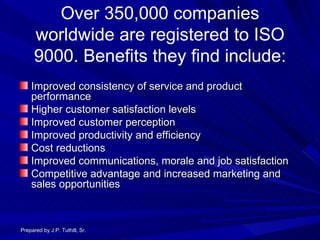
Over 350,000 companies worldwide are registered to ISO 9000. Benefits they find include: Improved consistency of service and product performance Higher customer satisfaction levels Improved customer perception  Improved productivity and efficiency Cost reductions Improved communications, morale and job satisfaction  Competitive advantage and increased marketing and sales opportunities Prepared by J.P. Tuthill, Sr.
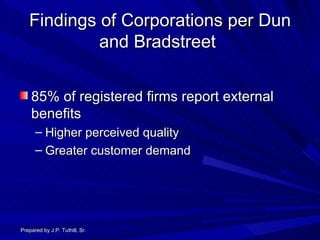
Findings of Corporations per Dun and Bradstreet  85% of registered firms report external benefits Higher perceived quality Greater customer demand Prepared by J.P. Tuthill, Sr.
Findings of Corporations per Dun and Bradstreet 95% report internal benefits Greater employee awareness Increased operational efficiency Reduced scrap expense Prepared by J.P. Tuthill, Sr.
General Benefits of Registration to ISO 9001:2000 Enables your organization to become more cost-effective, efficient and resilient to change. Requires your organization to monitor and improve key business and customer satisfaction measures. Improve internal communications. Improves product and process quality. Provides a passport to the global market. Prepared by J.P. Tuthill, Sr.
Typical Business Conditions resulting from incorporation of a Quality Management System Increased Productivity Reduced scrap and waste Record sales level Catching  inferior raw materials before they were used Prepared by J.P. Tuthill, Sr.
CIRAS (Center for Industrial Research and Service) News Reports Cutting quality cost in half can increase profit more than a 10 percent increase in sales. ISO 9000 is the most promising method for cutting the cost of quality. Prepared by J.P. Tuthill, Sr.
ISO Quality Standard Provides Corporations With Substantial Financial Rewards  US publicly held companies traded on the NYSE that received registration under the ISO 9000 quality standard show significant improvement in financial performance compared to those companies that have not pursued the standard. The firms that failed to seek registration experienced substantial deterioration in return on assets, productivity and sales.  Registered companies avoided such declines. Source: http://www.manufacturingnews.com/news/02/0830/art1.html Prepared by J.P. Tuthill, Sr.
Phases in Achieving ISO 9000 Registration Phase I: Awareness Development – Company wide training in ISO 9000 requirements Phase II: Documentation Phase – Document what you do and do what you document. Phase III: Gap Analysis – Audit the company operations, establish a Corrective/Preventive Action (CAPA) Plan, and train Internal Auditors.  Phase IV: Internal Audit Report and Scheduling – Internal Auditor Training from Phase III will serve as 1 st  Internal Audit. Audit schedules and Audit Reports will be documented as Quality Records. Phase V: Management Review & Quality Registrar Selection – Conduct a Management Review of the 1 st  Internal Audit and subsequent CAPA Plan. Pick a Quality Registrar to assess your company for Quality System approval. Prepared by J.P. Tuthill, Sr.

Iso 9000 Presentation

  • 1.
    The Benefits ofan ISO 9001:2008 Quality Management System
  • 2.
    Over 350,000 companiesworldwide are registered to ISO 9000. Benefits they find include: Improved consistency of service and product performance Higher customer satisfaction levels Improved customer perception Improved productivity and efficiency Cost reductions Improved communications, morale and job satisfaction Competitive advantage and increased marketing and sales opportunities Prepared by J.P. Tuthill, Sr.
  • 3.
    Findings of Corporationsper Dun and Bradstreet 85% of registered firms report external benefits Higher perceived quality Greater customer demand Prepared by J.P. Tuthill, Sr.
  • 4.
    Findings of Corporationsper Dun and Bradstreet 95% report internal benefits Greater employee awareness Increased operational efficiency Reduced scrap expense Prepared by J.P. Tuthill, Sr.
  • 5.
    General Benefits ofRegistration to ISO 9001:2000 Enables your organization to become more cost-effective, efficient and resilient to change. Requires your organization to monitor and improve key business and customer satisfaction measures. Improve internal communications. Improves product and process quality. Provides a passport to the global market. Prepared by J.P. Tuthill, Sr.
  • 6.
    Typical Business Conditionsresulting from incorporation of a Quality Management System Increased Productivity Reduced scrap and waste Record sales level Catching inferior raw materials before they were used Prepared by J.P. Tuthill, Sr.
  • 7.
    CIRAS (Center forIndustrial Research and Service) News Reports Cutting quality cost in half can increase profit more than a 10 percent increase in sales. ISO 9000 is the most promising method for cutting the cost of quality. Prepared by J.P. Tuthill, Sr.
  • 8.
    ISO Quality StandardProvides Corporations With Substantial Financial Rewards US publicly held companies traded on the NYSE that received registration under the ISO 9000 quality standard show significant improvement in financial performance compared to those companies that have not pursued the standard. The firms that failed to seek registration experienced substantial deterioration in return on assets, productivity and sales. Registered companies avoided such declines. Source: http://www.manufacturingnews.com/news/02/0830/art1.html Prepared by J.P. Tuthill, Sr.
  • 9.
    Phases in AchievingISO 9000 Registration Phase I: Awareness Development – Company wide training in ISO 9000 requirements Phase II: Documentation Phase – Document what you do and do what you document. Phase III: Gap Analysis – Audit the company operations, establish a Corrective/Preventive Action (CAPA) Plan, and train Internal Auditors. Phase IV: Internal Audit Report and Scheduling – Internal Auditor Training from Phase III will serve as 1 st Internal Audit. Audit schedules and Audit Reports will be documented as Quality Records. Phase V: Management Review & Quality Registrar Selection – Conduct a Management Review of the 1 st Internal Audit and subsequent CAPA Plan. Pick a Quality Registrar to assess your company for Quality System approval. Prepared by J.P. Tuthill, Sr.