


www.iso.org
International Organization
for Standardization
Dr Naqeeb Ullah Khan
XYZ Hospital Islamabad
International Organization
for Standardization
ISO (International Organization for Standardization) is the
world's largest developer and publisher of International
Standards.
It is a network of the National Standards Institutes of 163
countries with a Central Secretariat in Geneva.
It is an NGO that forms a bridge between the public and
private sectors. Many of its member institutes are from
governmental sectors while some are also from private
sector.
What is ISO
ISO would have different acronyms in different languages,
e.g
in English: International Organization for Standardization.
(IOS)
in French:Organisation internationale de normalisation).
(OIN)
But the founders decided to give it a short and all-purpose
name. Whatever the country, whatever the language, the
short form of the organization's name is always ISO.
ISO derived from the Greek isos, meaning "equal".
ISO's name
Overview of
ISO 9001
and
ISO 14001
ISO 9001 and ISO 14001
ISO 9001 and ISO 14001 are among ISO's most well
known standards ever.
They are implemented by more than one million
organizations in some 175 countries.
ISO 9001 helps organizations to implement quality
management.
ISO 14001 helps organizations to implement
environmental management.
Quality Management
Quality refers to all those features of a product
(or service) which are required by the customer.
Quality Management means what the organization does
to ensure that its products or services satisfy the
customer's quality requirements and comply with any
regulations applicable to those products or services.
Quality management also means what the organization
does to enhance customer satisfaction, and achieve
continual improvement of its performance.
Environmental Management
Environmental Management.
This means what the organization does to:
minimize harmful effects on the environment
caused by its activities,
to conform to applicable regulatory
requirements, and to achieve continual
improvement of its environmental performance.
Generic standards
ISO 9001 and ISO 14001 are generic standards.
Generic means that the same standards can be
applied:
to any organization, large or small, whatever its
product or service, and
in any sector of activity, and whether it is a
business enterprise, a public administration, or a
government department.
Generic standards (cont.)
Generic also means that no matter what the
organization's scope of activity
if it wants to establish a quality management
system, ISO 9001 gives the essential features
and if it wants to establish an environmental
management system, ISO 14001 gives the
essential features.
Management Systems
Management System:
The way the organization manage its activities in
order that its products or services meet the
organization’s objectives, such as:
• satisfying the customer's quality requirements,
• complying to regulations, and
• meeting environmental objectives
is called management system
Management Systems (cont.)
The most efficient and effective way the
organization can manage is by systemization,
e.g.
 Make sure that nothing important is left out.
 Everyone is clear about who is responsible for
doing what, when, how, why and where.
Management system standards provide the organization with
an international, state-of-the-art model to follow.
Management Systems (cont.)
Large organizations, or ones with complicated
processes, could not function well without
management systems.
Companies in such fields as aerospace,
automobiles, defense, or health care devices
have been operating management systems for
years.
The ISO 9001 and ISO 14001 management
system standards now make these successful
practices available for all organizations.
Processes, not products
Both ISO 9001 and ISO 14001 concern the way
an organization goes about its work.
They are not product standards.
They are not service standards.
But they are process standards.
They can be used by product manufacturers
and service providers.
Process
Processes, not products (cont.)
Processes affect final products or services.
ISO 9001 gives the requirements for what the
organization must do to manage processes
affecting quality of its products and services.
ISO 14001 gives the requirements for what the
organization must do to manage processes
affecting the impact of its activities on the
environment.
Clauses
Certification and registration
It means that an independent, external body
has audited an organization's management
system and verified that it conforms to the
requirements specified in the standard (ISO 9001).
ISO does not carry out certification and does
not issue or approve certificates,
ISO 9001 certification shows commitment to quality,
customers, and a willingness to work towards improving
efficiency.
It demonstrates the existence of an effective quality
management system that satisfies an independent,
external audit.
ISO 9001 certification enhances company image in the
eyes of customers, employees and shareholders alike.
It also gives a competitive edge to an organisation's
marketing
Why seek ISO 9001 certification?
First Identify the requirements of ISO 9001 and how they
apply to your business.
Establish quality objectives and how they fit in to the
operation of the business.
Produce a documented quality policy indicating how
these requirements are satisfied.
Communicate them throughout the organization.
Steps required for ISO 9001 certification
Evaluate the quality policy, its stated objectives and then
prioritize requirements to ensure they are met.
Identify the boundaries of the management system and
produce documented procedures as required.
Ensure these procedures are suitable and adhered to.
Once developed, internal audits are needed to ensure
the system carries on working.
Steps required for ISO 9001 certification (cont.)
When all the requirements of ISO 9001 have been met, it
is time for an external audit.
This should be carried out by a third party, accredited
certification body.
The chosen certification body will review the quality
manuals and procedures. This process involves looking at
the organization evaluation of quality and ascertains if
targets set for the management programme are
measurable and achievable.
Assessment to ISO 9001
This is followed at a later date by a full on-site audit to
ensure that working practices observe the procedures and
stated objectives and that appropriate records are kept.
After a successful audit, a certificate of registration to ISO
9001 will be issued.
There will then be surveillance visits (usually once or twice
a year) to ensure that the system continues to work.
Assessment to ISO 9001 (cont.)
5/13/2015 21
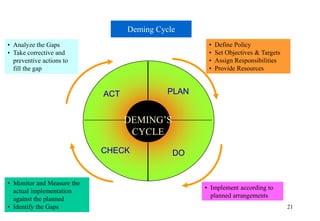
DEMING’S
CYCLE
PLAN
DOCHECK
ACT
• Define Policy
• Set Objectives & Targets
• Assign Responsibilities
• Provide Resources
• Implement according to
planned arrangements
• Monitor and Measure the
actual implementation
against the planned
• Identify the Gaps
• Analyze the Gaps
• Take corrective and
preventive actions to
fill the gap
Deming Cycle
Process Approach
Accreditation
Accreditation means the formal approval by a
specialized body that a certification body is competent to
carry out ISO 9001:2008 or ISO 14001:2004 certification
in specified business sectors.
Certificates issued by accredited certification bodies - and
known as accredited certificates - may be perceived on
the market as having increased credibility.
ISO itself does not carry out or approve accreditations.
Certification not a requirement
Certification is not a requirement of ISO 9001
or ISO 14001.
The organization can implement and benefit from
an ISO 9001 or ISO 14001 system without having
it certified.
The organization can implement them for the
internal benefits without spending money on a
certification programme.
Certification is a business decision
Certification is a decision to be taken for
business reasons:
if it is a contractual, regulatory, or market
requirement,
Or if it meets customer preferences
Or it is part of a risk management programme, or
if it will motivate staff by setting a clear goal.
ISO does not certify
ISO does not carry out ISO 9001 or ISO 14001
certification.
ISO does not issue certificates.
ISO does not accredit, approve or control the
certification bodies.
ISO develops standards and guides to
encourage good practice in accreditation and
certification.
The ISO 9000 family
ISO 9001 is the standard that gives the
requirements for a quality management system.
ISO 9001:2008 is the latest, improved version.
It is the only standard in the ISO 9000 family that
can be used for certification.
There are 16 other standards in the family that
can help an organization on specific aspects such
as performance improvement, auditing, training…
The ISO 14000 family
ISO 14001 is the standard that gives the requirements for
an environmental management system.
ISO 14001:2004 is the latest, improved version.
It is the only standard in the ISO 14000 family that can
be used for certification.
The ISO 14000 family includes 21 other standards that
can help an organization specific aspects such as
auditing, environmental labelling, etc.
ISO 9000 Series
The ISO Survey
The ISO Survey (cont.)
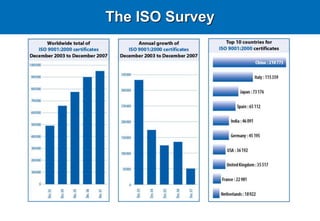
The worldwide total of certificates to ISO
9001:2001 at the end of 2007 was 9,51,486.
This was increase of 6 % over 2006 when the
total was 8,96,929 certificates.
Certificates had been issued in 175 countries
compared to 170 the previous year.
The ISO Survey (cont.)
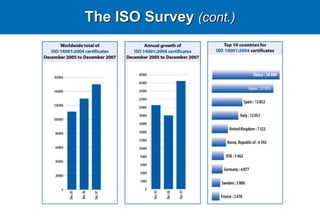
The worldwide total of ISO 14001 certificates at
the end of 2007 was 1,54,572.
This was an increase of 21 % over 2006 when
the total was 1,28,211.
Certificates had been issued in 148 countries
compared to 140 the year before.
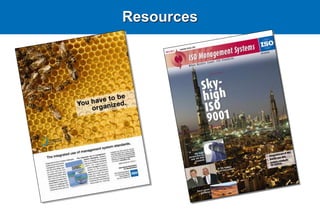
Resources
Thank You
very much
Indeed
34Running title of presentation
PR/mo/item ID
Date
5/13/2015 34
35Running title of presentation
PR/mo/item ID
Date
5/13/2015 35
36Running title of presentation
PR/mo/item ID
Date
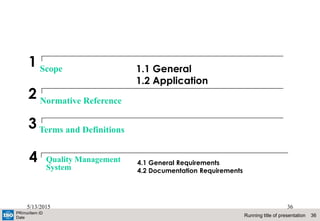
5/13/2015 36
Scope 1.1 General
1.2 Application
1
Normative Reference
2
Terms and Definitions3
Quality Management
System
4.1 General Requirements
4.2 Documentation Requirements
4
37Running title of presentation
PR/mo/item ID
Date
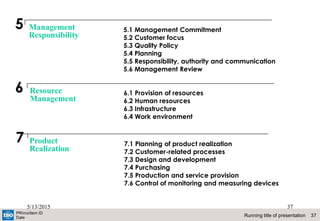
5/13/2015 37
Management
Responsibility
5.1 Management Commitment
5.2 Customer focus
5.3 Quality Policy
5.4 Planning
5.5 Responsibility, authority and communication
5.6 Management Review
5
Resource
Management
6.1 Provision of resources
6.2 Human resources
6.3 Infrastructure
6.4 Work environment
6
Product
Realization
7.1 Planning of product realization
7.2 Customer-related processes
7.3 Design and development
7.4 Purchasing
7.5 Production and service provision
7.6 Control of monitoring and measuring devices
7
38Running title of presentation
PR/mo/item ID
Date
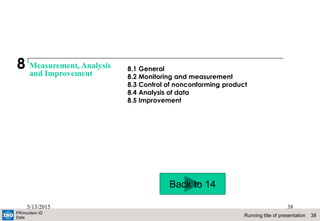
5/13/2015 38
Measurement, Analysis
and Improvement
8.1 General
8.2 Monitoring and measurement
8.3 Control of nonconforming product
8.4 Analysis of data
8.5 Improvement
8
Back to 14
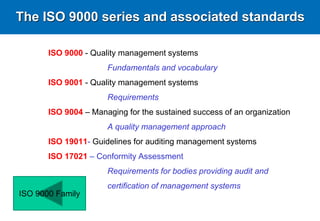
The ISO 9000 series and associated standards
ISO 9000 - Quality management systems
Fundamentals and vocabulary
ISO 9001 - Quality management systems
Requirements
ISO 9004 – Managing for the sustained success of an organization
A quality management approach
ISO 19011- Guidelines for auditing management systems
ISO 17021 – Conformity Assessment
Requirements for bodies providing audit and
certification of management systems
ISO 9000 Family
Pakistan Standards and Quality Control Authority
PSQCA Complex
Plot No. St - 7/A, Block - 3
Scheme No. 36 Gulistan-e-Johar
PK-Karachi
Tel: +92 21 34023842
Fax: +92 21 34023843
E-mail: psqcadg@super.net.pk
Web: www.psqca.com.pk
Pakistan (PSQCA)

ISO 9001:2008

  • 1.
    www.iso.org International Organization for Standardization DrNaqeeb Ullah Khan XYZ Hospital Islamabad International Organization for Standardization
  • 2.
    ISO (International Organizationfor Standardization) is the world's largest developer and publisher of International Standards. It is a network of the National Standards Institutes of 163 countries with a Central Secretariat in Geneva. It is an NGO that forms a bridge between the public and private sectors. Many of its member institutes are from governmental sectors while some are also from private sector. What is ISO
  • 3.
    ISO would havedifferent acronyms in different languages, e.g in English: International Organization for Standardization. (IOS) in French:Organisation internationale de normalisation). (OIN) But the founders decided to give it a short and all-purpose name. Whatever the country, whatever the language, the short form of the organization's name is always ISO. ISO derived from the Greek isos, meaning "equal". ISO's name
  • 4.
  • 5.
    ISO 9001 andISO 14001 ISO 9001 and ISO 14001 are among ISO's most well known standards ever. They are implemented by more than one million organizations in some 175 countries. ISO 9001 helps organizations to implement quality management. ISO 14001 helps organizations to implement environmental management.
  • 6.
    Quality Management Quality refersto all those features of a product (or service) which are required by the customer. Quality Management means what the organization does to ensure that its products or services satisfy the customer's quality requirements and comply with any regulations applicable to those products or services. Quality management also means what the organization does to enhance customer satisfaction, and achieve continual improvement of its performance.
  • 7.
    Environmental Management Environmental Management. Thismeans what the organization does to: minimize harmful effects on the environment caused by its activities, to conform to applicable regulatory requirements, and to achieve continual improvement of its environmental performance.
  • 8.
    Generic standards ISO 9001and ISO 14001 are generic standards. Generic means that the same standards can be applied: to any organization, large or small, whatever its product or service, and in any sector of activity, and whether it is a business enterprise, a public administration, or a government department.
  • 9.
    Generic standards (cont.) Genericalso means that no matter what the organization's scope of activity if it wants to establish a quality management system, ISO 9001 gives the essential features and if it wants to establish an environmental management system, ISO 14001 gives the essential features.
  • 10.
    Management Systems Management System: Theway the organization manage its activities in order that its products or services meet the organization’s objectives, such as: • satisfying the customer's quality requirements, • complying to regulations, and • meeting environmental objectives is called management system
  • 11.
    Management Systems (cont.) Themost efficient and effective way the organization can manage is by systemization, e.g.  Make sure that nothing important is left out.  Everyone is clear about who is responsible for doing what, when, how, why and where. Management system standards provide the organization with an international, state-of-the-art model to follow.
  • 12.
    Management Systems (cont.) Largeorganizations, or ones with complicated processes, could not function well without management systems. Companies in such fields as aerospace, automobiles, defense, or health care devices have been operating management systems for years. The ISO 9001 and ISO 14001 management system standards now make these successful practices available for all organizations.
  • 13.
    Processes, not products BothISO 9001 and ISO 14001 concern the way an organization goes about its work. They are not product standards. They are not service standards. But they are process standards. They can be used by product manufacturers and service providers. Process
  • 14.
    Processes, not products(cont.) Processes affect final products or services. ISO 9001 gives the requirements for what the organization must do to manage processes affecting quality of its products and services. ISO 14001 gives the requirements for what the organization must do to manage processes affecting the impact of its activities on the environment. Clauses
  • 15.
    Certification and registration Itmeans that an independent, external body has audited an organization's management system and verified that it conforms to the requirements specified in the standard (ISO 9001). ISO does not carry out certification and does not issue or approve certificates,
  • 16.
    ISO 9001 certificationshows commitment to quality, customers, and a willingness to work towards improving efficiency. It demonstrates the existence of an effective quality management system that satisfies an independent, external audit. ISO 9001 certification enhances company image in the eyes of customers, employees and shareholders alike. It also gives a competitive edge to an organisation's marketing Why seek ISO 9001 certification?
  • 17.
    First Identify therequirements of ISO 9001 and how they apply to your business. Establish quality objectives and how they fit in to the operation of the business. Produce a documented quality policy indicating how these requirements are satisfied. Communicate them throughout the organization. Steps required for ISO 9001 certification
  • 18.
    Evaluate the qualitypolicy, its stated objectives and then prioritize requirements to ensure they are met. Identify the boundaries of the management system and produce documented procedures as required. Ensure these procedures are suitable and adhered to. Once developed, internal audits are needed to ensure the system carries on working. Steps required for ISO 9001 certification (cont.)
  • 19.
    When all therequirements of ISO 9001 have been met, it is time for an external audit. This should be carried out by a third party, accredited certification body. The chosen certification body will review the quality manuals and procedures. This process involves looking at the organization evaluation of quality and ascertains if targets set for the management programme are measurable and achievable. Assessment to ISO 9001
  • 20.
    This is followedat a later date by a full on-site audit to ensure that working practices observe the procedures and stated objectives and that appropriate records are kept. After a successful audit, a certificate of registration to ISO 9001 will be issued. There will then be surveillance visits (usually once or twice a year) to ensure that the system continues to work. Assessment to ISO 9001 (cont.)
  • 21.
    5/13/2015 21 DEMING’S CYCLE PLAN DOCHECK ACT • DefinePolicy • Set Objectives & Targets • Assign Responsibilities • Provide Resources • Implement according to planned arrangements • Monitor and Measure the actual implementation against the planned • Identify the Gaps • Analyze the Gaps • Take corrective and preventive actions to fill the gap Deming Cycle Process Approach
  • 22.
    Accreditation Accreditation means theformal approval by a specialized body that a certification body is competent to carry out ISO 9001:2008 or ISO 14001:2004 certification in specified business sectors. Certificates issued by accredited certification bodies - and known as accredited certificates - may be perceived on the market as having increased credibility. ISO itself does not carry out or approve accreditations.
  • 23.
    Certification not arequirement Certification is not a requirement of ISO 9001 or ISO 14001. The organization can implement and benefit from an ISO 9001 or ISO 14001 system without having it certified. The organization can implement them for the internal benefits without spending money on a certification programme.
  • 24.
    Certification is abusiness decision Certification is a decision to be taken for business reasons: if it is a contractual, regulatory, or market requirement, Or if it meets customer preferences Or it is part of a risk management programme, or if it will motivate staff by setting a clear goal.
  • 25.
    ISO does notcertify ISO does not carry out ISO 9001 or ISO 14001 certification. ISO does not issue certificates. ISO does not accredit, approve or control the certification bodies. ISO develops standards and guides to encourage good practice in accreditation and certification.
  • 26.
    The ISO 9000family ISO 9001 is the standard that gives the requirements for a quality management system. ISO 9001:2008 is the latest, improved version. It is the only standard in the ISO 9000 family that can be used for certification. There are 16 other standards in the family that can help an organization on specific aspects such as performance improvement, auditing, training…
  • 27.
    The ISO 14000family ISO 14001 is the standard that gives the requirements for an environmental management system. ISO 14001:2004 is the latest, improved version. It is the only standard in the ISO 14000 family that can be used for certification. The ISO 14000 family includes 21 other standards that can help an organization specific aspects such as auditing, environmental labelling, etc. ISO 9000 Series
  • 28.
  • 29.
    The ISO Survey(cont.) The worldwide total of certificates to ISO 9001:2001 at the end of 2007 was 9,51,486. This was increase of 6 % over 2006 when the total was 8,96,929 certificates. Certificates had been issued in 175 countries compared to 170 the previous year.
  • 30.
  • 31.
    The ISO Survey(cont.) The worldwide total of ISO 14001 certificates at the end of 2007 was 1,54,572. This was an increase of 21 % over 2006 when the total was 1,28,211. Certificates had been issued in 148 countries compared to 140 the year before.
  • 32.
  • 33.
  • 34.
    34Running title ofpresentation PR/mo/item ID Date 5/13/2015 34
  • 35.
    35Running title ofpresentation PR/mo/item ID Date 5/13/2015 35
  • 36.
    36Running title ofpresentation PR/mo/item ID Date 5/13/2015 36 Scope 1.1 General 1.2 Application 1 Normative Reference 2 Terms and Definitions3 Quality Management System 4.1 General Requirements 4.2 Documentation Requirements 4
  • 37.
    37Running title ofpresentation PR/mo/item ID Date 5/13/2015 37 Management Responsibility 5.1 Management Commitment 5.2 Customer focus 5.3 Quality Policy 5.4 Planning 5.5 Responsibility, authority and communication 5.6 Management Review 5 Resource Management 6.1 Provision of resources 6.2 Human resources 6.3 Infrastructure 6.4 Work environment 6 Product Realization 7.1 Planning of product realization 7.2 Customer-related processes 7.3 Design and development 7.4 Purchasing 7.5 Production and service provision 7.6 Control of monitoring and measuring devices 7
  • 38.
    38Running title ofpresentation PR/mo/item ID Date 5/13/2015 38 Measurement, Analysis and Improvement 8.1 General 8.2 Monitoring and measurement 8.3 Control of nonconforming product 8.4 Analysis of data 8.5 Improvement 8 Back to 14
  • 39.
    The ISO 9000series and associated standards ISO 9000 - Quality management systems Fundamentals and vocabulary ISO 9001 - Quality management systems Requirements ISO 9004 – Managing for the sustained success of an organization A quality management approach ISO 19011- Guidelines for auditing management systems ISO 17021 – Conformity Assessment Requirements for bodies providing audit and certification of management systems ISO 9000 Family
  • 40.
    Pakistan Standards andQuality Control Authority PSQCA Complex Plot No. St - 7/A, Block - 3 Scheme No. 36 Gulistan-e-Johar PK-Karachi Tel: +92 21 34023842 Fax: +92 21 34023843 E-mail: psqcadg@super.net.pk Web: www.psqca.com.pk Pakistan (PSQCA)