ISO 9001:2015
Consequence for
Organisation
FOOD QUALIITY MANAGEMENT
Presented by
Francesca Cipriani
Rakhee Rachel Rajan
TABLE OF CONTENTS
1 Introduction
2 ISO 9000 Family
3 Changes
4 Organisation
5 Structure
6 Differences
7 New Principles
8 Benefits
9 Timeline
10 Conclusion
INTRODUCTION
•The increase in global competition forces organizations to
produce high quality products and to thrive for
improvement and the most common approach to this is
ISO 9001.
•Other popular quality management approaches used by
organizations - Lean management, Six Sigma, TQM, etc.
•The quality management standard has been
implemented by more than one million organizations in
163 countries since its introduction in 1987.
•A revised version of ISO 9001 will be introduced by
September 2015.
(Manders, p:1, 2015)
ISO 9000 FAMILY
• ISO has published more than 19 500 International
Standards. ISO 9001 is for quality management.
• Quality refers to all those features of a product/service
which are required by the customer. Quality
management means what the organization does to
ensure that its products or services satisfy the
customer's quality requirements and comply with any
regulations applicable to those products or services.
• ISO 9000 family has five different related parts.
• ISO 9000,9001,9002,9003,9004
(Manders, p:14, 2015)
ISO 9000 FAMILY
• ISO 9000 : ISO 9004- Guidelines for performance
improvements
•ISO 9001,9002,9003 are categories in which
companies can apply for certification
ISO 9000- Quality Management and Quality Assurance
Standards, guidelines for selection and use
ISO 9001- Quality Systems-Model for Quality Assurance
Design/Development, Production, Installation and
Services
ISO 9002- Quality Systems-Model for Quality Assurance
in Production and Installation
ISO 9003- Quality Systems-Model for Quality Assurance
in Final Inspection and Test
ISO 9004- Quality Management and Quality System
Elements Guidelines.
ISO 9001:2015…Why?
Why ISO 9001 being revised?
1. ISO standards are revised for suitability and
effectiveness every 5-7 years. The last revision was in
updated in 2008.
2. Compatible with other management systems
3. Developments in knowledge and technologies
4. Increasing diversity of ISO 9001 users
ISO 9001:2015 What has changed?
• Main Changes:
- the adoption of the High Level Structure (HLS)
Process Approach
Risk-Based Thinking
Documented Information
ISO 9001:2015 Revision Overview accessed on 17.06.2015
ISO 9001:2015 What has changed:
Process Approach
- The approach to processes is what allows the
organization to plan its processes and their interactions.
- The Plan-Do-Check-Act (PDCA) ensures that processes
are properly fed and managed and which are identified
opportunities for improvement
The Process Approach is a Management Strategy
- Managers use this Approach to manage and control the
processes, the interactions between these processes,
and the inputs and outputs that tie these processes
together.
www.bsigroup.com/IS09001Revision accessed on 11.06.2015
ISO 9001:2015 Risk-Based Thinking
- Risk Based Thinking
It allows the organization to determine the factors which
may render ineffective processes and Quality Management
System, and to take necessary checks to ensure that this
does not happen.
Risk-based approach, make the organization proactively
prevent or reduce undesirable effects and promote
continuous improvement.
www.bsigroup.com/IS09001Revision accessed on 11.06.2015
ISO 9001:2015 Risk-Based Thinking
• Using the Risk Based Thinking to ISO 9001: 2015:
- improves the likelihood of achieving the stated
objectives.
- improves customer confidence and satisfaction
- customers can be confident that they will receive the
product or service expected.
-assures consistency of quality of goods or services
ISO 9001:2015 Documented
Information
- Use of the term "documented information" instead of
"documents“ and "recordings".
- May be a flow diagram, a dvd or a checklist, without
any distinction
- Determine by themselves what information is important
to document manage and control.
-The preparation of the documentation system is not an
activity separate from each process but, within each
process!
www.bsigroup.com/IS09001Revision accessed on 11.06.2015
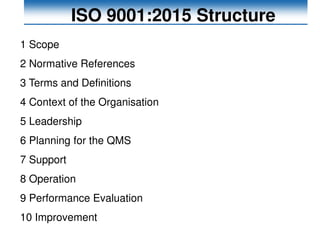
ISO 9001:2015 Structure
1 Scope
2 Normative References
3 Terms and Definitions
4 Context of the Organisation
5 Leadership
6 Planning for the QMS
7 Support
8 Operation
9 Performance Evaluation
10 Improvement
ISO 9001:2015 Differences:
ISO 9001:2015 ISO 9001:2008
1 Scope
2 Nominative References
3 Terms and Definitions
4 Quality Management System
5 Management ResponsIbility
6 Resource Management
7 Product Realisation
8 Measurement, analysis and
improvement
ISO 9001:2015 Revision Overview
New Principles of 9001:2015
1. Costumer Focus  satisfy the customer requirements
and customer expectations.
2. Leadership  create and maintain the internal
environment
3. Engagement of People  people competent to
achieve the objectives of the organization.
4. Process Approach  Understand the results of the
system and its processes to optimize performance.
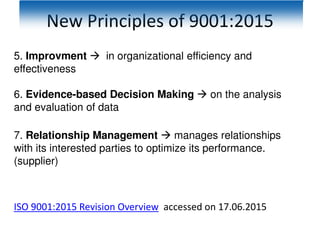
New Principles of 9001:2015
5. Improvment  in organizational efficiency and
effectiveness
6. Evidence-based Decision Making  on the analysis
and evaluation of data
7. Relationship Management  manages relationships
with its interested parties to optimize its performance.
(supplier)
ISO 9001:2015 Revision Overview accessed on 17.06.2015
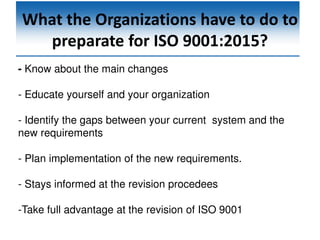
What the Organizations have to do to
preparate for ISO 9001:2015?
- Know about the main changes
- Educate yourself and your organization
- Identify the gaps between your current system and the
new requirements
- Plan implementation of the new requirements.
- Stays informed at the revision procedees
-Take full advantage at the revision of ISO 9001
ISO 9001:2015 What benefits are
expected?
- Tool for the control of all the risks of an
organization
- Tool for monitoring the efficiency of choices
organization.
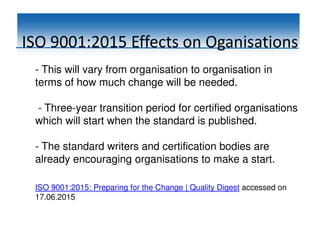
ISO 9001:2015 Effects on Oganisations
- This will vary from organisation to organisation in
terms of how much change will be needed.
- Three-year transition period for certified organisations
which will start when the standard is published.
- The standard writers and certification bodies are
already encouraging organisations to make a start.
ISO 9001:2015: Preparing for the Change | Quality Digest accessed on
17.06.2015
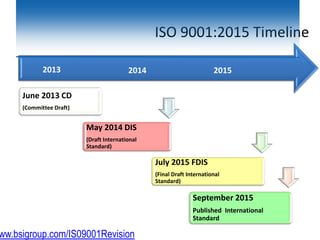
ISO 9001:2015 Timeline
June 2013 CD
(Committee Draft)
May 2014 DIS
(Draft International
Standard)
July 2015 FDIS
(Final Draft International
Standard)
September 2015
Published International
Standard
201520142013
ww.bsigroup.com/IS09001Revision
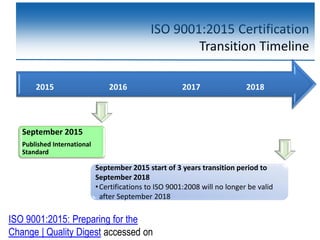
ISO 9001:2015 Certification
Transition Timeline
September 2015 start of 3 years transition period to
September 2018
•Certifications to ISO 9001:2008 will no longer be valid
after September 2018
2018201720162015
September 2015
Published International
Standard
ISO 9001:2015: Preparing for the
Change | Quality Digest accessed on
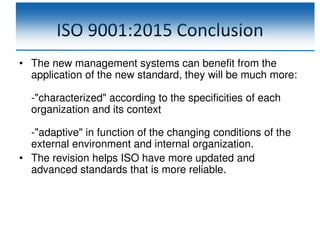
ISO 9001:2015 Conclusion
• The new management systems can benefit from the
application of the new standard, they will be much more:
-"characterized" according to the specificities of each
organization and its context
-"adaptive" in function of the changing conditions of the
external environment and internal organization.
• The revision helps ISO have more updated and
advanced standards that is more reliable.
ISO 9001:2015 References
-Croft, N.H., 2013, ISO 9001:2015, from CD to DIS, DNV Webinar
- Selection and use of the ISO 9000 family of standards» accessed at Web www.iso.org
-Quality Management principle accessed at Web www.iso.org accessed on 10.06.2015
-ISO 9001:2015 DIS Changes, Requirements and Implementation.
-ISO 9001:2015: Preparing for the Change | Quality Digest accessed on 17.06.2015
-ISO 9001:2015 Revision Overview accessed on 17.06.2015
-www.bsigroup.com/IS09001Revision accessed on 17.06.2015

ISO 9001:2015-Consequences for Organisation

  • 1.
    ISO 9001:2015 Consequence for Organisation FOODQUALIITY MANAGEMENT Presented by Francesca Cipriani Rakhee Rachel Rajan
  • 2.
    TABLE OF CONTENTS 1Introduction 2 ISO 9000 Family 3 Changes 4 Organisation 5 Structure 6 Differences 7 New Principles 8 Benefits 9 Timeline 10 Conclusion
  • 3.
    INTRODUCTION •The increase inglobal competition forces organizations to produce high quality products and to thrive for improvement and the most common approach to this is ISO 9001. •Other popular quality management approaches used by organizations - Lean management, Six Sigma, TQM, etc. •The quality management standard has been implemented by more than one million organizations in 163 countries since its introduction in 1987. •A revised version of ISO 9001 will be introduced by September 2015. (Manders, p:1, 2015)
  • 4.
    ISO 9000 FAMILY •ISO has published more than 19 500 International Standards. ISO 9001 is for quality management. • Quality refers to all those features of a product/service which are required by the customer. Quality management means what the organization does to ensure that its products or services satisfy the customer's quality requirements and comply with any regulations applicable to those products or services. • ISO 9000 family has five different related parts. • ISO 9000,9001,9002,9003,9004 (Manders, p:14, 2015)
  • 5.
    ISO 9000 FAMILY •ISO 9000 : ISO 9004- Guidelines for performance improvements •ISO 9001,9002,9003 are categories in which companies can apply for certification ISO 9000- Quality Management and Quality Assurance Standards, guidelines for selection and use ISO 9001- Quality Systems-Model for Quality Assurance Design/Development, Production, Installation and Services ISO 9002- Quality Systems-Model for Quality Assurance in Production and Installation ISO 9003- Quality Systems-Model for Quality Assurance in Final Inspection and Test ISO 9004- Quality Management and Quality System Elements Guidelines.
  • 6.
    ISO 9001:2015…Why? Why ISO9001 being revised? 1. ISO standards are revised for suitability and effectiveness every 5-7 years. The last revision was in updated in 2008. 2. Compatible with other management systems 3. Developments in knowledge and technologies 4. Increasing diversity of ISO 9001 users
  • 7.
    ISO 9001:2015 Whathas changed? • Main Changes: - the adoption of the High Level Structure (HLS) Process Approach Risk-Based Thinking Documented Information ISO 9001:2015 Revision Overview accessed on 17.06.2015
  • 8.
    ISO 9001:2015 Whathas changed: Process Approach - The approach to processes is what allows the organization to plan its processes and their interactions. - The Plan-Do-Check-Act (PDCA) ensures that processes are properly fed and managed and which are identified opportunities for improvement The Process Approach is a Management Strategy - Managers use this Approach to manage and control the processes, the interactions between these processes, and the inputs and outputs that tie these processes together. www.bsigroup.com/IS09001Revision accessed on 11.06.2015
  • 9.
    ISO 9001:2015 Risk-BasedThinking - Risk Based Thinking It allows the organization to determine the factors which may render ineffective processes and Quality Management System, and to take necessary checks to ensure that this does not happen. Risk-based approach, make the organization proactively prevent or reduce undesirable effects and promote continuous improvement. www.bsigroup.com/IS09001Revision accessed on 11.06.2015
  • 10.
    ISO 9001:2015 Risk-BasedThinking • Using the Risk Based Thinking to ISO 9001: 2015: - improves the likelihood of achieving the stated objectives. - improves customer confidence and satisfaction - customers can be confident that they will receive the product or service expected. -assures consistency of quality of goods or services
  • 11.
    ISO 9001:2015 Documented Information -Use of the term "documented information" instead of "documents“ and "recordings". - May be a flow diagram, a dvd or a checklist, without any distinction - Determine by themselves what information is important to document manage and control. -The preparation of the documentation system is not an activity separate from each process but, within each process! www.bsigroup.com/IS09001Revision accessed on 11.06.2015
  • 12.
    ISO 9001:2015 Structure 1Scope 2 Normative References 3 Terms and Definitions 4 Context of the Organisation 5 Leadership 6 Planning for the QMS 7 Support 8 Operation 9 Performance Evaluation 10 Improvement
  • 13.
    ISO 9001:2015 Differences: ISO9001:2015 ISO 9001:2008 1 Scope 2 Nominative References 3 Terms and Definitions 4 Quality Management System 5 Management ResponsIbility 6 Resource Management 7 Product Realisation 8 Measurement, analysis and improvement ISO 9001:2015 Revision Overview
  • 14.
    New Principles of9001:2015 1. Costumer Focus  satisfy the customer requirements and customer expectations. 2. Leadership  create and maintain the internal environment 3. Engagement of People  people competent to achieve the objectives of the organization. 4. Process Approach  Understand the results of the system and its processes to optimize performance.
  • 15.
    New Principles of9001:2015 5. Improvment  in organizational efficiency and effectiveness 6. Evidence-based Decision Making  on the analysis and evaluation of data 7. Relationship Management  manages relationships with its interested parties to optimize its performance. (supplier) ISO 9001:2015 Revision Overview accessed on 17.06.2015
  • 16.
    What the Organizationshave to do to preparate for ISO 9001:2015? - Know about the main changes - Educate yourself and your organization - Identify the gaps between your current system and the new requirements - Plan implementation of the new requirements. - Stays informed at the revision procedees -Take full advantage at the revision of ISO 9001
  • 17.
    ISO 9001:2015 Whatbenefits are expected? - Tool for the control of all the risks of an organization - Tool for monitoring the efficiency of choices organization.
  • 18.
    ISO 9001:2015 Effectson Oganisations - This will vary from organisation to organisation in terms of how much change will be needed. - Three-year transition period for certified organisations which will start when the standard is published. - The standard writers and certification bodies are already encouraging organisations to make a start. ISO 9001:2015: Preparing for the Change | Quality Digest accessed on 17.06.2015
  • 19.
    ISO 9001:2015 Timeline June2013 CD (Committee Draft) May 2014 DIS (Draft International Standard) July 2015 FDIS (Final Draft International Standard) September 2015 Published International Standard 201520142013 ww.bsigroup.com/IS09001Revision
  • 20.
    ISO 9001:2015 Certification TransitionTimeline September 2015 start of 3 years transition period to September 2018 •Certifications to ISO 9001:2008 will no longer be valid after September 2018 2018201720162015 September 2015 Published International Standard ISO 9001:2015: Preparing for the Change | Quality Digest accessed on
  • 21.
    ISO 9001:2015 Conclusion •The new management systems can benefit from the application of the new standard, they will be much more: -"characterized" according to the specificities of each organization and its context -"adaptive" in function of the changing conditions of the external environment and internal organization. • The revision helps ISO have more updated and advanced standards that is more reliable.
  • 22.
    ISO 9001:2015 References -Croft,N.H., 2013, ISO 9001:2015, from CD to DIS, DNV Webinar - Selection and use of the ISO 9000 family of standards» accessed at Web www.iso.org -Quality Management principle accessed at Web www.iso.org accessed on 10.06.2015 -ISO 9001:2015 DIS Changes, Requirements and Implementation. -ISO 9001:2015: Preparing for the Change | Quality Digest accessed on 17.06.2015 -ISO 9001:2015 Revision Overview accessed on 17.06.2015 -www.bsigroup.com/IS09001Revision accessed on 17.06.2015