A Presentation On
ISO 9001
Minhaz Hasan Sujan : 2011135004
Tuni Ahmed : 2011135012
Md. Ali Reza : 2011135025
Student of 4th Year, 2nd Semester
Department of Geography and Environment
Shahjalal University of Science and Technology
Presented By
 ISO is an international standard setting body composed
of representatives from various national standards
organizations.
 Part of United Nations initiative - is a non-governmental organization
Formation 23 February 1947
Type Non-governmental organization
Purpose International standardization
Headquarters Geneva, Switzerland
Membership 162 members
Official languages English, French, Russian
Why ISO Standards?
• Systems, machinery and devices
work well and safely when they
conform to standards.
• ISO standards contribute to making
the development, manufacturing
and supply of products and
services more efficient, safer and
cleaner.
• ISO standards also serve to
safeguard consumers, and users in
general, of products and services -
as well as to make their lives
simpler.
4
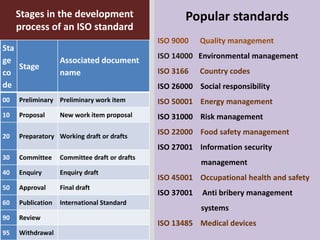
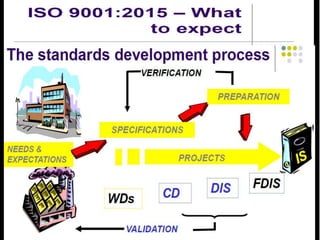
Stages in the development
process of an ISO standard
Sta
ge
co
de
Stage
Associated document
name
00 Preliminary Preliminary work item
10 Proposal New work item proposal
20 Preparatory Working draft or drafts
30 Committee Committee draft or drafts
40 Enquiry Enquiry draft
50 Approval Final draft
60 Publication International Standard
90 Review
95 Withdrawal
Popular standards
ISO 9000 Quality management
ISO 14000 Environmental management
ISO 3166 Country codes
ISO 26000 Social responsibility
ISO 50001 Energy management
ISO 31000 Risk management
ISO 22000 Food safety management
ISO 27001 Information security
management
ISO 45001 Occupational health and safety
ISO 37001 Anti bribery management
systems
ISO 13485 Medical devices
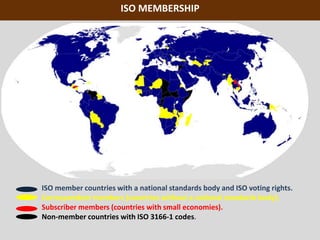
ISO member countries with a national standards body and ISO voting rights.
Correspondent members (countries without a national standards body).
Subscriber members (countries with small economies).
Non-member countries with ISO 3166-1 codes.
ISO MEMBERSHIP
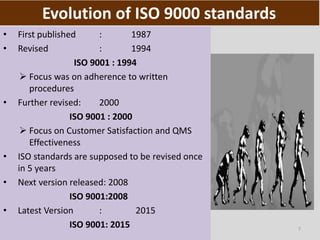
Evolution of ISO 9000 standards
• First published : 1987
• Revised : 1994
ISO 9001 : 1994
 Focus was on adherence to written
procedures
• Further revised: 2000
ISO 9001 : 2000
 Focus on Customer Satisfaction and QMS
Effectiveness
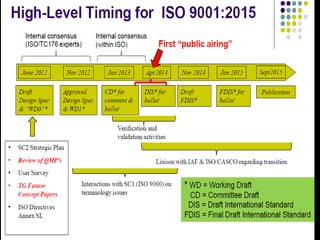
• ISO standards are supposed to be revised once
in 5 years
• Next version released: 2008
ISO 9001:2008
• Latest Version : 2015
ISO 9001: 2015 7
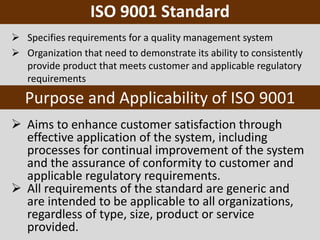
Purpose and Applicability of ISO 9001
 Aims to enhance customer satisfaction through
effective application of the system, including
processes for continual improvement of the system
and the assurance of conformity to customer and
applicable regulatory requirements.
 All requirements of the standard are generic and
are intended to be applicable to all organizations,
regardless of type, size, product or service
provided.
ISO 9001 Standard
 Specifies requirements for a quality management system
 Organization that need to demonstrate its ability to consistently
provide product that meets customer and applicable regulatory
requirements
9
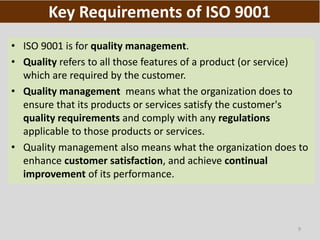
Key Requirements of ISO 9001
• ISO 9001 is for quality management.
• Quality refers to all those features of a product (or service)
which are required by the customer.
• Quality management means what the organization does to
ensure that its products or services satisfy the customer's
quality requirements and comply with any regulations
applicable to those products or services.
• Quality management also means what the organization does to
enhance customer satisfaction, and achieve continual
improvement of its performance.
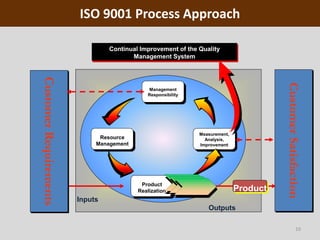
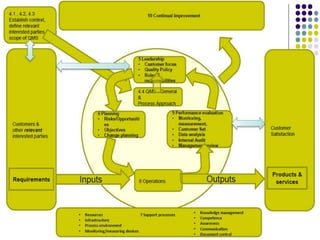
ISO 9001 Process Approach
10
Continual Improvement of the Quality
Management System
Resource
Management
Measurement,
Analysis,
Improvement
CustomerRequirements
Management
Responsibility
Product
Realization Product
Inputs
Outputs
CustomerSatisfaction
ISO 9001:2008 ELEMENTS
input Your QMS output
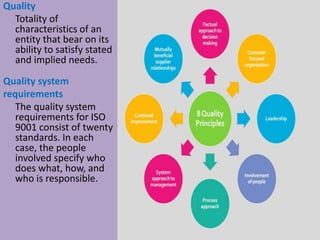
Quality
Totality of
characteristics of an
entity that bear on its
ability to satisfy stated
and implied needs.
Quality system
requirements
The quality system
requirements for ISO
9001 consist of twenty
standards. In each
case, the people
involved specify who
does what, how, and
who is responsible.
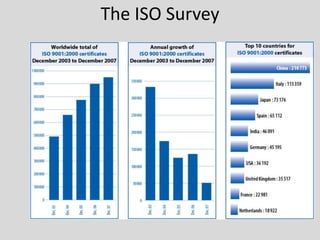
The ISO Survey
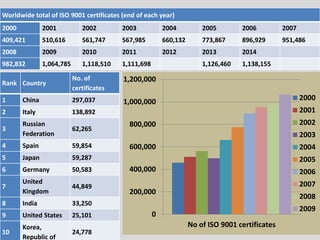
Rank Country
No. of
certificates
1 China 297,037
2 Italy 138,892
3
Russian
Federation
62,265
4 Spain 59,854
5 Japan 59,287
6 Germany 50,583
7
United
Kingdom
44,849
8 India 33,250
9 United States 25,101
10
Korea,
Republic of
24,778
Worldwide total of ISO 9001 certificates (end of each year)
2000 2001 2002 2003 2004 2005 2006 2007
409,421 510,616 561,747 567,985 660,132 773,867 896,929 951,486
2008 2009 2010 2011 2012 2013 2014
982,832 1,064,785 1,118,510 1,111,698 1,126,460 1,138,155
0
200,000
400,000
600,000
800,000
1,000,000
1,200,000
No of ISO 9001 certificates
2000
2001
2002
2003
2004
2005
2006
2007
2008
2009
ISO 9001: 2015
•VIDEO LINK
• https://www.youtube.com/watch?v=Lp6xP-
We5yY
ISO 9001 Version 2008 vs 2015
•VIDEO LINK
• https://www.youtube.com/watch?v=-
F4ShMqPM7c
23
Any Questions ?
?
?
THANKS TO ALL

ISO 9001:2005 The Quality Management System

  • 1.
  • 2.
    Minhaz Hasan Sujan: 2011135004 Tuni Ahmed : 2011135012 Md. Ali Reza : 2011135025 Student of 4th Year, 2nd Semester Department of Geography and Environment Shahjalal University of Science and Technology Presented By
  • 3.
     ISO isan international standard setting body composed of representatives from various national standards organizations.  Part of United Nations initiative - is a non-governmental organization Formation 23 February 1947 Type Non-governmental organization Purpose International standardization Headquarters Geneva, Switzerland Membership 162 members Official languages English, French, Russian
  • 4.
    Why ISO Standards? •Systems, machinery and devices work well and safely when they conform to standards. • ISO standards contribute to making the development, manufacturing and supply of products and services more efficient, safer and cleaner. • ISO standards also serve to safeguard consumers, and users in general, of products and services - as well as to make their lives simpler. 4
  • 5.
    Stages in thedevelopment process of an ISO standard Sta ge co de Stage Associated document name 00 Preliminary Preliminary work item 10 Proposal New work item proposal 20 Preparatory Working draft or drafts 30 Committee Committee draft or drafts 40 Enquiry Enquiry draft 50 Approval Final draft 60 Publication International Standard 90 Review 95 Withdrawal Popular standards ISO 9000 Quality management ISO 14000 Environmental management ISO 3166 Country codes ISO 26000 Social responsibility ISO 50001 Energy management ISO 31000 Risk management ISO 22000 Food safety management ISO 27001 Information security management ISO 45001 Occupational health and safety ISO 37001 Anti bribery management systems ISO 13485 Medical devices
  • 6.
    ISO member countrieswith a national standards body and ISO voting rights. Correspondent members (countries without a national standards body). Subscriber members (countries with small economies). Non-member countries with ISO 3166-1 codes. ISO MEMBERSHIP
  • 7.
    Evolution of ISO9000 standards • First published : 1987 • Revised : 1994 ISO 9001 : 1994  Focus was on adherence to written procedures • Further revised: 2000 ISO 9001 : 2000  Focus on Customer Satisfaction and QMS Effectiveness • ISO standards are supposed to be revised once in 5 years • Next version released: 2008 ISO 9001:2008 • Latest Version : 2015 ISO 9001: 2015 7
  • 8.
    Purpose and Applicabilityof ISO 9001  Aims to enhance customer satisfaction through effective application of the system, including processes for continual improvement of the system and the assurance of conformity to customer and applicable regulatory requirements.  All requirements of the standard are generic and are intended to be applicable to all organizations, regardless of type, size, product or service provided. ISO 9001 Standard  Specifies requirements for a quality management system  Organization that need to demonstrate its ability to consistently provide product that meets customer and applicable regulatory requirements
  • 9.
    9 Key Requirements ofISO 9001 • ISO 9001 is for quality management. • Quality refers to all those features of a product (or service) which are required by the customer. • Quality management means what the organization does to ensure that its products or services satisfy the customer's quality requirements and comply with any regulations applicable to those products or services. • Quality management also means what the organization does to enhance customer satisfaction, and achieve continual improvement of its performance.
  • 10.
    ISO 9001 ProcessApproach 10 Continual Improvement of the Quality Management System Resource Management Measurement, Analysis, Improvement CustomerRequirements Management Responsibility Product Realization Product Inputs Outputs CustomerSatisfaction
  • 11.
  • 12.
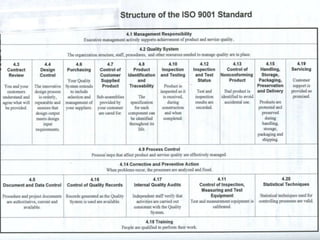
    Quality Totality of characteristics ofan entity that bear on its ability to satisfy stated and implied needs. Quality system requirements The quality system requirements for ISO 9001 consist of twenty standards. In each case, the people involved specify who does what, how, and who is responsible.
  • 14.
  • 15.
    Rank Country No. of certificates 1China 297,037 2 Italy 138,892 3 Russian Federation 62,265 4 Spain 59,854 5 Japan 59,287 6 Germany 50,583 7 United Kingdom 44,849 8 India 33,250 9 United States 25,101 10 Korea, Republic of 24,778 Worldwide total of ISO 9001 certificates (end of each year) 2000 2001 2002 2003 2004 2005 2006 2007 409,421 510,616 561,747 567,985 660,132 773,867 896,929 951,486 2008 2009 2010 2011 2012 2013 2014 982,832 1,064,785 1,118,510 1,111,698 1,126,460 1,138,155 0 200,000 400,000 600,000 800,000 1,000,000 1,200,000 No of ISO 9001 certificates 2000 2001 2002 2003 2004 2005 2006 2007 2008 2009
  • 21.
    ISO 9001: 2015 •VIDEOLINK • https://www.youtube.com/watch?v=Lp6xP- We5yY
  • 22.
    ISO 9001 Version2008 vs 2015 •VIDEO LINK • https://www.youtube.com/watch?v=- F4ShMqPM7c
  • 23.
  • 24.