1
Management Systems
Integration
Big Q or small q?
By
Engineer Sikander Nawaz
Certified Auditor for IMS
Environmental Specialist
2
Agenda
 Integrated Management System
 Need of Integrating the Management System
 ISO 9001
 ISO 14001
 OHSAS 18001
 Common Requirements
 Basic Elements of IMS
 How Implement IMS
 Benefits of IMS
3
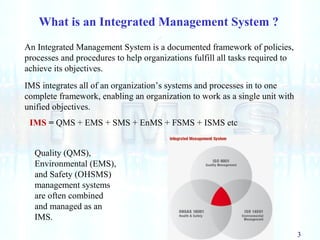
What is an Integrated Management System ?
An Integrated Management System is a documented framework of policies,
processes and procedures to help organizations fulfill all tasks required to
achieve its objectives.
IMS integrates all of an organization’s systems and processes in to one
complete framework, enabling an organization to work as a single unit with
unified objectives.
Quality (QMS),
Environmental (EMS),
and Safety (OHSMS)
management systems
are often combined
and managed as an
IMS.
IMS = QMS + EMS + SMS + EnMS + FSMS + ISMS etc
4
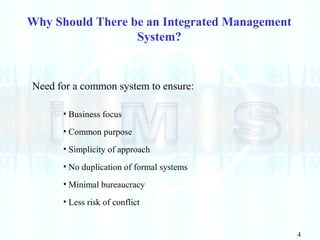
Why Should There be an Integrated Management
System?
Need for a common system to ensure:
• Business focus
• Common purpose
• Simplicity of approach
• No duplication of formal systems
• Minimal bureaucracy
• Less risk of conflict
5
Integrated the Systems, Its easy
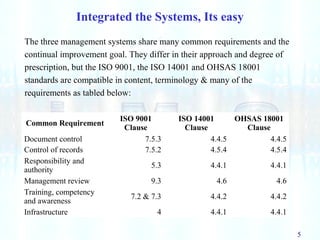
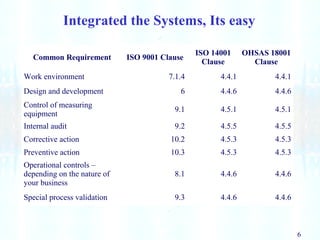
The three management systems share many common requirements and the
continual improvement goal. They differ in their approach and degree of
prescription, but the ISO 9001, the ISO 14001 and OHSAS 18001
standards are compatible in content, terminology & many of the
requirements as tabled below:
Common Requirement
ISO 9001
Clause
ISO 14001
Clause
OHSAS 18001
Clause
Document control 7.5.3 4.4.5 4.4.5
Control of records 7.5.2 4.5.4 4.5.4
Responsibility and
authority
5.3 4.4.1 4.4.1
Management review 9.3 4.6 4.6
Training, competency
and awareness
7.2 & 7.3 4.4.2 4.4.2
Infrastructure 4 4.4.1 4.4.1
6
Integrated the Systems, Its easy
Common Requirement ISO 9001 Clause
ISO 14001
Clause
OHSAS 18001
Clause
Work environment 7.1.4 4.4.1 4.4.1
Design and development 6 4.4.6 4.4.6
Control of measuring
equipment
9.1 4.5.1 4.5.1
Internal audit 9.2 4.5.5 4.5.5
Corrective action 10.2 4.5.3 4.5.3
Preventive action 10.3 4.5.3 4.5.3
Operational controls –
depending on the nature of
your business
8.1 4.4.6 4.4.6
Special process validation 9.3 4.4.6 4.4.6
7
History of ISO 9001
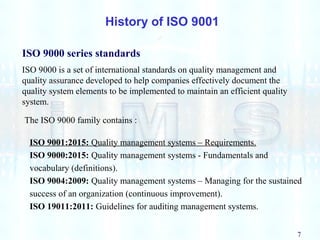
ISO 9000 series standards
ISO 9000 is a set of international standards on quality management and
quality assurance developed to help companies effectively document the
quality system elements to be implemented to maintain an efficient quality
system.
The ISO 9000 family contains :
ISO 9001:2015: Quality management systems – Requirements.
ISO 9000:2015: Quality management systems - Fundamentals and
vocabulary (definitions).
ISO 9004:2009: Quality management systems – Managing for the sustained
success of an organization (continuous improvement).
ISO 19011:2011: Guidelines for auditing management systems.
8
ISO 9001 is managed by the International Organisation for Standardisation
(ISO) in Geneva, Switzerland.
ISO 9000 (management system) was first published in 1987 by ISO
(International Organization for Standardization).
 ISO 9001:2015 was developed by the ISO / TC 176 / SC 2 – Quality
Systems Technical Committee.
 A new version of ISO 9001 appears about every seven years.
There is a transitional period of three years after the publication of each
new version of ISO 9001, during which organisations can adapt their quality
management to match the latest version. Organisations must therefore
implement the new ISO 9001:2015 standard before 23 September 2018 in
order to continue complying with ISO 9001.
History of ISO 9001
9
Difference between ISO 9001:2008 and ISO
9001:2015
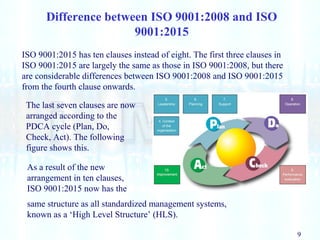
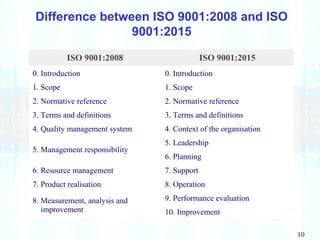
ISO 9001:2015 has ten clauses instead of eight. The first three clauses in
ISO 9001:2015 are largely the same as those in ISO 9001:2008, but there
are considerable differences between ISO 9001:2008 and ISO 9001:2015
from the fourth clause onwards.
The last seven clauses are now
arranged according to the
PDCA cycle (Plan, Do,
Check, Act). The following
figure shows this.
same structure as all standardized management systems,
known as a ‘High Level Structure’ (HLS).
As a result of the new
arrangement in ten clauses,
ISO 9001:2015 now has the
10
Difference between ISO 9001:2008 and ISO
9001:2015
ISO 9001:2008 ISO 9001:2015
0. Introduction 0. Introduction
1. Scope 1. Scope
2. Normative reference 2. Normative reference
3. Terms and definitions 3. Terms and definitions
4. Quality management system 4. Context of the organisation
5. Management responsibility
5. Leadership
6. Planning
6. Resource management 7. Support
7. Product realisation 8. Operation
8. Measurement, analysis and
improvement
9. Performance evaluation
10. Improvement
11
ISO 14001
ISO 14001 sets out the criteria for an environmental management system
and can be certified to. It maps out a framework that a company or
organization can follow to set up an effective environmental management
system. It can be used by any organization regardless of its activity or
sector.
ISO 14001 is a cornerstone standard of the ISO 14000 series. It specifies
a framework of control for an Environmental Management System
(EMS) and is the only ISO 14000 standard against which it is currently
possible to be certified by an external certification body.
It requires that an organization considers all environmental issues relevant
to its operations, such as air pollution, water and sewage issues, waste
management, soil contamination, climate change mitigation and
adaptation, and resource use and efficiency.
12
ISO 14001
ISO 14001 was first published as a standard in 1996 and it specifies the actual
requirements for an environmental management system.
 ISO-TC 207 its sub-committees developed ISO 14000 standards.
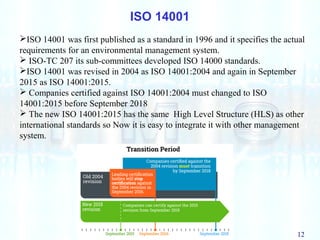
ISO 14001 was revised in 2004 as ISO 14001:2004 and again in September
2015 as ISO 14001:2015.
 Companies certified against ISO 14001:2004 must changed to ISO
14001:2015 before September 2018
 The new ISO 14001:2015 has the same High Level Structure (HLS) as other
international standards so Now it is easy to integrate it with other management
system.
13
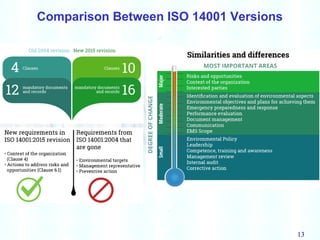
Comparison Between ISO 14001 Versions
14
OHSAS 18001
OHSAS 18001 is the International Occupational Health and Safety
Management Standard. It provides a framework for the effective management
of OH&S including all aspects of risk management and legal compliance. It
addresses occupational health and safety rather than any specific product
safety matters.]
 OHSAS 18001 is not an ISO standard, It is British Standard (BS)
 OHSAS Project Group published the OHSAS 18000 Series in 1999 and
BSI Group (UK’s national standards body) make the arrangements.
 OHSAS 18000 series consisted of two specifications, 18001 provided
requirements for an OHS management system and 18002 gave
implementation guidelines.
 OHSAS 18001 certification need to migrate to ISO 45001 to maintain
the validity of the certification.
 ISO 45001 is expected to be published in February 2018.
15
 Context of the Organization
 Policy
 Planning
 Operations
 Support
 Monitoring & Measurement
 Performance Evaluation
 Improvement
Key Focusing Points in IMS
16
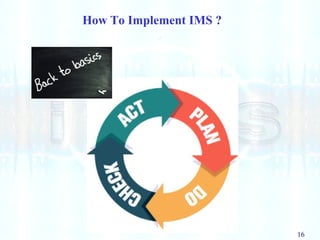
How To Implement IMS ?
17
PDCA means
Plan
• Identify product or service characteristics.
• Define methods, material, and machines to make or
deliver that product.
• Define the systems in which the product is made or
delivered.
18
PDCA means
Do
• Provide people, equipment, material and
infrastructure to make or deliver the product.
• Follow the defined methods
19
PDCA means
Check
• Measure progress in achieving defined products,
processes, and systems
Note: This can be through inspection, audit, customer
satisfaction, SPC, or any number of such tools
20
PDCA means
Act
• Reduce differences between desired
(Planned) and actual states.
• Make things better and smarter
21
Key Issues for the IMS to be Effective
• CONTROL - is there an adequate
structure?
• CO-OPERATION - are there adequate
arrangements?
• COMMUNICATIONS - are the
arrangements effective?
• COMPETENCE - are the systems and
competencies available?
22
Benefits of IMS Approach
• Provides a framework for a holistic management system that can
embrace all the processes and elements that need to be controlled by
the organization.
• Consistent objectives, planning, and document management.
• Implementation and Operation of the system cost less.
• Easier internal audits.
• No Redundancies, reducing the chance of conflict.
• One clause can describe all similar requirement on all related
management system.
• Evaluation is easier to conduct, since one clause already has all related
aspect to review.
• It’s easier to control the documents.
• Everyone within the company had have the same responsible to take
care of Quality, Environmental, Health, Safety, Security & Community
Development.
23
Conclusion
In considering a conclusion to the presentation it
became apparent that a closing argument for
integration is not needed.
Integration clearly speaks for itself.
I will just say that
“To managemanage your organisational risksorganisational risks with a
resilient management system you must integrate.”
24
Thank YouThank You
Question?Question?

Management systems integration - ims

  • 1.
    1 Management Systems Integration Big Qor small q? By Engineer Sikander Nawaz Certified Auditor for IMS Environmental Specialist
  • 2.
    2 Agenda  Integrated ManagementSystem  Need of Integrating the Management System  ISO 9001  ISO 14001  OHSAS 18001  Common Requirements  Basic Elements of IMS  How Implement IMS  Benefits of IMS
  • 3.
    3 What is anIntegrated Management System ? An Integrated Management System is a documented framework of policies, processes and procedures to help organizations fulfill all tasks required to achieve its objectives. IMS integrates all of an organization’s systems and processes in to one complete framework, enabling an organization to work as a single unit with unified objectives. Quality (QMS), Environmental (EMS), and Safety (OHSMS) management systems are often combined and managed as an IMS. IMS = QMS + EMS + SMS + EnMS + FSMS + ISMS etc
  • 4.
    4 Why Should Therebe an Integrated Management System? Need for a common system to ensure: • Business focus • Common purpose • Simplicity of approach • No duplication of formal systems • Minimal bureaucracy • Less risk of conflict
  • 5.
    5 Integrated the Systems,Its easy The three management systems share many common requirements and the continual improvement goal. They differ in their approach and degree of prescription, but the ISO 9001, the ISO 14001 and OHSAS 18001 standards are compatible in content, terminology & many of the requirements as tabled below: Common Requirement ISO 9001 Clause ISO 14001 Clause OHSAS 18001 Clause Document control 7.5.3 4.4.5 4.4.5 Control of records 7.5.2 4.5.4 4.5.4 Responsibility and authority 5.3 4.4.1 4.4.1 Management review 9.3 4.6 4.6 Training, competency and awareness 7.2 & 7.3 4.4.2 4.4.2 Infrastructure 4 4.4.1 4.4.1
  • 6.
    6 Integrated the Systems,Its easy Common Requirement ISO 9001 Clause ISO 14001 Clause OHSAS 18001 Clause Work environment 7.1.4 4.4.1 4.4.1 Design and development 6 4.4.6 4.4.6 Control of measuring equipment 9.1 4.5.1 4.5.1 Internal audit 9.2 4.5.5 4.5.5 Corrective action 10.2 4.5.3 4.5.3 Preventive action 10.3 4.5.3 4.5.3 Operational controls – depending on the nature of your business 8.1 4.4.6 4.4.6 Special process validation 9.3 4.4.6 4.4.6
  • 7.
    7 History of ISO9001 ISO 9000 series standards ISO 9000 is a set of international standards on quality management and quality assurance developed to help companies effectively document the quality system elements to be implemented to maintain an efficient quality system. The ISO 9000 family contains : ISO 9001:2015: Quality management systems – Requirements. ISO 9000:2015: Quality management systems - Fundamentals and vocabulary (definitions). ISO 9004:2009: Quality management systems – Managing for the sustained success of an organization (continuous improvement). ISO 19011:2011: Guidelines for auditing management systems.
  • 8.
    8 ISO 9001 ismanaged by the International Organisation for Standardisation (ISO) in Geneva, Switzerland. ISO 9000 (management system) was first published in 1987 by ISO (International Organization for Standardization).  ISO 9001:2015 was developed by the ISO / TC 176 / SC 2 – Quality Systems Technical Committee.  A new version of ISO 9001 appears about every seven years. There is a transitional period of three years after the publication of each new version of ISO 9001, during which organisations can adapt their quality management to match the latest version. Organisations must therefore implement the new ISO 9001:2015 standard before 23 September 2018 in order to continue complying with ISO 9001. History of ISO 9001
  • 9.
    9 Difference between ISO9001:2008 and ISO 9001:2015 ISO 9001:2015 has ten clauses instead of eight. The first three clauses in ISO 9001:2015 are largely the same as those in ISO 9001:2008, but there are considerable differences between ISO 9001:2008 and ISO 9001:2015 from the fourth clause onwards. The last seven clauses are now arranged according to the PDCA cycle (Plan, Do, Check, Act). The following figure shows this. same structure as all standardized management systems, known as a ‘High Level Structure’ (HLS). As a result of the new arrangement in ten clauses, ISO 9001:2015 now has the
  • 10.
    10 Difference between ISO9001:2008 and ISO 9001:2015 ISO 9001:2008 ISO 9001:2015 0. Introduction 0. Introduction 1. Scope 1. Scope 2. Normative reference 2. Normative reference 3. Terms and definitions 3. Terms and definitions 4. Quality management system 4. Context of the organisation 5. Management responsibility 5. Leadership 6. Planning 6. Resource management 7. Support 7. Product realisation 8. Operation 8. Measurement, analysis and improvement 9. Performance evaluation 10. Improvement
  • 11.
    11 ISO 14001 ISO 14001sets out the criteria for an environmental management system and can be certified to. It maps out a framework that a company or organization can follow to set up an effective environmental management system. It can be used by any organization regardless of its activity or sector. ISO 14001 is a cornerstone standard of the ISO 14000 series. It specifies a framework of control for an Environmental Management System (EMS) and is the only ISO 14000 standard against which it is currently possible to be certified by an external certification body. It requires that an organization considers all environmental issues relevant to its operations, such as air pollution, water and sewage issues, waste management, soil contamination, climate change mitigation and adaptation, and resource use and efficiency.
  • 12.
    12 ISO 14001 ISO 14001was first published as a standard in 1996 and it specifies the actual requirements for an environmental management system.  ISO-TC 207 its sub-committees developed ISO 14000 standards. ISO 14001 was revised in 2004 as ISO 14001:2004 and again in September 2015 as ISO 14001:2015.  Companies certified against ISO 14001:2004 must changed to ISO 14001:2015 before September 2018  The new ISO 14001:2015 has the same High Level Structure (HLS) as other international standards so Now it is easy to integrate it with other management system.
  • 13.
  • 14.
    14 OHSAS 18001 OHSAS 18001is the International Occupational Health and Safety Management Standard. It provides a framework for the effective management of OH&S including all aspects of risk management and legal compliance. It addresses occupational health and safety rather than any specific product safety matters.]  OHSAS 18001 is not an ISO standard, It is British Standard (BS)  OHSAS Project Group published the OHSAS 18000 Series in 1999 and BSI Group (UK’s national standards body) make the arrangements.  OHSAS 18000 series consisted of two specifications, 18001 provided requirements for an OHS management system and 18002 gave implementation guidelines.  OHSAS 18001 certification need to migrate to ISO 45001 to maintain the validity of the certification.  ISO 45001 is expected to be published in February 2018.
  • 15.
    15  Context ofthe Organization  Policy  Planning  Operations  Support  Monitoring & Measurement  Performance Evaluation  Improvement Key Focusing Points in IMS
  • 16.
  • 17.
    17 PDCA means Plan • Identifyproduct or service characteristics. • Define methods, material, and machines to make or deliver that product. • Define the systems in which the product is made or delivered.
  • 18.
    18 PDCA means Do • Providepeople, equipment, material and infrastructure to make or deliver the product. • Follow the defined methods
  • 19.
    19 PDCA means Check • Measureprogress in achieving defined products, processes, and systems Note: This can be through inspection, audit, customer satisfaction, SPC, or any number of such tools
  • 20.
    20 PDCA means Act • Reducedifferences between desired (Planned) and actual states. • Make things better and smarter
  • 21.
    21 Key Issues forthe IMS to be Effective • CONTROL - is there an adequate structure? • CO-OPERATION - are there adequate arrangements? • COMMUNICATIONS - are the arrangements effective? • COMPETENCE - are the systems and competencies available?
  • 22.
    22 Benefits of IMSApproach • Provides a framework for a holistic management system that can embrace all the processes and elements that need to be controlled by the organization. • Consistent objectives, planning, and document management. • Implementation and Operation of the system cost less. • Easier internal audits. • No Redundancies, reducing the chance of conflict. • One clause can describe all similar requirement on all related management system. • Evaluation is easier to conduct, since one clause already has all related aspect to review. • It’s easier to control the documents. • Everyone within the company had have the same responsible to take care of Quality, Environmental, Health, Safety, Security & Community Development.
  • 23.
    23 Conclusion In considering aconclusion to the presentation it became apparent that a closing argument for integration is not needed. Integration clearly speaks for itself. I will just say that “To managemanage your organisational risksorganisational risks with a resilient management system you must integrate.”
  • 24.

Editor's Notes

  • #8 Delegate Notes ISO 9001:2000 - formally ISO 9001:1994 ISO 9004:2000 Quality management systems - Guidelines for performance improvements- formally ISO 9004:1994 ISO 1011-1:1990 Guidelines for auditing quality systems - Part 1: Auditing ISO 1011-2:1991 Guidelines for auditing quality in project management - Part 2 Qualification criteria for quality systems auditors ISO 1011-3:1991 Guidelines for auditing quality systems - part 3, management of audit programmes ISO 10005:1995 Quality management - Guidelines for quality plans ISO 10006:1997 Quality management - Guidelines to quality in project management ISO10007:1995 Quality management - Guidelines for configuration management
  • #15 Delegate Notes To support OHSAS 18001, OHSAS 18002 gives guidance on the inputs needed to deliver OHSAS 18002. It does not, however, tell you how to do it. Guidance on how to is given in BS 8800 and OHSAS 18002 gives the intent behind the “shall” statements in OHSAS 18001. It also gives typical inputs, process and outputs behind each requirement BS 8800 also includes an initial status review and more comprehensive guidance on hazard identification and risk assessment
  • #16 Delegate Notes Risk Assessment BenefitsIdentifies activities/areas where there are significant risks to health and occupational health and safetyIs pro-active - does not wait for legislative or reactive measuresCan be used as a positive tool to involve workforce in effective controls - cultural benefits
  • #17 Delegate Notes Risk Assessment BenefitsIdentifies activities/areas where there are significant risks to health and occupational health and safetyIs pro-active - does not wait for legislative or reactive measuresCan be used as a positive tool to involve workforce in effective controls - cultural benefits