Study of international organizationStudy of international organization
for standardization (ISO)for standardization (ISO)
ISO -9000 ,14000 and certificationISO -9000 ,14000 and certification
procedureprocedure
PREPARED BY :
JAY
What is ISO?What is ISO?
• ISO is name used for the international organization
for standardization
• It was formed in 1947 in Geneva Switzerland.
• It is federation of national standard bodies of 143
countries.
Standard
• A standard is defined as a document, established
by consensus and approved by a recognized
body, that provides; for common and repeated
use, rules, guidelines or characteristics for activities
or their results, aimed at the achievement of the
optimum degree of order in a given context.
Aims of standardization:Aims of standardization:
i. To promote the quality of the products process and
series
ii. To promote the improvement in the quality of life,
safety, health and protection of the environment
iii. To promote the economic use of materials energy and
human resources in the production of goods
iv. To promote international trade by the removal of
barriers caused by differences in national practices
v. To promote industrial efficiency through variety control
ISO implementation
• Implementation ISO 9000 in an organization can be
very beneficial
• The goal of this implementation is to achieve
customer satisfaction at its highest level.
ISO 9000 :
Definition:
• ISO 9000 is a series of standards, development
and published by the ISO that define , establish
an maintain an effective quality assurance
system for manufacturing and service industries.
• ISO 9000 is European standard.
 Organization has two stated objectives:
1. To promote development of standardization to
facilities international exchange of goods and
services.
2. To promote corporation is scientifically,
technological, and economic activity.
Parts of ISO 9000Parts of ISO 9000
• ISO 9000 is compressed of 5 different but
related parts:
• ISO – 9000
• ISO – 9001
• ISO – 9002
• ISO – 9003
• ISO – 9004
• ISO 9000 and 9004 are guideline, while ISO
9001, 9002 and 9003 are the categories in
which a company may apply for certification.
• ISO 9000 : “quality management and quality
assurance standards guidelines for selection
and use”.
• ISO – 9001 : Quality systems Model for quality
assurance in design, development ,
production, installation and servicing..
• ISO – 9002 : Quality systems Model for quality
assurance in production, installation and
servicing.
• ISO – 9003 : Quality systems Model for quality
assurance in final inspection and test.
• ISO – 9004 : Quality management and quality
systems elements
Benefits of becoming as ISO 9000
company:
 Countries attached to European free trade
association (EFTA) in their agreement have made it
compulsory to have bilateral trade with only those
parties which have received ISO 9000 certificate
 It builds customer confidence on the organization
that it can supply products of desired quality and
avoids time and money spent on multiple inspection
of the products for conformance.
 These quality systems improve the efficiency and
reduce inspection and rework.
 Enhance the quality image of the company in the
eyes of the national public and gives a competitive
edge over others who do not have the system
operating in their company.
 Motivate the employees and develops
pride in them for achieving excellence.
 Export-import policy of government of
India gives concessions for imports to
those companies whose quality system is
certified by the certifying body.
 Adoption of ISO 9000 helps in reducing
litigation because evidence can be
produced that the supplies made
conform to the agreed specifications.
 A move is also on in some countries for a
higher insurance premium for suppliers
not having registered ISO 9000 quality
systems.
ISO 9000 models recommendedISO 9000 models recommended
for some industries:for some industries:
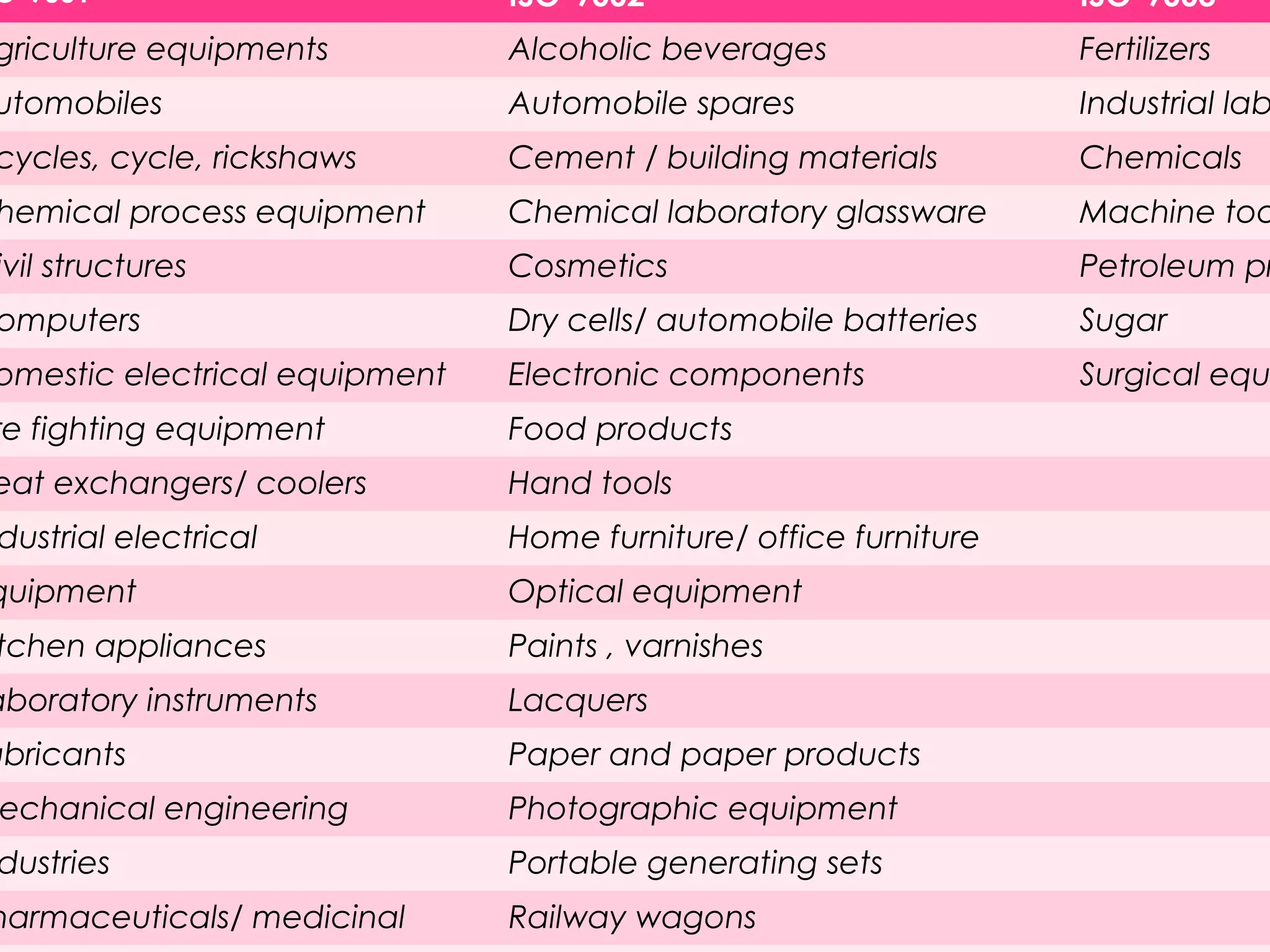
• ISO 9000 series of standards have three models ISO
9001, ISO 9002 and ISO 9003. for which company
which type of model is suitable is shown in the
table below:
O-9001 ISO-9002 ISO-9003
griculture equipments Alcoholic beverages Fertilizers
utomobiles Automobile spares Industrial lab
cycles, cycle, rickshaws Cement / building materials Chemicals
hemical process equipment Chemical laboratory glassware Machine too
ivil structures Cosmetics Petroleum pr
omputers Dry cells/ automobile batteries Sugar
omestic electrical equipment Electronic components Surgical equ
re fighting equipment Food products
eat exchangers/ coolers Hand tools
dustrial electrical Home furniture/ office furniture
quipment Optical equipment
tchen appliances Paints , varnishes
aboratory instruments Lacquers
ubricants Paper and paper products
echanical engineering Photographic equipment
dustries Portable generating sets
harmaceuticals/ medicinal Railway wagons
 Application for registration
 Adequacy audit by certification body
 Compliance audit by the certification
body
 Certification
ISO 14000:ISO 14000:
• ISO 14000 series of international standards on
environmental management.
• It provides a framework for the development of
an environmental management system and
supporting audit program.
 Environmental management system
 Environmental auditing
 Environmental performance
evaluation
ISO 14001ISO 14001:
• Framework for managing significant environmental
aspects that can be controlled.
• Use by any company of any size.
• Voluntary consensus, standard.
• System based, placing relining on the system, not
on individual specialists.
• Represents a faradign shift toward holistic
management and total employee involvement.
• Represents a shift to proactive thinking and acting.
• Urges employees to define their roles from bottom
up and requires top management backing
resources and visibility to support.
Main ideas of ISO 14001:Main ideas of ISO 14001:
Waste prevention:
• Prevent leakage
• Reduce waste
• Run machine with efficiency and utility
Energy conservation:
• Conserve energy as needed
• Find new methods of energy conservation
Pollution control:
• Air pollution
• Water pollution
• Soil pollution
Shortcomings of ISO 14001Shortcomings of ISO 14001
standardstandard:
• Management standard and not a
performance standard.
• It fails to differentiate between pollution
prevention and pollution control
• The certificate does not absolve an
organization from compliance with existing
environment legislations.
• The standard is also being viewed as a
system that will privatize environmental
regulation.
Benefits of ISO 14000:
Any organization or corporation can:
• Protect human health and the environment from the
potential impacts of its activity, products and services.
• Assist in manufacturing and improving the quality of the
environment.
• Meet customer’s environmental expectations.
• Maintain good public and community relations.
• Provide insurance at a reasonable level.
• Satisfy vendor certification criteria.
• Improve cost control.
• Gain an enhanced image and market share.
• Provide resource conservation.
• Provide confidence to interested parties.
• Provide effective technology development.
Study of international organization for standardization (ISO)  ISO -9000 ,14000 and certification procedure

Study of international organization for standardization (ISO) ISO -9000 ,14000 and certification procedure

  • 1.
    Study of internationalorganizationStudy of international organization for standardization (ISO)for standardization (ISO) ISO -9000 ,14000 and certificationISO -9000 ,14000 and certification procedureprocedure PREPARED BY : JAY
  • 2.
    What is ISO?Whatis ISO? • ISO is name used for the international organization for standardization • It was formed in 1947 in Geneva Switzerland. • It is federation of national standard bodies of 143 countries.
  • 3.
    Standard • A standardis defined as a document, established by consensus and approved by a recognized body, that provides; for common and repeated use, rules, guidelines or characteristics for activities or their results, aimed at the achievement of the optimum degree of order in a given context.
  • 4.
    Aims of standardization:Aimsof standardization: i. To promote the quality of the products process and series ii. To promote the improvement in the quality of life, safety, health and protection of the environment iii. To promote the economic use of materials energy and human resources in the production of goods iv. To promote international trade by the removal of barriers caused by differences in national practices v. To promote industrial efficiency through variety control
  • 5.
    ISO implementation • ImplementationISO 9000 in an organization can be very beneficial • The goal of this implementation is to achieve customer satisfaction at its highest level.
  • 6.
    ISO 9000 : Definition: •ISO 9000 is a series of standards, development and published by the ISO that define , establish an maintain an effective quality assurance system for manufacturing and service industries. • ISO 9000 is European standard.  Organization has two stated objectives: 1. To promote development of standardization to facilities international exchange of goods and services. 2. To promote corporation is scientifically, technological, and economic activity.
  • 7.
    Parts of ISO9000Parts of ISO 9000 • ISO 9000 is compressed of 5 different but related parts: • ISO – 9000 • ISO – 9001 • ISO – 9002 • ISO – 9003 • ISO – 9004 • ISO 9000 and 9004 are guideline, while ISO 9001, 9002 and 9003 are the categories in which a company may apply for certification.
  • 8.
    • ISO 9000: “quality management and quality assurance standards guidelines for selection and use”. • ISO – 9001 : Quality systems Model for quality assurance in design, development , production, installation and servicing.. • ISO – 9002 : Quality systems Model for quality assurance in production, installation and servicing. • ISO – 9003 : Quality systems Model for quality assurance in final inspection and test. • ISO – 9004 : Quality management and quality systems elements
  • 9.
    Benefits of becomingas ISO 9000 company:  Countries attached to European free trade association (EFTA) in their agreement have made it compulsory to have bilateral trade with only those parties which have received ISO 9000 certificate  It builds customer confidence on the organization that it can supply products of desired quality and avoids time and money spent on multiple inspection of the products for conformance.  These quality systems improve the efficiency and reduce inspection and rework.  Enhance the quality image of the company in the eyes of the national public and gives a competitive edge over others who do not have the system operating in their company.
  • 10.
     Motivate theemployees and develops pride in them for achieving excellence.  Export-import policy of government of India gives concessions for imports to those companies whose quality system is certified by the certifying body.  Adoption of ISO 9000 helps in reducing litigation because evidence can be produced that the supplies made conform to the agreed specifications.  A move is also on in some countries for a higher insurance premium for suppliers not having registered ISO 9000 quality systems.
  • 11.
    ISO 9000 modelsrecommendedISO 9000 models recommended for some industries:for some industries: • ISO 9000 series of standards have three models ISO 9001, ISO 9002 and ISO 9003. for which company which type of model is suitable is shown in the table below:
  • 12.
    O-9001 ISO-9002 ISO-9003 gricultureequipments Alcoholic beverages Fertilizers utomobiles Automobile spares Industrial lab cycles, cycle, rickshaws Cement / building materials Chemicals hemical process equipment Chemical laboratory glassware Machine too ivil structures Cosmetics Petroleum pr omputers Dry cells/ automobile batteries Sugar omestic electrical equipment Electronic components Surgical equ re fighting equipment Food products eat exchangers/ coolers Hand tools dustrial electrical Home furniture/ office furniture quipment Optical equipment tchen appliances Paints , varnishes aboratory instruments Lacquers ubricants Paper and paper products echanical engineering Photographic equipment dustries Portable generating sets harmaceuticals/ medicinal Railway wagons
  • 13.
     Application forregistration  Adequacy audit by certification body  Compliance audit by the certification body  Certification
  • 14.
    ISO 14000:ISO 14000: •ISO 14000 series of international standards on environmental management. • It provides a framework for the development of an environmental management system and supporting audit program.
  • 15.
     Environmental managementsystem  Environmental auditing  Environmental performance evaluation
  • 16.
    ISO 14001ISO 14001: •Framework for managing significant environmental aspects that can be controlled. • Use by any company of any size. • Voluntary consensus, standard. • System based, placing relining on the system, not on individual specialists. • Represents a faradign shift toward holistic management and total employee involvement. • Represents a shift to proactive thinking and acting. • Urges employees to define their roles from bottom up and requires top management backing resources and visibility to support.
  • 17.
    Main ideas ofISO 14001:Main ideas of ISO 14001: Waste prevention: • Prevent leakage • Reduce waste • Run machine with efficiency and utility Energy conservation: • Conserve energy as needed • Find new methods of energy conservation Pollution control: • Air pollution • Water pollution • Soil pollution
  • 18.
    Shortcomings of ISO14001Shortcomings of ISO 14001 standardstandard: • Management standard and not a performance standard. • It fails to differentiate between pollution prevention and pollution control • The certificate does not absolve an organization from compliance with existing environment legislations. • The standard is also being viewed as a system that will privatize environmental regulation.
  • 19.
    Benefits of ISO14000: Any organization or corporation can: • Protect human health and the environment from the potential impacts of its activity, products and services. • Assist in manufacturing and improving the quality of the environment. • Meet customer’s environmental expectations. • Maintain good public and community relations. • Provide insurance at a reasonable level. • Satisfy vendor certification criteria. • Improve cost control. • Gain an enhanced image and market share. • Provide resource conservation. • Provide confidence to interested parties. • Provide effective technology development.

Editor's Notes