INTEGRATED
MANAGEMENT SYSTEMS
QUALITY MANAGEMENT
MHT0060
ARCHIL NASRASHVILI
Definitions and Generic Methods of Implementation
Definitions
Management System -
Documented framework of policies, processes and procedures to help organizations fulfill all tasks required to achieve
its objectives
(PDCA cycle is used mostly)
Examples –
Quality (ISO 9000)
Environmental (ISO 14000), (EMAS)
Occupational Health & Safety Management (OHSAS 18001), (ILO-OSH)
Information Security (ISO/IEC 27001)
Food Safety (ISO 22000)
IT Service Management (ISO/IEC 20000)
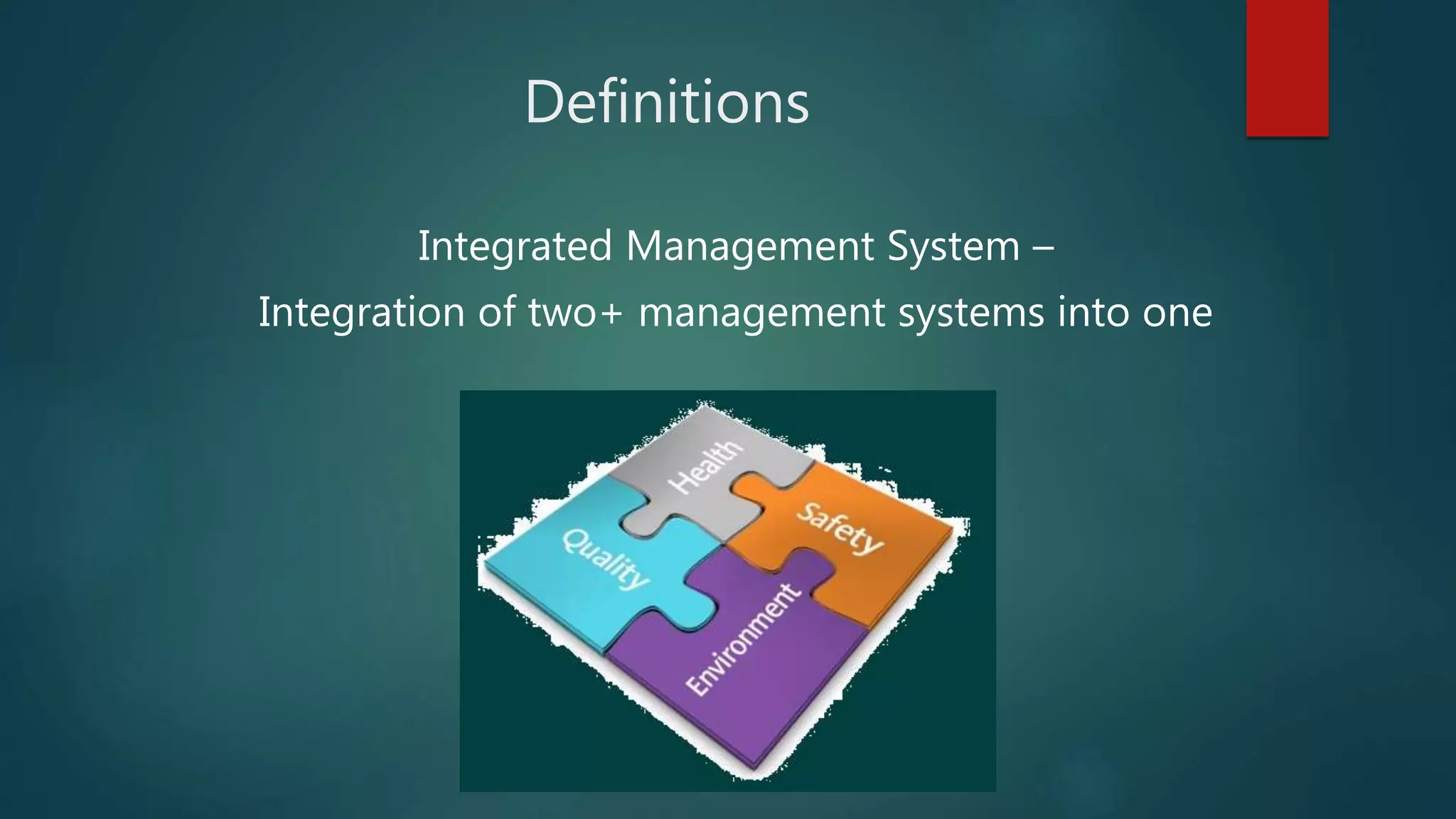
Integrated Management System –
Integration of two+ management systems into one
Definitions
Management systems? Why?
Market expects them
Helps improve processes and products
Cost of implementation outweighed by benefits
Some numbers for rigor
95% of firms report internal benefits [Iowa State University] –
 Greater employee awareness
 Increased operational efficiency
 Reduced scrap expense
85% report external benefits [Dun and Bradstreet] -
 Higher perceived quality
 Greater customer demand
100 firms reported [Irwin Professional Publishing]
 Average improvement in their operating margin was at 5% of sales
ISO9001 - Quality
ISO14001 - Environment
OHSAS18001 - Occupational Health
& Safety
I – None
II – Quality
III – Environment
IV – Quality + Environment
V – Quality + OH&S
VI – Quality + Environment + OH&S
Some numbers for rigor
Generic guidelines for implementing IMS
Study conducted in three Australia based international enterprises
1. Top management involvement
2. Appointing a champion
3. Training
4. Skilled employees
5. Documentation system / control
6. Auditing and addressing of issues
7. Change culture and avoidance of personality clashes
8. Working with suppliers
9. Communication
Company-specific approach for implementing
IMS – Case review
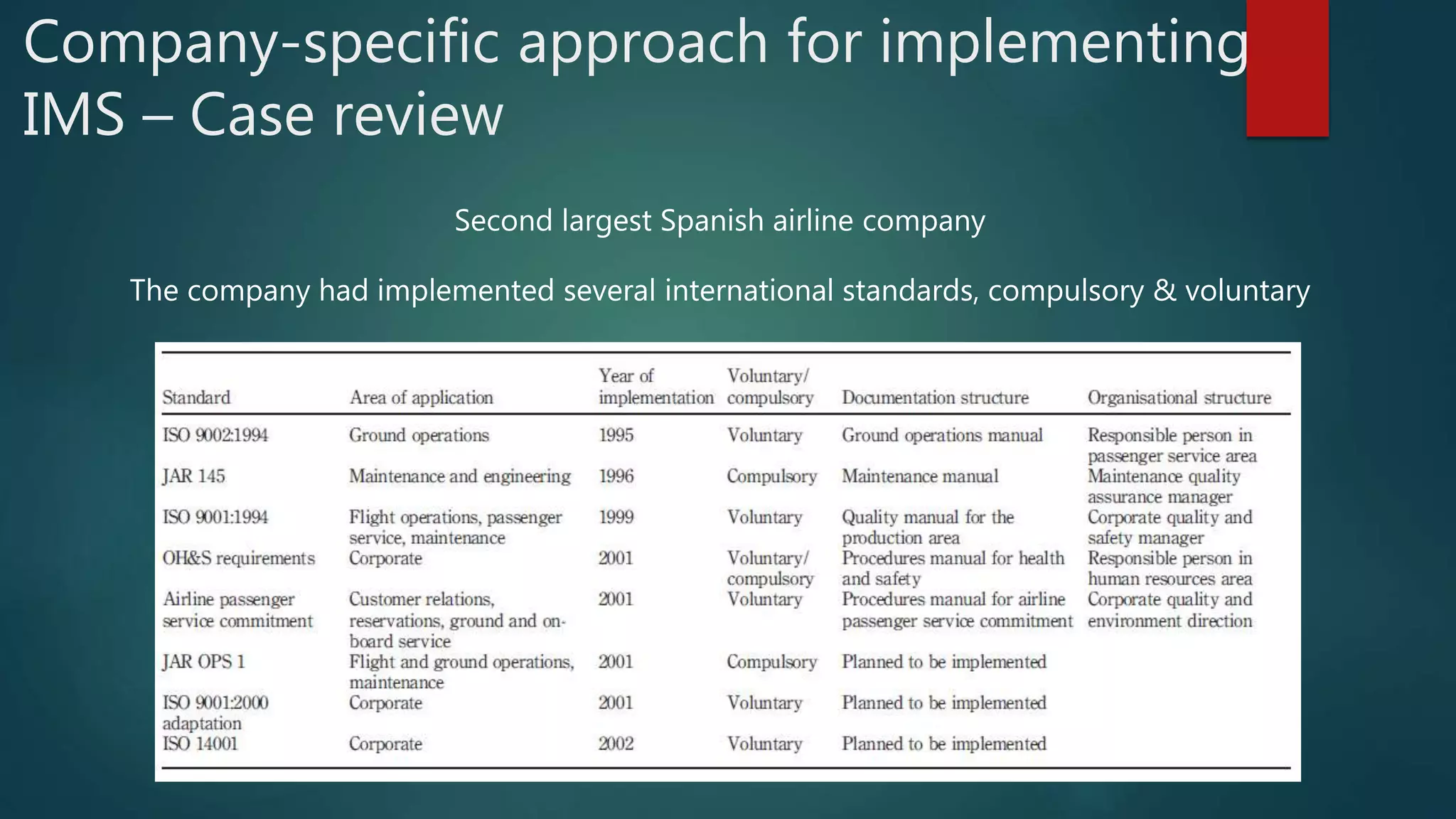
Second largest Spanish airline company
The company had implemented several international standards, compulsory & voluntary
Company-specific approach for
implementing IMS – Case review
Introducing new standards also means the need for corresponding management system which they didn’t
have, result was:
 all the sets of different systems were functioning in a fragmented manner
 using different organizational structures
 using separate documents
Thus:
 Inefficiency
 overlapping of resources
 lack of communication
 poor performance in terms of alignment with company’s strategy
Company-specific approach for
implementing IMS – Case review
For some time, these shortcomings were viewed as inevitable due to “airline sector peculiarities” – in my
experience this is a common shortcoming in reasoning - thinking that you are special
Finally top management decided to embark on the road of integrating all the existent systems into one to
develop a holistic IMS that would include:
1. all the policies
2. guidelines and requirements on main management aspects
3. and to solve the problem of fragmented vision of company
Company-specific approach for
implementing IMS – Case review
Sets of actions were introduced:
1. Analysis of the current situation to identify the starting point
2. Definition of the scope of the integration
3. Interrelation of requirements matrix
4. Linking processes and requirements
5. Design of the model: framework and modules
Company-specific approach for
implementing IMS – Case review
Corporate Quality Manual consisting of 3 chapters was created
1. Global framework, which consisted of policies and general guidelines describing corporate
management system and which provided a global vision of the company
2. Manuals for teams
Company-specific approach for
implementing IMS – Case review
Corporate Quality Manual consisting of 3 chapters was created
1. Global framework, which consisted of policies and general guidelines describing corporate
management system and which provided a global vision of the company
2. Manuals for teams
3. Following-up and evaluation tools
I. Integrated audit plan
II. Performance measurement guideline
Thanks

Integrated management systems

  • 1.
    INTEGRATED MANAGEMENT SYSTEMS QUALITY MANAGEMENT MHT0060 ARCHILNASRASHVILI Definitions and Generic Methods of Implementation
  • 2.
    Definitions Management System - Documentedframework of policies, processes and procedures to help organizations fulfill all tasks required to achieve its objectives (PDCA cycle is used mostly) Examples – Quality (ISO 9000) Environmental (ISO 14000), (EMAS) Occupational Health & Safety Management (OHSAS 18001), (ILO-OSH) Information Security (ISO/IEC 27001) Food Safety (ISO 22000) IT Service Management (ISO/IEC 20000)
  • 3.
    Integrated Management System– Integration of two+ management systems into one Definitions
  • 4.
    Management systems? Why? Marketexpects them Helps improve processes and products Cost of implementation outweighed by benefits
  • 5.
    Some numbers forrigor 95% of firms report internal benefits [Iowa State University] –  Greater employee awareness  Increased operational efficiency  Reduced scrap expense 85% report external benefits [Dun and Bradstreet] -  Higher perceived quality  Greater customer demand 100 firms reported [Irwin Professional Publishing]  Average improvement in their operating margin was at 5% of sales
  • 6.
    ISO9001 - Quality ISO14001- Environment OHSAS18001 - Occupational Health & Safety I – None II – Quality III – Environment IV – Quality + Environment V – Quality + OH&S VI – Quality + Environment + OH&S Some numbers for rigor
  • 7.
    Generic guidelines forimplementing IMS Study conducted in three Australia based international enterprises 1. Top management involvement 2. Appointing a champion 3. Training 4. Skilled employees 5. Documentation system / control 6. Auditing and addressing of issues 7. Change culture and avoidance of personality clashes 8. Working with suppliers 9. Communication
  • 8.
    Company-specific approach forimplementing IMS – Case review Second largest Spanish airline company The company had implemented several international standards, compulsory & voluntary
  • 9.
    Company-specific approach for implementingIMS – Case review Introducing new standards also means the need for corresponding management system which they didn’t have, result was:  all the sets of different systems were functioning in a fragmented manner  using different organizational structures  using separate documents Thus:  Inefficiency  overlapping of resources  lack of communication  poor performance in terms of alignment with company’s strategy
  • 10.
    Company-specific approach for implementingIMS – Case review For some time, these shortcomings were viewed as inevitable due to “airline sector peculiarities” – in my experience this is a common shortcoming in reasoning - thinking that you are special Finally top management decided to embark on the road of integrating all the existent systems into one to develop a holistic IMS that would include: 1. all the policies 2. guidelines and requirements on main management aspects 3. and to solve the problem of fragmented vision of company
  • 11.
    Company-specific approach for implementingIMS – Case review Sets of actions were introduced: 1. Analysis of the current situation to identify the starting point 2. Definition of the scope of the integration 3. Interrelation of requirements matrix 4. Linking processes and requirements 5. Design of the model: framework and modules
  • 12.
    Company-specific approach for implementingIMS – Case review Corporate Quality Manual consisting of 3 chapters was created 1. Global framework, which consisted of policies and general guidelines describing corporate management system and which provided a global vision of the company 2. Manuals for teams
  • 14.
    Company-specific approach for implementingIMS – Case review Corporate Quality Manual consisting of 3 chapters was created 1. Global framework, which consisted of policies and general guidelines describing corporate management system and which provided a global vision of the company 2. Manuals for teams 3. Following-up and evaluation tools I. Integrated audit plan II. Performance measurement guideline
  • 15.

Editor's Notes

  • #8 Study conducted by Ambika Zutshi and Amrik S. Sohal (Sohal, 2005) from Deakin University, Bowater School of Management; and Marketing Burwood, Australia and Monash University, Department of Management Faculty of Business and Economics, Caulfield East, Australia
  • #9 The case study conducted by Palmira Lopez-Fresno, representing Spanish Association for Quality (AEC), Barcelona, Spain (Lopez-Fresno, 2010) Study was conducted during 2002 - 2003
  • #12 For this sake they examined company’s overall goals and visions, objectives scope, documentation and organizational structure The company wanted to design fully integrated IMS addressing all requirements of governmentally imposed and voluntarily adopted standards to achieve maximum efficiency Quality, operations & product managers defined interrelationships between each-other First the company identified macro processes, strategic, operational and support processes. Matrix with a set of processes was created integrating every process