ISO 9001:2015
Presented By:
Ankur Chaturvedi
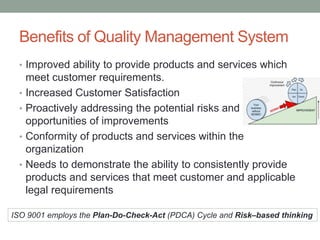
• Improved ability to provide products and services which
meet customer requirements.
• Increased Customer Satisfaction
• Proactively addressing the potential risks and
opportunities of improvements
• Conformity of products and services within the
organization
• Needs to demonstrate the ability to consistently provide
products and services that meet customer and applicable
legal requirements
Benefits of Quality Management System
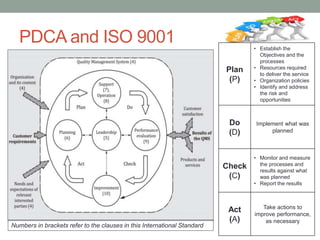
ISO 9001 employs the Plan-Do-Check-Act (PDCA) Cycle and Risk–based thinking
Quality Management Principles
• Customer focus
• Leadership
• Employee Involvement
• Process approach
• Continual Improvement
• Evidence-based decision making
• Relationship management/Communications
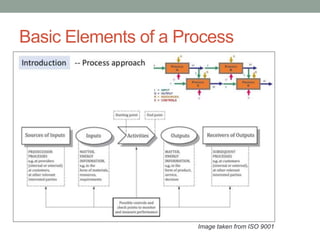
Basic Elements of a Process
Image taken from ISO 9001
PDCA and ISO 9001
Numbers in brackets refer to the clauses in this International Standard
Plan
(P)
• Establish the
Objectives and the
processes
• Resources required
to deliver the service
• Organization policies
• Identify and address
the risk and
opportunities
Do
(D)
Implement what was
planned
Check
(C)
• Monitor and measure
the processes and
results against what
was planned
• Report the results
Act
(A)
Take actions to
improve performance,
as necessary
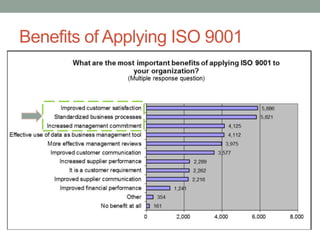
Benefits of Applying ISO 9001
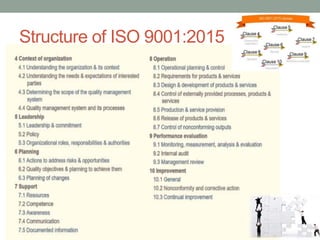
Structure of ISO 9001:2015
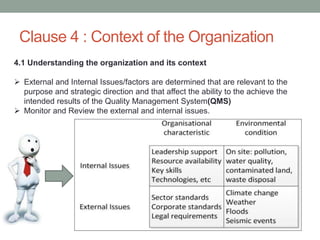
Clause 4 : Context of the Organization
4.1 Understanding the organization and its context
 External and Internal Issues/factors are determined that are relevant to the
purpose and strategic direction and that affect the ability to the achieve the
intended results of the Quality Management System(QMS)
 Monitor and Review the external and internal issues.
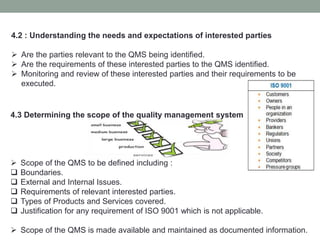
4.2 : Understanding the needs and expectations of interested parties
 Are the parties relevant to the QMS being identified.
 Are the requirements of these interested parties to the QMS identified.
 Monitoring and review of these interested parties and their requirements to be
executed.
4.3 Determining the scope of the quality management system
 Scope of the QMS to be defined including :
 Boundaries.
 External and Internal Issues.
 Requirements of relevant interested parties.
 Types of Products and Services covered.
 Justification for any requirement of ISO 9001 which is not applicable.
 Scope of the QMS is made available and maintained as documented information.
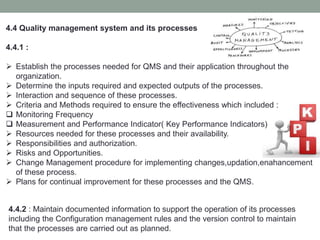
4.4 Quality management system and its processes
4.4.1 :
 Establish the processes needed for QMS and their application throughout the
organization.
 Determine the inputs required and expected outputs of the processes.
 Interaction and sequence of these processes.
 Criteria and Methods required to ensure the effectiveness which included :
 Monitoring Frequency
 Measurement and Performance Indicator( Key Performance Indicators)
 Resources needed for these processes and their availability.
 Responsibilities and authorization.
 Risks and Opportunities.
 Change Management procedure for implementing changes,updation,enahancement
of these process.
 Plans for continual improvement for these processes and the QMS.
4.4.2 : Maintain documented information to support the operation of its processes
including the Configuration management rules and the version control to maintain
that the processes are carried out as planned.
Leadership
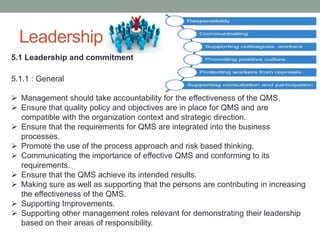
5.1 Leadership and commitment
5.1.1 : General
 Management should take accountability for the effectiveness of the QMS.
 Ensure that quality policy and objectives are in place for QMS and are
compatible with the organization context and strategic direction.
 Ensure that the requirements for QMS are integrated into the business
processes.
 Promote the use of the process approach and risk based thinking.
 Communicating the importance of effective QMS and conforming to its
requirements.
 Ensure that the QMS achieve its intended results.
 Making sure as well as supporting that the persons are contributing in increasing
the effectiveness of the QMS.
 Supporting Improvements.
 Supporting other management roles relevant for demonstrating their leadership
based on their areas of responsibility.
5.1.2 Customer focus
 Ensure that the customer and legal requirements are determined,understood and
met.
 Risks and Opportunities affecting to the conformity of the product and services are
determined.
 Customer issues are determined and addressed promptly
 Focus on improving the customer satisfaction is maintained.
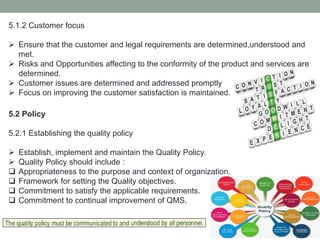
5.2 Policy
5.2.1 Establishing the quality policy
 Establish, implement and maintain the Quality Policy.
 Quality Policy should include :
 Appropriateness to the purpose and context of organization.
 Framework for setting the Quality objectives.
 Commitment to satisfy the applicable requirements.
 Commitment to continual improvement of QMS.
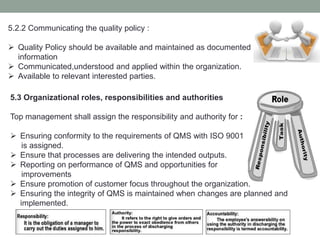
5.3 Organizational roles, responsibilities and authorities
Top management shall assign the responsibility and authority for :
 Ensuring conformity to the requirements of QMS with ISO 9001
is assigned.
 Ensure that processes are delivering the intended outputs.
 Reporting on performance of QMS and opportunities for
improvements
 Ensure promotion of customer focus throughout the organization.
 Ensuring the integrity of QMS is maintained when changes are planned and
implemented.
5.2.2 Communicating the quality policy :
 Quality Policy should be available and maintained as documented
information
 Communicated,understood and applied within the organization.
 Available to relevant interested parties.
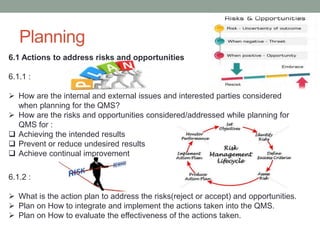
Planning
6.1 Actions to address risks and opportunities
6.1.1 :
 How are the internal and external issues and interested parties considered
when planning for the QMS?
 How are the risks and opportunities considered/addressed while planning for
QMS for :
 Achieving the intended results
 Prevent or reduce undesired results
 Achieve continual improvement
6.1.2 :
 What is the action plan to address the risks(reject or accept) and opportunities.
 Plan on How to integrate and implement the actions taken into the QMS.
 Plan on How to evaluate the effectiveness of the actions taken.
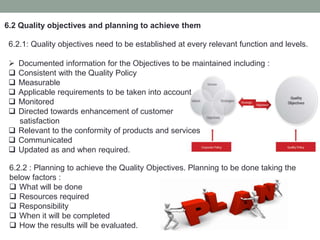
6.2 Quality objectives and planning to achieve them
6.2.1: Quality objectives need to be established at every relevant function and levels.
 Documented information for the Objectives to be maintained including :
 Consistent with the Quality Policy
 Measurable
 Applicable requirements to be taken into account
 Monitored
 Directed towards enhancement of customer
satisfaction
 Relevant to the conformity of products and services
 Communicated
 Updated as and when required.
6.2.2 : Planning to achieve the Quality Objectives. Planning to be done taking the
below factors :
 What will be done
 Resources required
 Responsibility
 When it will be completed
 How the results will be evaluated.
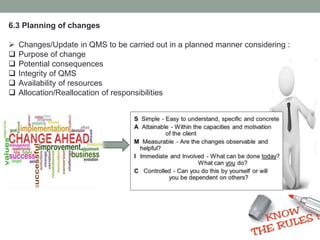
6.3 Planning of changes
 Changes/Update in QMS to be carried out in a planned manner considering :
 Purpose of change
 Potential consequences
 Integrity of QMS
 Availability of resources
 Allocation/Reallocation of responsibilities
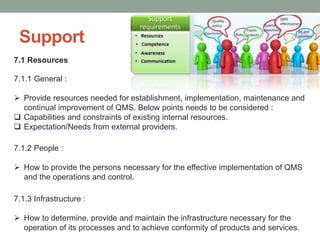
Support
7.1 Resources
7.1.1 General :
 Provide resources needed for establishment, implementation, maintenance and
continual improvement of QMS. Below points needs to be considered :
 Capabilities and constraints of existing internal resources.
 Expectation/Needs from external providers.
7.1.2 People :
 How to provide the persons necessary for the effective implementation of QMS
and the operations and control.
7.1.3 Infrastructure :
 How to determine, provide and maintain the infrastructure necessary for the
operation of its processes and to achieve conformity of products and services.
7.1.4 Environment for the operation of processes
 How do you determine, provide and maintain the environment for the operation of
processes to achieve products and service conformity?
 Stress reducing
 Burnout prevention
 Emotionally preventive
 Temperature,humidity,light,airflow,hygiene,noise
7.1.5 Monitoring and measuring resources
 7.1.5.1 General :
 How are the resources determined/provided for ensuring valid and reliable
monitoring and measuring results to verify the conformity of products and services
to requirements.
 How to determine that the resources are suitable for the specific type of monitoring
and measurement activities
 How it is ensured that the resources are maintained for continuing fitness for their
purpose in form of a documented information as evidence of fitness.( Trainings)
 7.1.5.2 Measurement traceability :
 How are the measuring instruments calibrated/verified at specified intervals/prior to
use against the measurement standards traceable to international/national
measurement standards or documented information(in case no such measurement
standards exist)
 Identification of measuring instruments in order to determine the status.
 Safeguarded from adjustments, damage or deterioration.
 Verify the validity of previous measurement results. When found unfit, necessary
actions to be taken as necessary.
 7.1.6 Organizational knowledge :
 How do you determine necessary knowledge for the operation of processes.
 How do you determine necessary knowledge to achieve conformity of products
and services?
 How is the knowledge maintained and how it is made available.
 How to acquire access knowledge considering changing needs and trends as
compared to the current knowledge base.
Organizational knowledge : Knowledge gained from experience, lessons learned,
capturing and sharing undocumented knowledge, results of improvements in
processes, products and services, standards, conferences, gathering knowledge
from customers or external providers
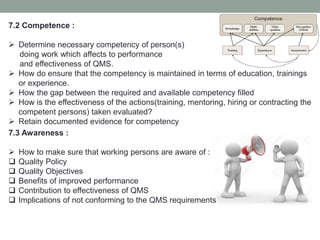
7.2 Competence :
 Determine necessary competency of person(s)
doing work which affects to performance
and effectiveness of QMS.
 How do ensure that the competency is maintained in terms of education, trainings
or experience.
 How the gap between the required and available competency filled
 How is the effectiveness of the actions(training, mentoring, hiring or contracting the
competent persons) taken evaluated?
 Retain documented evidence for competency
7.3 Awareness :
 How to make sure that working persons are aware of :
 Quality Policy
 Quality Objectives
 Benefits of improved performance
 Contribution to effectiveness of QMS
 Implications of not conforming to the QMS requirements
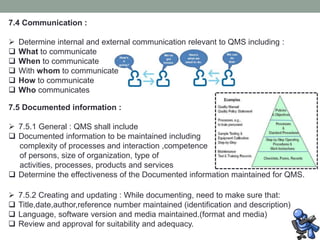
7.4 Communication :
 Determine internal and external communication relevant to QMS including :
 What to communicate
 When to communicate
 With whom to communicate
 How to communicate
 Who communicates
7.5 Documented information :
 7.5.1 General : QMS shall include
 Documented information to be maintained including
complexity of processes and interaction ,competence
of persons, size of organization, type of
activities, processes, products and services
 Determine the effectiveness of the Documented information maintained for QMS.
 7.5.2 Creating and updating : While documenting, need to make sure that:
 Title,date,author,reference number maintained (identification and description)
 Language, software version and media maintained.(format and media)
 Review and approval for suitability and adequacy.
 7.5.3 Control of documented information :
 7.5.3.1 Documented information as required ,need to be controlled to ensure :
Availability, Suitability for use, where and when needed
Adequately protected from improper use ,loss of integrity and confidentiality
 7.5.3.2 : For the control of documented information, need to ensure
Distribution,access,retrieval and use.
Storage and preservation.
Control of changes.
Retention and Disposition.
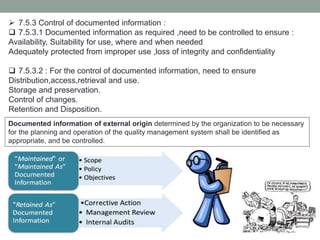
Documented information of external origin determined by the organization to be necessary
for the planning and operation of the quality management system shall be identified as
appropriate, and be controlled.
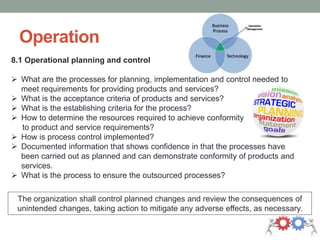
Operation
8.1 Operational planning and control
 What are the processes for planning, implementation and control needed to
meet requirements for providing products and services?
 What is the acceptance criteria of products and services?
 What is the establishing criteria for the process?
 How to determine the resources required to achieve conformity
to product and service requirements?
 How is process control implemented?
 Documented information that shows confidence in that the processes have
been carried out as planned and can demonstrate conformity of products and
services.
 What is the process to ensure the outsourced processes?
The organization shall control planned changes and review the consequences of
unintended changes, taking action to mitigate any adverse effects, as necessary.
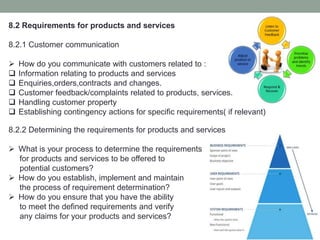
8.2 Requirements for products and services
8.2.1 Customer communication
 How do you communicate with customers related to :
 Information relating to products and services
 Enquiries,orders,contracts and changes.
 Customer feedback/complaints related to products, services.
 Handling customer property
 Establishing contingency actions for specific requirements( if relevant)
8.2.2 Determining the requirements for products and services
 What is your process to determine the requirements
for products and services to be offered to
potential customers?
 How do you establish, implement and maintain
the process of requirement determination?
 How do you ensure that you have the ability
to meet the defined requirements and verify
any claims for your products and services?
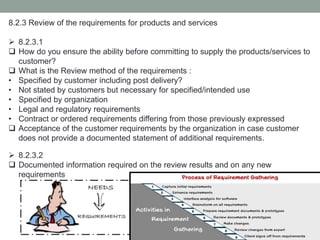
8.2.3 Review of the requirements for products and services
 8.2.3.1
 How do you ensure the ability before committing to supply the products/services to
customer?
 What is the Review method of the requirements :
• Specified by customer including post delivery?
• Not stated by customers but necessary for specified/intended use
• Specified by organization
• Legal and regulatory requirements
• Contract or ordered requirements differing from those previously expressed
 Acceptance of the customer requirements by the organization in case customer
does not provide a documented statement of additional requirements.
 8.2.3.2
 Documented information required on the review results and on any new
requirements
8.3 Design and development of products and services
8.3.1 General :
 What is the process for maintaining design and
development process ?
8.3.2 Design and development planning :
 Determine the stages and controls for design and development process including:
 Nature,Duration,Complexity of design and development activities
 Required process stages including reviews
 Verification/validation activities.
 Responsibilities and authorities involved in the design process
 Resources required ( internal and external)
 Need to control interfaces between persons involved in design/development
 Level of control required by customer and other relevant parties
 Documented information required to show that requirements for
design/development process is met
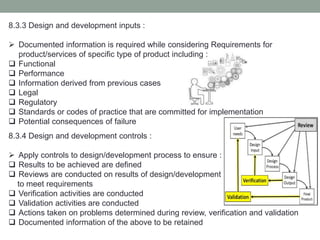
8.2.4 Changes to requirements for products and services :
 Documented information containing changes to products and services is required.
 Relevant persons to be informed for the changed requirements.
8.3.3 Design and development inputs :
 Documented information is required while considering Requirements for
product/services of specific type of product including :
 Functional
 Performance
 Information derived from previous cases
 Legal
 Regulatory
 Standards or codes of practice that are committed for implementation
 Potential consequences of failure
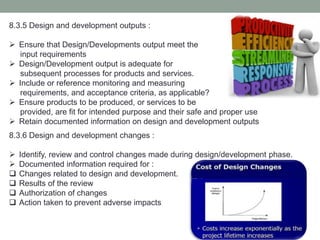
8.3.4 Design and development controls :
 Apply controls to design/development process to ensure :
 Results to be achieved are defined
 Reviews are conducted on results of design/development
to meet requirements
 Verification activities are conducted
 Validation activities are conducted
 Actions taken on problems determined during review, verification and validation
 Documented information of the above to be retained
8.3.5 Design and development outputs :
 Ensure that Design/Developments output meet the
input requirements
 Design/Development output is adequate for
subsequent processes for products and services.
 Include or reference monitoring and measuring
requirements, and acceptance criteria, as applicable?
 Ensure products to be produced, or services to be
provided, are fit for intended purpose and their safe and proper use
 Retain documented information on design and development outputs
8.3.6 Design and development changes :
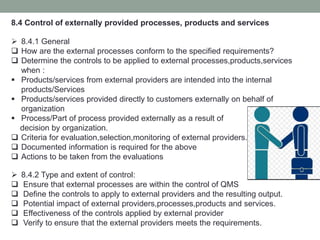
 Identify, review and control changes made during design/development phase.
 Documented information required for :
 Changes related to design and development.
 Results of the review
 Authorization of changes
 Action taken to prevent adverse impacts
8.4 Control of externally provided processes, products and services
 8.4.1 General
 How are the external processes conform to the specified requirements?
 Determine the controls to be applied to external processes,products,services
when :
 Products/services from external providers are intended into the internal
products/Services
 Products/services provided directly to customers externally on behalf of
organization
 Process/Part of process provided externally as a result of
decision by organization.
 Criteria for evaluation,selection,monitoring of external providers.
 Documented information is required for the above
 Actions to be taken from the evaluations
 8.4.2 Type and extent of control:
 Ensure that external processes are within the control of QMS
 Define the controls to apply to external providers and the resulting output.
 Potential impact of external providers,processes,products and services.
 Effectiveness of the controls applied by external provider
 Verify to ensure that the external providers meets the requirements.
8.4.3 Information for external providers
 Communicate external providers its requirements for processes, products and
services
 Approvals for products,services,methods,processes,outputs,release of
products/services.
 Competency
 Interaction with the organization
 Control and monitoring external providers performance
 Verification and validation activities that organization or customer intends to
perform.
8.5 Production and service provision
8.5.1 Control of production and service provision
 Documented information is required which defines the characteristics of the
product to be produced and services to be provided or activities to be performed
and the results achieved.
 Monitoring and measuring resources availability
 Monitoring and measuring activities implementation at appropriate stages to
verify the control and acceptance criteria.
 Availability of infrastructure and environment for operation of process.
 Appointment of competent person (include qualification required)
 Periodic Validation and revalidation for the ability to achieve the planned results.
 Implementation of actions to prevent human error.
 Implementation of release, delivery and post-delivery activities.
8.5.2 Identification and traceability
 Identify the outputs to ensure the
conformity of the products and services
 Identify the status of process outputs.
 Control the unique identification of the process output
 Documented information is required
for traceability ( as a requirement) maintenance.
8.5.3 Property belonging to customers or external providers :
 What care do you provide for customer or external provider’s property while under
your control?
 How do you identify, verify, protect and safeguard that property which is provided
for use or incorporation into your products or services?
 Report and retain documented information when the customer/external provider’s
property is lost, damaged or found unsuitable for use.
8.5.4 Preservation :
 Preserve the outputs during production and service provision for an evidence to
ensure conformity to the requirements.
8.5.5 Post-delivery activities :
 Identify the requirements for post-delivery activities associated with the product.
 Consider the below points for post delivery activities :
 Legal, regulatory requirements
 Potential undesired consequences associated with product/service
 Nature, use and intended lifetime of product/service.
 Customer requirements
 Customer feedback
8.5.6 Control of changes :
 Review and control changes to ensure conformity with requirements
 Documented information is required describing the results of the reviews, person
authorizing the change, and action arising from the review.
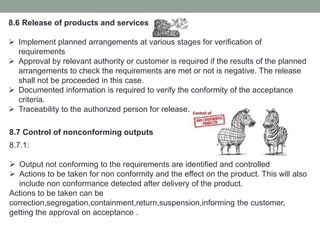
8.6 Release of products and services
 Implement planned arrangements at various stages for verification of
requirements
 Approval by relevant authority or customer is required if the results of the planned
arrangements to check the requirements are met or not is negative. The release
shall not be proceeded in this case.
 Documented information is required to verify the conformity of the acceptance
criteria.
 Traceability to the authorized person for release.
8.7 Control of nonconforming outputs
8.7.1:
 Output not conforming to the requirements are identified and controlled
 Actions to be taken for non conformity and the effect on the product. This will also
include non conformance detected after delivery of the product.
Actions to be taken can be
correction,segregation,containment,return,suspension,informing the customer,
getting the approval on acceptance .
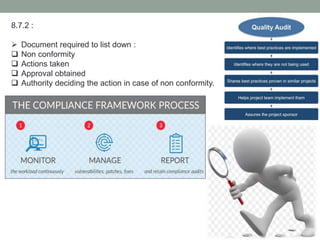
8.7.2 :
 Document required to list down :
 Non conformity
 Actions taken
 Approval obtained
 Authority deciding the action in case of non conformity.
Performance Evaluation
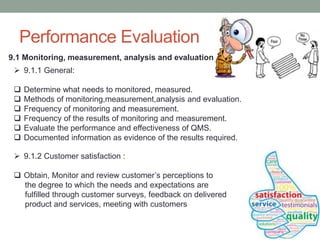
9.1 Monitoring, measurement, analysis and evaluation
 9.1.1 General:
 Determine what needs to monitored, measured.
 Methods of monitoring,measurement,analysis and evaluation.
 Frequency of monitoring and measurement.
 Frequency of the results of monitoring and measurement.
 Evaluate the performance and effectiveness of QMS.
 Documented information as evidence of the results required.
 9.1.2 Customer satisfaction :
 Obtain, Monitor and review customer’s perceptions to
the degree to which the needs and expectations are
fulfilled through customer surveys, feedback on delivered
product and services, meeting with customers
 9.1.3 Analysis and evaluation :
Evaluate the results from monitoring and measurement in terms of :
 Conformity of products and services
 Degree of customer satisfaction
 Performance and effectiveness of QMS
 Effective planning
 Effectiveness of actions taken to address risks and opportunities
 Performances of external providers
 Improvement needs for QMS
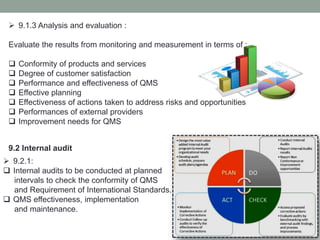
9.2 Internal audit
 9.2.1:
 Internal audits to be conducted at planned
intervals to check the conformity of QMS
and Requirement of International Standards.
 QMS effectiveness, implementation
and maintenance.
 9.2.2 :
 Plan,establish,implement and maintain the audit programme(s)
 Frequency,methods,responsibilities,planning requirements and reporting to be
included while auditing
 Audit should consider importance of processes, changes
affecting and results of previous audits
 Audit criteria and scope to be defined
 Auditors to be selected to ensure the objective
and impartiality
 Audit results to be reported to management.
 Corrective actions to be planned and implemented
without undue delay.
 Documented information required as evidence of audit programme and
results.
9.3 Management review
9.3.1 General
 What is the frequency that top management reviews the organization's QMS?
 How to ensure that QMS is continuing suitability, adequacy, effectiveness and
alignment with the strategic direction of the organization?
9.3.2 Management review inputs
 Management reviews to be planned taking into consideration :
 Status of actions from previous management reviews
 Changes in external and internal issues relevant to QMS
 Information on performance and effectiveness of
QMS including:
 Customer satisfaction/Feedback
 Quality Objectives
 Process Performance
 Conformity of products/services
 Non-Conformity and corrective
actions
 Monitoring and Measurement Results
 Audit Results
 External provider performance
 Resource Adequacy
 Actions taken on risks and opportunities including the effectiveness
 Resource needs
 Documented information to be required as evidence
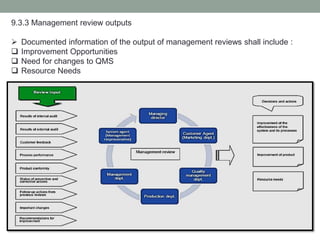
9.3.3 Management review outputs
 Documented information of the output of management reviews shall include :
 Improvement Opportunities
 Need for changes to QMS
 Resource Needs
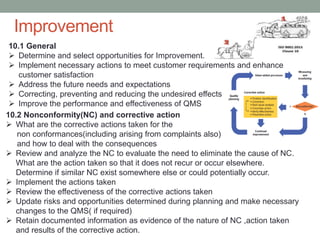
10.2 Nonconformity(NC) and corrective action
 What are the corrective actions taken for the
non conformances(including arising from complaints also)
and how to deal with the consequences
 Review and analyze the NC to evaluate the need to eliminate the cause of NC.
What are the action taken so that it does not recur or occur elsewhere.
Determine if similar NC exist somewhere else or could potentially occur.
 Implement the actions taken
 Review the effectiveness of the corrective actions taken
 Update risks and opportunities determined during planning and make necessary
changes to the QMS( if required)
 Retain documented information as evidence of the nature of NC ,action taken
and results of the corrective action.
10.1 General
 Determine and select opportunities for Improvement.
 Implement necessary actions to meet customer requirements and enhance
customer satisfaction
 Address the future needs and expectations
 Correcting, preventing and reducing the undesired effects
 Improve the performance and effectiveness of QMS
Improvement
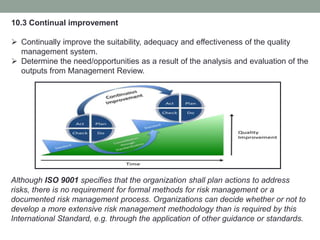
10.3 Continual improvement
 Continually improve the suitability, adequacy and effectiveness of the quality
management system.
 Determine the need/opportunities as a result of the analysis and evaluation of the
outputs from Management Review.
Although ISO 9001 specifies that the organization shall plan actions to address
risks, there is no requirement for formal methods for risk management or a
documented risk management process. Organizations can decide whether or not to
develop a more extensive risk management methodology than is required by this
International Standard, e.g. through the application of other guidance or standards.
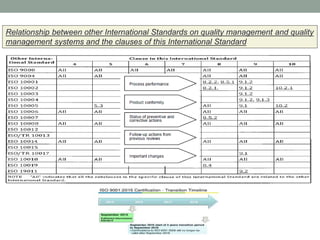
Relationship between other International Standards on quality management and quality
management systems and the clauses of this International Standard

Iso 9001

  • 1.
  • 2.
    • Improved abilityto provide products and services which meet customer requirements. • Increased Customer Satisfaction • Proactively addressing the potential risks and opportunities of improvements • Conformity of products and services within the organization • Needs to demonstrate the ability to consistently provide products and services that meet customer and applicable legal requirements Benefits of Quality Management System ISO 9001 employs the Plan-Do-Check-Act (PDCA) Cycle and Risk–based thinking
  • 3.
    Quality Management Principles •Customer focus • Leadership • Employee Involvement • Process approach • Continual Improvement • Evidence-based decision making • Relationship management/Communications
  • 4.
    Basic Elements ofa Process Image taken from ISO 9001
  • 5.
    PDCA and ISO9001 Numbers in brackets refer to the clauses in this International Standard Plan (P) • Establish the Objectives and the processes • Resources required to deliver the service • Organization policies • Identify and address the risk and opportunities Do (D) Implement what was planned Check (C) • Monitor and measure the processes and results against what was planned • Report the results Act (A) Take actions to improve performance, as necessary
  • 6.
  • 7.
  • 8.
    Clause 4 :Context of the Organization 4.1 Understanding the organization and its context  External and Internal Issues/factors are determined that are relevant to the purpose and strategic direction and that affect the ability to the achieve the intended results of the Quality Management System(QMS)  Monitor and Review the external and internal issues.
  • 9.
    4.2 : Understandingthe needs and expectations of interested parties  Are the parties relevant to the QMS being identified.  Are the requirements of these interested parties to the QMS identified.  Monitoring and review of these interested parties and their requirements to be executed. 4.3 Determining the scope of the quality management system  Scope of the QMS to be defined including :  Boundaries.  External and Internal Issues.  Requirements of relevant interested parties.  Types of Products and Services covered.  Justification for any requirement of ISO 9001 which is not applicable.  Scope of the QMS is made available and maintained as documented information.
  • 10.
    4.4 Quality managementsystem and its processes 4.4.1 :  Establish the processes needed for QMS and their application throughout the organization.  Determine the inputs required and expected outputs of the processes.  Interaction and sequence of these processes.  Criteria and Methods required to ensure the effectiveness which included :  Monitoring Frequency  Measurement and Performance Indicator( Key Performance Indicators)  Resources needed for these processes and their availability.  Responsibilities and authorization.  Risks and Opportunities.  Change Management procedure for implementing changes,updation,enahancement of these process.  Plans for continual improvement for these processes and the QMS. 4.4.2 : Maintain documented information to support the operation of its processes including the Configuration management rules and the version control to maintain that the processes are carried out as planned.
  • 11.
    Leadership 5.1 Leadership andcommitment 5.1.1 : General  Management should take accountability for the effectiveness of the QMS.  Ensure that quality policy and objectives are in place for QMS and are compatible with the organization context and strategic direction.  Ensure that the requirements for QMS are integrated into the business processes.  Promote the use of the process approach and risk based thinking.  Communicating the importance of effective QMS and conforming to its requirements.  Ensure that the QMS achieve its intended results.  Making sure as well as supporting that the persons are contributing in increasing the effectiveness of the QMS.  Supporting Improvements.  Supporting other management roles relevant for demonstrating their leadership based on their areas of responsibility.
  • 12.
    5.1.2 Customer focus Ensure that the customer and legal requirements are determined,understood and met.  Risks and Opportunities affecting to the conformity of the product and services are determined.  Customer issues are determined and addressed promptly  Focus on improving the customer satisfaction is maintained. 5.2 Policy 5.2.1 Establishing the quality policy  Establish, implement and maintain the Quality Policy.  Quality Policy should include :  Appropriateness to the purpose and context of organization.  Framework for setting the Quality objectives.  Commitment to satisfy the applicable requirements.  Commitment to continual improvement of QMS.
  • 13.
    5.3 Organizational roles,responsibilities and authorities Top management shall assign the responsibility and authority for :  Ensuring conformity to the requirements of QMS with ISO 9001 is assigned.  Ensure that processes are delivering the intended outputs.  Reporting on performance of QMS and opportunities for improvements  Ensure promotion of customer focus throughout the organization.  Ensuring the integrity of QMS is maintained when changes are planned and implemented. 5.2.2 Communicating the quality policy :  Quality Policy should be available and maintained as documented information  Communicated,understood and applied within the organization.  Available to relevant interested parties.
  • 14.
    Planning 6.1 Actions toaddress risks and opportunities 6.1.1 :  How are the internal and external issues and interested parties considered when planning for the QMS?  How are the risks and opportunities considered/addressed while planning for QMS for :  Achieving the intended results  Prevent or reduce undesired results  Achieve continual improvement 6.1.2 :  What is the action plan to address the risks(reject or accept) and opportunities.  Plan on How to integrate and implement the actions taken into the QMS.  Plan on How to evaluate the effectiveness of the actions taken.
  • 15.
    6.2 Quality objectivesand planning to achieve them 6.2.1: Quality objectives need to be established at every relevant function and levels.  Documented information for the Objectives to be maintained including :  Consistent with the Quality Policy  Measurable  Applicable requirements to be taken into account  Monitored  Directed towards enhancement of customer satisfaction  Relevant to the conformity of products and services  Communicated  Updated as and when required. 6.2.2 : Planning to achieve the Quality Objectives. Planning to be done taking the below factors :  What will be done  Resources required  Responsibility  When it will be completed  How the results will be evaluated.
  • 16.
    6.3 Planning ofchanges  Changes/Update in QMS to be carried out in a planned manner considering :  Purpose of change  Potential consequences  Integrity of QMS  Availability of resources  Allocation/Reallocation of responsibilities
  • 17.
    Support 7.1 Resources 7.1.1 General:  Provide resources needed for establishment, implementation, maintenance and continual improvement of QMS. Below points needs to be considered :  Capabilities and constraints of existing internal resources.  Expectation/Needs from external providers. 7.1.2 People :  How to provide the persons necessary for the effective implementation of QMS and the operations and control. 7.1.3 Infrastructure :  How to determine, provide and maintain the infrastructure necessary for the operation of its processes and to achieve conformity of products and services.
  • 18.
    7.1.4 Environment forthe operation of processes  How do you determine, provide and maintain the environment for the operation of processes to achieve products and service conformity?  Stress reducing  Burnout prevention  Emotionally preventive  Temperature,humidity,light,airflow,hygiene,noise 7.1.5 Monitoring and measuring resources  7.1.5.1 General :  How are the resources determined/provided for ensuring valid and reliable monitoring and measuring results to verify the conformity of products and services to requirements.  How to determine that the resources are suitable for the specific type of monitoring and measurement activities  How it is ensured that the resources are maintained for continuing fitness for their purpose in form of a documented information as evidence of fitness.( Trainings)
  • 19.
     7.1.5.2 Measurementtraceability :  How are the measuring instruments calibrated/verified at specified intervals/prior to use against the measurement standards traceable to international/national measurement standards or documented information(in case no such measurement standards exist)  Identification of measuring instruments in order to determine the status.  Safeguarded from adjustments, damage or deterioration.  Verify the validity of previous measurement results. When found unfit, necessary actions to be taken as necessary.  7.1.6 Organizational knowledge :  How do you determine necessary knowledge for the operation of processes.  How do you determine necessary knowledge to achieve conformity of products and services?  How is the knowledge maintained and how it is made available.  How to acquire access knowledge considering changing needs and trends as compared to the current knowledge base. Organizational knowledge : Knowledge gained from experience, lessons learned, capturing and sharing undocumented knowledge, results of improvements in processes, products and services, standards, conferences, gathering knowledge from customers or external providers
  • 20.
    7.2 Competence : Determine necessary competency of person(s) doing work which affects to performance and effectiveness of QMS.  How do ensure that the competency is maintained in terms of education, trainings or experience.  How the gap between the required and available competency filled  How is the effectiveness of the actions(training, mentoring, hiring or contracting the competent persons) taken evaluated?  Retain documented evidence for competency 7.3 Awareness :  How to make sure that working persons are aware of :  Quality Policy  Quality Objectives  Benefits of improved performance  Contribution to effectiveness of QMS  Implications of not conforming to the QMS requirements
  • 21.
    7.4 Communication : Determine internal and external communication relevant to QMS including :  What to communicate  When to communicate  With whom to communicate  How to communicate  Who communicates 7.5 Documented information :  7.5.1 General : QMS shall include  Documented information to be maintained including complexity of processes and interaction ,competence of persons, size of organization, type of activities, processes, products and services  Determine the effectiveness of the Documented information maintained for QMS.  7.5.2 Creating and updating : While documenting, need to make sure that:  Title,date,author,reference number maintained (identification and description)  Language, software version and media maintained.(format and media)  Review and approval for suitability and adequacy.
  • 22.
     7.5.3 Controlof documented information :  7.5.3.1 Documented information as required ,need to be controlled to ensure : Availability, Suitability for use, where and when needed Adequately protected from improper use ,loss of integrity and confidentiality  7.5.3.2 : For the control of documented information, need to ensure Distribution,access,retrieval and use. Storage and preservation. Control of changes. Retention and Disposition. Documented information of external origin determined by the organization to be necessary for the planning and operation of the quality management system shall be identified as appropriate, and be controlled.
  • 23.
    Operation 8.1 Operational planningand control  What are the processes for planning, implementation and control needed to meet requirements for providing products and services?  What is the acceptance criteria of products and services?  What is the establishing criteria for the process?  How to determine the resources required to achieve conformity to product and service requirements?  How is process control implemented?  Documented information that shows confidence in that the processes have been carried out as planned and can demonstrate conformity of products and services.  What is the process to ensure the outsourced processes? The organization shall control planned changes and review the consequences of unintended changes, taking action to mitigate any adverse effects, as necessary.
  • 24.
    8.2 Requirements forproducts and services 8.2.1 Customer communication  How do you communicate with customers related to :  Information relating to products and services  Enquiries,orders,contracts and changes.  Customer feedback/complaints related to products, services.  Handling customer property  Establishing contingency actions for specific requirements( if relevant) 8.2.2 Determining the requirements for products and services  What is your process to determine the requirements for products and services to be offered to potential customers?  How do you establish, implement and maintain the process of requirement determination?  How do you ensure that you have the ability to meet the defined requirements and verify any claims for your products and services?
  • 25.
    8.2.3 Review ofthe requirements for products and services  8.2.3.1  How do you ensure the ability before committing to supply the products/services to customer?  What is the Review method of the requirements : • Specified by customer including post delivery? • Not stated by customers but necessary for specified/intended use • Specified by organization • Legal and regulatory requirements • Contract or ordered requirements differing from those previously expressed  Acceptance of the customer requirements by the organization in case customer does not provide a documented statement of additional requirements.  8.2.3.2  Documented information required on the review results and on any new requirements
  • 26.
    8.3 Design anddevelopment of products and services 8.3.1 General :  What is the process for maintaining design and development process ? 8.3.2 Design and development planning :  Determine the stages and controls for design and development process including:  Nature,Duration,Complexity of design and development activities  Required process stages including reviews  Verification/validation activities.  Responsibilities and authorities involved in the design process  Resources required ( internal and external)  Need to control interfaces between persons involved in design/development  Level of control required by customer and other relevant parties  Documented information required to show that requirements for design/development process is met 8.2.4 Changes to requirements for products and services :  Documented information containing changes to products and services is required.  Relevant persons to be informed for the changed requirements.
  • 27.
    8.3.3 Design anddevelopment inputs :  Documented information is required while considering Requirements for product/services of specific type of product including :  Functional  Performance  Information derived from previous cases  Legal  Regulatory  Standards or codes of practice that are committed for implementation  Potential consequences of failure 8.3.4 Design and development controls :  Apply controls to design/development process to ensure :  Results to be achieved are defined  Reviews are conducted on results of design/development to meet requirements  Verification activities are conducted  Validation activities are conducted  Actions taken on problems determined during review, verification and validation  Documented information of the above to be retained
  • 28.
    8.3.5 Design anddevelopment outputs :  Ensure that Design/Developments output meet the input requirements  Design/Development output is adequate for subsequent processes for products and services.  Include or reference monitoring and measuring requirements, and acceptance criteria, as applicable?  Ensure products to be produced, or services to be provided, are fit for intended purpose and their safe and proper use  Retain documented information on design and development outputs 8.3.6 Design and development changes :  Identify, review and control changes made during design/development phase.  Documented information required for :  Changes related to design and development.  Results of the review  Authorization of changes  Action taken to prevent adverse impacts
  • 29.
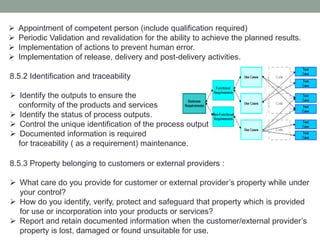
    8.4 Control ofexternally provided processes, products and services  8.4.1 General  How are the external processes conform to the specified requirements?  Determine the controls to be applied to external processes,products,services when :  Products/services from external providers are intended into the internal products/Services  Products/services provided directly to customers externally on behalf of organization  Process/Part of process provided externally as a result of decision by organization.  Criteria for evaluation,selection,monitoring of external providers.  Documented information is required for the above  Actions to be taken from the evaluations  8.4.2 Type and extent of control:  Ensure that external processes are within the control of QMS  Define the controls to apply to external providers and the resulting output.  Potential impact of external providers,processes,products and services.  Effectiveness of the controls applied by external provider  Verify to ensure that the external providers meets the requirements.
  • 30.
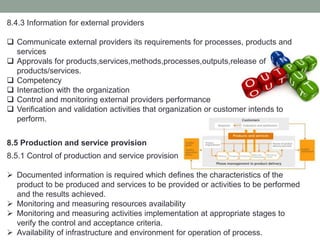
    8.4.3 Information forexternal providers  Communicate external providers its requirements for processes, products and services  Approvals for products,services,methods,processes,outputs,release of products/services.  Competency  Interaction with the organization  Control and monitoring external providers performance  Verification and validation activities that organization or customer intends to perform. 8.5 Production and service provision 8.5.1 Control of production and service provision  Documented information is required which defines the characteristics of the product to be produced and services to be provided or activities to be performed and the results achieved.  Monitoring and measuring resources availability  Monitoring and measuring activities implementation at appropriate stages to verify the control and acceptance criteria.  Availability of infrastructure and environment for operation of process.
  • 31.
     Appointment ofcompetent person (include qualification required)  Periodic Validation and revalidation for the ability to achieve the planned results.  Implementation of actions to prevent human error.  Implementation of release, delivery and post-delivery activities. 8.5.2 Identification and traceability  Identify the outputs to ensure the conformity of the products and services  Identify the status of process outputs.  Control the unique identification of the process output  Documented information is required for traceability ( as a requirement) maintenance. 8.5.3 Property belonging to customers or external providers :  What care do you provide for customer or external provider’s property while under your control?  How do you identify, verify, protect and safeguard that property which is provided for use or incorporation into your products or services?  Report and retain documented information when the customer/external provider’s property is lost, damaged or found unsuitable for use.
  • 32.
    8.5.4 Preservation : Preserve the outputs during production and service provision for an evidence to ensure conformity to the requirements. 8.5.5 Post-delivery activities :  Identify the requirements for post-delivery activities associated with the product.  Consider the below points for post delivery activities :  Legal, regulatory requirements  Potential undesired consequences associated with product/service  Nature, use and intended lifetime of product/service.  Customer requirements  Customer feedback 8.5.6 Control of changes :  Review and control changes to ensure conformity with requirements  Documented information is required describing the results of the reviews, person authorizing the change, and action arising from the review.
  • 33.
    8.6 Release ofproducts and services  Implement planned arrangements at various stages for verification of requirements  Approval by relevant authority or customer is required if the results of the planned arrangements to check the requirements are met or not is negative. The release shall not be proceeded in this case.  Documented information is required to verify the conformity of the acceptance criteria.  Traceability to the authorized person for release. 8.7 Control of nonconforming outputs 8.7.1:  Output not conforming to the requirements are identified and controlled  Actions to be taken for non conformity and the effect on the product. This will also include non conformance detected after delivery of the product. Actions to be taken can be correction,segregation,containment,return,suspension,informing the customer, getting the approval on acceptance .
  • 34.
    8.7.2 :  Documentrequired to list down :  Non conformity  Actions taken  Approval obtained  Authority deciding the action in case of non conformity.
  • 35.
    Performance Evaluation 9.1 Monitoring,measurement, analysis and evaluation  9.1.1 General:  Determine what needs to monitored, measured.  Methods of monitoring,measurement,analysis and evaluation.  Frequency of monitoring and measurement.  Frequency of the results of monitoring and measurement.  Evaluate the performance and effectiveness of QMS.  Documented information as evidence of the results required.  9.1.2 Customer satisfaction :  Obtain, Monitor and review customer’s perceptions to the degree to which the needs and expectations are fulfilled through customer surveys, feedback on delivered product and services, meeting with customers
  • 36.
     9.1.3 Analysisand evaluation : Evaluate the results from monitoring and measurement in terms of :  Conformity of products and services  Degree of customer satisfaction  Performance and effectiveness of QMS  Effective planning  Effectiveness of actions taken to address risks and opportunities  Performances of external providers  Improvement needs for QMS 9.2 Internal audit  9.2.1:  Internal audits to be conducted at planned intervals to check the conformity of QMS and Requirement of International Standards.  QMS effectiveness, implementation and maintenance.
  • 37.
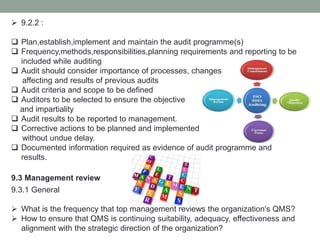
     9.2.2 : Plan,establish,implement and maintain the audit programme(s)  Frequency,methods,responsibilities,planning requirements and reporting to be included while auditing  Audit should consider importance of processes, changes affecting and results of previous audits  Audit criteria and scope to be defined  Auditors to be selected to ensure the objective and impartiality  Audit results to be reported to management.  Corrective actions to be planned and implemented without undue delay.  Documented information required as evidence of audit programme and results. 9.3 Management review 9.3.1 General  What is the frequency that top management reviews the organization's QMS?  How to ensure that QMS is continuing suitability, adequacy, effectiveness and alignment with the strategic direction of the organization?
  • 38.
    9.3.2 Management reviewinputs  Management reviews to be planned taking into consideration :  Status of actions from previous management reviews  Changes in external and internal issues relevant to QMS  Information on performance and effectiveness of QMS including:  Customer satisfaction/Feedback  Quality Objectives  Process Performance  Conformity of products/services  Non-Conformity and corrective actions  Monitoring and Measurement Results  Audit Results  External provider performance  Resource Adequacy  Actions taken on risks and opportunities including the effectiveness  Resource needs  Documented information to be required as evidence
  • 39.
    9.3.3 Management reviewoutputs  Documented information of the output of management reviews shall include :  Improvement Opportunities  Need for changes to QMS  Resource Needs
  • 40.
    10.2 Nonconformity(NC) andcorrective action  What are the corrective actions taken for the non conformances(including arising from complaints also) and how to deal with the consequences  Review and analyze the NC to evaluate the need to eliminate the cause of NC. What are the action taken so that it does not recur or occur elsewhere. Determine if similar NC exist somewhere else or could potentially occur.  Implement the actions taken  Review the effectiveness of the corrective actions taken  Update risks and opportunities determined during planning and make necessary changes to the QMS( if required)  Retain documented information as evidence of the nature of NC ,action taken and results of the corrective action. 10.1 General  Determine and select opportunities for Improvement.  Implement necessary actions to meet customer requirements and enhance customer satisfaction  Address the future needs and expectations  Correcting, preventing and reducing the undesired effects  Improve the performance and effectiveness of QMS Improvement
  • 41.
    10.3 Continual improvement Continually improve the suitability, adequacy and effectiveness of the quality management system.  Determine the need/opportunities as a result of the analysis and evaluation of the outputs from Management Review. Although ISO 9001 specifies that the organization shall plan actions to address risks, there is no requirement for formal methods for risk management or a documented risk management process. Organizations can decide whether or not to develop a more extensive risk management methodology than is required by this International Standard, e.g. through the application of other guidance or standards.
  • 42.
    Relationship between otherInternational Standards on quality management and quality management systems and the clauses of this International Standard

Editor's Notes

  • #3 PDCA : Processes are adequately resourced and managed. Improvement opportunities are determined and acted on. Risk Based thinking : Determine the factors that could cause deviations from the planned results. Put in place the preventive results and minimize the negative impact.
  • #9 Context : the circumstances that form the setting for an event, statement, or idea, and in terms of which it can be fully understood Issues : Positive and Negative factors or conditions External Context : Issues arising from legal,technological,competitive,market, cultural, social and economic environments Internal Context : Issues arising from values, culture, knowledge and performance of the organization
  • #10 Conformity to this International Standard may only be claimed if the requirements determined as not being applicable do not affect the organization's ability or responsibility to ensure the conformity of its products and services and the enhancement of customer satisfaction.
  • #15 Address risks : avoiding risk, taking risk in order to pursue an opportunity, eliminating the risk source, changing the likelihood or consequences, sharing the risk, or retaining risk by informed decision. Opportunities : adoption of new practices, launching new products, opening new markets, addressing new customers, building partnerships, using new technology and other desirable and viable possibilities to address the organization's or its customers' needs
  • #18 Infrastructure can include: buildings and associated utilities, hardware and software equipments,transportation,information and communication technology.
  • #32 A customer's or external provider's property can include materials, components, tools and equipment, premises, intellectual property and personal data.
  • #33 Preservation can include identification, handling, contamination control, packaging, storage,transmission or transportation, and protection.