ISO9000
AKSHAY ANAND M
I Year – Master of Pharmacy
Pharmaceutical Regulatory Affairs
JSS College Of Pharmacy
Mysuru 570015, Karnataka
ISO9000
• The ISO 9000 family of quality management
systems standards is designed to help organizations ensure
that they meet the needs of customers and other
stakeholders while meeting statutory and regulatory
requirements related to a product.
• ISO 9000 deals with the fundamentals of quality
management systems,including the eight management
principles upon which the family of standards is based.
• ISO 9001 deals with the requirements that organizations
wishing to meet the standard must fulfil.
01
ISO9000
• Third-party certification bodies provide independent
confirmation that organizations meet the requirements of
ISO 9001.
• Over one million organizations worldwideare independently
certified, making ISO 9001 one of the most widely used
management tools in the world today.
• Despite widespread use, the ISO certification process has
been criticized as being wasteful and not being useful for all
organizations
02
HISTORY
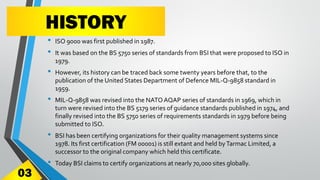
• ISO 9000 was first published in 1987.
• It was based on the BS 5750 series of standards from BSI that were proposed to ISO in
1979.
• However, its history can be traced back some twenty years before that, to the
publication of the United States Department of Defence MIL-Q-9858 standard in
1959.
• MIL-Q-9858 was revised into the NATOAQAP series of standards in 1969, which in
turn were revised into the BS 5179 series of guidance standards published in 1974, and
finally revised into the BS 5750 series of requirements standards in 1979 before being
submitted to ISO.
• BSI has been certifying organizations for their quality management systems since
1978. Its first certification (FM 00001) is still extant and held byTarmac Limited, a
successor to the original company which held this certificate.
• Today BSI claims to certify organizations at nearly 70,000 sites globally.
03
GLOBAL ADAPTION
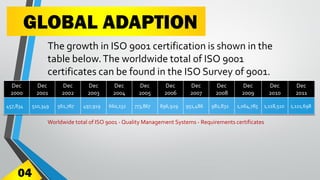
The growth in ISO 9001 certification is shown in the
table below.The worldwide total of ISO 9001
certificates can be found in the ISO Survey of 9001.
04
Dec
2000
Dec
2001
Dec
2002
Dec
2003
Dec
2004
Dec
2005
Dec
2006
Dec
2007
Dec
2008
Dec
2009
Dec
2010
Dec
2011
457,834 510,349 561,767 497,919 660,132 773,867 896,929 951,486 982,832 1,064,785 1,118,510 1,111,698
Worldwide total of ISO 9001 - Quality Management Systems - Requirements certificates
GLOBAL ADAPTION
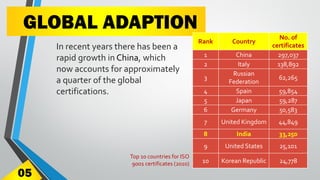
In recent years there has been a
rapid growth in China, which
now accounts for approximately
a quarter of the global
certifications.
05
Top 10 countries for ISO
9001 certificates (2010)
Rank Country
No. of
certificates
1 China 297,037
2 Italy 138,892
3
Russian
Federation
62,265
4 Spain 59,854
5 Japan 59,287
6 Germany 50,583
7 United Kingdom 44,849
8 India 33,250
9 United States 25,101
10 Korean Republic 24,778
CONTENTS OF ISO9001
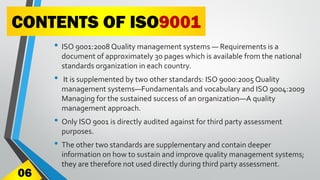
• ISO 9001:2008 Quality management systems — Requirements is a
document of approximately 30 pages which is available from the national
standards organization in each country.
• It is supplemented by two other standards: ISO 9000:2005 Quality
management systems—Fundamentals and vocabulary and ISO 9004:2009
Managing for the sustained success of an organization—A quality
management approach.
• Only ISO 9001 is directly audited against for third party assessment
purposes.
• The other two standards are supplementary and contain deeper
information on how to sustain and improve quality management systems;
they are therefore not used directly during third party assessment.
06
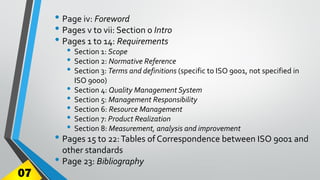
• Page iv: Foreword
• Pages v to vii: Section 0 Intro
• Pages 1 to 14: Requirements
• Section 1: Scope
• Section 2: Normative Reference
• Section 3: Terms and definitions (specific to ISO 9001, not specified in
ISO 9000)
• Section 4: Quality Management System
• Section 5: Management Responsibility
• Section 6: Resource Management
• Section 7: Product Realization
• Section 8: Measurement, analysis and improvement
• Pages 15 to 22:Tables of Correspondence between ISO 9001 and
other standards
• Page 23: Bibliography
07
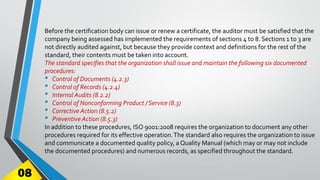
Before the certification body can issue or renew a certificate, the auditor must be satisfied that the
company being assessed has implemented the requirements of sections 4 to 8. Sections 1 to 3 are
not directly audited against, but because they provide context and definitions for the rest of the
standard, their contents must be taken into account.
The standard specifies that the organization shall issue and maintain the following six documented
procedures:
• Control of Documents (4.2.3)
• Control of Records (4.2.4)
• Internal Audits (8.2.2)
• Control of Nonconforming Product / Service (8.3)
• Corrective Action (8.5.2)
• Preventive Action (8.5.3)
In addition to these procedures, ISO 9001:2008 requires the organization to document any other
procedures required for its effective operation.The standard also requires the organization to issue
and communicate a documented quality policy, a Quality Manual (which may or may not include
the documented procedures) and numerous records, as specified throughout the standard.
08
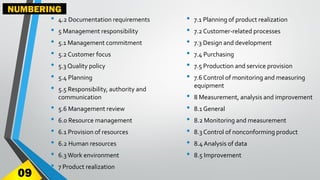
• 4.2 Documentation requirements
• 5 Management responsibility
• 5.1 Management commitment
• 5.2 Customer focus
• 5.3 Quality policy
• 5.4 Planning
• 5.5 Responsibility, authority and
communication
• 5.6 Management review
• 6.0 Resource management
• 6.1 Provision of resources
• 6.2 Human resources
• 6.3Work environment
• 7 Product realization
• 7.1 Planning of product realization
• 7.2 Customer-related processes
• 7.3 Design and development
• 7.4 Purchasing
• 7.5 Production and service provision
• 7.6 Control of monitoring and measuring
equipment
• 8 Measurement, analysis and improvement
• 8.1 General
• 8.2 Monitoring and measurement
• 8.3 Control of nonconforming product
• 8.4 Analysis of data
• 8.5 Improvement
09
NUMBERING
CERTIFICATION
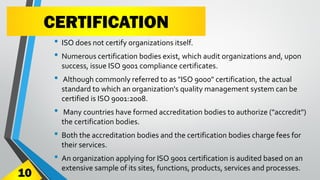
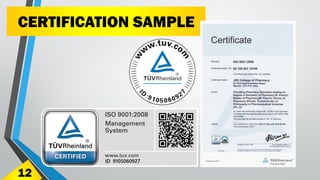
• ISO does not certify organizations itself.
• Numerous certification bodies exist, which audit organizations and, upon
success, issue ISO 9001 compliance certificates.
• Although commonly referred to as "ISO 9000" certification, the actual
standard to which an organization's quality management system can be
certified is ISO 9001:2008.
• Many countries have formed accreditation bodies to authorize ("accredit")
the certification bodies.
• Both the accreditation bodies and the certification bodies charge fees for
their services.
• An organization applying for ISO 9001 certification is audited based on an
extensive sample of its sites, functions, products, services and processes.
10
CERTIFICATION BODIES
11
CERTIFICATION SAMPLE
12
VERSIONS
The ISO 9000 standard is continually being revised by
standing technical committees and advisory groups,
who receive feedback from those professionals who are
implementing the standard
•1987
•1994
•2000
•2008
•2015
13
ADVANTAGES
• Creates a more efficient, effective operation
• Increases customer satisfaction and retention
• Reduces audits
• Enhances marketing
• Improves employee motivation, awareness, and
morale
• Promotes international trade
• Increases profit
• Reduces waste and increases productivity
• Common tool for standardization
14
thankyou!axayanand@gmail.com

ISO 9000 Quality Management System - A Presentation by Akshay Anand

  • 1.
    ISO9000 AKSHAY ANAND M IYear – Master of Pharmacy Pharmaceutical Regulatory Affairs JSS College Of Pharmacy Mysuru 570015, Karnataka
  • 2.
    ISO9000 • The ISO9000 family of quality management systems standards is designed to help organizations ensure that they meet the needs of customers and other stakeholders while meeting statutory and regulatory requirements related to a product. • ISO 9000 deals with the fundamentals of quality management systems,including the eight management principles upon which the family of standards is based. • ISO 9001 deals with the requirements that organizations wishing to meet the standard must fulfil. 01
  • 3.
    ISO9000 • Third-party certificationbodies provide independent confirmation that organizations meet the requirements of ISO 9001. • Over one million organizations worldwideare independently certified, making ISO 9001 one of the most widely used management tools in the world today. • Despite widespread use, the ISO certification process has been criticized as being wasteful and not being useful for all organizations 02
  • 4.
    HISTORY • ISO 9000was first published in 1987. • It was based on the BS 5750 series of standards from BSI that were proposed to ISO in 1979. • However, its history can be traced back some twenty years before that, to the publication of the United States Department of Defence MIL-Q-9858 standard in 1959. • MIL-Q-9858 was revised into the NATOAQAP series of standards in 1969, which in turn were revised into the BS 5179 series of guidance standards published in 1974, and finally revised into the BS 5750 series of requirements standards in 1979 before being submitted to ISO. • BSI has been certifying organizations for their quality management systems since 1978. Its first certification (FM 00001) is still extant and held byTarmac Limited, a successor to the original company which held this certificate. • Today BSI claims to certify organizations at nearly 70,000 sites globally. 03
  • 5.
    GLOBAL ADAPTION The growthin ISO 9001 certification is shown in the table below.The worldwide total of ISO 9001 certificates can be found in the ISO Survey of 9001. 04 Dec 2000 Dec 2001 Dec 2002 Dec 2003 Dec 2004 Dec 2005 Dec 2006 Dec 2007 Dec 2008 Dec 2009 Dec 2010 Dec 2011 457,834 510,349 561,767 497,919 660,132 773,867 896,929 951,486 982,832 1,064,785 1,118,510 1,111,698 Worldwide total of ISO 9001 - Quality Management Systems - Requirements certificates
  • 6.
    GLOBAL ADAPTION In recentyears there has been a rapid growth in China, which now accounts for approximately a quarter of the global certifications. 05 Top 10 countries for ISO 9001 certificates (2010) Rank Country No. of certificates 1 China 297,037 2 Italy 138,892 3 Russian Federation 62,265 4 Spain 59,854 5 Japan 59,287 6 Germany 50,583 7 United Kingdom 44,849 8 India 33,250 9 United States 25,101 10 Korean Republic 24,778
  • 7.
    CONTENTS OF ISO9001 •ISO 9001:2008 Quality management systems — Requirements is a document of approximately 30 pages which is available from the national standards organization in each country. • It is supplemented by two other standards: ISO 9000:2005 Quality management systems—Fundamentals and vocabulary and ISO 9004:2009 Managing for the sustained success of an organization—A quality management approach. • Only ISO 9001 is directly audited against for third party assessment purposes. • The other two standards are supplementary and contain deeper information on how to sustain and improve quality management systems; they are therefore not used directly during third party assessment. 06
  • 8.
    • Page iv:Foreword • Pages v to vii: Section 0 Intro • Pages 1 to 14: Requirements • Section 1: Scope • Section 2: Normative Reference • Section 3: Terms and definitions (specific to ISO 9001, not specified in ISO 9000) • Section 4: Quality Management System • Section 5: Management Responsibility • Section 6: Resource Management • Section 7: Product Realization • Section 8: Measurement, analysis and improvement • Pages 15 to 22:Tables of Correspondence between ISO 9001 and other standards • Page 23: Bibliography 07
  • 9.
    Before the certificationbody can issue or renew a certificate, the auditor must be satisfied that the company being assessed has implemented the requirements of sections 4 to 8. Sections 1 to 3 are not directly audited against, but because they provide context and definitions for the rest of the standard, their contents must be taken into account. The standard specifies that the organization shall issue and maintain the following six documented procedures: • Control of Documents (4.2.3) • Control of Records (4.2.4) • Internal Audits (8.2.2) • Control of Nonconforming Product / Service (8.3) • Corrective Action (8.5.2) • Preventive Action (8.5.3) In addition to these procedures, ISO 9001:2008 requires the organization to document any other procedures required for its effective operation.The standard also requires the organization to issue and communicate a documented quality policy, a Quality Manual (which may or may not include the documented procedures) and numerous records, as specified throughout the standard. 08
  • 10.
    • 4.2 Documentationrequirements • 5 Management responsibility • 5.1 Management commitment • 5.2 Customer focus • 5.3 Quality policy • 5.4 Planning • 5.5 Responsibility, authority and communication • 5.6 Management review • 6.0 Resource management • 6.1 Provision of resources • 6.2 Human resources • 6.3Work environment • 7 Product realization • 7.1 Planning of product realization • 7.2 Customer-related processes • 7.3 Design and development • 7.4 Purchasing • 7.5 Production and service provision • 7.6 Control of monitoring and measuring equipment • 8 Measurement, analysis and improvement • 8.1 General • 8.2 Monitoring and measurement • 8.3 Control of nonconforming product • 8.4 Analysis of data • 8.5 Improvement 09 NUMBERING
  • 11.
    CERTIFICATION • ISO doesnot certify organizations itself. • Numerous certification bodies exist, which audit organizations and, upon success, issue ISO 9001 compliance certificates. • Although commonly referred to as "ISO 9000" certification, the actual standard to which an organization's quality management system can be certified is ISO 9001:2008. • Many countries have formed accreditation bodies to authorize ("accredit") the certification bodies. • Both the accreditation bodies and the certification bodies charge fees for their services. • An organization applying for ISO 9001 certification is audited based on an extensive sample of its sites, functions, products, services and processes. 10
  • 12.
  • 13.
  • 14.
    VERSIONS The ISO 9000standard is continually being revised by standing technical committees and advisory groups, who receive feedback from those professionals who are implementing the standard •1987 •1994 •2000 •2008 •2015 13
  • 15.
    ADVANTAGES • Creates amore efficient, effective operation • Increases customer satisfaction and retention • Reduces audits • Enhances marketing • Improves employee motivation, awareness, and morale • Promotes international trade • Increases profit • Reduces waste and increases productivity • Common tool for standardization 14
  • 16.