International Organization
for Standardization
for Standardization
www.iso.org
Overview of ISO
9001 and ISO
14001


1951 - The first ISO standard was published.



ISO 9001 and ISO 14001 are among ISO's most well
known standards ever.



They are implemented by more than a million organizations
in some 175 countries.



ISO 9001 helps organizations to implement quality
management.



ISO 14001 helps organizations to implement environmental
management.


ISO 9001 is for quality management .



Quality refers to all those features of a product (or service) which
are required by the customer.



Quality management means what the organization does to
ensure that its products or services satisfy the customer's quality
requirements and comply with any regulations applicable to
those products or services.



Quality management also means what the organization does to
enhance customer satisfaction , and achieve continual
improvement of its performance.


ISO 14001 is for environmental management . This
means what the organization does to minimize
harmful effects on the environment caused by its
activities, to conform to applicable regulatory
requirements, and to achieve continual improvement
of its environmental performance .
ISO 9001 and ISO 14001 are generic standards.
Generic means that the same standards can be
applied to any organization, large or small,
whatever its product or service, in any sector of
activity, and whether it is a business enterprise, a
public administration, or a government department.
Generic also signifies that
 no matter what the organization's scope of activity
 if it wants to establish a quality management
system, ISO 9001 gives the essential features
 or if it wants to establish an environmental
management system, ISO 14001 gives the
essential features.


Management system means what the organization does
to manage its processes, or activities in order that



its products or services meet the organization’s
objectives, such as



satisfying the customer's quality requirements ,



complying to regulations, or



meeting environmental objectives







To be really efficient and effective, the organization can
manage its way of doing things by systemizing it.
Nothing important is left out.
Everyone is clear about who is responsible for doing
what, when, how, why and where.
Management system standards provide the organization with
an international, state-of-the-art model to follow.
Large organizations, or ones with complicated
processes, could not function well without
management systems.
 Companies in such fields as aerospace, automobiles,
defence, or health care devices have been operating
management systems for years.
 The ISO 9001 and ISO 14001 management system
standards now make these successful practices
available for all organizations .

Both ISO 9001 and ISO 14001 concern the way an
organization goes about its work .
 They are not product standards.
 They are not service standards.
 They are process standards.
 They can be used by product manufacturers and
service providers.

Processes affect final products or services.
 ISO 9001 gives the requirements for what the
organization must do to manage processes
affecting quality of its products and services.
 ISO 14001 gives the requirements for what the
organization must do to manage processes
affecting the impact of its activities on the
environment.

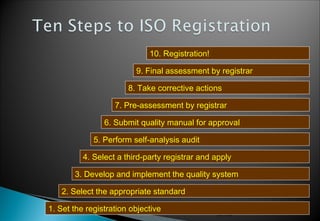
10. Registration!
9. Final assessment by registrar
8. Take corrective actions
7. Pre-assessment by registrar
6. Submit quality manual for approval
5. Perform self-analysis audit
4. Select a third-party registrar and apply
3. Develop and implement the quality system
2. Select the appropriate standard
1. Set the registration objective

ISO 9000
Certification is known in some countries as
registration.
 It means that an independent, external body has
audited an organization's management system and
verified that it conforms to the requirements specified
in the standard (ISO 9001 or ISO 14001).
 ISO does not carry out certification and does
not issue or approve certificates,



Accreditation is like certification of the certification body.



It means the formal approval by a specialized body - an
accreditation body - that a certification body is competent to
carry out ISO 9001:2008 or ISO 14001:2004 certification in
specified business sectors.



Certificates issued by accredited certification bodies - and
known as accredited certificates - may be perceived on
the market as having increased credibility.



ISO does not carry out or approve accreditations.
Certification is not a requirement of ISO 9001
or ISO 14001.
 The organization can implement and benefit from an
ISO 9001 or ISO 14001 system without having it
certified.
 The organization can implement them for the internal
benefits without spending money on a certification
programme.

Certification is a decision to be taken for
business reasons:
 if it is a contractual, regulatory, or market requirement,
 If it meets customer preferences
 it is part of a risk management programme, or
 if it will motivate staff by setting a clear goal.

ISO does not carry out ISO 9001 or ISO
14001 certification .
 ISO does not issue certificates.
 ISO does not accredit, approve or control the
certification bodies.
 ISO develops standards and guides to
encourage good practice in accreditation and
certification.

ISO 9001 is the standard that gives the requirements
for a quality management system .
 ISO 9001:2008 is the latest, improved version.
 It is the only standard in the ISO 9000 family that
can be used for certification.
 There are 16 other standards in the family that can
help an organization on specific aspects such as
performance improvement, auditing, training…



ISO 14001 is the standard that gives the requirements for
an environmental management system.



ISO 14001:2004 is the latest, improved version.



It is the only standard in the ISO 14000 family that can be
used for certification.



The ISO 14000 family includes 21 other standards that
can help an organization specific aspects such as auditing,
environmental labelling, life cycle analysis…
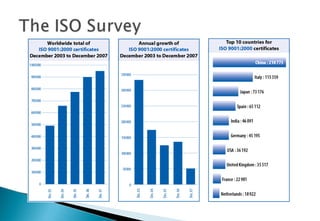
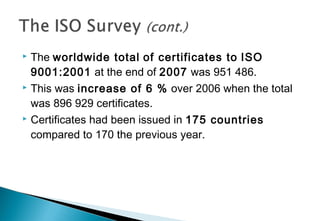
The worldwide total of certificates to ISO
9001:2001 at the end of 2007 was 951 486.
 This was increase of 6 % over 2006 when the total
was 896 929 certificates.
 Certificates had been issued in 175 countries
compared to 170 the previous year.

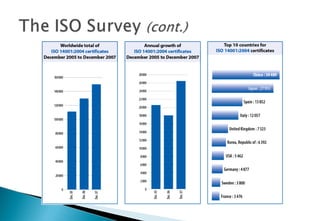
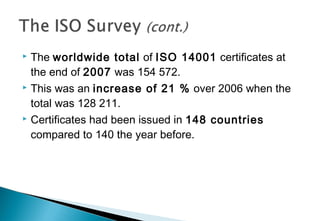
The worldwide total of ISO 14001 certificates at
the end of 2007 was 154 572.
 This was an increase of 21 % over 2006 when the
total was 128 211.
 Certificates had been issued in 148 countries
compared to 140 the year before.

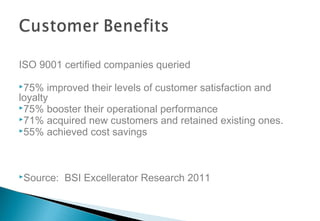
ISO 9001 certified companies queried
75%

improved their levels of customer satisfaction and
loyalty
75% booster their operational performance
71% acquired new customers and retained existing ones.
55% achieved cost savings

Source:

BSI Excellerator Research 2011
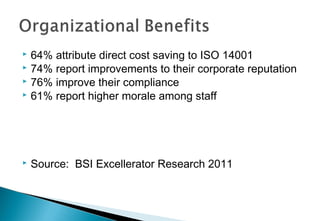
64% attribute direct cost saving to ISO 14001
 74% report improvements to their corporate reputation
 76% improve their compliance
 61% report higher morale among staff




Source: BSI Excellerator Research 2011
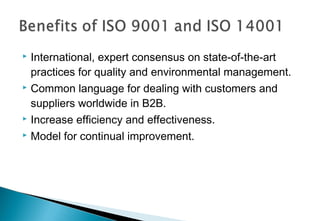
International, expert consensus on state-of-the-art
practices for quality and environmental management.
 Common language for dealing with customers and
suppliers worldwide in B2B.
 Increase efficiency and effectiveness.
 Model for continual improvement.

Model for satisfying customers and other stakeholders.
 Build quality into products and services from design
onwards.
 Address environmental concerns of customers and
public, and comply with government regulations.
 Integrate with global economy.

Sustainable business.
 Unifying base for industry sectors
 Qualify suppliers for global supply chains
 Technical support for regulations

Transfer of good practice to developing countries
 Tools for new economic players
 Regional integration
 Facilitate rise of services

ISO 9000/ISO 14000 section on ISO Web site:
www.iso.org
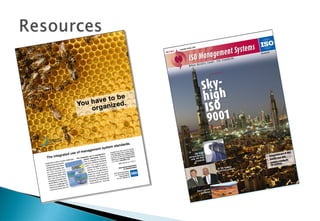
 ISO Management Systems magazine
www.iso.org/ims
 IMS Alerts free electronic newsletter
www.iso.org/imsalerts

iso 9001 &14001

iso 9001 &14001

  • 1.
    International Organization International Organization forStandardization for Standardization www.iso.org
  • 2.
    Overview of ISO 9001and ISO 14001
  • 3.
     1951 - Thefirst ISO standard was published.  ISO 9001 and ISO 14001 are among ISO's most well known standards ever.  They are implemented by more than a million organizations in some 175 countries.  ISO 9001 helps organizations to implement quality management.  ISO 14001 helps organizations to implement environmental management.
  • 4.
     ISO 9001 isfor quality management .  Quality refers to all those features of a product (or service) which are required by the customer.  Quality management means what the organization does to ensure that its products or services satisfy the customer's quality requirements and comply with any regulations applicable to those products or services.  Quality management also means what the organization does to enhance customer satisfaction , and achieve continual improvement of its performance.
  • 5.
     ISO 14001 isfor environmental management . This means what the organization does to minimize harmful effects on the environment caused by its activities, to conform to applicable regulatory requirements, and to achieve continual improvement of its environmental performance .
  • 6.
    ISO 9001 andISO 14001 are generic standards. Generic means that the same standards can be applied to any organization, large or small, whatever its product or service, in any sector of activity, and whether it is a business enterprise, a public administration, or a government department.
  • 7.
    Generic also signifiesthat  no matter what the organization's scope of activity  if it wants to establish a quality management system, ISO 9001 gives the essential features  or if it wants to establish an environmental management system, ISO 14001 gives the essential features.
  • 8.
     Management system meanswhat the organization does to manage its processes, or activities in order that  its products or services meet the organization’s objectives, such as  satisfying the customer's quality requirements ,  complying to regulations, or  meeting environmental objectives
  • 9.
        To be reallyefficient and effective, the organization can manage its way of doing things by systemizing it. Nothing important is left out. Everyone is clear about who is responsible for doing what, when, how, why and where. Management system standards provide the organization with an international, state-of-the-art model to follow.
  • 10.
    Large organizations, orones with complicated processes, could not function well without management systems.  Companies in such fields as aerospace, automobiles, defence, or health care devices have been operating management systems for years.  The ISO 9001 and ISO 14001 management system standards now make these successful practices available for all organizations . 
  • 11.
    Both ISO 9001and ISO 14001 concern the way an organization goes about its work .  They are not product standards.  They are not service standards.  They are process standards.  They can be used by product manufacturers and service providers. 
  • 12.
    Processes affect finalproducts or services.  ISO 9001 gives the requirements for what the organization must do to manage processes affecting quality of its products and services.  ISO 14001 gives the requirements for what the organization must do to manage processes affecting the impact of its activities on the environment. 
  • 13.
    10. Registration! 9. Finalassessment by registrar 8. Take corrective actions 7. Pre-assessment by registrar 6. Submit quality manual for approval 5. Perform self-analysis audit 4. Select a third-party registrar and apply 3. Develop and implement the quality system 2. Select the appropriate standard 1. Set the registration objective ISO 9000
  • 14.
    Certification is knownin some countries as registration.  It means that an independent, external body has audited an organization's management system and verified that it conforms to the requirements specified in the standard (ISO 9001 or ISO 14001).  ISO does not carry out certification and does not issue or approve certificates, 
  • 15.
     Accreditation is likecertification of the certification body.  It means the formal approval by a specialized body - an accreditation body - that a certification body is competent to carry out ISO 9001:2008 or ISO 14001:2004 certification in specified business sectors.  Certificates issued by accredited certification bodies - and known as accredited certificates - may be perceived on the market as having increased credibility.  ISO does not carry out or approve accreditations.
  • 16.
    Certification is nota requirement of ISO 9001 or ISO 14001.  The organization can implement and benefit from an ISO 9001 or ISO 14001 system without having it certified.  The organization can implement them for the internal benefits without spending money on a certification programme. 
  • 17.
    Certification is adecision to be taken for business reasons:  if it is a contractual, regulatory, or market requirement,  If it meets customer preferences  it is part of a risk management programme, or  if it will motivate staff by setting a clear goal. 
  • 18.
    ISO does notcarry out ISO 9001 or ISO 14001 certification .  ISO does not issue certificates.  ISO does not accredit, approve or control the certification bodies.  ISO develops standards and guides to encourage good practice in accreditation and certification. 
  • 19.
    ISO 9001 isthe standard that gives the requirements for a quality management system .  ISO 9001:2008 is the latest, improved version.  It is the only standard in the ISO 9000 family that can be used for certification.  There are 16 other standards in the family that can help an organization on specific aspects such as performance improvement, auditing, training… 
  • 20.
     ISO 14001 isthe standard that gives the requirements for an environmental management system.  ISO 14001:2004 is the latest, improved version.  It is the only standard in the ISO 14000 family that can be used for certification.  The ISO 14000 family includes 21 other standards that can help an organization specific aspects such as auditing, environmental labelling, life cycle analysis…
  • 22.
    The worldwide totalof certificates to ISO 9001:2001 at the end of 2007 was 951 486.  This was increase of 6 % over 2006 when the total was 896 929 certificates.  Certificates had been issued in 175 countries compared to 170 the previous year. 
  • 24.
    The worldwide totalof ISO 14001 certificates at the end of 2007 was 154 572.  This was an increase of 21 % over 2006 when the total was 128 211.  Certificates had been issued in 148 countries compared to 140 the year before. 
  • 25.
    ISO 9001 certifiedcompanies queried 75% improved their levels of customer satisfaction and loyalty 75% booster their operational performance 71% acquired new customers and retained existing ones. 55% achieved cost savings Source: BSI Excellerator Research 2011
  • 26.
    64% attribute directcost saving to ISO 14001  74% report improvements to their corporate reputation  76% improve their compliance  61% report higher morale among staff   Source: BSI Excellerator Research 2011
  • 27.
    International, expert consensuson state-of-the-art practices for quality and environmental management.  Common language for dealing with customers and suppliers worldwide in B2B.  Increase efficiency and effectiveness.  Model for continual improvement. 
  • 28.
    Model for satisfyingcustomers and other stakeholders.  Build quality into products and services from design onwards.  Address environmental concerns of customers and public, and comply with government regulations.  Integrate with global economy. 
  • 29.
    Sustainable business.  Unifyingbase for industry sectors  Qualify suppliers for global supply chains  Technical support for regulations 
  • 30.
    Transfer of goodpractice to developing countries  Tools for new economic players  Regional integration  Facilitate rise of services 
  • 31.
    ISO 9000/ISO 14000section on ISO Web site: www.iso.org  ISO Management Systems magazine www.iso.org/ims  IMS Alerts free electronic newsletter www.iso.org/imsalerts 