Y.G

 Definition
 Types
 Precautions and contraindications to ROM exercises
 Principles and procedures for applying ROM
exercises
 ROM techniques
 Self assisted ROM
 Continuous passive motion
 ROM through functional patterns
Outlines

 The full movement potential of a joint.
 a basic technique used for the examination of
movement and for initiating movement into a
program of therapeutic intervention.
 The structure of the joints, as well as the integrity
and flexibility of the soft tissues that pass over the
joints, affects the amount of motion that can occur
between any two bones
Range of motion

1. Passive ROM(PROM) is movement of a segment
within the unrestricted ROM that is produced entirely
by an external force
 There is little to or no voluntary muscle contraction.
 The external force may be from gravity, a machine,
another individual, or another part of the individual’s
own body.
 PROM and passive stretching are not synonymous
TYPES OF ROM
EXERCISES

2. Active ROM(AROM) :It is a movement of a segment
within the unrestricted ROM that is produced by active
contraction of the muscles crossing that joint.
3. Active-Assistive ROM(AAROM):It is a type of AROM
in which assistance is provided manually or
mechanically by an outside force because the prime
mover muscles need assistance to complete the motion.

 In the region where there is acute, inflamed tissue,
passive motion is beneficial; active motion would be
detrimental to the healing process. Inflammation
after injury or surgery usually lasts 2 to 6 days.
 When a patient is not able to or not supposed to
actively move a segment or segments of the body, as
when comatose, paralyzed, or on complete bed rest,
movement is provided by an external source.
INDICATIONS AND
GOALS FOR PROM

 The primary goal for PROM is to decrease the
complications that would occur with immobilization,
such as
 cartilage degeneration,
 adhesion and contracture formation,
 and sluggish circulation.
Goals for PROM
Degeneration refers to the process by which tissue deteriorates and
loses its functional ability.
Adhesion- the abnormal union of separate tissue surfaces by new
fibrous tissue.

 To maintain joint and connective tissue mobility
 To minimize the effects of the formation of contractures
 To maintain mechanical elasticity of muscle
 To assist circulation and vascular dynamics
 To enhance synovial movement for cartilage nutrition and
diffusion of materials in the joint
 To decrease or inhibit pain
 To assist with the healing process after injury or surgery
 To help maintain the patient’s awareness of movement
The Specific goals

 Whenever a patient is able to contract the muscles actively
and move a segment with or without assistance, AROM is
used.
 When a patient has weak musculature and is unable to move
a joint through the desired range (usually against gravity),
A-AROM is used to provide enough assistance to the
muscles in a carefully controlled manner.
 Once patients gain control of their ROM, they are progressed
to manual or mechanical resistance exercises to improve
muscle performance for a return to functional activities
Indications for AROM

 When a segment of the body is immobilized for a
period of time, AROM is used on the regions above
and below the immobilized segment to maintain the
areas in as normal a condition as possible and to
prepare for new activities, such as walking with
crutches.

 If there is no inflammation or contraindication to
active motion, the same goals of PROM can be met
with AROM.
 In addition, there are physiological benefits that
result from active muscle contraction and motor
learning from voluntary muscle control.
Goals for AROM

 Maintain physiological elasticity and contractility of
the participating muscles
 Provide sensory feedback from the contracting
muscles
 Provide a stimulus for bone and joint tissue integrity
 Increase circulation and prevent thrombus formation
 Develop coordination and motor skills for functional
activities
Specific goals are to:

 ROM should not be done when motion is disruptive to the
healing process.
 Carefully controlled motion within the limits of pain-free
motion during early phases of healing has been shown to
benefit healing and early recovery.
 Signs of too much or the wrong motion include increased pain
and inflammation.
 ROM should not be done when patient response or the
condition is life-threatening.
PROM may be carefully initiated to major joints and AROM to
ankles and feet to minimize venous stasis and thrombus
formation.
 After myocardial infarction, coronary artery bypass surgery,
or percutaneous transluminal coronary angioplasty, AROM of
upper extremities and limited walking are usually tolerated
under careful monitoring of symptoms.
PRECAUTIONS AND CONTRAINDICATIONS TO
ROM EXERCISES

1. Examine and evaluate the patient’s impairments
and level of function,
2. Determine any precautions and prognosis, and
plan the intervention.
3. Determine whether PROM, A-AROM, or AROM
can meet the immediate goals
4. Determine the amount of motion that can be safely
applied for the condition of the tissues and health of
the individual
PRINCIPLES AND PROCEDURES
FOR APPLYING ROM
TECHNIQUES

5. Decide what patterns can best meet the goals.
ROM techniques may be performed in the
a. Anatomic planes of motion: frontal, sagittal, transverse
b. Muscle range of elongation: antagonistic to the line of pull of
the muscle
c. Combined patterns: diagonal motions or movements that
incorporate several planes of motion
d. Functional patterns: motions used in activities of daily living
(ADL)
5. Monitor the patient’s general condition and responses during
and after the examination and intervention; note any change in
vital signs, any change in the warmth and color of the segment,
and any change in the ROM, pain, or quality of movement.
6. Document and communicate findings and intervention.
7. Re-evaluate and modify the intervention as necessary.

1. Communicate with the patient. Describe the plan and
method of intervention to meet the goals.
2. Free the region from restrictive clothing, linen, splints, and
dressings. Drape the patient as necessary.
3. Position the patient in a comfortable position with proper
body alignment and stabilization but that also allows you to
move the segment through the available ROM.
4. Position yourself so proper body mechanics can be used.
Application of ROM
Patient Preparation

1. To control movement, grasp the extremity around the
joints. If the joints are painful, modify the grip, still
providing support necessary for control.
2. Support areas of poor structural integrity, such as a
hypermobile joint, recent fracture site, or paralyzed limb
segment.
3. Move the segment through its complete pain-free range to
the point of tissue resistance. Do not force beyond the
available range. If you force motion, it becomes a
stretching technique.
4. Perform the motions smoothly and rhythmically, with 5 to
10 repetitions. The number of repetitions depends on the
objectives of the program and the patient’s condition and
response to the treatment
Application of Techniques

1. During PROM the force for movement is external, being
provided by a therapist or mechanical device. When
appropriate, a patient may provide the force and be taught
to move the part with a normal extremity.
2. No active resistance or assistance is given by the
patient’s muscles that cross the joint. If the muscles
contract, it becomes an active exercise.
3. The motion is carried out within the free ROM, that is, the
range that is available without forced motion or pain.
Application of PROM

 1. Demonstrate the motion desired using PROM; then ask
the patient to perform the motion. Have your hands in
position to assist or guide the patient if needed.
 2. Provide assistance only as needed for smooth motion.
When there is weakness, assistance may be required only at
the beginning or the end of the ROM, or when the effect of
gravity has the greatest moment arm(torque).
 3. The motion is performed within the available ROM.
Application of AROM

 With cases of unilateral weakness or paralysis, or during
early stages of recovery after trauma or surgery, the patient
can be taught to use the uninvolved extremity to move the
involved extremity through ranges of motion.
 After surgery or traumatic injury, self-assisted ROM (S-
AROM) is used to protect the healing tissues when more
intensive muscle contraction is contraindicated.
 Forms of Self-Assisted ROM
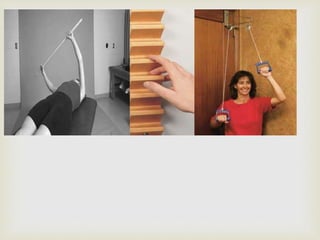
• Manual
• Equipment
Wand or T-bar
Finger ladder, wall climbing, ball rolling( provides objective
reinforcement)
Pulleys
Skate board/powder board
Reciprocal exercise devices
SELF-ASSISTED ROM


 Continuous passive motion (CPM) refers to passive
motion performed by a mechanical device that
moves a joint slowly and continuously through a
controlled ROM.
 The device may be applied to the involved extremity
immediately after surgery while the patient is still
under anaesthesia or as soon as possible if bulky
dressings prevent early motion
CONTINUOUS PASSIVE
MOTION

 effective in lessening the negative effects of joint immobilization in
conditions such as arthritis, contractures, and intra-articular fractures
 improved the recovery rate and ROM after a variety of surgical
procedures.
 Prevents development of adhesions and contractures and thus joint
stiffness
 Provides a stimulating effect on the healing of tendons and ligaments
 Enhances healing of incisions over the moving joint.
 Increases synovial fluid lubrication of the joint and thus increases the
rate of intra-articular cartilage healing and regeneration
 Prevents the degrading effects of immobilization
 Provides a quicker return of ROM
 Decreases postoperative pain
Benefits of CPM


 To accomplish motion through functional patterns,
first determine what pattern of movement is desired
and then move the extremity through that pattern
using manual assistance, mechanical assistance if it is
appropriate, or self-assistance from the patient.
 Functional patterning can be beneficial in initiating
the teaching of ADL and instrumental activities of
daily living (IADL) as well as in instructing patients
with visual impairments in functional activities.
ROM THROUGH FUNCTIONAL
PATTERNS

Don’t forget
 Joint contractures may begin to form within as little
as eight hours of immobility.
A contracture is a permanent shortening of tissue –
such as muscle, tendon or skin tissue – resulting from
disuse, injury or disease.
2-3 weeks of immobilisation will produce a much more
severe form of joint contracture/restriction of
movement.
THANK YOUR
ATTENSION!!!

Range of Motion.pptx

  • 1.
  • 2.
      Definition  Types Precautions and contraindications to ROM exercises  Principles and procedures for applying ROM exercises  ROM techniques  Self assisted ROM  Continuous passive motion  ROM through functional patterns Outlines
  • 3.
      The fullmovement potential of a joint.  a basic technique used for the examination of movement and for initiating movement into a program of therapeutic intervention.  The structure of the joints, as well as the integrity and flexibility of the soft tissues that pass over the joints, affects the amount of motion that can occur between any two bones Range of motion
  • 4.
     1. Passive ROM(PROM)is movement of a segment within the unrestricted ROM that is produced entirely by an external force  There is little to or no voluntary muscle contraction.  The external force may be from gravity, a machine, another individual, or another part of the individual’s own body.  PROM and passive stretching are not synonymous TYPES OF ROM EXERCISES
  • 5.
     2. Active ROM(AROM):It is a movement of a segment within the unrestricted ROM that is produced by active contraction of the muscles crossing that joint. 3. Active-Assistive ROM(AAROM):It is a type of AROM in which assistance is provided manually or mechanically by an outside force because the prime mover muscles need assistance to complete the motion.
  • 6.
      In theregion where there is acute, inflamed tissue, passive motion is beneficial; active motion would be detrimental to the healing process. Inflammation after injury or surgery usually lasts 2 to 6 days.  When a patient is not able to or not supposed to actively move a segment or segments of the body, as when comatose, paralyzed, or on complete bed rest, movement is provided by an external source. INDICATIONS AND GOALS FOR PROM
  • 7.
      The primarygoal for PROM is to decrease the complications that would occur with immobilization, such as  cartilage degeneration,  adhesion and contracture formation,  and sluggish circulation. Goals for PROM Degeneration refers to the process by which tissue deteriorates and loses its functional ability. Adhesion- the abnormal union of separate tissue surfaces by new fibrous tissue.
  • 8.
      To maintainjoint and connective tissue mobility  To minimize the effects of the formation of contractures  To maintain mechanical elasticity of muscle  To assist circulation and vascular dynamics  To enhance synovial movement for cartilage nutrition and diffusion of materials in the joint  To decrease or inhibit pain  To assist with the healing process after injury or surgery  To help maintain the patient’s awareness of movement The Specific goals
  • 9.
      Whenever apatient is able to contract the muscles actively and move a segment with or without assistance, AROM is used.  When a patient has weak musculature and is unable to move a joint through the desired range (usually against gravity), A-AROM is used to provide enough assistance to the muscles in a carefully controlled manner.  Once patients gain control of their ROM, they are progressed to manual or mechanical resistance exercises to improve muscle performance for a return to functional activities Indications for AROM
  • 10.
      When asegment of the body is immobilized for a period of time, AROM is used on the regions above and below the immobilized segment to maintain the areas in as normal a condition as possible and to prepare for new activities, such as walking with crutches.
  • 11.
      If thereis no inflammation or contraindication to active motion, the same goals of PROM can be met with AROM.  In addition, there are physiological benefits that result from active muscle contraction and motor learning from voluntary muscle control. Goals for AROM
  • 12.
      Maintain physiologicalelasticity and contractility of the participating muscles  Provide sensory feedback from the contracting muscles  Provide a stimulus for bone and joint tissue integrity  Increase circulation and prevent thrombus formation  Develop coordination and motor skills for functional activities Specific goals are to:
  • 13.
      ROM shouldnot be done when motion is disruptive to the healing process.  Carefully controlled motion within the limits of pain-free motion during early phases of healing has been shown to benefit healing and early recovery.  Signs of too much or the wrong motion include increased pain and inflammation.  ROM should not be done when patient response or the condition is life-threatening. PROM may be carefully initiated to major joints and AROM to ankles and feet to minimize venous stasis and thrombus formation.  After myocardial infarction, coronary artery bypass surgery, or percutaneous transluminal coronary angioplasty, AROM of upper extremities and limited walking are usually tolerated under careful monitoring of symptoms. PRECAUTIONS AND CONTRAINDICATIONS TO ROM EXERCISES
  • 14.
     1. Examine andevaluate the patient’s impairments and level of function, 2. Determine any precautions and prognosis, and plan the intervention. 3. Determine whether PROM, A-AROM, or AROM can meet the immediate goals 4. Determine the amount of motion that can be safely applied for the condition of the tissues and health of the individual PRINCIPLES AND PROCEDURES FOR APPLYING ROM TECHNIQUES
  • 15.
     5. Decide whatpatterns can best meet the goals. ROM techniques may be performed in the a. Anatomic planes of motion: frontal, sagittal, transverse b. Muscle range of elongation: antagonistic to the line of pull of the muscle c. Combined patterns: diagonal motions or movements that incorporate several planes of motion d. Functional patterns: motions used in activities of daily living (ADL) 5. Monitor the patient’s general condition and responses during and after the examination and intervention; note any change in vital signs, any change in the warmth and color of the segment, and any change in the ROM, pain, or quality of movement. 6. Document and communicate findings and intervention. 7. Re-evaluate and modify the intervention as necessary.
  • 16.
     1. Communicate withthe patient. Describe the plan and method of intervention to meet the goals. 2. Free the region from restrictive clothing, linen, splints, and dressings. Drape the patient as necessary. 3. Position the patient in a comfortable position with proper body alignment and stabilization but that also allows you to move the segment through the available ROM. 4. Position yourself so proper body mechanics can be used. Application of ROM Patient Preparation
  • 17.
     1. To controlmovement, grasp the extremity around the joints. If the joints are painful, modify the grip, still providing support necessary for control. 2. Support areas of poor structural integrity, such as a hypermobile joint, recent fracture site, or paralyzed limb segment. 3. Move the segment through its complete pain-free range to the point of tissue resistance. Do not force beyond the available range. If you force motion, it becomes a stretching technique. 4. Perform the motions smoothly and rhythmically, with 5 to 10 repetitions. The number of repetitions depends on the objectives of the program and the patient’s condition and response to the treatment Application of Techniques
  • 18.
     1. During PROMthe force for movement is external, being provided by a therapist or mechanical device. When appropriate, a patient may provide the force and be taught to move the part with a normal extremity. 2. No active resistance or assistance is given by the patient’s muscles that cross the joint. If the muscles contract, it becomes an active exercise. 3. The motion is carried out within the free ROM, that is, the range that is available without forced motion or pain. Application of PROM
  • 19.
      1. Demonstratethe motion desired using PROM; then ask the patient to perform the motion. Have your hands in position to assist or guide the patient if needed.  2. Provide assistance only as needed for smooth motion. When there is weakness, assistance may be required only at the beginning or the end of the ROM, or when the effect of gravity has the greatest moment arm(torque).  3. The motion is performed within the available ROM. Application of AROM
  • 20.
      With casesof unilateral weakness or paralysis, or during early stages of recovery after trauma or surgery, the patient can be taught to use the uninvolved extremity to move the involved extremity through ranges of motion.  After surgery or traumatic injury, self-assisted ROM (S- AROM) is used to protect the healing tissues when more intensive muscle contraction is contraindicated.  Forms of Self-Assisted ROM • Manual • Equipment Wand or T-bar Finger ladder, wall climbing, ball rolling( provides objective reinforcement) Pulleys Skate board/powder board Reciprocal exercise devices SELF-ASSISTED ROM
  • 21.
  • 22.
      Continuous passivemotion (CPM) refers to passive motion performed by a mechanical device that moves a joint slowly and continuously through a controlled ROM.  The device may be applied to the involved extremity immediately after surgery while the patient is still under anaesthesia or as soon as possible if bulky dressings prevent early motion CONTINUOUS PASSIVE MOTION
  • 23.
      effective inlessening the negative effects of joint immobilization in conditions such as arthritis, contractures, and intra-articular fractures  improved the recovery rate and ROM after a variety of surgical procedures.  Prevents development of adhesions and contractures and thus joint stiffness  Provides a stimulating effect on the healing of tendons and ligaments  Enhances healing of incisions over the moving joint.  Increases synovial fluid lubrication of the joint and thus increases the rate of intra-articular cartilage healing and regeneration  Prevents the degrading effects of immobilization  Provides a quicker return of ROM  Decreases postoperative pain Benefits of CPM
  • 24.
  • 25.
      To accomplishmotion through functional patterns, first determine what pattern of movement is desired and then move the extremity through that pattern using manual assistance, mechanical assistance if it is appropriate, or self-assistance from the patient.  Functional patterning can be beneficial in initiating the teaching of ADL and instrumental activities of daily living (IADL) as well as in instructing patients with visual impairments in functional activities. ROM THROUGH FUNCTIONAL PATTERNS
  • 26.
     Don’t forget  Jointcontractures may begin to form within as little as eight hours of immobility. A contracture is a permanent shortening of tissue – such as muscle, tendon or skin tissue – resulting from disuse, injury or disease. 2-3 weeks of immobilisation will produce a much more severe form of joint contracture/restriction of movement. THANK YOUR ATTENSION!!!

Editor's Notes

  • #21 Reciprocal_ bicycle- provide movement of involved extremity with the power of uninvolved extremity.
  • #23 The device may be applied to the involved extremity immediately after surgery while the patient is still under anaesthesia or as soon as possible if bulky dressings prevent early motion.