INFRARED RADIATION
BY RAMESH G.A
I YEAR M.P.T
INTRODUCTION
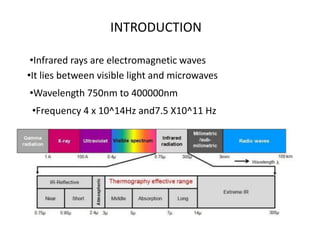
•Infrared rays are electromagnetic waves
•It lies between visible light and microwaves
•Wavelength 750nm to 400000nm
•Frequency 4 x 10^14Hz and7.5 X10^11 Hz
RADIATION
INFRARED RADIATIONS ARE SUBDIVIDED INTO
IRR A 760-1400nm
IRR B 1400-3000nm
IRR C 3000nm-1mm
WAVELENGTH
TYPE
FORMER CLASSIFICATION
NEAR OR SHORT IRR 760-1500nm
FAR OR LONG IRR 1500-15000nm
TYPES OF LAMPS
Two types of generators are used in physiotherapy practice:
A)Non luminous generators
B)Luminous generators
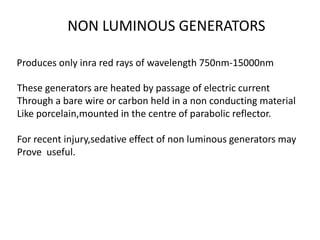
NON LUMINOUS GENERATORS
Produces only inra red rays of wavelength 750nm-15000nm
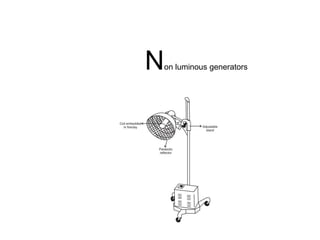
These generators are heated by passage of electric current
Through a bare wire or carbon held in a non conducting material
Like porcelain,mounted in the centre of parabolic reflector.
For recent injury,sedative effect of non luminous generators may
Prove useful.
Non luminous generators
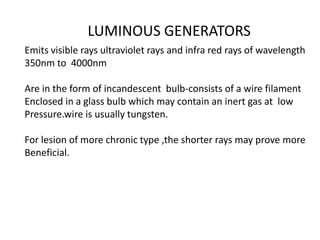
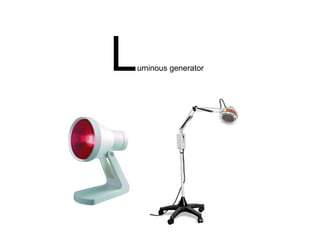
LUMINOUS GENERATORS
Emits visible rays ultraviolet rays and infra red rays of wavelength
350nm to 4000nm
Are in the form of incandescent bulb-consists of a wire filament
Enclosed in a glass bulb which may contain an inert gas at low
Pressure.wire is usually tungsten.
For lesion of more chronic type ,the shorter rays may prove more
Beneficial.
Luminous generator
NO
Luminous
generators
Non luminous
generators
1 Sources Electrically heated filament Electrically heated resistance wire coiled
2 Gives IR + visible rays Only IR rays
3 Produce Short IR Long IR
4 Wavelength 350 – 4000 nm [ max .= 1000 nm ] 1500 – 12000 nm [ max. 4000 nm ]
5 Emission
70 % near IRR
24 % far
5 % visible light
1 % UV
90 % far IRR
10 % near IRR
6 Penetration
Epidermis , dermis &
Subcutaneous tissue [ 5-10 mm ]
Epidermis & superficial dermis [ 2 mm ]
7 Heating Deeply Superficial
8 Uses Chronic inflammation Acute inflammation
9
Physiological
effect
Pain reduction via
counter – irritant effect
Pain reduction via
sedative effect
10
Therapeutic
effect
Heating Sensory heating
11 Treatment time 15 -20 minute 20 -30 minutes
12 Distance 40 – 60 cm form treated area 75 -90 form treated area
Difference between luminous and non luminous generators :
Difference between luminous and non luminous generators
LAWS REGULATING ABSORPTION OF
RADIATION
GROTHUS LAW
LAWOF INVERSE SQUARE LAW
COSINE LAW
BEER-LAMBERT LAW
KIRCHOFFS LAW
WIENS LAW
ARNDT- SCHULTZ LAW
STEFAN-BOLTZMAN LAW
PENETRATION
IR rays produced by luminou generators can penetrate into
Dermis and epidermis.
IR rays produceed by Nonluminous generators can penetrate
The superficial dermis only.
Penetration of energy into medium depeds upon:
a)Intensity of the source of infra red
b)Wavelength and frequency.
c)Angle at which the radiationhits the surface.
d)Coefficient of absorption of the material.
PHYSIOLOGICAL EFFECTS
•Increases metabolic rate
•Cutaneous vasodilation
•Sweating
•Stimulation of thermalheat receptors
THERAPEUTIC USES
•Relief of pain
•Muscle relaxation
•Increased blood supply
•Increase in joint mobility
•Acceleration of healing and repair
RECENT ADVANCES
IN IRR THERAPY
WAON THERAPY IN JAPAN
Body is warmedin an IR Chamber for15 minutes at 60 degrees centigrade
Then the patient is wrapped in thermal blankets and laid down to maintain heat
For 40 minutes.
Patient is made to drink lot of water to replenish moisture lost by perspiration.
It seems to increase cardiac function.
This can be applied as an alternate to moderate exercise in sedentary patients.
(OA,CARDIO PULMONARY PATIENTS)
IRR EMITTING MATERIAL FOR CLOTHING
Sports professionals use FIR emitting garments to enhance performance and
Recovery.
Garments absorb body emitted heat energy and they reemit it throughradiation
(FIR)Wavelength back to body.
FIR emitting polymers or ceramic nanoparticles are incorporated into sports apparel
Which help in reducing pain and inducing tissue repair.
DANGERS
•Burns
•Electric shock
•Faintness or giddiness
•Headache
•Gangrene
•Injury to the eyes
•Dehydration
TECHNIQUE OF APPLICATION
Explanation:Explain the nature and effects of the treatment to the
Patient.
Examination:Examine the skin to be treated and test the thermal
Sensation and also check for contraindications.
CONTRAINDICATIONS
•Defective arterial blood supply
•Haemorrhage
•Defective skin sensation
•Over pelvic region during pregnancy
•Varicose veins
•Malignancy
•Directly over the eyes
•Patient whose conciousness is lowered
•After deepxray and cobalt therapy
•Skin diseases like dermatitisand eczema
•Advanced cardiac disorders
APPARATUS
•Nonluminous generators take some time to get heated,so they
•Should be switched on 5-7minutes before treatment.
•Luminous generators need no such warmup time.
ARRANGEMENT OF LAMP AND
PATIENT
Expose the skin to be irradiated and shield the eyes.
The lamp is positioned in such a way that the rays strike theskin at
Right angles.
Set the lamp at approprate distance of 50-75 cm
INSTRUCTIONS AND WARNINGS
The patient is instructed to report immediately if heating becomes
Excessive.
Patient should be warned not touch any part of the instrument
Or to move nearer to it.
APPLICATION
Initially the intensity of the radiation should be low but after 5-10 minutes
(after vasodilation)strength of the radiation can be increased.
Physiotherapist should be near the patient throughout the treatment duration.
Sweating is encouraged.
TERMINATION
On completion of treatment the skin should be checked carefully.
Moderate erythema and warmth should be evident.
Afterexcessive irradiation the patient should not rise suddenly from
Recumbent position.
DOSAGE
For acute cases irradiation can be given for 10 to 15 minutes
Daily for 1to 3 timesas per the requirement.
For chronic cases upto 30 minutes daily or on alternate days can be
Given.
REFERENCE
Electrotherapy explained (low and Reed)
Textbook of Electrotherapy(Jagmohansingh)
Electrotherapy evidence based practice 12th edition
(shiela kitchen)
Online journals

INFRARED RADIATION ppt 1 new.pdf

  • 1.
  • 2.
    INTRODUCTION •Infrared rays areelectromagnetic waves •It lies between visible light and microwaves •Wavelength 750nm to 400000nm •Frequency 4 x 10^14Hz and7.5 X10^11 Hz
  • 3.
    RADIATION INFRARED RADIATIONS ARESUBDIVIDED INTO IRR A 760-1400nm IRR B 1400-3000nm IRR C 3000nm-1mm WAVELENGTH TYPE FORMER CLASSIFICATION NEAR OR SHORT IRR 760-1500nm FAR OR LONG IRR 1500-15000nm
  • 4.
    TYPES OF LAMPS Twotypes of generators are used in physiotherapy practice: A)Non luminous generators B)Luminous generators
  • 5.
    NON LUMINOUS GENERATORS Producesonly inra red rays of wavelength 750nm-15000nm These generators are heated by passage of electric current Through a bare wire or carbon held in a non conducting material Like porcelain,mounted in the centre of parabolic reflector. For recent injury,sedative effect of non luminous generators may Prove useful.
  • 6.
  • 7.
    LUMINOUS GENERATORS Emits visiblerays ultraviolet rays and infra red rays of wavelength 350nm to 4000nm Are in the form of incandescent bulb-consists of a wire filament Enclosed in a glass bulb which may contain an inert gas at low Pressure.wire is usually tungsten. For lesion of more chronic type ,the shorter rays may prove more Beneficial.
  • 8.
  • 9.
    NO Luminous generators Non luminous generators 1 SourcesElectrically heated filament Electrically heated resistance wire coiled 2 Gives IR + visible rays Only IR rays 3 Produce Short IR Long IR 4 Wavelength 350 – 4000 nm [ max .= 1000 nm ] 1500 – 12000 nm [ max. 4000 nm ] 5 Emission 70 % near IRR 24 % far 5 % visible light 1 % UV 90 % far IRR 10 % near IRR 6 Penetration Epidermis , dermis & Subcutaneous tissue [ 5-10 mm ] Epidermis & superficial dermis [ 2 mm ] 7 Heating Deeply Superficial 8 Uses Chronic inflammation Acute inflammation 9 Physiological effect Pain reduction via counter – irritant effect Pain reduction via sedative effect 10 Therapeutic effect Heating Sensory heating 11 Treatment time 15 -20 minute 20 -30 minutes 12 Distance 40 – 60 cm form treated area 75 -90 form treated area Difference between luminous and non luminous generators : Difference between luminous and non luminous generators
  • 10.
    LAWS REGULATING ABSORPTIONOF RADIATION GROTHUS LAW LAWOF INVERSE SQUARE LAW COSINE LAW BEER-LAMBERT LAW KIRCHOFFS LAW WIENS LAW ARNDT- SCHULTZ LAW STEFAN-BOLTZMAN LAW
  • 11.
    PENETRATION IR rays producedby luminou generators can penetrate into Dermis and epidermis. IR rays produceed by Nonluminous generators can penetrate The superficial dermis only. Penetration of energy into medium depeds upon: a)Intensity of the source of infra red b)Wavelength and frequency. c)Angle at which the radiationhits the surface. d)Coefficient of absorption of the material.
  • 12.
    PHYSIOLOGICAL EFFECTS •Increases metabolicrate •Cutaneous vasodilation •Sweating •Stimulation of thermalheat receptors
  • 13.
    THERAPEUTIC USES •Relief ofpain •Muscle relaxation •Increased blood supply •Increase in joint mobility •Acceleration of healing and repair
  • 14.
    RECENT ADVANCES IN IRRTHERAPY WAON THERAPY IN JAPAN Body is warmedin an IR Chamber for15 minutes at 60 degrees centigrade Then the patient is wrapped in thermal blankets and laid down to maintain heat For 40 minutes. Patient is made to drink lot of water to replenish moisture lost by perspiration. It seems to increase cardiac function. This can be applied as an alternate to moderate exercise in sedentary patients. (OA,CARDIO PULMONARY PATIENTS)
  • 15.
    IRR EMITTING MATERIALFOR CLOTHING Sports professionals use FIR emitting garments to enhance performance and Recovery. Garments absorb body emitted heat energy and they reemit it throughradiation (FIR)Wavelength back to body. FIR emitting polymers or ceramic nanoparticles are incorporated into sports apparel Which help in reducing pain and inducing tissue repair.
  • 16.
    DANGERS •Burns •Electric shock •Faintness orgiddiness •Headache •Gangrene •Injury to the eyes •Dehydration
  • 17.
    TECHNIQUE OF APPLICATION Explanation:Explainthe nature and effects of the treatment to the Patient. Examination:Examine the skin to be treated and test the thermal Sensation and also check for contraindications.
  • 18.
    CONTRAINDICATIONS •Defective arterial bloodsupply •Haemorrhage •Defective skin sensation •Over pelvic region during pregnancy •Varicose veins •Malignancy •Directly over the eyes •Patient whose conciousness is lowered •After deepxray and cobalt therapy •Skin diseases like dermatitisand eczema •Advanced cardiac disorders
  • 19.
    APPARATUS •Nonluminous generators takesome time to get heated,so they •Should be switched on 5-7minutes before treatment. •Luminous generators need no such warmup time.
  • 20.
    ARRANGEMENT OF LAMPAND PATIENT Expose the skin to be irradiated and shield the eyes. The lamp is positioned in such a way that the rays strike theskin at Right angles. Set the lamp at approprate distance of 50-75 cm
  • 21.
    INSTRUCTIONS AND WARNINGS Thepatient is instructed to report immediately if heating becomes Excessive. Patient should be warned not touch any part of the instrument Or to move nearer to it.
  • 22.
    APPLICATION Initially the intensityof the radiation should be low but after 5-10 minutes (after vasodilation)strength of the radiation can be increased. Physiotherapist should be near the patient throughout the treatment duration. Sweating is encouraged.
  • 23.
    TERMINATION On completion oftreatment the skin should be checked carefully. Moderate erythema and warmth should be evident. Afterexcessive irradiation the patient should not rise suddenly from Recumbent position.
  • 24.
    DOSAGE For acute casesirradiation can be given for 10 to 15 minutes Daily for 1to 3 timesas per the requirement. For chronic cases upto 30 minutes daily or on alternate days can be Given.
  • 25.
    REFERENCE Electrotherapy explained (lowand Reed) Textbook of Electrotherapy(Jagmohansingh) Electrotherapy evidence based practice 12th edition (shiela kitchen) Online journals