Dr. Arjun Patel
MPT- musculoskeletal and sports science
1
INFRA RED
IR has no color, it is detected by warmth
IR is emitted from any heated body
Its wavelength is higher than visible light
IR has a wavelength of 760nm to 1mm
2
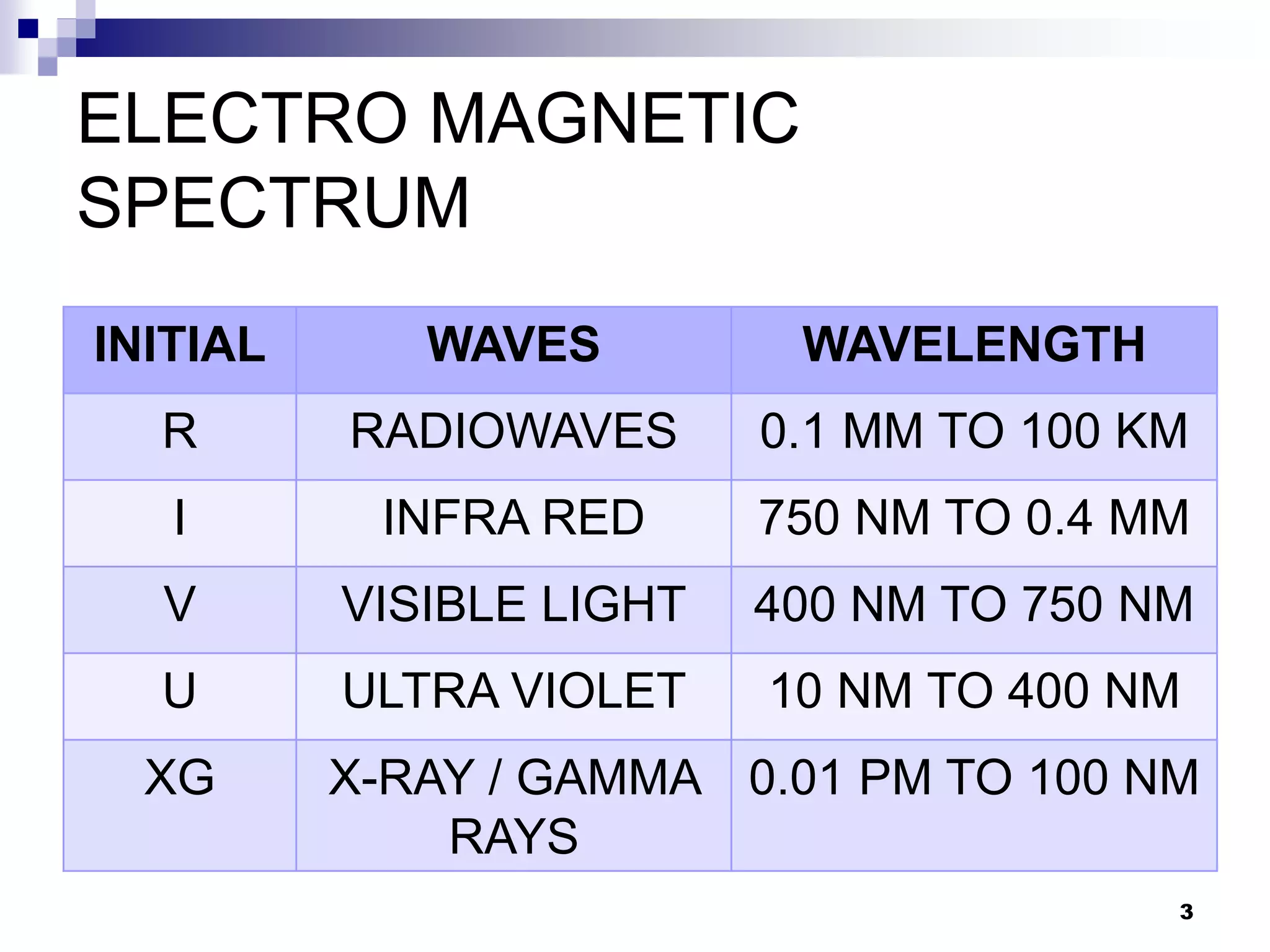
ELECTRO MAGNETIC
SPECTRUM
INITIAL WAVES WAVELENGTH
R RADIOWAVES 0.1 MM TO 100 KM
I INFRA RED 750 NM TO 0.4 MM
V VISIBLE LIGHT 400 NM TO 750 NM
U ULTRA VIOLET 10 NM TO 400 NM
XG X-RAY / GAMMA
RAYS
0.01 PM TO 100 NM
3
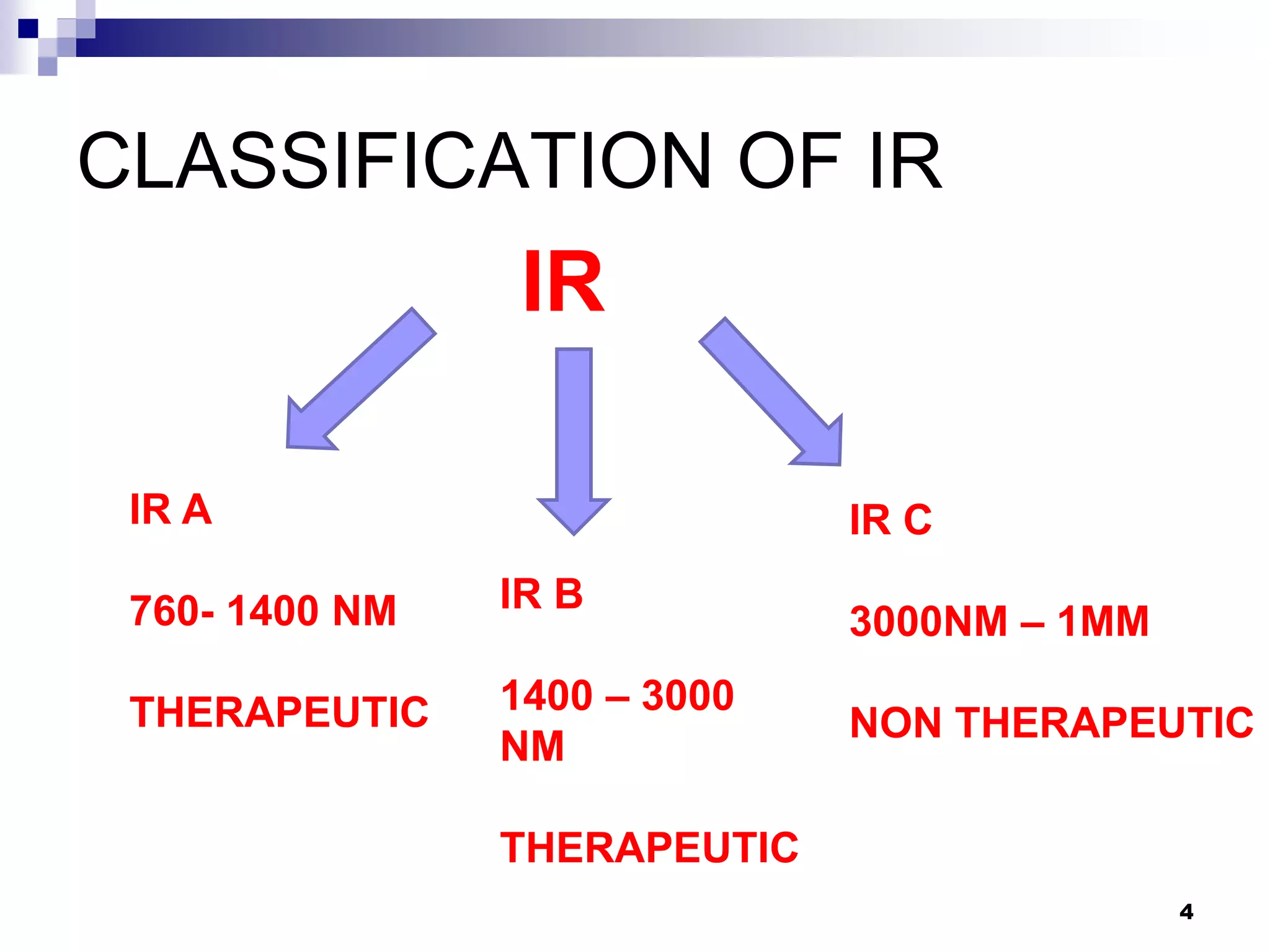
CLASSIFICATION OF IR
4
IR
IR A
760- 1400 NM
THERAPEUTIC
IR B
1400 – 3000
NM
THERAPEUTIC
IR C
3000NM – 1MM
NON THERAPEUTIC
Heated material produce IR radiation
Higher temperature are associate with higher frequency, &
shorter wavelength
TEMP α 1 / WAVELENGTH & TEMP α FREQUENCY
If short IR is to be produced material must not be burnt by
higher temperature used.
Convenient method is to heat a resistance WIRE by
passing an electric current through it
Electrical heater is made up of coil of suitable resistance
WIRE , i.e. nickel- chromium alloy, wound on ceramic
insulator
5
6
NON LUMINOUS GENERATOR
(coil heater)
IR source is a coil of WIRE wrapped around a
cylindrical ceramic insulator.
In this heaters WIRE glows red, thus giving some
radiation in visible spectrum.
Some IR lamps for therapy have WIRE embedded
in insulation ceramic, ceramic is heated because of
lamp which emits IR so that little or no visible
radiation is emitted
7
Heater WIRE can also be mounted
behind a metal plate or inside a metal tube
which does not become hot spot but emits
IR in same way
IR emitter is placed at focus of reflector to
produce an uniform wave
8
If reflector is more spherical instead of
convergence of beam, it will be diverge, this is
usually adapted in clinic.
Reflector & emitter are mounted on a mobile
metal stand which can be adjusted to alter
height & angle of reflector or emitter.
When lamps are switched on they require time
to warm up because of thermal inertia of mass
of metal & insulating material that has to be
heated
9
Small lamps may take about 5 min. but large
ones may take up to 15 min to reach maximum
emission
Lamps with an exposed coil give off a red glow
although they are collectively designated as “
non-luminous” sources
With non-luminous Exposure is in Long IR
wavelength range
10
LUMINOUS GENERATOR (Bulb)
They consist of a tungsten filament in a large glass
envelope which contains inert gas at low pressure.
Part of inside of glass bulb is silvered to provide a
reflector
Works on same principle as a simple electric light bulb
Filament is heated to a high temperature around 3000
by a current passed through it
11
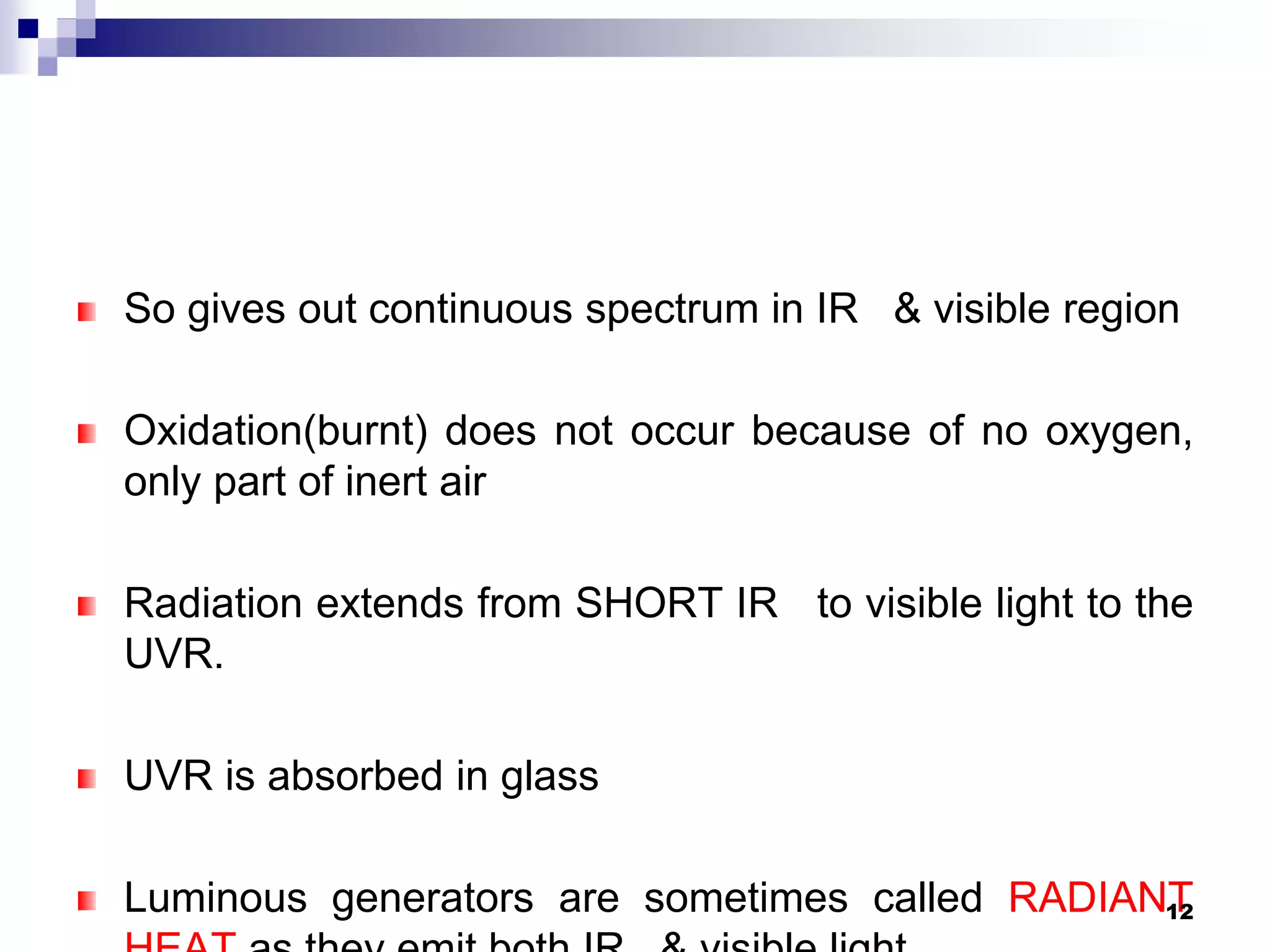
So gives out continuous spectrum in IR & visible region
Oxidation(burnt) does not occur because of no oxygen,
only part of inert air
Radiation extends from SHORT IR to visible light to the
UVR.
UVR is absorbed in glass
Luminous generators are sometimes called RADIANT
12
POWER
SMALL LAMPS (BOTH) 250-500 WATT
LARGE, NON LUMINOUS 750-1000 W
LARGE , LUMINOUS 750-1500 W
Larger lamps are used to treat extensive
area , but same effect can be achieved by
placing small three lamps in a row
13
EMISSION
 NON LUMINOUS
3000 – 4000 NM (LONG IR )
 LUMINOUS
SHORT IR
5% VISIBLE
1% UVR
14
PENETRATION & ABSORBTION
IT DEPENDS UPON:
STRUCTURE
VASCULARITY
PIGMENTATION OF SKIN
WAVELENGTH OF RADIATION
15
DEPTH OF PENETRATION
Depth of penetration: it is depth at which
approximately 63% of radiation energy has
been absorbed & 37% remains
3000 nm depth of penetration is 0.1mm
Increasing penetration with decreasing
wavelength in short IR to a maximum
penetration depth of 3 mm at 1000 nm
16
17
CHOICE OF APPRATUS
 Acute inflammation/recent injury –
sedative effects by non-luminous
generator is more effective than luminous
generator because pain relief is needed
than counter-irritant effect.
 For chronic injury /lesion counter irritant
effect by shorter IR is more effective than
non-luminous generator.
18
CHOICE OF APPRATUS
 Only on part /surface of body requires
treatment than single lamp will be
sufficient.
 If several part/surface of body requires
treatment than tunnel bath/combination of
4-6lamps is needed.
19
THERAPEUTIC EFFECT
Relief of pain
Mild heating – sedative effect on superficial
nerve endings
Stronger heating – irritate the superficial
nerve endings – counter irritant effect
( pain may be because of accumulation of
waste product of metabolism and IR
removes that substances so relieves the
pain.) 20
 Muscle relaxation – tissue get warm – pain
relief – relieve muscle spasm – perform
exercise more efficiently
 Increased of blood supply – superficial
tissue – treatment of superficial wounds
and infection
 Arthritic condition :small joints of hand and
feet
21
DANGERS
 Burns
 Electric shock
 Gangrene – area with defective arterial
supply
 Headache – if treatment given during a hot
weather.- back of head.
 faintness – decrease in blood pressure –
brain hypoxia – either patient suddenly
rises from supine position after extensive
treatment 22
Technique of application
 Patient
 Position : suitable, well supported, with area to
be treated exposed.
 Explanation : explain nature and effect of
treatment to patient
 Examination and testing : examine the skin to
be treated and test thermal sensation.
23
 Apparatus :
If a non – luminous lamp is chosen switch it 5
min before treatment starts to allow a time to
warm up
Luminous lamp does not require warm up
time.
24
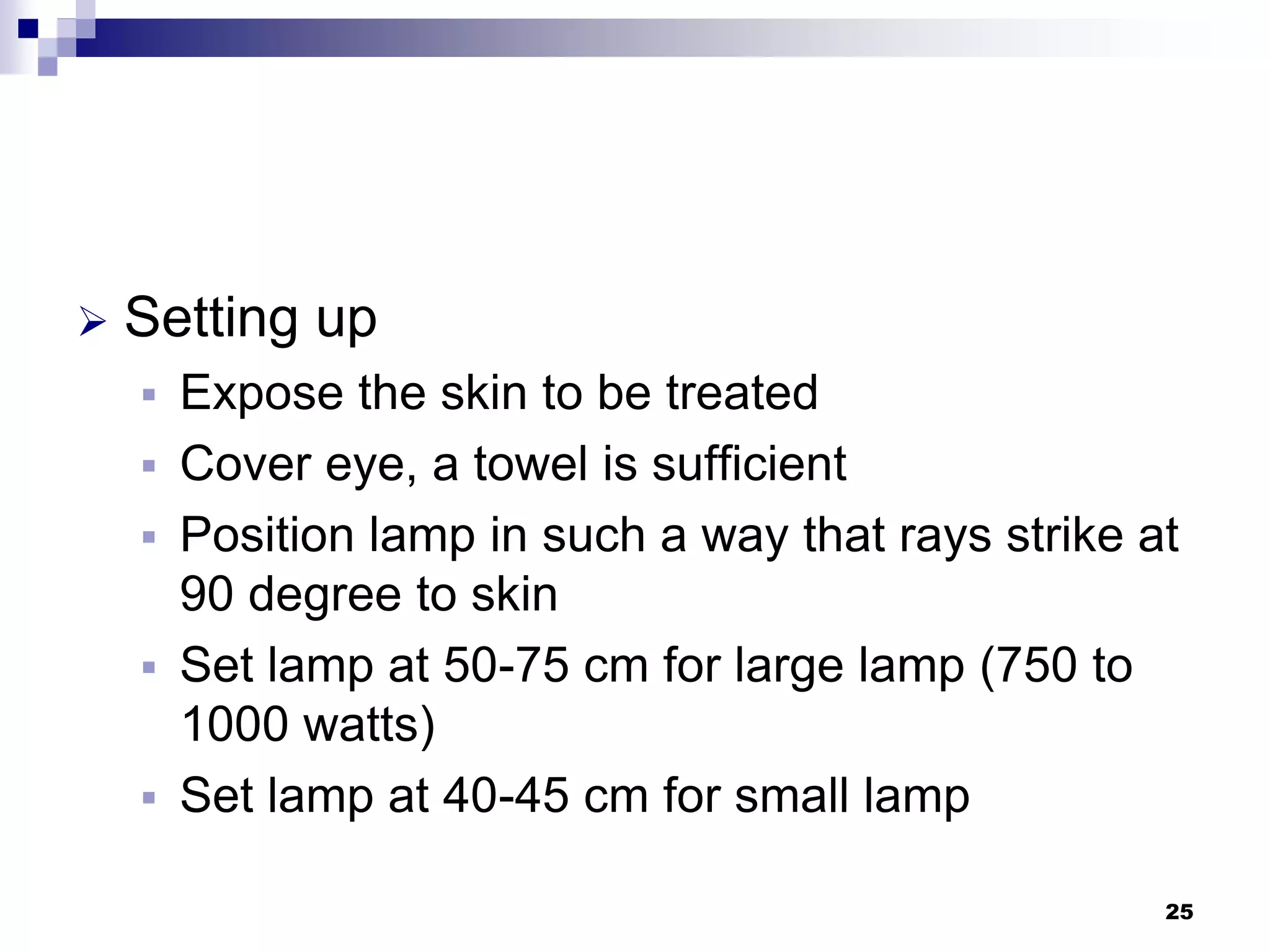
 Setting up
 Expose the skin to be treated
 Cover eye, a towel is sufficient
 Position lamp in such a way that rays strike at
90 degree to skin
 Set lamp at 50-75 cm for large lamp (750 to
1000 watts)
 Set lamp at 40-45 cm for small lamp
25
 Instructions and warning
 Advise patient of required level of heat and it
must not be hot as it burn.
 Ask patient not to touch any part of lamp or to
move during treatment
 Alert therapist if it is more than comfortable
level of heating. 26
 Application
 Intensity in most IR lamp is controlled by
distance.
 Doubling the lamp to skin distance reduce the
intensity (wcm-2) to one quarter
 Tripling the lamp to skin distance reduce the
intensity to one ninth
27
 Termination
At the end of treatment skin should be
checked
On palpation it looks mild or moderately warm
Moderate erythema should be visible.
Erythema tends to vary with skin color, not
just temperature.
28
 LUMINOUS HEAT
LAMP
Penetrates more
compare to non
luminous
More efficient tissue
heating
Therapeutic effect is
mostly due to heating
 NON LUMINOUS
LAMP
Does not penetrate
more deeply
Mostly absorbed in
skin
Therapeutic effect is
mostly due to sensory
heating
29
References:
1. Clayton’s Electrotherapy: Theory and Practice
- Forster & Palastanga (Ninth Edition)
2. Electrotherapy Explained – John Low & Ann
Reed (Third Edition)
3. Electrotherapy Simplified – Basanta Kumar
Nanda
4. Basics of Electrotherapy – Subhash Khatri
30
31

Infrared Radiation

  • 1.
    Dr. Arjun Patel MPT-musculoskeletal and sports science 1
  • 2.
    INFRA RED IR hasno color, it is detected by warmth IR is emitted from any heated body Its wavelength is higher than visible light IR has a wavelength of 760nm to 1mm 2
  • 3.
    ELECTRO MAGNETIC SPECTRUM INITIAL WAVESWAVELENGTH R RADIOWAVES 0.1 MM TO 100 KM I INFRA RED 750 NM TO 0.4 MM V VISIBLE LIGHT 400 NM TO 750 NM U ULTRA VIOLET 10 NM TO 400 NM XG X-RAY / GAMMA RAYS 0.01 PM TO 100 NM 3
  • 4.
    CLASSIFICATION OF IR 4 IR IRA 760- 1400 NM THERAPEUTIC IR B 1400 – 3000 NM THERAPEUTIC IR C 3000NM – 1MM NON THERAPEUTIC
  • 5.
    Heated material produceIR radiation Higher temperature are associate with higher frequency, & shorter wavelength TEMP α 1 / WAVELENGTH & TEMP α FREQUENCY If short IR is to be produced material must not be burnt by higher temperature used. Convenient method is to heat a resistance WIRE by passing an electric current through it Electrical heater is made up of coil of suitable resistance WIRE , i.e. nickel- chromium alloy, wound on ceramic insulator 5
  • 6.
  • 7.
    NON LUMINOUS GENERATOR (coilheater) IR source is a coil of WIRE wrapped around a cylindrical ceramic insulator. In this heaters WIRE glows red, thus giving some radiation in visible spectrum. Some IR lamps for therapy have WIRE embedded in insulation ceramic, ceramic is heated because of lamp which emits IR so that little or no visible radiation is emitted 7
  • 8.
    Heater WIRE canalso be mounted behind a metal plate or inside a metal tube which does not become hot spot but emits IR in same way IR emitter is placed at focus of reflector to produce an uniform wave 8
  • 9.
    If reflector ismore spherical instead of convergence of beam, it will be diverge, this is usually adapted in clinic. Reflector & emitter are mounted on a mobile metal stand which can be adjusted to alter height & angle of reflector or emitter. When lamps are switched on they require time to warm up because of thermal inertia of mass of metal & insulating material that has to be heated 9
  • 10.
    Small lamps maytake about 5 min. but large ones may take up to 15 min to reach maximum emission Lamps with an exposed coil give off a red glow although they are collectively designated as “ non-luminous” sources With non-luminous Exposure is in Long IR wavelength range 10
  • 11.
    LUMINOUS GENERATOR (Bulb) Theyconsist of a tungsten filament in a large glass envelope which contains inert gas at low pressure. Part of inside of glass bulb is silvered to provide a reflector Works on same principle as a simple electric light bulb Filament is heated to a high temperature around 3000 by a current passed through it 11
  • 12.
    So gives outcontinuous spectrum in IR & visible region Oxidation(burnt) does not occur because of no oxygen, only part of inert air Radiation extends from SHORT IR to visible light to the UVR. UVR is absorbed in glass Luminous generators are sometimes called RADIANT 12
  • 13.
    POWER SMALL LAMPS (BOTH)250-500 WATT LARGE, NON LUMINOUS 750-1000 W LARGE , LUMINOUS 750-1500 W Larger lamps are used to treat extensive area , but same effect can be achieved by placing small three lamps in a row 13
  • 14.
    EMISSION  NON LUMINOUS 3000– 4000 NM (LONG IR )  LUMINOUS SHORT IR 5% VISIBLE 1% UVR 14
  • 15.
    PENETRATION & ABSORBTION ITDEPENDS UPON: STRUCTURE VASCULARITY PIGMENTATION OF SKIN WAVELENGTH OF RADIATION 15
  • 16.
    DEPTH OF PENETRATION Depthof penetration: it is depth at which approximately 63% of radiation energy has been absorbed & 37% remains 3000 nm depth of penetration is 0.1mm Increasing penetration with decreasing wavelength in short IR to a maximum penetration depth of 3 mm at 1000 nm 16
  • 17.
  • 18.
    CHOICE OF APPRATUS Acute inflammation/recent injury – sedative effects by non-luminous generator is more effective than luminous generator because pain relief is needed than counter-irritant effect.  For chronic injury /lesion counter irritant effect by shorter IR is more effective than non-luminous generator. 18
  • 19.
    CHOICE OF APPRATUS Only on part /surface of body requires treatment than single lamp will be sufficient.  If several part/surface of body requires treatment than tunnel bath/combination of 4-6lamps is needed. 19
  • 20.
    THERAPEUTIC EFFECT Relief ofpain Mild heating – sedative effect on superficial nerve endings Stronger heating – irritate the superficial nerve endings – counter irritant effect ( pain may be because of accumulation of waste product of metabolism and IR removes that substances so relieves the pain.) 20
  • 21.
     Muscle relaxation– tissue get warm – pain relief – relieve muscle spasm – perform exercise more efficiently  Increased of blood supply – superficial tissue – treatment of superficial wounds and infection  Arthritic condition :small joints of hand and feet 21
  • 22.
    DANGERS  Burns  Electricshock  Gangrene – area with defective arterial supply  Headache – if treatment given during a hot weather.- back of head.  faintness – decrease in blood pressure – brain hypoxia – either patient suddenly rises from supine position after extensive treatment 22
  • 23.
    Technique of application Patient  Position : suitable, well supported, with area to be treated exposed.  Explanation : explain nature and effect of treatment to patient  Examination and testing : examine the skin to be treated and test thermal sensation. 23
  • 24.
     Apparatus : Ifa non – luminous lamp is chosen switch it 5 min before treatment starts to allow a time to warm up Luminous lamp does not require warm up time. 24
  • 25.
     Setting up Expose the skin to be treated  Cover eye, a towel is sufficient  Position lamp in such a way that rays strike at 90 degree to skin  Set lamp at 50-75 cm for large lamp (750 to 1000 watts)  Set lamp at 40-45 cm for small lamp 25
  • 26.
     Instructions andwarning  Advise patient of required level of heat and it must not be hot as it burn.  Ask patient not to touch any part of lamp or to move during treatment  Alert therapist if it is more than comfortable level of heating. 26
  • 27.
     Application  Intensityin most IR lamp is controlled by distance.  Doubling the lamp to skin distance reduce the intensity (wcm-2) to one quarter  Tripling the lamp to skin distance reduce the intensity to one ninth 27
  • 28.
     Termination At theend of treatment skin should be checked On palpation it looks mild or moderately warm Moderate erythema should be visible. Erythema tends to vary with skin color, not just temperature. 28
  • 29.
     LUMINOUS HEAT LAMP Penetratesmore compare to non luminous More efficient tissue heating Therapeutic effect is mostly due to heating  NON LUMINOUS LAMP Does not penetrate more deeply Mostly absorbed in skin Therapeutic effect is mostly due to sensory heating 29
  • 30.
    References: 1. Clayton’s Electrotherapy:Theory and Practice - Forster & Palastanga (Ninth Edition) 2. Electrotherapy Explained – John Low & Ann Reed (Third Edition) 3. Electrotherapy Simplified – Basanta Kumar Nanda 4. Basics of Electrotherapy – Subhash Khatri 30
  • 31.