Infrared Radiation (IR/IRR)
Introduction
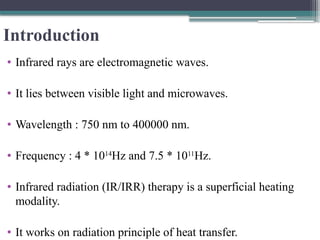
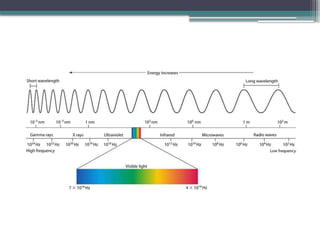
• Infrared rays are electromagnetic waves.
• It lies between visible light and microwaves.
• Wavelength : 750 nm to 400000 nm.
• Frequency : 4 * 1014
Hz and 7.5 * 1011
Hz.
• Infrared radiation (IR/IRR) therapy is a superficial heating
modality.
• It works on radiation principle of heat transfer.
Classification
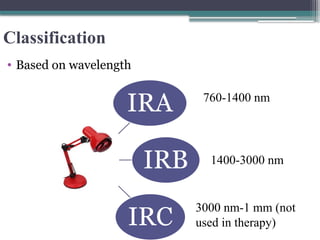
• Based on wavelength
IRA
IRB
IRC
760-1400 nm
1400-3000 nm
3000 nm-1 mm (not
used in therapy)
• Former classification
Near or short IR – 760-1500 nm
Far or long IR – 1500-15000 nm
Sources of infrared radiation
• The sources of infrared can be either natural or artificial.
• Artificial infrared is generally produced by passing electric
current through coiled resistance wire.
• Sun is the natural source of infrared radiation.
• In the physiotherapy department Infrared radiation are
produced by two type if generators:
1. non-luminous generators
2. luminous generators
Production of Infrared
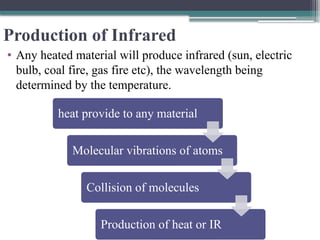
• Any heated material will produce infrared (sun, electric
bulb, coal fire, gas fire etc), the wavelength being
determined by the temperature.
heat provide to any material
Molecular vibrations of atoms
Collision of molecules
Production of heat or IR
• Higher temperature are associated with higher frequency
and shorter wavelength radiation.
• The most convenient method is to heat a resistance wire by
passing an electric current through it.
Non-luminous generators
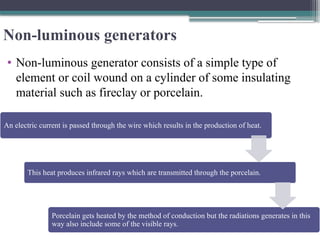
• Non-luminous generator consists of a simple type of
element or coil wound on a cylinder of some insulating
material such as fireclay or porcelain.
An electric current is passed through the wire which results in the production of heat.
This heat produces infrared rays which are transmitted through the porcelain.
Porcelain gets heated by the method of conduction but the radiations generates in this
way also include some of the visible rays.
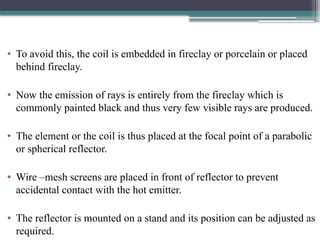
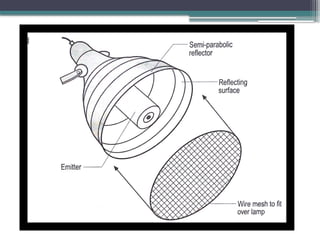
• To avoid this, the coil is embedded in fireclay or porcelain or placed
behind fireclay.
• Now the emission of rays is entirely from the fireclay which is
commonly painted black and thus very few visible rays are produced.
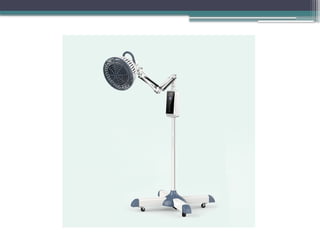
• The element or the coil is thus placed at the focal point of a parabolic
or spherical reflector.
• Wire –mesh screens are placed in front of reflector to prevent
accidental contact with the hot emitter.
• The reflector is mounted on a stand and its position can be adjusted as
required.
Disadvantage :
• All of these non-luminous generators take some time to get
heated up for the production of infrared radiations, so they
should be switched on before 5-15 minutes of the treatment.
Advantage :
• Non-luminous generators provide infrared rays only.
Luminous Generators
• Luminous generators emit infrared, visible and a few
ultraviolet rays.
• Heat produce by it is called radiant heat.
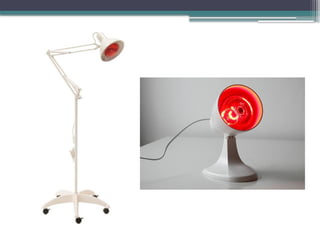
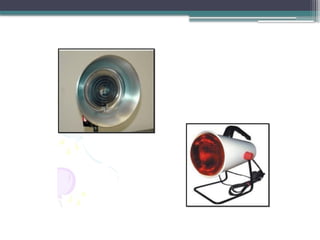
• These generators are in the form of incandescent lamps or
bulbs.
• An incandescent lamp consists of a wire filament enclosed
in a glass bulb, which may contain an inert gas at low
pressure.
• The filament is a coil of fine wire which is usually made up
of tungsten.
• Tungsten is a metal which is used because it can tolerate
repeated heating and cooling.
• Front of bulb is usually red to filter out shorter visible &
ultraviolet rays.
• Incandescent bulb is usually mounted at the center of the
parabolic reflector and the reflector is mounted on an
adjustable stand.
Disadvantage :
• luminous generators emit infrared rays, visible as well as
ultraviolet rays.
Advantage :
• Require less time for production of IRR.
Depth of penetration of rays
Luminous generator
• Produces infrared rays
having wavelength
between 750-1500 nm
(maximum 1000 nm).
• It can penetrate into
epidermis, dermis and
subcutaneous tissue (5-
10 mm)
Non-luminous generator
• Produces infrared rays
having wavelength
between 1500-12000 nm
(maximum 4000 nm).
• It can penetrate into
epidermis & superficial
dermis (2 mm)
Choice of luminous and non-luminous
source
• In most cases luminous and non-luminous generators are
equally suitable, but in some instances one proves more
satisfactory than the others.
• Luminous radiation : more efficient tissue heating source
since it penetrates further (because peak emission is in the
short infrared) and therefore the energy is distributed in a
larger volume of tissue.
• Non-luminous radiation : with peak emission around
4000nm, is absorbed almost entirely in the skin.
• If the desired effects are due to:
Heating : the luminous infrared is preferred
Sensory stimulation : the non-luminous is preferred
• When there is acute inflammation or recent injury, the nom-
luminous generator were used.
• When there is chronic lesion or injury, the luminous
generator were used.
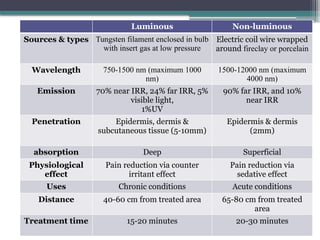
Luminous Non-luminous
Sources & types Tungsten filament enclosed in bulb
with insert gas at low pressure
Electric coil wire wrapped
around fireclay or porcelain
Wavelength 750-1500 nm (maximum 1000
nm)
1500-12000 nm (maximum
4000 nm)
Emission 70% near IRR, 24% far IRR, 5%
visible light,
1%UV
90% far IRR, and 10%
near IRR
Penetration Epidermis, dermis &
subcutaneous tissue (5-10mm)
Epidermis & dermis
(2mm)
absorption Deep Superficial
Physiological
effect
Pain reduction via counter
irritant effect
Pain reduction via
sedative effect
Uses Chronic conditions Acute conditions
Distance 40-60 cm from treated area 65-80 cm from treated
area
Treatment time 15-20 minutes 20-30 minutes
Power
The power of IR sources can described as;
• Small lamps (luminous and non-luminous), usually
250-500W.
• Large, non-luminous, 750-1000W.
• Large, luminous, 650-1500W.
Emission
Non-luminous
• Mainly 3000-4000 nm (long IR), with about 10% between
1500 nm and visible (short IR)
Luminous
• Approximately 70% short IR
• 5% visible
• 24% long IR
• 1% UVR absorbed by glass of bulb
Absorption and penetration of infrared
radiation
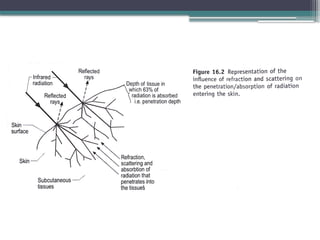
• All radiations, when it strikes the body, will be reflected,
some will penetrate, to be scattered, refracted and ultimately
absorbed in the tissues.
• Close to 95%of the radiation applied perpendicular to the
skin is transmitted rather than reflected.
• The transmitted energy is rapidly absorbed so only small
amounts of radiation penetrate to the subcutaneous tissues;
most is absorbed in the skin.
• The absorption of infrared and the maximal penetration of
the rays will depend upon the following variables:
1. frequency or wavelength of the rays
2. thermal conductivity of the tissue
3. angle of incidence of the rays
4. density of each tissue
5. distance from the source of infrared
6. patency of the circulation
7. source of the infrared
Penetration
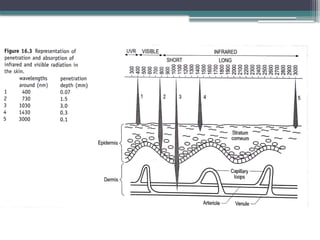
• Penetration is depends on penetration depth.
• Penetration depth : The depth at which 63% of the
original radiation has been absorbed and 37% remains.
• Very long wavelength infrared ( around 40000nm ) behaves
like microwave and penetrates several centimetres.
• However, the long infrared used therapeutically is absorbed
at the surface, much of it by the water on the skin surface.
• At around 3000nm, the penetration depth is about 0.1 mm.
• There is increasing penetration with decreasing wavelength in the
short infrared region, to a maximum penetration depth of about
3mm around the 1000nm wavelength region.
• Very short infrared and red visible radiation have penetration
depths of about 1 or 2 mm, while those of the rest of the visible
spectrum penetrate much less.
• In fact, at the blue end of the visible spectrum, the penetration
depth is about 0.07 mm and decreases uniformly with wavelength
through the UVR region.
Physiological effect
Cutaneous vasodilatation
• Due to the heating of the cutaneous structure, infrared
radiations produce local cutaneous vasodilataion.
• This effect is due to;
1. The liberation of chemicals such as histamine and similar
substance.
2. Due to the direct effect on blood vessels.
• The vasodilatation starts after 1-2 min and is largely due to
arteriolar vasodilatation.
• Due to heating erythema start developing.
• The rate of erythema depends on rate and degree of heating.
• For normal individuals, heating the skin to about core
temperature (37 c) over some 20 minutes will lead to very
mild erythema; heating to around (42 c) will lead to marked
erythema.
• The local erythema lasts for about 30 minutes after radiation
has stopped.
Sweating
• The heat produced by the IRR increases the activity of the
sweat glands, causing release of sweat.
• Produced sweat absorb some of the applied infrared radiation
and leads to surface cooling as it evaporates.
Sensation
• Due to the effects of heating the thermal heat receptors in the
skin are stimulated, giving the sensation of warmth.
Increase in metabolism
• As per vant hoff’s law, which states that the chemical
changes are accelerated due to heat, the heat produced by
IRR increases the metabolisum, due to which there is
increased demand in the tissue for oxygen and food stuffs
which is maintained by an increased arterial flow.
• The waste metabolites produced are removed by increased
lymphatic and venous returns.
Chronic changes
• Excessive and prolonged IR application can cause the
destruction of erythrocytes, releasing pigments and causing
brown discoloration of the skin.
• This rarely occurs as a normal treatment.
• Epidemiological studies also indicate that due to prolonged
use of high temperature IR can produce carcinogenic effect.
Therapeutic uses
Pain relief
• Mild heating on the superficial tissues by IRR causes
sedative effects of superficial sensory nerve endings.
• Pain may be due to accumulation of waste products of
metabolism, an increased flow of blood through the part
removes these substances and thus relives the pain.
• The pain due to acute inflammation or recent injury is
relieved most effectively by mild heating.
• When pain is due to chronic injury, stronger heating is
required. The treatment may last up to 30 minutes.
Reduction of muscle spasm/muscle relaxation
• Mild heating by IR causes relaxation of muscles and thus
relieves spasm.
• Relief of pain also induces relaxation in muscles and helps
relieving muscle spasm associated with injury.
• Relaxation of muscles provide greater ROM to the
exercising part as it relieves muscular spasm.
Acceleration of healing and repair
• It accelerate healing and repair by increasing blood supply.
• IRR increase the temperature in the superficial tissues,
causing vasodilatation in the superficial tissues.
• It provide more WBC and fresh nutrients to the area being
treated.
• It also accelerates removal of waste products and helps
bring about resolution of inflammation.
• Fresh supply of blood rejuvenates the tissues, removes
waste products of metabolism and also relives muscle
spasms.
• Ex, Arthritic condition
Reduction of joint stiffness
• There is increased blood flow and consequent muscle
relaxation which leads to decrease in the joint stiffness and
improves range of motion.
Relives skin lesions
• In case of skin infections such as dermatitis, viral infections
caused due to bacteria.
• IRR can be given to destroy the bacteria and thus help to
reduce the infections.
Indications
• Subacute or chronic inflammatory conditions such as; Low
back pain, cervical spondylosis, osteo-arthritis, rheumatoid
arthritis.
• Skin infections
• Pressure sore/decubitus ulcer
• Bell’s palsy following middle ear infection
• Peripheral nerve injuries before the application of electrical
stimulation
• Prior to stretching, massage, mobilization, traction and
electrical stimulation
Contraindication
• Acute skin disease (dermatitis or eczema)
• Defective cutaneous circulation (Peripheral vascular disease)
• Haemorrhagic condition
• Areas with impaired thermal sensation
• Recently radiated tissues (following radiotherapy)
• Over areas of scars
• Severe edema
• Region of suspected mallignant tumor
• Metal impalnts tissues
• Directly over Eyes
• After deep X ray or cobalt therapy
Advantages
• Cost effective
• Easy to use at home
• Dry heat is very comfortable in the winter
• Can be used to treat large areas, with local superficial
heating effects.
• Superficial tissue temperature can be increased; even
though the unit does not touch the patient.
Disadvantages
• Uneven body parts can not be treated due to uneven heating.
• Constant temperature source increases the risk of burns.
• Lack of therapeutic evidence.
• Heating only superficial tissues, not effective as moist heat
pack and paraffin wax.
precautions
• IRR exposure of the tissue should not be more than 30
minutes.
• Distance between the source of the lamp and the tissue
should not be less than 18 inches.
• Ask the patient not to touch the IRR lamp and wires during
the treatment.
• Ask the patient not to sleep and move towards IRR lamp
during IR radiation exposure.
• People with sensitive skin.
• Never apply IRR directly over the eyes and genitals.
Technique of application
Patient
• Position the patient in a suitable, well supported position
with the area to be treated exposed.
• Explain the nature and effects of the treatment to the
patient.
• Before starting the treatment examine the skin to be treated
and test the thermal sensation.
Apparatus
• If non-luminous lamp is chosen, switch it on at least 10
minutes prior to treatment, to allow time for it to warm and
reach its maximum emission.
• A luminous lamp needs no warm up time and can be
switched on once patient is ready for the treatment.
Setting up
• Expose the skin to be treated and cover the eye with towel
or goggles.
• Position the lamp 90 degree so that the radiation strikes the
surface at near right angle to achieve maximum penetration.
• Set the lamp at appropriate distance: about 60-75 cm for
large lamps and about 45-50 cm for the smaller ones.
Instructions and warnings
• Ask the patient to indicate the level of heat they can feel
and where.
• Advice the patient not to touch any part of lamp or not to
move during treatment and alert therapist if it is more than
comfortably warm level of heating.
Application
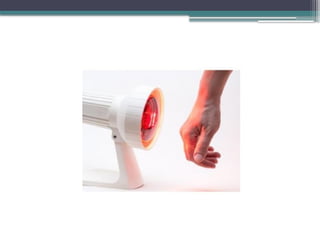
• The intensity of the heating is most IR lamps is controlled by the
distance of the lamp from the skin.
• Adjacent areas can be protected from heating by placing the layer of
towel.
• The therapist should check the level of heating on completion of the set
up and again after 5 to 8 minutes and, if required, adjust the distance of
the lamp to the skin.
• IR is usually only applied for 10 to 15 minutes as it is only part of a
treatment, not a treatment itself.
Termination
• On completion of the treatment the skin should be carefully
checked.
• On palpation it may feel mildly or moderately warm and a
moderate erythema should be evident.
Dangers
Burn
• Excessive heating of superficial tissues can causes burn.
• Erythema after the treatment is a physiological effect, but if the intensity of IR
is more, it may cause the formation of blisters.
• The burn may be caused due to the following reasons:
1. If intensity of radiation is too high
2. If sensation is not proper
3. Patients fails to report over heating
4. Unconscious patient
5. Patient moves closer to the lamp
6. Falls asleep during the treatment
7. Metal implanted tissue
Electric shock
• It can occur if some exposed part of the circuit is touched
by the patient.
• Due to heating of the wires in the circuit, insulation of wires
may go off and thus regular checking of wires is necessary
to avoid electric shock.
Faintness of giddiness
• Excessive IRR cause fall in BP which may result in
faintness or giddiness due to hypoxia of the brain.
• This is observed when the patient rises up suddenly from
the recumbent position after extensive treatment.
Reduced or altered peripheral blood flow
• Do not use IRR if the vascular response is insufficient
because of the risk of tissue damage.
• Areas affected by arterial disease, such as atherosclerosis,
arterial injury or after skin grafting, should not normally
treated with IRR.
Headache
• IRR over the back of the head may cause headache.
• Headache is also occur when treatment is given during hot
weather.
Following Radiotherapy
• Avoid IRR at least 2 months following radiotherapy.
Injury to eyes
• Direct heating over the eyes causes drying up and thus leads
to corneal and retinal burns.
• Another problem is forming cataracts.
Infection/skin inflammatory conditions
• Avoid applying heat over acute skin infections or previously
known tumours to prevent spreading of disease.
INFRA RED therapy in physiotherapy .pptx

INFRA RED therapy in physiotherapy .pptx

  • 1.
  • 2.
    Introduction • Infrared raysare electromagnetic waves. • It lies between visible light and microwaves. • Wavelength : 750 nm to 400000 nm. • Frequency : 4 * 1014 Hz and 7.5 * 1011 Hz. • Infrared radiation (IR/IRR) therapy is a superficial heating modality. • It works on radiation principle of heat transfer.
  • 4.
    Classification • Based onwavelength IRA IRB IRC 760-1400 nm 1400-3000 nm 3000 nm-1 mm (not used in therapy)
  • 5.
    • Former classification Nearor short IR – 760-1500 nm Far or long IR – 1500-15000 nm
  • 6.
    Sources of infraredradiation • The sources of infrared can be either natural or artificial. • Artificial infrared is generally produced by passing electric current through coiled resistance wire. • Sun is the natural source of infrared radiation. • In the physiotherapy department Infrared radiation are produced by two type if generators: 1. non-luminous generators 2. luminous generators
  • 7.
    Production of Infrared •Any heated material will produce infrared (sun, electric bulb, coal fire, gas fire etc), the wavelength being determined by the temperature. heat provide to any material Molecular vibrations of atoms Collision of molecules Production of heat or IR
  • 8.
    • Higher temperatureare associated with higher frequency and shorter wavelength radiation. • The most convenient method is to heat a resistance wire by passing an electric current through it.
  • 9.
    Non-luminous generators • Non-luminousgenerator consists of a simple type of element or coil wound on a cylinder of some insulating material such as fireclay or porcelain. An electric current is passed through the wire which results in the production of heat. This heat produces infrared rays which are transmitted through the porcelain. Porcelain gets heated by the method of conduction but the radiations generates in this way also include some of the visible rays.
  • 10.
    • To avoidthis, the coil is embedded in fireclay or porcelain or placed behind fireclay. • Now the emission of rays is entirely from the fireclay which is commonly painted black and thus very few visible rays are produced. • The element or the coil is thus placed at the focal point of a parabolic or spherical reflector. • Wire –mesh screens are placed in front of reflector to prevent accidental contact with the hot emitter. • The reflector is mounted on a stand and its position can be adjusted as required.
  • 13.
    Disadvantage : • Allof these non-luminous generators take some time to get heated up for the production of infrared radiations, so they should be switched on before 5-15 minutes of the treatment. Advantage : • Non-luminous generators provide infrared rays only.
  • 14.
    Luminous Generators • Luminousgenerators emit infrared, visible and a few ultraviolet rays. • Heat produce by it is called radiant heat. • These generators are in the form of incandescent lamps or bulbs. • An incandescent lamp consists of a wire filament enclosed in a glass bulb, which may contain an inert gas at low pressure.
  • 15.
    • The filamentis a coil of fine wire which is usually made up of tungsten. • Tungsten is a metal which is used because it can tolerate repeated heating and cooling. • Front of bulb is usually red to filter out shorter visible & ultraviolet rays. • Incandescent bulb is usually mounted at the center of the parabolic reflector and the reflector is mounted on an adjustable stand.
  • 17.
    Disadvantage : • luminousgenerators emit infrared rays, visible as well as ultraviolet rays. Advantage : • Require less time for production of IRR.
  • 19.
    Depth of penetrationof rays Luminous generator • Produces infrared rays having wavelength between 750-1500 nm (maximum 1000 nm). • It can penetrate into epidermis, dermis and subcutaneous tissue (5- 10 mm) Non-luminous generator • Produces infrared rays having wavelength between 1500-12000 nm (maximum 4000 nm). • It can penetrate into epidermis & superficial dermis (2 mm)
  • 20.
    Choice of luminousand non-luminous source • In most cases luminous and non-luminous generators are equally suitable, but in some instances one proves more satisfactory than the others. • Luminous radiation : more efficient tissue heating source since it penetrates further (because peak emission is in the short infrared) and therefore the energy is distributed in a larger volume of tissue. • Non-luminous radiation : with peak emission around 4000nm, is absorbed almost entirely in the skin.
  • 21.
    • If thedesired effects are due to: Heating : the luminous infrared is preferred Sensory stimulation : the non-luminous is preferred • When there is acute inflammation or recent injury, the nom- luminous generator were used. • When there is chronic lesion or injury, the luminous generator were used.
  • 22.
    Luminous Non-luminous Sources &types Tungsten filament enclosed in bulb with insert gas at low pressure Electric coil wire wrapped around fireclay or porcelain Wavelength 750-1500 nm (maximum 1000 nm) 1500-12000 nm (maximum 4000 nm) Emission 70% near IRR, 24% far IRR, 5% visible light, 1%UV 90% far IRR, and 10% near IRR Penetration Epidermis, dermis & subcutaneous tissue (5-10mm) Epidermis & dermis (2mm) absorption Deep Superficial Physiological effect Pain reduction via counter irritant effect Pain reduction via sedative effect Uses Chronic conditions Acute conditions Distance 40-60 cm from treated area 65-80 cm from treated area Treatment time 15-20 minutes 20-30 minutes
  • 23.
    Power The power ofIR sources can described as; • Small lamps (luminous and non-luminous), usually 250-500W. • Large, non-luminous, 750-1000W. • Large, luminous, 650-1500W.
  • 24.
    Emission Non-luminous • Mainly 3000-4000nm (long IR), with about 10% between 1500 nm and visible (short IR) Luminous • Approximately 70% short IR • 5% visible • 24% long IR • 1% UVR absorbed by glass of bulb
  • 25.
    Absorption and penetrationof infrared radiation • All radiations, when it strikes the body, will be reflected, some will penetrate, to be scattered, refracted and ultimately absorbed in the tissues. • Close to 95%of the radiation applied perpendicular to the skin is transmitted rather than reflected. • The transmitted energy is rapidly absorbed so only small amounts of radiation penetrate to the subcutaneous tissues; most is absorbed in the skin.
  • 26.
    • The absorptionof infrared and the maximal penetration of the rays will depend upon the following variables: 1. frequency or wavelength of the rays 2. thermal conductivity of the tissue 3. angle of incidence of the rays 4. density of each tissue 5. distance from the source of infrared 6. patency of the circulation 7. source of the infrared
  • 28.
    Penetration • Penetration isdepends on penetration depth. • Penetration depth : The depth at which 63% of the original radiation has been absorbed and 37% remains. • Very long wavelength infrared ( around 40000nm ) behaves like microwave and penetrates several centimetres. • However, the long infrared used therapeutically is absorbed at the surface, much of it by the water on the skin surface.
  • 29.
    • At around3000nm, the penetration depth is about 0.1 mm. • There is increasing penetration with decreasing wavelength in the short infrared region, to a maximum penetration depth of about 3mm around the 1000nm wavelength region. • Very short infrared and red visible radiation have penetration depths of about 1 or 2 mm, while those of the rest of the visible spectrum penetrate much less. • In fact, at the blue end of the visible spectrum, the penetration depth is about 0.07 mm and decreases uniformly with wavelength through the UVR region.
  • 31.
    Physiological effect Cutaneous vasodilatation •Due to the heating of the cutaneous structure, infrared radiations produce local cutaneous vasodilataion. • This effect is due to; 1. The liberation of chemicals such as histamine and similar substance. 2. Due to the direct effect on blood vessels. • The vasodilatation starts after 1-2 min and is largely due to arteriolar vasodilatation.
  • 32.
    • Due toheating erythema start developing. • The rate of erythema depends on rate and degree of heating. • For normal individuals, heating the skin to about core temperature (37 c) over some 20 minutes will lead to very mild erythema; heating to around (42 c) will lead to marked erythema. • The local erythema lasts for about 30 minutes after radiation has stopped.
  • 33.
    Sweating • The heatproduced by the IRR increases the activity of the sweat glands, causing release of sweat. • Produced sweat absorb some of the applied infrared radiation and leads to surface cooling as it evaporates. Sensation • Due to the effects of heating the thermal heat receptors in the skin are stimulated, giving the sensation of warmth.
  • 34.
    Increase in metabolism •As per vant hoff’s law, which states that the chemical changes are accelerated due to heat, the heat produced by IRR increases the metabolisum, due to which there is increased demand in the tissue for oxygen and food stuffs which is maintained by an increased arterial flow. • The waste metabolites produced are removed by increased lymphatic and venous returns.
  • 35.
    Chronic changes • Excessiveand prolonged IR application can cause the destruction of erythrocytes, releasing pigments and causing brown discoloration of the skin. • This rarely occurs as a normal treatment. • Epidemiological studies also indicate that due to prolonged use of high temperature IR can produce carcinogenic effect.
  • 36.
    Therapeutic uses Pain relief •Mild heating on the superficial tissues by IRR causes sedative effects of superficial sensory nerve endings. • Pain may be due to accumulation of waste products of metabolism, an increased flow of blood through the part removes these substances and thus relives the pain.
  • 37.
    • The paindue to acute inflammation or recent injury is relieved most effectively by mild heating. • When pain is due to chronic injury, stronger heating is required. The treatment may last up to 30 minutes.
  • 38.
    Reduction of musclespasm/muscle relaxation • Mild heating by IR causes relaxation of muscles and thus relieves spasm. • Relief of pain also induces relaxation in muscles and helps relieving muscle spasm associated with injury. • Relaxation of muscles provide greater ROM to the exercising part as it relieves muscular spasm.
  • 39.
    Acceleration of healingand repair • It accelerate healing and repair by increasing blood supply. • IRR increase the temperature in the superficial tissues, causing vasodilatation in the superficial tissues. • It provide more WBC and fresh nutrients to the area being treated.
  • 40.
    • It alsoaccelerates removal of waste products and helps bring about resolution of inflammation. • Fresh supply of blood rejuvenates the tissues, removes waste products of metabolism and also relives muscle spasms. • Ex, Arthritic condition
  • 41.
    Reduction of jointstiffness • There is increased blood flow and consequent muscle relaxation which leads to decrease in the joint stiffness and improves range of motion. Relives skin lesions • In case of skin infections such as dermatitis, viral infections caused due to bacteria. • IRR can be given to destroy the bacteria and thus help to reduce the infections.
  • 42.
    Indications • Subacute orchronic inflammatory conditions such as; Low back pain, cervical spondylosis, osteo-arthritis, rheumatoid arthritis. • Skin infections • Pressure sore/decubitus ulcer • Bell’s palsy following middle ear infection • Peripheral nerve injuries before the application of electrical stimulation • Prior to stretching, massage, mobilization, traction and electrical stimulation
  • 43.
    Contraindication • Acute skindisease (dermatitis or eczema) • Defective cutaneous circulation (Peripheral vascular disease) • Haemorrhagic condition • Areas with impaired thermal sensation • Recently radiated tissues (following radiotherapy) • Over areas of scars • Severe edema • Region of suspected mallignant tumor • Metal impalnts tissues • Directly over Eyes • After deep X ray or cobalt therapy
  • 44.
    Advantages • Cost effective •Easy to use at home • Dry heat is very comfortable in the winter • Can be used to treat large areas, with local superficial heating effects. • Superficial tissue temperature can be increased; even though the unit does not touch the patient.
  • 45.
    Disadvantages • Uneven bodyparts can not be treated due to uneven heating. • Constant temperature source increases the risk of burns. • Lack of therapeutic evidence. • Heating only superficial tissues, not effective as moist heat pack and paraffin wax.
  • 46.
    precautions • IRR exposureof the tissue should not be more than 30 minutes. • Distance between the source of the lamp and the tissue should not be less than 18 inches. • Ask the patient not to touch the IRR lamp and wires during the treatment. • Ask the patient not to sleep and move towards IRR lamp during IR radiation exposure. • People with sensitive skin. • Never apply IRR directly over the eyes and genitals.
  • 47.
    Technique of application Patient •Position the patient in a suitable, well supported position with the area to be treated exposed. • Explain the nature and effects of the treatment to the patient. • Before starting the treatment examine the skin to be treated and test the thermal sensation.
  • 48.
    Apparatus • If non-luminouslamp is chosen, switch it on at least 10 minutes prior to treatment, to allow time for it to warm and reach its maximum emission. • A luminous lamp needs no warm up time and can be switched on once patient is ready for the treatment.
  • 49.
    Setting up • Exposethe skin to be treated and cover the eye with towel or goggles. • Position the lamp 90 degree so that the radiation strikes the surface at near right angle to achieve maximum penetration. • Set the lamp at appropriate distance: about 60-75 cm for large lamps and about 45-50 cm for the smaller ones.
  • 50.
    Instructions and warnings •Ask the patient to indicate the level of heat they can feel and where. • Advice the patient not to touch any part of lamp or not to move during treatment and alert therapist if it is more than comfortably warm level of heating.
  • 51.
    Application • The intensityof the heating is most IR lamps is controlled by the distance of the lamp from the skin. • Adjacent areas can be protected from heating by placing the layer of towel. • The therapist should check the level of heating on completion of the set up and again after 5 to 8 minutes and, if required, adjust the distance of the lamp to the skin. • IR is usually only applied for 10 to 15 minutes as it is only part of a treatment, not a treatment itself.
  • 53.
    Termination • On completionof the treatment the skin should be carefully checked. • On palpation it may feel mildly or moderately warm and a moderate erythema should be evident.
  • 54.
    Dangers Burn • Excessive heatingof superficial tissues can causes burn. • Erythema after the treatment is a physiological effect, but if the intensity of IR is more, it may cause the formation of blisters. • The burn may be caused due to the following reasons: 1. If intensity of radiation is too high 2. If sensation is not proper 3. Patients fails to report over heating 4. Unconscious patient 5. Patient moves closer to the lamp 6. Falls asleep during the treatment 7. Metal implanted tissue
  • 55.
    Electric shock • Itcan occur if some exposed part of the circuit is touched by the patient. • Due to heating of the wires in the circuit, insulation of wires may go off and thus regular checking of wires is necessary to avoid electric shock.
  • 56.
    Faintness of giddiness •Excessive IRR cause fall in BP which may result in faintness or giddiness due to hypoxia of the brain. • This is observed when the patient rises up suddenly from the recumbent position after extensive treatment.
  • 57.
    Reduced or alteredperipheral blood flow • Do not use IRR if the vascular response is insufficient because of the risk of tissue damage. • Areas affected by arterial disease, such as atherosclerosis, arterial injury or after skin grafting, should not normally treated with IRR.
  • 58.
    Headache • IRR overthe back of the head may cause headache. • Headache is also occur when treatment is given during hot weather. Following Radiotherapy • Avoid IRR at least 2 months following radiotherapy.
  • 59.
    Injury to eyes •Direct heating over the eyes causes drying up and thus leads to corneal and retinal burns. • Another problem is forming cataracts. Infection/skin inflammatory conditions • Avoid applying heat over acute skin infections or previously known tumours to prevent spreading of disease.