SHORT WAVE DIATHERMY
Dr. Brij Karangiya
INTRODUCTION
TYPE OF DIATHERMY
SHORT WAVE DIATHERMY
PRINICILE OF DIATHERMY
CONSTRUCTION
METHOD OF APPLICATION
TYPE OF ELECTRODE
EFFECTS OF SWD
INDICATION,CONTRAINDICATION & DANGERS
CONDITION
EVIDENCE BASED PRACTICE
INTRODUCTION
• Diathermy is a therapeutic treatment commonly prescribed
for muscular joint associated pains.
• The term “diathermy” means “through heating” or
producing deep heating directly in the tissue of the body
 “Dia” through (also means two)
 “Thermy” heat or temperature
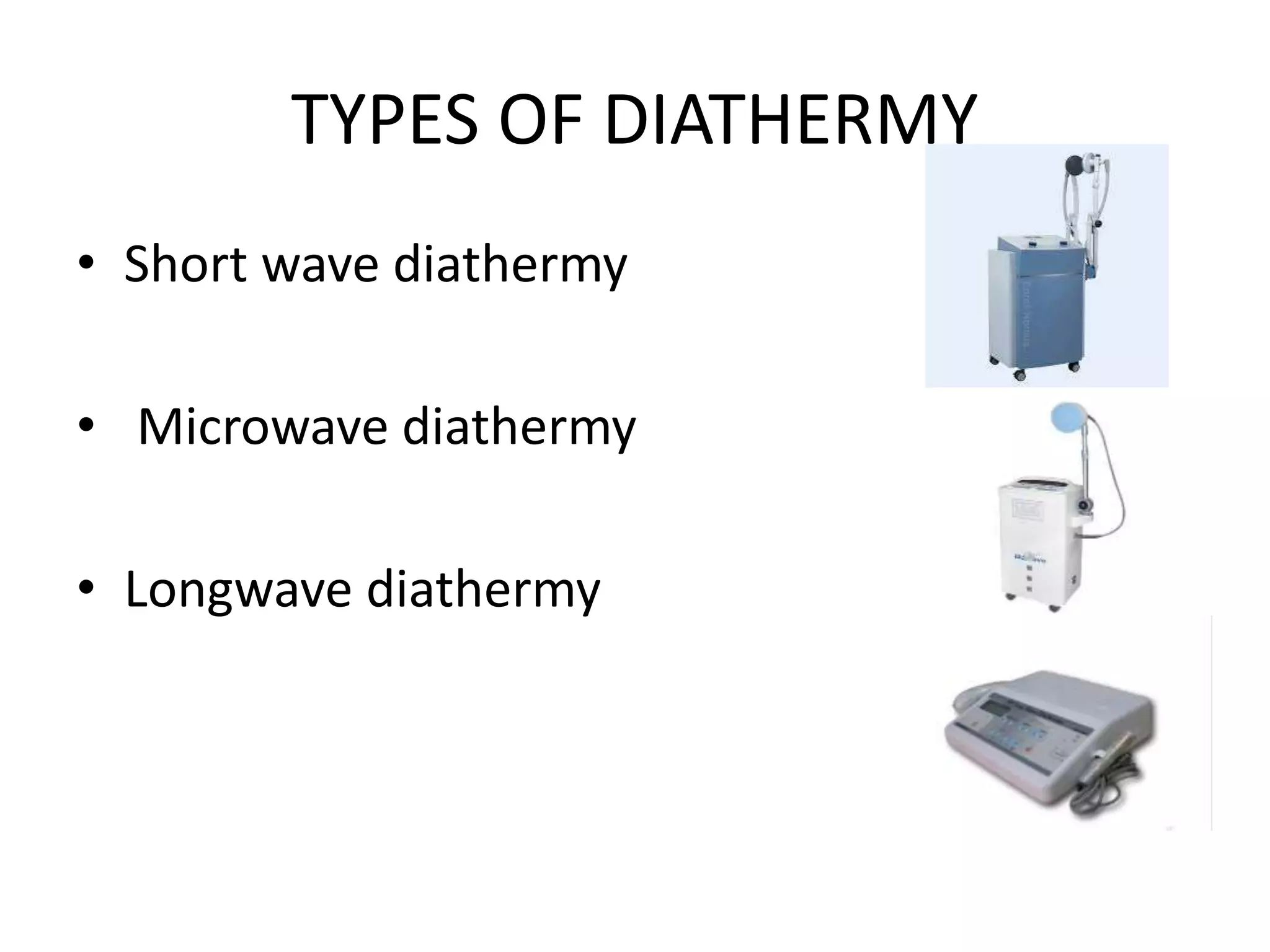
TYPES OF DIATHERMY
• Short wave diathermy
• Microwave diathermy
• Longwave diathermy
SHORT WAVE DIATHERMY
• SWD is a modality that produce deep heating
via conversion of “electromagnetic” energy to
“thermal energy”
• The therapeutically used frequencies and
wavelengths are 27.12 MHz and 11 m
• The less common frequencies and wavelength
are 40.68 MHz and 7.5 m and 13.56 MHz and
22 m
PRINCIPLE OF DIATHERMY
1. Before injury, the dipole molecules of the body tissue are
arranged on the basis of polarity.
2. When the tissue damaged the dipoles distribution
become irregular and deviates from polarity based
arrangement.
3. Under the influence of an electric field, they rotate
according to the polarity of their charge in the direction of
the field lines and get rearranged and tends to acquired
its previous stage of polarity.
CONSTRUCTION
• The system consist of two circuit.
1. The Machine Circuit.
2. The Patient Circuit.
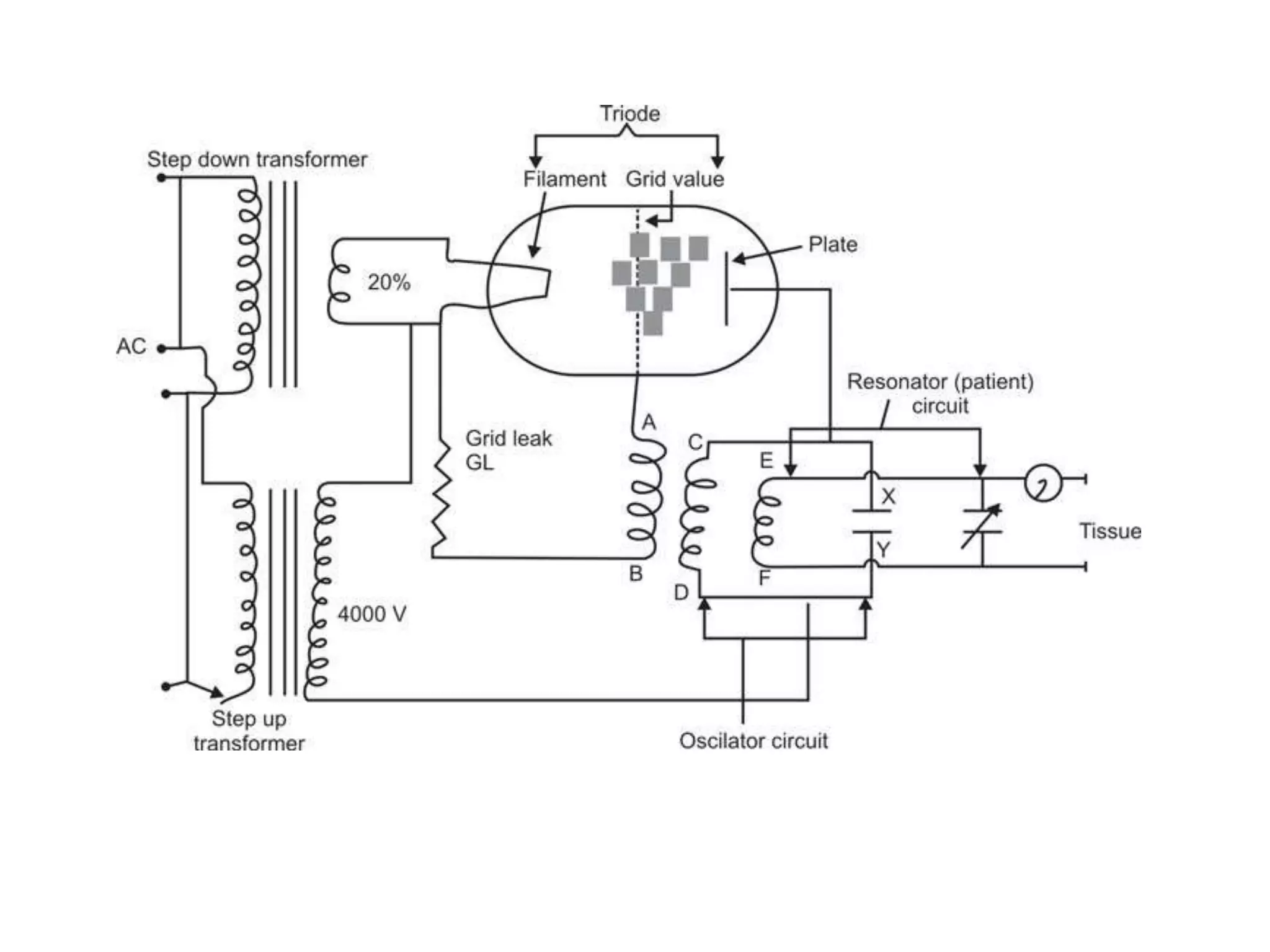
The MACHINE CIRCUIT
• It consist of two transformer , whose primary coil
connected to the source of Ac.
• One is step-down transformer and its secondary coil
supplies current to filament heating circuit of triode
valve.
• The other is step-up transformer and connected to
Anode Circuit.
• Anode circuit carries the current produced by valve.
Here its consists of triode valve and oscillator circuit.
• Oscillator circuit consist of condenser (XY) and inductor or
oscillator coil (CD).
• Current of different frequencies are obtained by selecting
suitable condensers and inductances.
• To produce a current of high frequency the capacitance and
inductances used must be small and is made of charge and
discharge repeatedly and for obtaining this an oscillator is
incorporate with machine circuit along with valve circuit.
• Another coil AB lies close to oscillator circuit (CD) and has one
end connected to the grid of the valve and other through the
grid leak(GL) resistance to the filament.
THE PATIENT CIRCUIT
• The patient circuit is coupled to machine circuit by a
inductor coil(EF) lying close to oscillator coil (CD) and also
consist variable condenser (HK) which is usually in
parallel to patient terminal.
• A matching high frequency current is produced in the
resonator circuit by electromagnetic induction.
• For this to happen the oscillator and resonator circuit
must be in resonance with each other, which requires
that the product of inductance and capacitance must be
the same for both circuits.
METHODS OF APPLICATION
1. Condenser Field Method
2. Cable Method
Condenser Field Method
Contraplaner Method
Coplanar Method
Cross fire Method
Monopolar Method
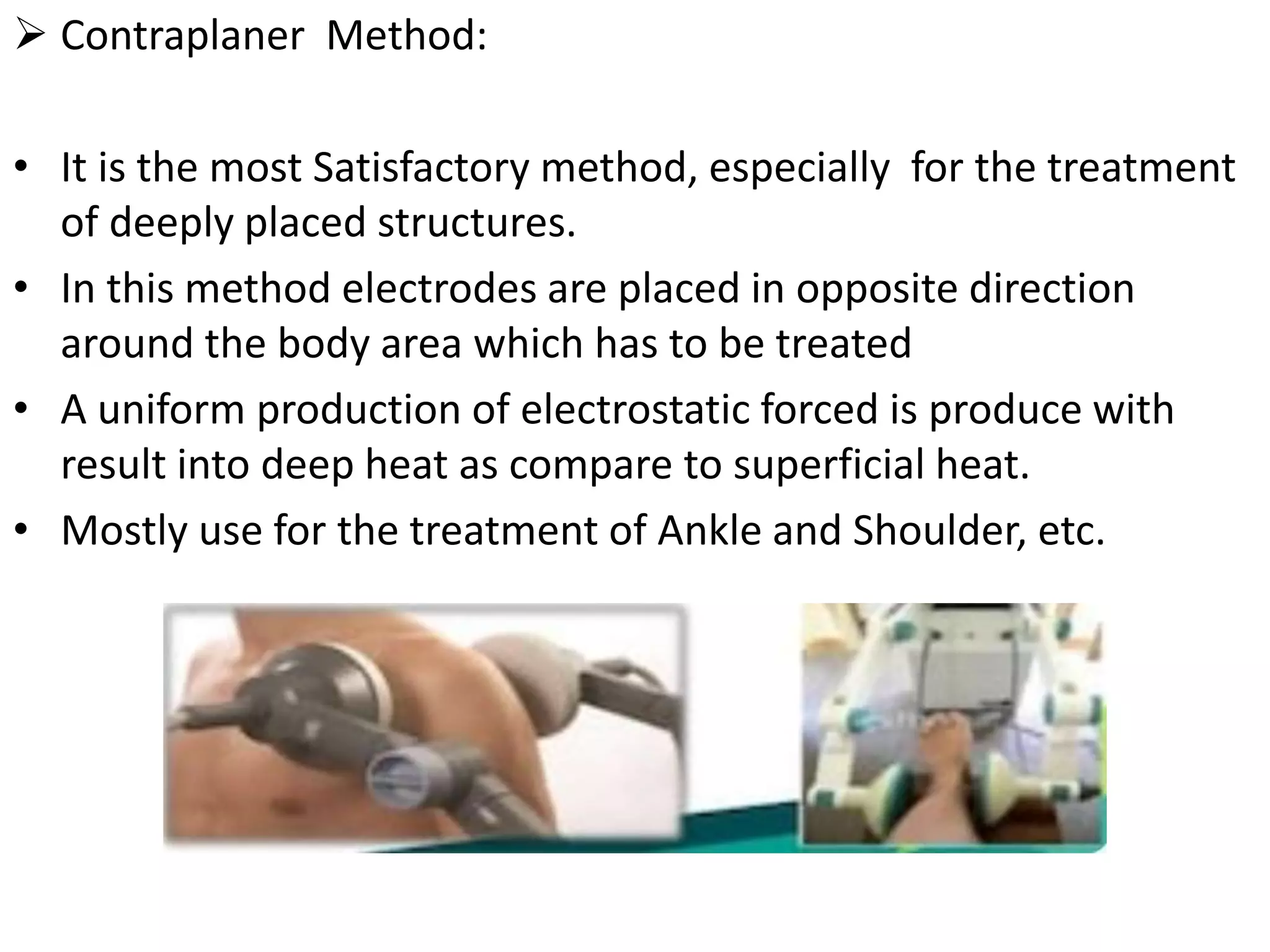
 Contraplaner Method:
• It is the most Satisfactory method, especially for the treatment
of deeply placed structures.
• In this method electrodes are placed in opposite direction
around the body area which has to be treated
• A uniform production of electrostatic forced is produce with
result into deep heat as compare to superficial heat.
• Mostly use for the treatment of Ankle and Shoulder, etc.
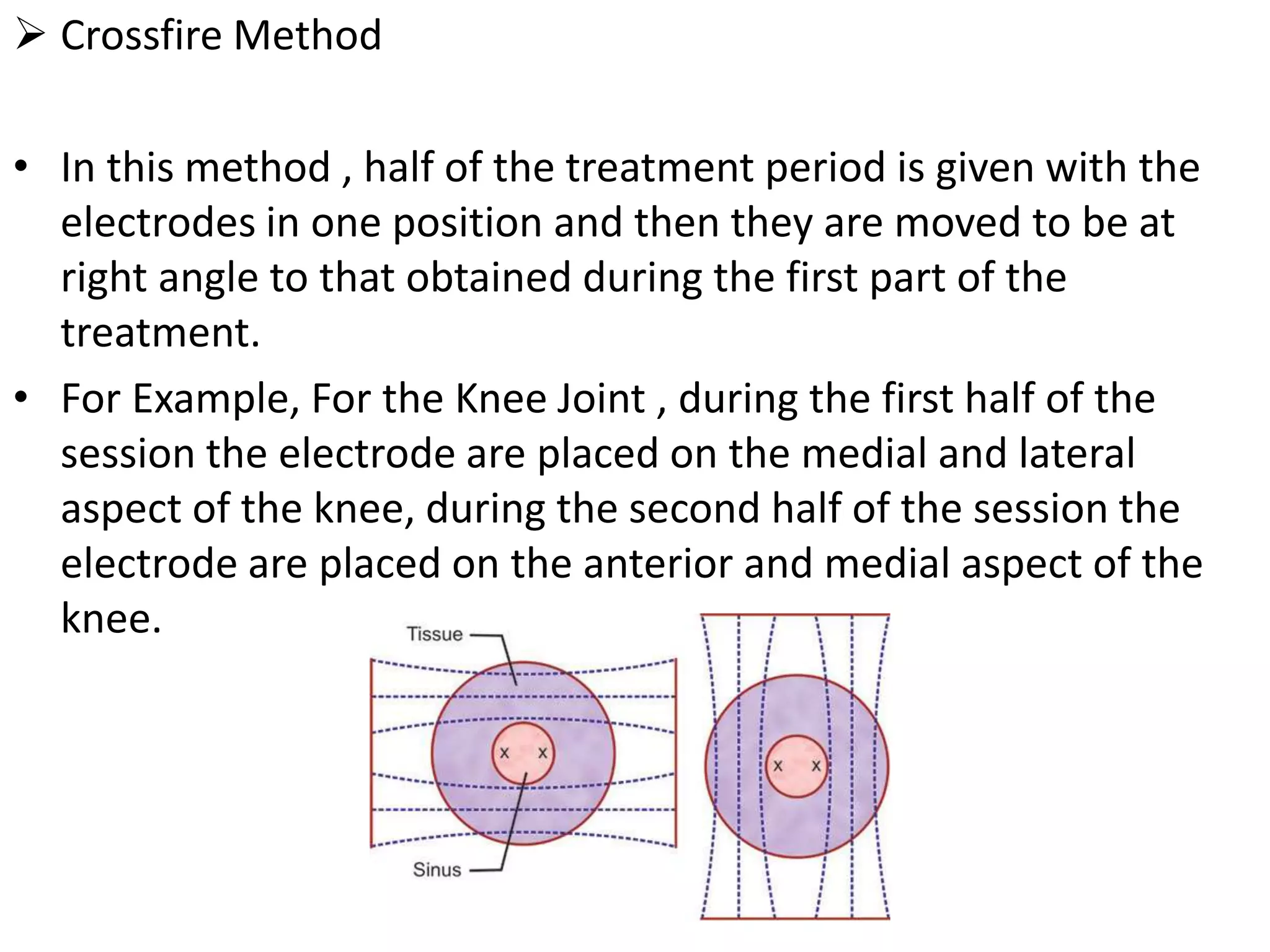
 Crossfire Method
• In this method , half of the treatment period is given with the
electrodes in one position and then they are moved to be at
right angle to that obtained during the first part of the
treatment.
• For Example, For the Knee Joint , during the first half of the
session the electrode are placed on the medial and lateral
aspect of the knee, during the second half of the session the
electrode are placed on the anterior and medial aspect of the
knee.
 Coplanar Method:
• In this method, electrode are placed side by side on the same
aspect of the part, provided there is an adequate distance
between them.
• The distance between the two electrodes should be more then
the total width of spacing.
• In this method , the heat is more superficial and suits certain
areas such as the spine, where one electrode is placed over the
dorsal region , while the other placed over the lumber one.
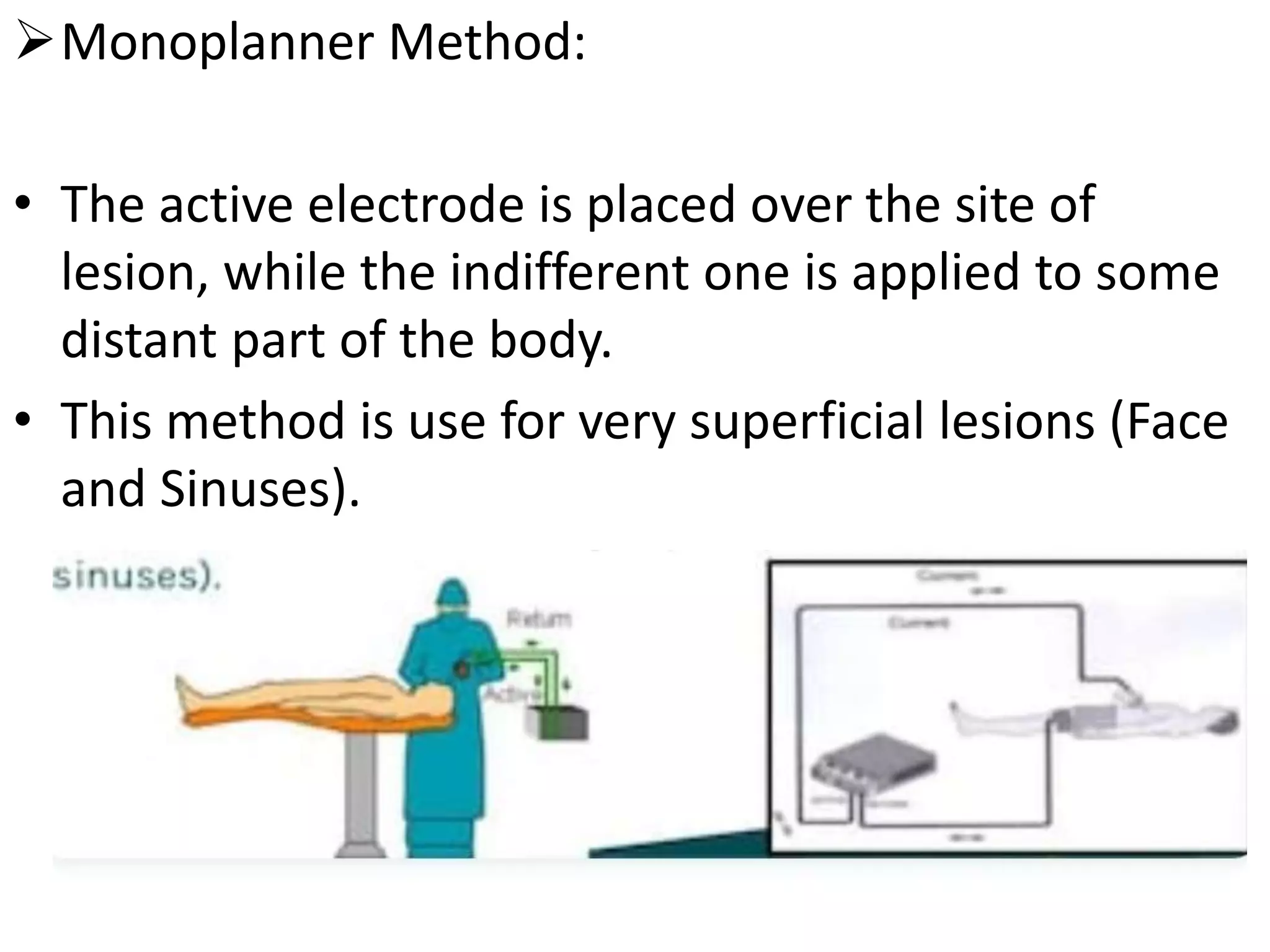
Monoplanner Method:
• The active electrode is placed over the site of
lesion, while the indifferent one is applied to some
distant part of the body.
• This method is use for very superficial lesions (Face
and Sinuses).
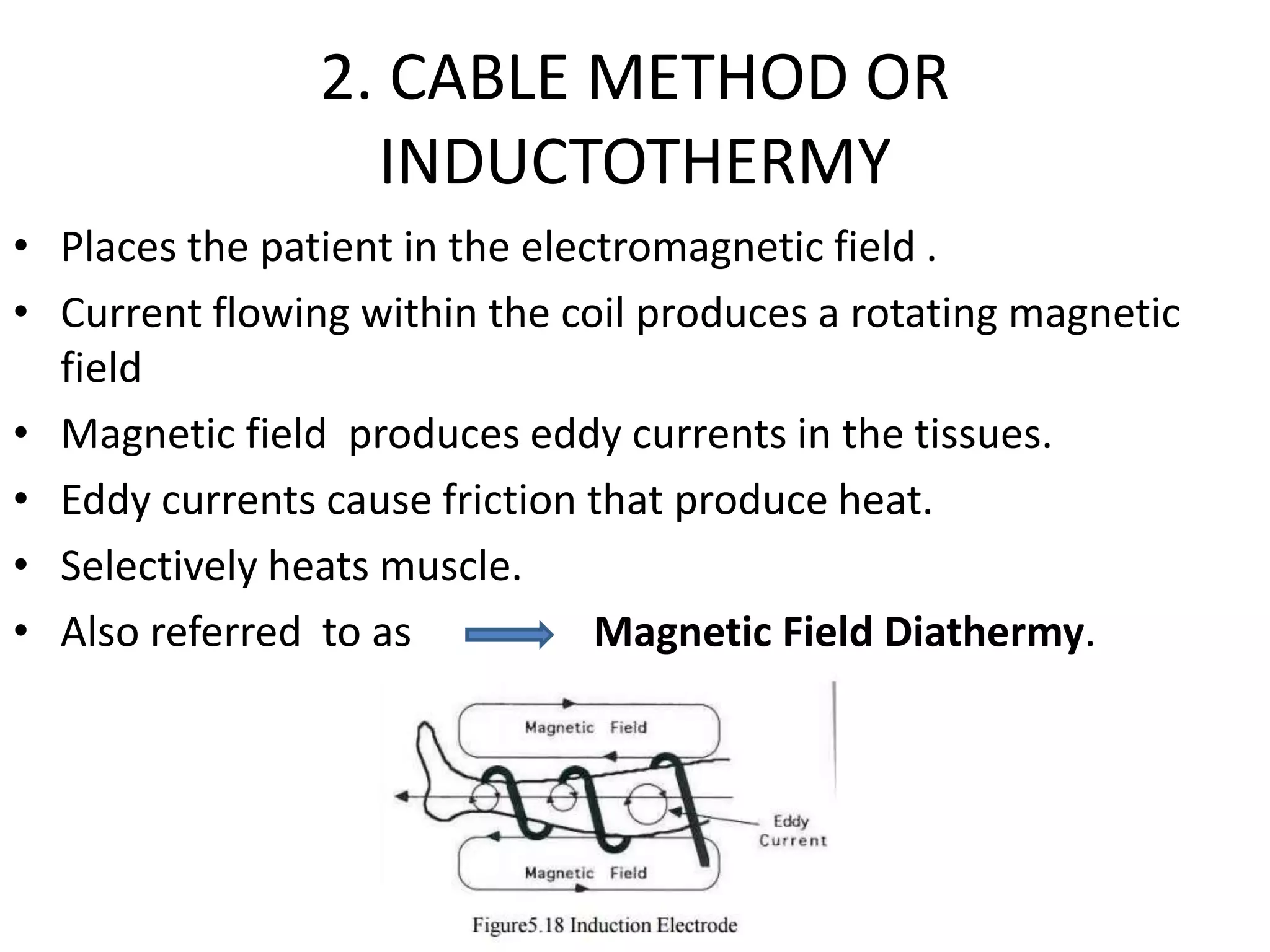
2. CABLE METHOD OR
INDUCTOTHERMY
• Places the patient in the electromagnetic field .
• Current flowing within the coil produces a rotating magnetic
field
• Magnetic field produces eddy currents in the tissues.
• Eddy currents cause friction that produce heat.
• Selectively heats muscle.
• Also referred to as Magnetic Field Diathermy.
• Advantages of cable method:
1. For the treatment of an extensive area which could not be
included between the condenser electrode.
2. When the area is irregular.
3. When it is desirable to avoid heating of the subcutaneous fat.
• Disadvantages of cable method:
1. The impossibility of using air spacing:
• Dosage
 The treatment dosage should have an intensity that cause
sufficient warmth of the tissue and the duration of the
treatment should be 20-30min. The treatment may be given
daily or alternate day.
 As the general rule, for the treatment of acute inflammation
and any acute injury the intensity of the treatment should be
less but it should be carried out frequently.
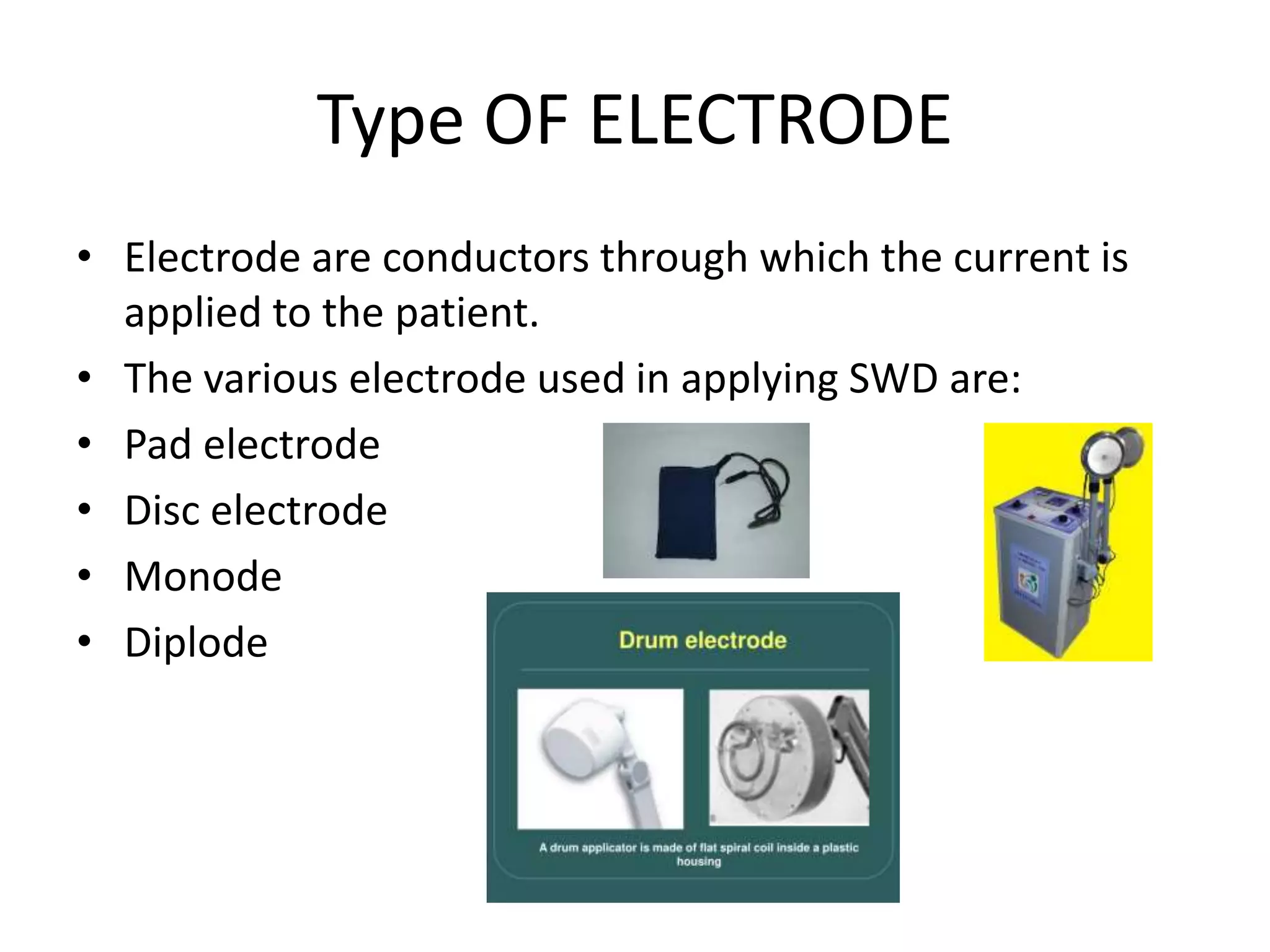
Type OF ELECTRODE
• Electrode are conductors through which the current is
applied to the patient.
• The various electrode used in applying SWD are:
• Pad electrode
• Disc electrode
• Monode
• Diplode
• Size of Electrode:
1. If the two electrode are of different sizes, they will behave as a
capacitor of different sized plates. The different quantities of
electricity are required to charge them to the same potential.
The puts an uneven load to the machine. The charge will
concentrate on the part of large electrode which lies opposite
to the smaller electrode.
Electrodes of different sizes
2. If the electrode are little larger than the area treated, the outer
part where the spread is greatest is deliberately not utilize. The
part of the body to be heated lies in the central part of the field,
which is more even. For treatment of the limbs, the electrode
should be larger than the diameter of the limbs and for trunk and
back electrode should be as large as possible
Correct size of electrodes
3.The diameter of the electrode is smaller than of the limbs, the
lines of forces spread in the the tissues, causing more heating of
the superficial than of deep structures.
Smaller electrodes
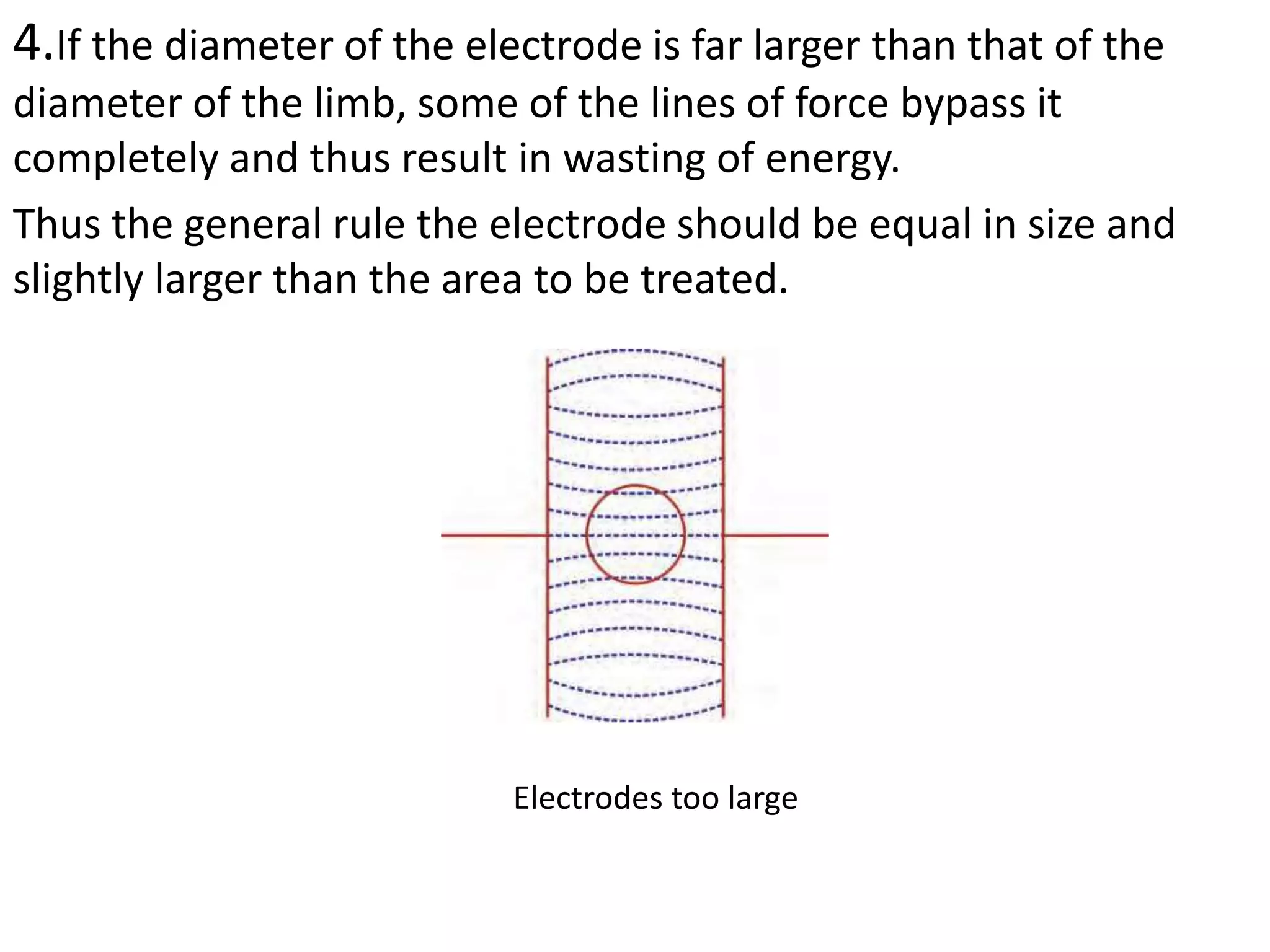
4.If the diameter of the electrode is far larger than that of the
diameter of the limb, some of the lines of force bypass it
completely and thus result in wasting of energy.
Thus the general rule the electrode should be equal in size and
slightly larger than the area to be treated.
Electrodes too large
SPACING OF ELECTRODE
1. If the distance between the plates is small and the material
between then is of high dielectric constant, the lines of forces
spread as they pass between the plates of a charged
condenser
Distance too small
2. When the distance between the electrodes is large, the
spreading out of the electric field is minimal, which the use of
spacing material of a low dielectric constant also limits the spread
of the field.
Adequate distance
3.When the electrode spacing is narrow, the superficial tissue line
in the concentrated part of the field close to the electrode are thus
heated more then the deep tissues, where density of the field is
less.
Electrodes closer to the body
4.If the two electrode are placed at an placed at an unequal
distance from the body, the one electrode is placed nearer to the
body than the other then than there is a greater heating effect
under the closer electrode than under the farther one. The line of
force under the farther electrode have a greater distance in which
to spread before reaching the body than those under the nearer
one. They therefore cover a greater area of skin and their density
is less than under the nearer electrode.
Electrodes at uneven distance
PHYSIOLOGICAL EFFECTS
• Increased metabolism:
Heating tissues accelerates chemical change
such as metabolism, so oxygen and food stuffs
are used up.
With increased metabolism, there will be
increased output of waste products.
• Increased Blood supply:
As a result of increased output of waste products such as
metabolites, which act on the walls of the capillaries and
arterioles, these tissues dilate.
In addition, heat has direct effect on blood vessels, causing
vasodilation.
Heat also produces stimulation of superficial nerve ending, causing
reflex dilatation of the arterioles.
• General rise in temperature:
As blood asses through the heated tissues, it also become heated
and carries the heat to other body arts.
Risk of temperature induces muscle relaxation and increases the
efficiency of muscle action.
• Fall in blood pressure:
The generalized vasodilatation reduces the peripheral
resistance to blood flow.
Heat also reduced blood viscosity which helps in the
reduction of blood pressures.
• Increased activity of sweet glands:
If a general rise of temperature occurs, there will be
increased activation of sweet glands.
THERAPEUTIC USES
• Effect on Inflammation
Assist in removal of waste products All these effects bring
about resolution of inflammation.
Vasodilation
O2 and
Nutritive
material
Antibodies &
White blood cells
• Effect on Bacterial infection:
• Inflammation is normal response of body to bacteria
• Heating the tissue augments these changes so reinforce body’s
normal mechanism of dealing with infecting organisms
Ex: Boils, Carbuncles, Abscesses
Vasodilation
O2 and Nutritive
material
Antibody &
White blood cells
• Reducing Healing Time:
• Increased Blood supply
• More Nutritive material
• More o2 supply
• Induction of Muscle relaxation:
• When SWD applied over spasmodic muscle in inflammatory and
traumatic conditions induce muscle relaxation and reduces
pain.
• Fibrosis:
• Application of SWD increased the extensibility of fibrosis tissues
such as tendon, scars, and joint capsule by 5 to 10 times.
• Indication
Effects on inflammation
Effects in Bacterial infection
Traumatic condition
Relief of pain
Arthritis
Sinuses
• Contraindications :
• Hemorrhage: Diathermy should never be applied to the
open wounds. It should also be not applied where hemorrhage
has recently occurred, because diathermy causes further
dilatation of the blood vessels.
• Venous Thrombosis: Diathermy is contraindicated in the
cases of venous thrombosis or thrombophlebitis around the
area drained by the vessel because the increased flow of blood
may dislodge the clot or aggravates the inflammation.
• Arterial disease : Diathermy should never be applied to
the area having defective arterial supply. The inability of
the circulation to disperse the heat could result in an
increase of temperature in the area, which could lead to
burn. Also, if demand of nutrients cannot be fulfilled with
its supply then gangrene can precipitate.
 Pregnancy: Diathermy should never be applied to the abdomen or
pelvis during pregnancy.
 Tumors: Diathermy should not be applied to the area of tumor
growth because the temperature could accelerate the growth of the
tumor. Further, due to increased circulation metastasis, i.e. spreading
of tumor may occur.
 Mentally retarded patient: It is unsafe to give short wave diathermy
to mentally retarded patients who are unable to understand the
degree of heating required and the necessity to report excessive
heating.
 Metal in the tissue: Diathermy should also be not applied in
cases of metals in the tissues because diathermy currents may
get concentrated in the metals and excessive heating may cause
burn.
• Dangers
Burns
Electric Shock
Overdose
Faintness
Giddiness
Precipitation of gangrene
• Cervical Spondylosis:
• Cervical spondylosis is the condition in which there are
degenerative changes in the intervertebral joints between the
bodies and disk in the cervical spine.
• In early stage, it is localized in 2–3 cervical vertebrae region due
to degeneration of the inter vertebral disk and there is
narrowing, osteophytes formation of the anterior and posterior
margins of the spine and these osteophytes causes narrowing of
intervertebral foramen resulting in nerve root irritation.
• Incidence:
• Middle aged and elderly (30 to 45 years of age) women and
men. Particularly, in those occupations which involves a posture
of prolonged neck flexion.
• Etiology
• Poor posture associated with anxiety habit occupation stress
(involves) a posture of prolonged neck flexion.
• Typists of poorly positioned desks, writer, drivers, holding
telephone on one shoulder, sleeping in awkward conditions.
• Pathogenesis
• Degeneration of disk results in reduction of disk space and
peripheral osteophyte formation.
• The posterior intervertebral joints get secondarily involved and
generate pain in the neck.
• The osteophytes impinging on the nerve roots give rise to
radicular pain in the upper limb
• Clinical Features :
• a. Pain:
 Headaches due to upper cervical pathology
 Neck ache due to middle cervical pathology
 Shoulder girdle, shoulder and arm pain due to pathology from
C4 to T2 (Radiating pain)
• b. Neck postural muscles are often weak
• c. Tenderness in the cervical spine present
• d. Limitation of all movements of cervical spine.
• Investigations :
• X-rays : Osteophytes formation (New growth)
 Narrowing of joint space
 Narrowing of intervertebral foramen.
• Treatment: Physiotherapy
• Relief of pain:
• a. Analgesics, SWD to neck, intermittent cervical traction
• b. Shoulder bracing and neck exercise
• c. Use of cervical collar (in acute and extremely painful
conditions).
• Local Contraindications
1. Pulmonary TB
2. Hearing aids
3. VBI—For giddiness
4. Any skin diseases
5. Abscess
6. Recent injury.
• Positioning of the Patient
• Arm lean sitting (neck and shoulder be in neutral position).
• Placement of Electrodes
• Monoplanar tech : For localized pain
• Coplanar tech : For radiating pain
• Spacing : Narrow
• Dosage : Acute - Subthermal
• Subacute - Mildthermal
• Chronic - Thermal
• Duration:
• Acute - 10 to 15 minutes
• Subacute - 15 to 20 minutes
• Chronic - 20 to 30 minutes
• EVIDENCE BASED PRACTICE:
“Effects of Repetitive Shortwave Diathermy for
Reducing Synovitis in Patients With Knee
Osteoarthritis: An Ultrasonography Study ”
Author:
• Mei-Hwa Jan, Huei-Ming Chai, Chung-Li Wang, Yeong-Fwu
Lin, Li-Ying Tsai
• Physical Therapy, Volume 86, Issue 2, 1 February 2006,
 Conclusion: After 10 swd treatment, the total synovial sac
thickness in both treatment groups was significantly less than
the initial thickness. And the synovial sac continued to become
significantly thinner with 20 sessions of treatment. These
observations were not made in the control subjects.
2. “Short-wave diathermy in the clinical management
of musculoskeletal disorders: a pilot observational
study”
Author:
• Stefano Masiero,
• Andrea Pignataro,
• Giovanni Piran,
• International Journal of Biometeorology
Conclusion: The results of our study confirm that SWD is
effective and safe and improves pain and quality of life in people
with musculoskeletal disorders. However, these results cannot
be considered conclusive.
THANK YOU

Short wave diathermy (s.w.d) electro therapy

  • 1.
  • 2.
    INTRODUCTION TYPE OF DIATHERMY SHORTWAVE DIATHERMY PRINICILE OF DIATHERMY CONSTRUCTION METHOD OF APPLICATION TYPE OF ELECTRODE EFFECTS OF SWD INDICATION,CONTRAINDICATION & DANGERS CONDITION EVIDENCE BASED PRACTICE
  • 3.
    INTRODUCTION • Diathermy isa therapeutic treatment commonly prescribed for muscular joint associated pains. • The term “diathermy” means “through heating” or producing deep heating directly in the tissue of the body  “Dia” through (also means two)  “Thermy” heat or temperature
  • 4.
    TYPES OF DIATHERMY •Short wave diathermy • Microwave diathermy • Longwave diathermy
  • 5.
    SHORT WAVE DIATHERMY •SWD is a modality that produce deep heating via conversion of “electromagnetic” energy to “thermal energy” • The therapeutically used frequencies and wavelengths are 27.12 MHz and 11 m • The less common frequencies and wavelength are 40.68 MHz and 7.5 m and 13.56 MHz and 22 m
  • 6.
    PRINCIPLE OF DIATHERMY 1.Before injury, the dipole molecules of the body tissue are arranged on the basis of polarity. 2. When the tissue damaged the dipoles distribution become irregular and deviates from polarity based arrangement. 3. Under the influence of an electric field, they rotate according to the polarity of their charge in the direction of the field lines and get rearranged and tends to acquired its previous stage of polarity.
  • 7.
    CONSTRUCTION • The systemconsist of two circuit. 1. The Machine Circuit. 2. The Patient Circuit.
  • 8.
    The MACHINE CIRCUIT •It consist of two transformer , whose primary coil connected to the source of Ac. • One is step-down transformer and its secondary coil supplies current to filament heating circuit of triode valve. • The other is step-up transformer and connected to Anode Circuit. • Anode circuit carries the current produced by valve. Here its consists of triode valve and oscillator circuit.
  • 10.
    • Oscillator circuitconsist of condenser (XY) and inductor or oscillator coil (CD). • Current of different frequencies are obtained by selecting suitable condensers and inductances. • To produce a current of high frequency the capacitance and inductances used must be small and is made of charge and discharge repeatedly and for obtaining this an oscillator is incorporate with machine circuit along with valve circuit. • Another coil AB lies close to oscillator circuit (CD) and has one end connected to the grid of the valve and other through the grid leak(GL) resistance to the filament.
  • 11.
    THE PATIENT CIRCUIT •The patient circuit is coupled to machine circuit by a inductor coil(EF) lying close to oscillator coil (CD) and also consist variable condenser (HK) which is usually in parallel to patient terminal. • A matching high frequency current is produced in the resonator circuit by electromagnetic induction. • For this to happen the oscillator and resonator circuit must be in resonance with each other, which requires that the product of inductance and capacitance must be the same for both circuits.
  • 12.
    METHODS OF APPLICATION 1.Condenser Field Method 2. Cable Method
  • 13.
    Condenser Field Method ContraplanerMethod Coplanar Method Cross fire Method Monopolar Method
  • 14.
     Contraplaner Method: •It is the most Satisfactory method, especially for the treatment of deeply placed structures. • In this method electrodes are placed in opposite direction around the body area which has to be treated • A uniform production of electrostatic forced is produce with result into deep heat as compare to superficial heat. • Mostly use for the treatment of Ankle and Shoulder, etc.
  • 15.
     Crossfire Method •In this method , half of the treatment period is given with the electrodes in one position and then they are moved to be at right angle to that obtained during the first part of the treatment. • For Example, For the Knee Joint , during the first half of the session the electrode are placed on the medial and lateral aspect of the knee, during the second half of the session the electrode are placed on the anterior and medial aspect of the knee.
  • 16.
     Coplanar Method: •In this method, electrode are placed side by side on the same aspect of the part, provided there is an adequate distance between them. • The distance between the two electrodes should be more then the total width of spacing. • In this method , the heat is more superficial and suits certain areas such as the spine, where one electrode is placed over the dorsal region , while the other placed over the lumber one.
  • 17.
    Monoplanner Method: • Theactive electrode is placed over the site of lesion, while the indifferent one is applied to some distant part of the body. • This method is use for very superficial lesions (Face and Sinuses).
  • 18.
    2. CABLE METHODOR INDUCTOTHERMY • Places the patient in the electromagnetic field . • Current flowing within the coil produces a rotating magnetic field • Magnetic field produces eddy currents in the tissues. • Eddy currents cause friction that produce heat. • Selectively heats muscle. • Also referred to as Magnetic Field Diathermy.
  • 19.
    • Advantages ofcable method: 1. For the treatment of an extensive area which could not be included between the condenser electrode. 2. When the area is irregular. 3. When it is desirable to avoid heating of the subcutaneous fat. • Disadvantages of cable method: 1. The impossibility of using air spacing:
  • 20.
    • Dosage  Thetreatment dosage should have an intensity that cause sufficient warmth of the tissue and the duration of the treatment should be 20-30min. The treatment may be given daily or alternate day.  As the general rule, for the treatment of acute inflammation and any acute injury the intensity of the treatment should be less but it should be carried out frequently.
  • 21.
    Type OF ELECTRODE •Electrode are conductors through which the current is applied to the patient. • The various electrode used in applying SWD are: • Pad electrode • Disc electrode • Monode • Diplode
  • 22.
    • Size ofElectrode: 1. If the two electrode are of different sizes, they will behave as a capacitor of different sized plates. The different quantities of electricity are required to charge them to the same potential. The puts an uneven load to the machine. The charge will concentrate on the part of large electrode which lies opposite to the smaller electrode. Electrodes of different sizes
  • 23.
    2. If theelectrode are little larger than the area treated, the outer part where the spread is greatest is deliberately not utilize. The part of the body to be heated lies in the central part of the field, which is more even. For treatment of the limbs, the electrode should be larger than the diameter of the limbs and for trunk and back electrode should be as large as possible Correct size of electrodes 3.The diameter of the electrode is smaller than of the limbs, the lines of forces spread in the the tissues, causing more heating of the superficial than of deep structures. Smaller electrodes
  • 24.
    4.If the diameterof the electrode is far larger than that of the diameter of the limb, some of the lines of force bypass it completely and thus result in wasting of energy. Thus the general rule the electrode should be equal in size and slightly larger than the area to be treated. Electrodes too large
  • 25.
    SPACING OF ELECTRODE 1.If the distance between the plates is small and the material between then is of high dielectric constant, the lines of forces spread as they pass between the plates of a charged condenser Distance too small 2. When the distance between the electrodes is large, the spreading out of the electric field is minimal, which the use of spacing material of a low dielectric constant also limits the spread of the field.
  • 26.
    Adequate distance 3.When theelectrode spacing is narrow, the superficial tissue line in the concentrated part of the field close to the electrode are thus heated more then the deep tissues, where density of the field is less. Electrodes closer to the body
  • 27.
    4.If the twoelectrode are placed at an placed at an unequal distance from the body, the one electrode is placed nearer to the body than the other then than there is a greater heating effect under the closer electrode than under the farther one. The line of force under the farther electrode have a greater distance in which to spread before reaching the body than those under the nearer one. They therefore cover a greater area of skin and their density is less than under the nearer electrode. Electrodes at uneven distance
  • 28.
    PHYSIOLOGICAL EFFECTS • Increasedmetabolism: Heating tissues accelerates chemical change such as metabolism, so oxygen and food stuffs are used up. With increased metabolism, there will be increased output of waste products.
  • 29.
    • Increased Bloodsupply: As a result of increased output of waste products such as metabolites, which act on the walls of the capillaries and arterioles, these tissues dilate. In addition, heat has direct effect on blood vessels, causing vasodilation. Heat also produces stimulation of superficial nerve ending, causing reflex dilatation of the arterioles. • General rise in temperature: As blood asses through the heated tissues, it also become heated and carries the heat to other body arts. Risk of temperature induces muscle relaxation and increases the efficiency of muscle action.
  • 30.
    • Fall inblood pressure: The generalized vasodilatation reduces the peripheral resistance to blood flow. Heat also reduced blood viscosity which helps in the reduction of blood pressures. • Increased activity of sweet glands: If a general rise of temperature occurs, there will be increased activation of sweet glands.
  • 31.
    THERAPEUTIC USES • Effecton Inflammation Assist in removal of waste products All these effects bring about resolution of inflammation. Vasodilation O2 and Nutritive material Antibodies & White blood cells
  • 32.
    • Effect onBacterial infection: • Inflammation is normal response of body to bacteria • Heating the tissue augments these changes so reinforce body’s normal mechanism of dealing with infecting organisms Ex: Boils, Carbuncles, Abscesses Vasodilation O2 and Nutritive material Antibody & White blood cells
  • 33.
    • Reducing HealingTime: • Increased Blood supply • More Nutritive material • More o2 supply • Induction of Muscle relaxation: • When SWD applied over spasmodic muscle in inflammatory and traumatic conditions induce muscle relaxation and reduces pain. • Fibrosis: • Application of SWD increased the extensibility of fibrosis tissues such as tendon, scars, and joint capsule by 5 to 10 times.
  • 34.
    • Indication Effects oninflammation Effects in Bacterial infection Traumatic condition Relief of pain Arthritis Sinuses
  • 35.
    • Contraindications : •Hemorrhage: Diathermy should never be applied to the open wounds. It should also be not applied where hemorrhage has recently occurred, because diathermy causes further dilatation of the blood vessels. • Venous Thrombosis: Diathermy is contraindicated in the cases of venous thrombosis or thrombophlebitis around the area drained by the vessel because the increased flow of blood may dislodge the clot or aggravates the inflammation. • Arterial disease : Diathermy should never be applied to the area having defective arterial supply. The inability of the circulation to disperse the heat could result in an increase of temperature in the area, which could lead to burn. Also, if demand of nutrients cannot be fulfilled with its supply then gangrene can precipitate.
  • 36.
     Pregnancy: Diathermyshould never be applied to the abdomen or pelvis during pregnancy.  Tumors: Diathermy should not be applied to the area of tumor growth because the temperature could accelerate the growth of the tumor. Further, due to increased circulation metastasis, i.e. spreading of tumor may occur.  Mentally retarded patient: It is unsafe to give short wave diathermy to mentally retarded patients who are unable to understand the degree of heating required and the necessity to report excessive heating.  Metal in the tissue: Diathermy should also be not applied in cases of metals in the tissues because diathermy currents may get concentrated in the metals and excessive heating may cause burn.
  • 37.
  • 38.
    • Cervical Spondylosis: •Cervical spondylosis is the condition in which there are degenerative changes in the intervertebral joints between the bodies and disk in the cervical spine. • In early stage, it is localized in 2–3 cervical vertebrae region due to degeneration of the inter vertebral disk and there is narrowing, osteophytes formation of the anterior and posterior margins of the spine and these osteophytes causes narrowing of intervertebral foramen resulting in nerve root irritation. • Incidence: • Middle aged and elderly (30 to 45 years of age) women and men. Particularly, in those occupations which involves a posture of prolonged neck flexion.
  • 39.
    • Etiology • Poorposture associated with anxiety habit occupation stress (involves) a posture of prolonged neck flexion. • Typists of poorly positioned desks, writer, drivers, holding telephone on one shoulder, sleeping in awkward conditions. • Pathogenesis • Degeneration of disk results in reduction of disk space and peripheral osteophyte formation. • The posterior intervertebral joints get secondarily involved and generate pain in the neck. • The osteophytes impinging on the nerve roots give rise to radicular pain in the upper limb
  • 40.
    • Clinical Features: • a. Pain:  Headaches due to upper cervical pathology  Neck ache due to middle cervical pathology  Shoulder girdle, shoulder and arm pain due to pathology from C4 to T2 (Radiating pain) • b. Neck postural muscles are often weak • c. Tenderness in the cervical spine present • d. Limitation of all movements of cervical spine.
  • 41.
    • Investigations : •X-rays : Osteophytes formation (New growth)  Narrowing of joint space  Narrowing of intervertebral foramen. • Treatment: Physiotherapy • Relief of pain: • a. Analgesics, SWD to neck, intermittent cervical traction • b. Shoulder bracing and neck exercise • c. Use of cervical collar (in acute and extremely painful conditions).
  • 42.
    • Local Contraindications 1.Pulmonary TB 2. Hearing aids 3. VBI—For giddiness 4. Any skin diseases 5. Abscess 6. Recent injury. • Positioning of the Patient • Arm lean sitting (neck and shoulder be in neutral position).
  • 43.
    • Placement ofElectrodes • Monoplanar tech : For localized pain • Coplanar tech : For radiating pain • Spacing : Narrow • Dosage : Acute - Subthermal • Subacute - Mildthermal • Chronic - Thermal • Duration: • Acute - 10 to 15 minutes • Subacute - 15 to 20 minutes • Chronic - 20 to 30 minutes
  • 44.
    • EVIDENCE BASEDPRACTICE: “Effects of Repetitive Shortwave Diathermy for Reducing Synovitis in Patients With Knee Osteoarthritis: An Ultrasonography Study ” Author: • Mei-Hwa Jan, Huei-Ming Chai, Chung-Li Wang, Yeong-Fwu Lin, Li-Ying Tsai • Physical Therapy, Volume 86, Issue 2, 1 February 2006,  Conclusion: After 10 swd treatment, the total synovial sac thickness in both treatment groups was significantly less than the initial thickness. And the synovial sac continued to become significantly thinner with 20 sessions of treatment. These observations were not made in the control subjects.
  • 45.
    2. “Short-wave diathermyin the clinical management of musculoskeletal disorders: a pilot observational study” Author: • Stefano Masiero, • Andrea Pignataro, • Giovanni Piran, • International Journal of Biometeorology Conclusion: The results of our study confirm that SWD is effective and safe and improves pain and quality of life in people with musculoskeletal disorders. However, these results cannot be considered conclusive.
  • 46.