INFRARED RADIATION
THERAPY
Presented By: Umme Kulsum Khanum
2nd year BPT
Cauvery college of physiotherapy
CONTENTS:
Introduction
Classification of IRR
Production of IRR
Absorption and Depth of Penetration of IRR
Techniques of the treatment
Physiological effects of IRR
Therapeautic effects of IRR
Dangers and contraindications of IRR
INTRODUCTION TO INFRARED
THERAPY
•
The infrared rays are electromagnetic waves with wavelengths of 750-4,00,000 nm and a frequency of 4*1014
Hz and 7.5*1011
Hz.
•
It lies behind the red boundary of the visible spectrum. Any hot substance such as sun, electric bulb, coal fire, gas fire etc can produce
Infrared radiations.
•
In Physiotherapy departments, Infrared rays are produced by two types of generators:
I. Luminous Generators
II.Non-Luminous generators.
 Non-luminous generators only produce infrared radiations whereas luminous generators produce infrared radiations, ultraviolet
radiations as well as visible radiations
•
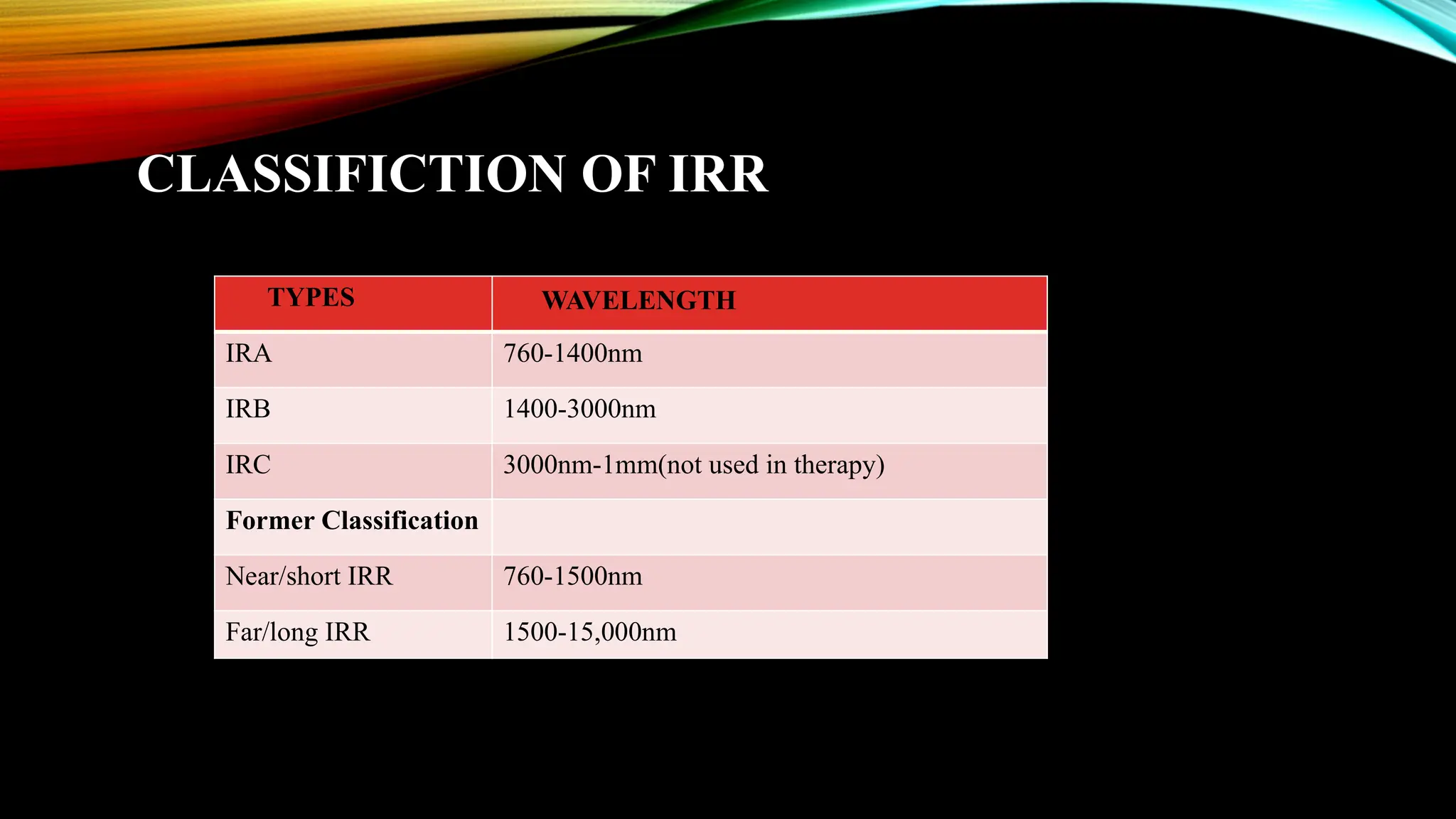
CLASSIFICTION OF IRR
TYPES WAVELENGTH
IRA 760-1400nm
IRB 1400-3000nm
IRC 3000nm-1mm(not used in therapy)
Former Classification
Near/short IRR 760-1500nm
Far/long IRR 1500-15,000nm
PRODUCTION OF IRR
• Heated materials produce infrared radiation, the wavelength being determined by the temperature.
• Higher temperatures are associated with shorter wavelength and higher frequency radiation.
LUMINOUS LAMPS:
• Have electrically heated filament in an evacuated glass bulb, often with silvered inner suface to provide a reflector.
• Produce both IR and visible radiation mostly in the short IR band (peak around 1000nm)
• These generators are in the form of incandescent lamps or bulbs.
• An incandescent lamp consists of a wire filament enclosed in a glass bulb, which may contain an inert gas at low pressure.
• The filament is a coil of fine wire which is usually made up of tungsten.
• Tungsten is a metal which is used because it can tolerate repeated heating and cooling.
• The exclusion of air prevents oxidation of the filament, which would cause an opaque
deposit to form on the inside of the bulb.
• Incandescent bulb is usually mounted at the center of the parabolic reflector and the reflector
is mounted on an adjustable stand.
• These luminous generators emit the electromagnetic waves with the wavelength in between
350-4000nm, the maximum proportion of the rays having wavelength in the region of
1000nm.
• The front of the bulb is usually red so as to filter out the shorter visible and the ultraviolet
rays.
NON-LUMINOUS GENERATORS:
• Non luminous generator consists of a simple type of element or coil wound on a cylinder of some
insulating material such as fireclay or porcelain.
• An electric current is passed through the wire, which results in the production of heat.
• This heat produces infrared rays which are transmitted through the porcelain.
• Porcelain gets heated by the method of conduction but the radiations generated in this way also include
some of the visible rays.
• Therefore to avoid this, the coil is embedded in fireclay or porcelain or placed behind fireclay.
• Now the emission of rays is entirely from the fireclay which is commonly painted black and thus very
few visible rays are produced.
• The element or the coil is thus placed at the focal point of a parabolic or spherical reflector.
• The reflector is mounted on a stand and its position can be adjusted as required.
• In another type of non-luminous generator, a steel tube within which electric coil is
embedded on some material which is electric insulator but good conductor of heat is
used.
• Electric current is passed through the central coil and thus heat is produced. The steel
tube thus emits infrared rays.
• The construction of the outer part of the apparatus should be such that the reflectors
and other parts donot become excessive hot and there should be wire mesh surrounding
the element.
• All of these non luminous generators take some time to get heated up for the
production of infrared radiations, so they should be switched on before 5-7 minutes
before treatmnent.
ABSORPTION AND DEPTH OF PENETRATION
OF IRR
• Some radiations striking the surface of the skin will be penetrated to be scattered, refracted and ultimately
absorbed in the tissues, and some will be reflected.
• The amount of reflection of visible radiation varies with skin color but, for therapeautic infrared, is negligible.
• Close to 95% of the radiation applied perpendicular to the skin is transmitted rather than reflected.
• The transmitted energy is rapidly absorbed so only small amounts of radiation penetrate to the subcutaneous
tissues; most is absorbed in the skin.
• Skin is a homogenous tissue but a complicated multilayer of hair follicles and sweat glands.
• In general, water and proteins are strong absorbers of infrared radiations.
• Absorption of Infrared radiations depends upon;
- Structure
- Vascularity
- Pigmentation of the skin and most crucially
- Wavelength of the radiation
PENETRATION:
• Luminous generator produces infrared rays having wavelength between 350nm and 4000nm.
• It can penetrate into dermis and epidefrmis of the subcutaneous tissue.
• Nonluminous generator produces infrared rays of wavelength 750-15,000nm which can penetrate the superficial
dermis only.
• The depth of penetration depends upon the wavelength and the natural of the material. Thus, infrared rays produced
from a luminous generator have more penetration power than that produced from nonluminous generator.
TECHNIQUES OF IRR
• PATIENT:
-Position the patient in a suitable, well supported position with the area to be treated exposed.
-Explain the nature and effects of the treatment to the patient.
-Examine the skin to be treated and test the thermal sensation.
• APPARATUS:
If a non-luminous lamp is chosen, switch it on at least 5 minutes before treatment to allow time for it to warm up
and reach its maximum emission. A luminous lamp needs no warm-up time and can be switched on once the
patient is ready for the treatment.
• SETTING UP:
Expose the skin to be irradiated with infrared and cover or shield the eyes. A towel is sufficient to limit the
exposure of eyes.
Position the lamp so that the radiation strikes the surface at or near right angles to achieve
maximum penetration. Set the lamps at an approximate distance: about 60-75 cm for large 750 or
1000 W lamps and about 45-50 cm for the smaller ones.
• INSTRUCTIONS AND WARNINGS:
Advise the patient of the required level heat and that it must not be hot as it can burn. Ask them to
indicate the level of heat they can feel and where. Advise the patient not to touch any part of the
lamp
or to move during treatment and to alert the therapist if it is more than a comfortably warm level
of
heating.
• APPLICATIONS:
The intensity of heating in most infrared lamps is controlled by the distance of the lamp from the
skin.
Despite the reflector, radiation diverges considerably so that small changes of distance lead to
7.5*1011
Hz
Adjacent areas of the skin should be protected from heating by judicious placement of a
layer of towelling. The therapist should check the level of heating on completion of the set up and
again after 5-8 minutes and, if required, adjust the distance of the lamp to the skin. Infrared is
usually applied only for
10-15 minutes as it is only a part of a treatment, not a treatment in itself.
• TERMINATION:
On completion of the treatment the skin should be carefully checked. On palpation it may
feel mildly or moderately warm and a moderate erythema should be evident. Note, the intensity
of erythema tends to vary with skin color, not just temperature.
PHYSIOLOGICAL EFFECTS OF IRR
• Cutaneous Dilatation: Caused due to liberation of free chemical vasodilators, histamine and similar
substances, as well as direct effect on the blood vessel (pain gate theoy). And largely due to
arterial arterial vasodilation.
• Sweating: With prolonged or intense cutaneous heating, sweating will start to occur. This absorbs some of
the infrared radiations and leads to surface cooling. This allows better healing at depth.
• Sensation: Thermal heat receptors will be stimulated in the skin so that the patient is aware of heating.
• Increase in metabolism: Where the temperature is raised there will be an increase in local tissue
metabolism.
THERAPEAUTIC EFFECTS OF IRR
• In relieving pain: IRR are effective in relieving pain by causing sedative effects on the superficial sensory
nerve endings. Pain caused due to accumulation of waste products of metabolism, is reduced by
removing these
substances and thus reduces pain.
• In muscle relaxation: Relaxation is achieved by mild heating of tissues. Relaxation is also caused due to
pain reduction and also due to spasm relief.
• In increasing blood supply: Infrared radiations increase the temperature in the superficial tissues, causing
vasodilation in the superficial tissues. It provides more white blood cells and fresh nutrients to the area
being treated. It also accelerates removal of waste products and helps bring about resolution of
inflammation.
DANGERS AND CONTRAINDICATIONS
DANGERS:
• Burns
• Electric shock
• Faintness
• Headache
• Gaangrene
• Injury to the eyes
CONTRAINDICATIONS:
• Defective arterial blood supply
• Areas where there is a danger of haemorrhage
• Defective skin sensation
• Directly over the eyes
• After deep X-rays or cobalt therapy
• Known cases of tumors
REFERENCES
1. Electro therapy explained by Robertson Ward and Low Reed; 4th
edition
2. Textbook of electro therapy by Jagmohan Singh; 3rd
edition
THANK YOU

Infrared Radiation Therapy in Physiotherapy

  • 1.
    INFRARED RADIATION THERAPY Presented By:Umme Kulsum Khanum 2nd year BPT Cauvery college of physiotherapy
  • 2.
    CONTENTS: Introduction Classification of IRR Productionof IRR Absorption and Depth of Penetration of IRR Techniques of the treatment Physiological effects of IRR Therapeautic effects of IRR Dangers and contraindications of IRR
  • 3.
    INTRODUCTION TO INFRARED THERAPY • Theinfrared rays are electromagnetic waves with wavelengths of 750-4,00,000 nm and a frequency of 4*1014 Hz and 7.5*1011 Hz. • It lies behind the red boundary of the visible spectrum. Any hot substance such as sun, electric bulb, coal fire, gas fire etc can produce Infrared radiations. • In Physiotherapy departments, Infrared rays are produced by two types of generators: I. Luminous Generators II.Non-Luminous generators.  Non-luminous generators only produce infrared radiations whereas luminous generators produce infrared radiations, ultraviolet radiations as well as visible radiations •
  • 4.
    CLASSIFICTION OF IRR TYPESWAVELENGTH IRA 760-1400nm IRB 1400-3000nm IRC 3000nm-1mm(not used in therapy) Former Classification Near/short IRR 760-1500nm Far/long IRR 1500-15,000nm
  • 5.
    PRODUCTION OF IRR •Heated materials produce infrared radiation, the wavelength being determined by the temperature. • Higher temperatures are associated with shorter wavelength and higher frequency radiation. LUMINOUS LAMPS: • Have electrically heated filament in an evacuated glass bulb, often with silvered inner suface to provide a reflector. • Produce both IR and visible radiation mostly in the short IR band (peak around 1000nm) • These generators are in the form of incandescent lamps or bulbs. • An incandescent lamp consists of a wire filament enclosed in a glass bulb, which may contain an inert gas at low pressure. • The filament is a coil of fine wire which is usually made up of tungsten.
  • 6.
    • Tungsten isa metal which is used because it can tolerate repeated heating and cooling. • The exclusion of air prevents oxidation of the filament, which would cause an opaque deposit to form on the inside of the bulb. • Incandescent bulb is usually mounted at the center of the parabolic reflector and the reflector is mounted on an adjustable stand. • These luminous generators emit the electromagnetic waves with the wavelength in between 350-4000nm, the maximum proportion of the rays having wavelength in the region of 1000nm. • The front of the bulb is usually red so as to filter out the shorter visible and the ultraviolet rays.
  • 7.
    NON-LUMINOUS GENERATORS: • Nonluminous generator consists of a simple type of element or coil wound on a cylinder of some insulating material such as fireclay or porcelain. • An electric current is passed through the wire, which results in the production of heat. • This heat produces infrared rays which are transmitted through the porcelain. • Porcelain gets heated by the method of conduction but the radiations generated in this way also include some of the visible rays. • Therefore to avoid this, the coil is embedded in fireclay or porcelain or placed behind fireclay. • Now the emission of rays is entirely from the fireclay which is commonly painted black and thus very few visible rays are produced. • The element or the coil is thus placed at the focal point of a parabolic or spherical reflector. • The reflector is mounted on a stand and its position can be adjusted as required.
  • 8.
    • In anothertype of non-luminous generator, a steel tube within which electric coil is embedded on some material which is electric insulator but good conductor of heat is used. • Electric current is passed through the central coil and thus heat is produced. The steel tube thus emits infrared rays. • The construction of the outer part of the apparatus should be such that the reflectors and other parts donot become excessive hot and there should be wire mesh surrounding the element. • All of these non luminous generators take some time to get heated up for the production of infrared radiations, so they should be switched on before 5-7 minutes before treatmnent.
  • 10.
    ABSORPTION AND DEPTHOF PENETRATION OF IRR • Some radiations striking the surface of the skin will be penetrated to be scattered, refracted and ultimately absorbed in the tissues, and some will be reflected. • The amount of reflection of visible radiation varies with skin color but, for therapeautic infrared, is negligible. • Close to 95% of the radiation applied perpendicular to the skin is transmitted rather than reflected. • The transmitted energy is rapidly absorbed so only small amounts of radiation penetrate to the subcutaneous tissues; most is absorbed in the skin. • Skin is a homogenous tissue but a complicated multilayer of hair follicles and sweat glands. • In general, water and proteins are strong absorbers of infrared radiations.
  • 11.
    • Absorption ofInfrared radiations depends upon; - Structure - Vascularity - Pigmentation of the skin and most crucially - Wavelength of the radiation PENETRATION: • Luminous generator produces infrared rays having wavelength between 350nm and 4000nm. • It can penetrate into dermis and epidefrmis of the subcutaneous tissue. • Nonluminous generator produces infrared rays of wavelength 750-15,000nm which can penetrate the superficial dermis only. • The depth of penetration depends upon the wavelength and the natural of the material. Thus, infrared rays produced from a luminous generator have more penetration power than that produced from nonluminous generator.
  • 13.
    TECHNIQUES OF IRR •PATIENT: -Position the patient in a suitable, well supported position with the area to be treated exposed. -Explain the nature and effects of the treatment to the patient. -Examine the skin to be treated and test the thermal sensation. • APPARATUS: If a non-luminous lamp is chosen, switch it on at least 5 minutes before treatment to allow time for it to warm up and reach its maximum emission. A luminous lamp needs no warm-up time and can be switched on once the patient is ready for the treatment. • SETTING UP: Expose the skin to be irradiated with infrared and cover or shield the eyes. A towel is sufficient to limit the exposure of eyes.
  • 14.
    Position the lampso that the radiation strikes the surface at or near right angles to achieve maximum penetration. Set the lamps at an approximate distance: about 60-75 cm for large 750 or 1000 W lamps and about 45-50 cm for the smaller ones. • INSTRUCTIONS AND WARNINGS: Advise the patient of the required level heat and that it must not be hot as it can burn. Ask them to indicate the level of heat they can feel and where. Advise the patient not to touch any part of the lamp or to move during treatment and to alert the therapist if it is more than a comfortably warm level of heating. • APPLICATIONS: The intensity of heating in most infrared lamps is controlled by the distance of the lamp from the skin. Despite the reflector, radiation diverges considerably so that small changes of distance lead to 7.5*1011 Hz
  • 15.
    Adjacent areas ofthe skin should be protected from heating by judicious placement of a layer of towelling. The therapist should check the level of heating on completion of the set up and again after 5-8 minutes and, if required, adjust the distance of the lamp to the skin. Infrared is usually applied only for 10-15 minutes as it is only a part of a treatment, not a treatment in itself. • TERMINATION: On completion of the treatment the skin should be carefully checked. On palpation it may feel mildly or moderately warm and a moderate erythema should be evident. Note, the intensity of erythema tends to vary with skin color, not just temperature.
  • 16.
    PHYSIOLOGICAL EFFECTS OFIRR • Cutaneous Dilatation: Caused due to liberation of free chemical vasodilators, histamine and similar substances, as well as direct effect on the blood vessel (pain gate theoy). And largely due to arterial arterial vasodilation. • Sweating: With prolonged or intense cutaneous heating, sweating will start to occur. This absorbs some of the infrared radiations and leads to surface cooling. This allows better healing at depth. • Sensation: Thermal heat receptors will be stimulated in the skin so that the patient is aware of heating. • Increase in metabolism: Where the temperature is raised there will be an increase in local tissue metabolism.
  • 17.
    THERAPEAUTIC EFFECTS OFIRR • In relieving pain: IRR are effective in relieving pain by causing sedative effects on the superficial sensory nerve endings. Pain caused due to accumulation of waste products of metabolism, is reduced by removing these substances and thus reduces pain. • In muscle relaxation: Relaxation is achieved by mild heating of tissues. Relaxation is also caused due to pain reduction and also due to spasm relief. • In increasing blood supply: Infrared radiations increase the temperature in the superficial tissues, causing vasodilation in the superficial tissues. It provides more white blood cells and fresh nutrients to the area being treated. It also accelerates removal of waste products and helps bring about resolution of inflammation.
  • 18.
    DANGERS AND CONTRAINDICATIONS DANGERS: •Burns • Electric shock • Faintness • Headache • Gaangrene • Injury to the eyes CONTRAINDICATIONS: • Defective arterial blood supply • Areas where there is a danger of haemorrhage • Defective skin sensation • Directly over the eyes • After deep X-rays or cobalt therapy • Known cases of tumors
  • 19.
    REFERENCES 1. Electro therapyexplained by Robertson Ward and Low Reed; 4th edition 2. Textbook of electro therapy by Jagmohan Singh; 3rd edition
  • 20.