Dr. Nitin Saini
 CONTENT:--
 INTRODUCTON
 Types of Whirlpool bath
 Principles of Application
 Technique of application
 USES
 Beware of
 Indications
 Contraindication
INTRODUCTON
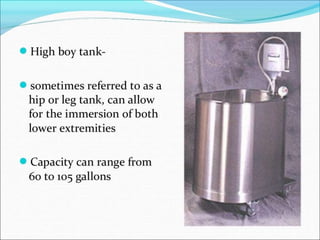
 The whirlpool is a large tub that is filled with water.
 The body part that is to be treated is then placed in the
tub of water, and a small motor agitates the water.
While in the water, you can move your body part to
help improve the motion around the injured area.
 A whirlpool may be used by your physical therapist to
help improve circulation, mobility, and comfort after
an injury or after surgery.
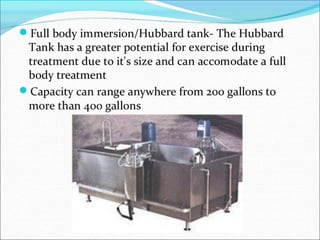
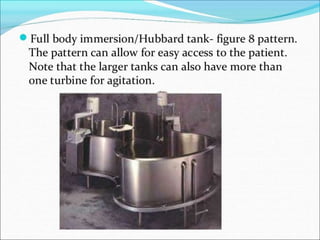
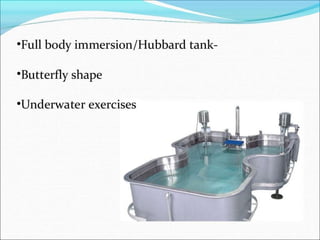
 There are some whirlpools that are larger, and your
entire body can be placed inside.
 Most whirlpools that you will encounter in a physical
therapy clinic are small, and only your arm or leg will
be able to be placed in it.
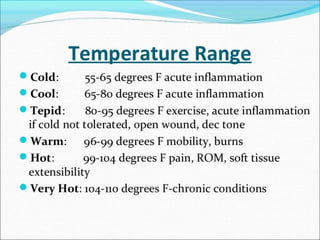
 The temperature of the water in the whirlpool can be
warm or cold, depending on the desired goal.
 The typical temperature of a warm whirlpool is 98-110
degrees Fahrenheit.
 A typical whirlpool treatment lasts for 10 to 15
minutes.
Principles of Application
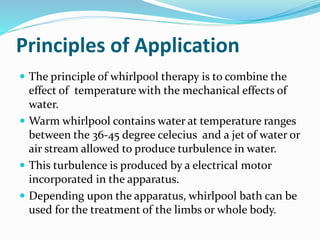
 The principle of whirlpool therapy is to combine the
effect of temperature with the mechanical effects of
water.
 Warm whirlpool contains water at temperature ranges
between the 36-45 degree celecius and a jet of water or
air stream allowed to produce turbulence in water.
 This turbulence is produced by a electrical motor
incorporated in the apparatus.
 Depending upon the apparatus, whirlpool bath can be
used for the treatment of the limbs or whole body.
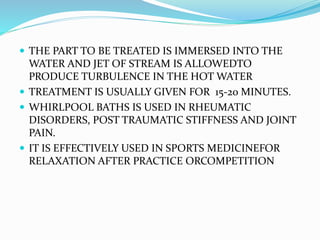
 THE PART TO BE TREATED IS IMMERSED INTO THE
WATER AND JET OF STREAM IS ALLOWEDTO
PRODUCE TURBULENCE IN THE HOT WATER
 TREATMENT IS USUALLY GIVEN FOR 15-20 MINUTES.
 WHIRLPOOL BATHS IS USED IN RHEUMATIC
DISORDERS, POST TRAUMATIC STIFFNESS AND JOINT
PAIN.
 IT IS EFFECTIVELY USED IN SPORTS MEDICINEFOR
RELAXATION AFTER PRACTICE ORCOMPETITION
Common Conditions That May be
Treated with Whirlpool Therapy:-
 Common injuries and conditions that may be treated with
whirlpool therapy include:
 Ankle fracture
 Plantar fasciitis
 Lisfranc dislocation
 Colle’s and Smith’s fractures
 Ankle Strain
 Tennis elbow
 Achilles tendon rupture and tendinitis
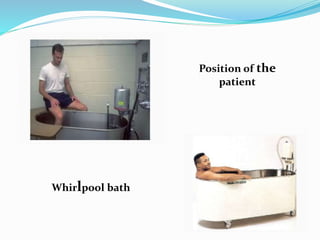
Position of the
patient
Whirlpool bath
USES:-
 Burns if no agitation is used.
 Open wounds for debridement purposes.
 Post operative orthopedics condition where the
water will add a bouyancy element to eliminate the
weight of extremity for movement.
 As a resistance force for exercises.
Beware of:-
 Any adverse condition that may appear
 Skin pallor
 Shivering
 Dizziness
 Rapid, weak pulse
 Headache
 Edema
 Decrease in ROM
 Hyperventilation
 Seasickness
Indications:-
 Poor circulation
 Chronic edema
 Separate dead tissue
 Pain relief in amputation
 After removal of plaster cast(fractures)
 Stiff joints
 Infected wounds-with added antiseptic agent
 Arthritis with stiff and swollen joints
 Poliomyelitis and paraplegia to improve circulation
 Traumatic and chronic inflammatory conditions
 Weak and painful feet
Contraindication:-
 Feverish patient
 Recent skin grafts
 Circulatory impairment
 Open wounds
 Hemorrhage
 Skin allergy
 Active bleeding
Whirlpool Bath -  Physiotherapy.pptx

Whirlpool Bath - Physiotherapy.pptx

  • 1.
  • 2.
     CONTENT:--  INTRODUCTON Types of Whirlpool bath  Principles of Application  Technique of application  USES  Beware of  Indications  Contraindication
  • 3.
    INTRODUCTON  The whirlpoolis a large tub that is filled with water.  The body part that is to be treated is then placed in the tub of water, and a small motor agitates the water. While in the water, you can move your body part to help improve the motion around the injured area.  A whirlpool may be used by your physical therapist to help improve circulation, mobility, and comfort after an injury or after surgery.  There are some whirlpools that are larger, and your entire body can be placed inside.
  • 4.
     Most whirlpoolsthat you will encounter in a physical therapy clinic are small, and only your arm or leg will be able to be placed in it.  The temperature of the water in the whirlpool can be warm or cold, depending on the desired goal.  The typical temperature of a warm whirlpool is 98-110 degrees Fahrenheit.  A typical whirlpool treatment lasts for 10 to 15 minutes.
  • 14.
    Principles of Application The principle of whirlpool therapy is to combine the effect of temperature with the mechanical effects of water.  Warm whirlpool contains water at temperature ranges between the 36-45 degree celecius and a jet of water or air stream allowed to produce turbulence in water.  This turbulence is produced by a electrical motor incorporated in the apparatus.  Depending upon the apparatus, whirlpool bath can be used for the treatment of the limbs or whole body.
  • 15.
     THE PARTTO BE TREATED IS IMMERSED INTO THE WATER AND JET OF STREAM IS ALLOWEDTO PRODUCE TURBULENCE IN THE HOT WATER  TREATMENT IS USUALLY GIVEN FOR 15-20 MINUTES.  WHIRLPOOL BATHS IS USED IN RHEUMATIC DISORDERS, POST TRAUMATIC STIFFNESS AND JOINT PAIN.  IT IS EFFECTIVELY USED IN SPORTS MEDICINEFOR RELAXATION AFTER PRACTICE ORCOMPETITION
  • 17.
    Common Conditions ThatMay be Treated with Whirlpool Therapy:-  Common injuries and conditions that may be treated with whirlpool therapy include:  Ankle fracture  Plantar fasciitis  Lisfranc dislocation  Colle’s and Smith’s fractures  Ankle Strain  Tennis elbow  Achilles tendon rupture and tendinitis
  • 18.
  • 21.
    USES:-  Burns ifno agitation is used.  Open wounds for debridement purposes.  Post operative orthopedics condition where the water will add a bouyancy element to eliminate the weight of extremity for movement.  As a resistance force for exercises.
  • 22.
    Beware of:-  Anyadverse condition that may appear  Skin pallor  Shivering  Dizziness  Rapid, weak pulse  Headache  Edema  Decrease in ROM  Hyperventilation  Seasickness
  • 23.
    Indications:-  Poor circulation Chronic edema  Separate dead tissue  Pain relief in amputation  After removal of plaster cast(fractures)  Stiff joints  Infected wounds-with added antiseptic agent  Arthritis with stiff and swollen joints  Poliomyelitis and paraplegia to improve circulation  Traumatic and chronic inflammatory conditions  Weak and painful feet
  • 24.
    Contraindication:-  Feverish patient Recent skin grafts  Circulatory impairment  Open wounds  Hemorrhage  Skin allergy  Active bleeding