Parkinsonโ€™s disease
Sisay.D(MSc PT)
Introduction
โ€ข Parkinsonโ€™s disease is a chronic neuro-
degenerative condition which affects the
neurons of basal ganglia.
โ€ข It is is a progressive nervous system disorder
that affects movement.
โ€ข Symptoms start gradually, get worse over time.
Cont.โ€ฆ
โ€ข it affects parts of basal ganglia and pathway from
the substantia nigra.
โ€ข The key pathology is the loss of dopaminergic
neurons that lead to the symptoms.
โ–ซ the main source of dopamine (DA).
โ–ซ Control voluntary movement and behavioral
process.
Cont.โ€ฆ
โ€ข presents with differing combinations of
symptoms.
โ–ซ slowness of movement (bradykinesia)
โ–ซ increased tone (rigidity)
โ–ซ tremor and loss of postural reflexes/instability.
Aetiology and risk factors
โ€ข The cause of the disease/the loss of the nigra cell
is unknown.
โ€ข Low dopamine levels
โ€ข Low norepinephrine levels
โ–ซ Low levels of norepinephrine in Parkinsonโ€™s
disease may increase the risk of both motor and
non-motor symptoms.
Cont.โ€ฆ
โ€ข Environmental factor
โ–ซ Exposure to certain toxins or environmental factors
โ–ซ Use of pesticides, herbicides, and proximity to
industrial plants.
โ€ข Genetic factors
โ–ซ Genes, the risk of PD in siblings is increased.
โ–ซ changes in several genes that appear to have links with
Parkinsonโ€™s disease, but they do not consider it a
hereditary condition.
cont.
โ€ข Lewy bodies
โ–ซ A person with Parkinsonโ€™s disease may have clumps of
protein known as alpha-synuclein, or Lewy bodies, in
their brain.
โ€ข The accumulation of Lewy bodies can cause a loss of
nerve cells leading to changes in
โ–ซ movement
โ–ซ thinking
โ–ซ behavior and mood.
โ–ซ It can also lead to dementia.
CONT
โ€ข AGE
โ–ซ Although most people with PD develop the disease
after age 60
โ–ซ about 5% to 10% experience onset before the age of 50.
โ–ซ Early-onset forms of Parkinsonโ€™s are often, but not
always,
โ€ข Sex incidence is more in men.
โ–ซ higher rate head trauma
โ–ซ exposure to occupational toxins
โ–ซ genetic susceptibility
epidemiology
โ€ข Parkinsonโ€™s disease has an annual incidence of
about 0.2/1000 and a prevalence of 1.5/1000 in
the UK.
โ€ข Prevalence rates are similar throughout the
world.
โ€ข lower rates have been reported for China and
West Africa.
Clinical features
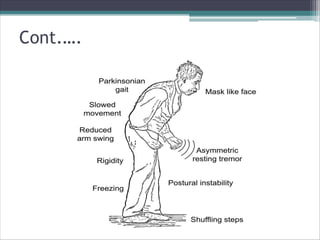
โ€ข The classical symptoms
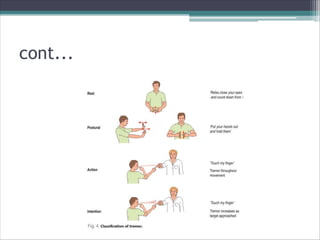
โ–ซ tremor ( resting tremor common in upper limb)
โ–ซ rigidity
โ–ซ bradykinesia
โ–ซ postural instability
โ€ข non-specific symptoms
โ–ซ tiredness
โ–ซ aching limbs
โ–ซ mental slowness
โ–ซ depression and
โ–ซ small handwriting (micrographia) may be noticed.
Cont.โ€ฆ
โ€ข a resting tremor is a common presenting feature.
โ€ข Festination gait/ small shuffling gait.
โ€ข Rigidity and bradykinesia may lead to a stooped
posture.
โ€ข Postures of chronic flexion may precipitate joint
contractures and altered muscle length.
Cont.โ€ฆ
โ€ข Limitation of ROM in the affected joints.
โ€ข Diminished muscle strength and
โ€ข flexibility have been reported to affect righting
and balance reactions, and thus contribute to
balance disturbances and falls.
cont...
Commonly experienced non-motor
symptoms include:
โ€ข Cognitive: thinking, reasoning and decision
making skills are usually affected.
โ€ข problems in multi-tasking, concentration,
learning and remembering, understanding and
using language, planning and carrying out
activities.
โ€ข Sleep problems and daytime tiredness.
Cont.โ€ฆ.
โ€ข Mood: depression, lack of interest (apathy) and
anxiety.
โ€ข Psychotic Symptoms: hallucinations and
delusion.
โ€ข Physiological: pain, genitourinary problems,
constipation, excessive sweating, drooling of
saliva, restless leg syndrome and irregular
heartbeat.
Cont.โ€ฆ.
Cont.โ€ฆ
โ€ข There are other conditions that can produce
similar clinical features to Parkinsonโ€™s disease;
e.g.-Alzheimerโ€™s disease or some type of head
injury , and this is known as parkinsonian
syndrome.
stages
โ€ข Stage One
โ–ซ mild symptoms that generally do not interfere
with ADL.
โ–ซ Tremor and other movement symptoms occur on
one side of the body only.
โ–ซ They may also experience changes in posture,
walking and facial expressions.
Cont.โ€ฆ
โ€ข Stage Two
โ–ซ Symptoms worsen
โ–ซ symptoms including tremor, rigidity and other
movement symptoms on both sides of the body.
โ–ซ The person is still able to live alone, but daily tasks
are more difficult and lengthier.
cont.โ€ฆ
โ€ข Stage Three
โ–ซ This is considered mid-stage.
โ–ซ Individuals experience loss of balance and slowness of
movements.
โ–ซ still fully independent.
โ–ซ these symptoms significantly impair activities such as
dressing and eating.
โ–ซ Falls are also more common.
Cont.โ€ฆ
โ€ข Stage Four
โ–ซ Symptoms are severe and limiting.
โ–ซ may stand without help, but movement likely
requires a walker.
โ–ซ require help with daily activities and are unable to
live alone.
Cont.โ€ฆ.
โ€ข Stage Five
โ–ซ Stiffness in the legs may make it impossible to
stand or walk.
โ–ซ requires a wheelchair or is bedridden.
โ–ซ The person may experience hallucinations and
delusions.
Treatment
โ€ข Medications used to treat movement-related
symptoms of Parkinson's disease include:
โ–ซ levodopa and carbidopa (L-dopa)
โ€ข for cognitive difficulties
โ–ซ Memantine
โ–ซ galantamine
โ€ข for mood disorders
โ–ซ Antidepressants
โ€ข For pain
โ–ซ Gabapentin
โ–ซ duloxetine
Deep brain stimulation
โ€ข Deep-brain stimulation is an effective therapy
for carefully screened patients with Parkinson's
disease who have disabling onโ€“off fluctuations,
dyskinesia (uncontrolled, involuntary muscle
movement)
New England Journal of Medicine. 2012 Oct 18;367(16):1529-38.
Physiotherapyโ€ฆ.
โ€ข The Physiotherapist will carry out a comprehensive
assessment, which will include :
โ€ข history relating to diagnosis
โ€ข history of symptoms, i.e. stiffness, fatigue, pain and
โ€ข how they affect everyday activities in the home, at
work and social activities.
โ€ข Physiotherapist will ask about current medication
and past medical history.
Cont.โ€ฆ
โ€ข The assessment will also include โ€ฆ..
โ€ข a physical examination
โ€ข an analysis of
โ–ซ posture
โ–ซ Pain
โ–ซ Muscle tone/power
โ–ซ body movements and ROM
โ–ซ Balance
Cont.โ€ฆ
โ€ข performance of functional activities, e.g.
โ–ซ Rolling, sitting, transfer
โ–ซ walking indoors / outdoors,
โ–ซ balance activities, and climbing stairsโ€ฆโ€ฆ
Aim of physical therapy
โ€ข Correct and improve abnormal movement
patterns and posture.
โ€ข Maximize muscle strength and joint flexibility.
โ€ข Correct and improve balance and minimize risks
of falls.
โ€ข Maintain a good breathing pattern and effective
cough.
Cont.โ€ฆ
โ€ข To give the psychological support.
โ€ข To protect from muscle rigidity.
โ€ข To improve from slowness of movement/gait.
โ€ข To reduce the effect of fatigability.
โ€ข to promote and maximize a personโ€™s independence and
quality of life.
Treatment
โ€ข Exercise
โ–ซ Strength
โ–ซ Endurance
โ–ซ flexibility
โ–ซ Balance
โ€ข functional practice
โ€ข physical activity ; aerobic exercise
Cont.โ€ฆ
โ€ข Executing a dual task, e.g. talking while walking
โ€ข Improves dual-task ability and might improve
gait, balance and cognition.
โ€ข Progressive resistance training (PRT)
โ€ข Postural re-education
Cont.โ€ฆ
โ€ข Muscle Stretching
โ€ข Gait training
โ€ข Joint mobilization and ROM.
โ€ข Pain reducing modalities
References
โ€ข Dauer W, Przedborski S. Parkinson's disease: mechanisms and
models. Neuron. 2003 Sep 11;39(6):889-909.
โ€ข Umphred DA, Lazaro RT. Neurological rehabilitation. Elsevier
Health Sciences; 2012 Aug 14.
โ€ข Tomlinson CL, Patel S, Meek C, Herd CP, Clarke CE, Stowe R, Shah
L, Sackley C, Deane KH, Wheatley K, Ives N. Physiotherapy
intervention in Parkinsonโ€™s disease: systematic review and meta-
analysis. Bmj. 2012 Aug 6;345.
โ€ข Mueller K, Jech R, Schroeter ML. Deep-brain stimulation for
Parkinson's disease. The New England journal of medicine. 2013
Jan 1;368(5):482-3.

parkinson disease for physiotherapy students

  • 1.
  • 2.
    Introduction โ€ข Parkinsonโ€™s diseaseis a chronic neuro- degenerative condition which affects the neurons of basal ganglia. โ€ข It is is a progressive nervous system disorder that affects movement. โ€ข Symptoms start gradually, get worse over time.
  • 3.
    Cont.โ€ฆ โ€ข it affectsparts of basal ganglia and pathway from the substantia nigra. โ€ข The key pathology is the loss of dopaminergic neurons that lead to the symptoms. โ–ซ the main source of dopamine (DA). โ–ซ Control voluntary movement and behavioral process.
  • 4.
    Cont.โ€ฆ โ€ข presents withdiffering combinations of symptoms. โ–ซ slowness of movement (bradykinesia) โ–ซ increased tone (rigidity) โ–ซ tremor and loss of postural reflexes/instability.
  • 5.
    Aetiology and riskfactors โ€ข The cause of the disease/the loss of the nigra cell is unknown. โ€ข Low dopamine levels โ€ข Low norepinephrine levels โ–ซ Low levels of norepinephrine in Parkinsonโ€™s disease may increase the risk of both motor and non-motor symptoms.
  • 6.
    Cont.โ€ฆ โ€ข Environmental factor โ–ซExposure to certain toxins or environmental factors โ–ซ Use of pesticides, herbicides, and proximity to industrial plants. โ€ข Genetic factors โ–ซ Genes, the risk of PD in siblings is increased. โ–ซ changes in several genes that appear to have links with Parkinsonโ€™s disease, but they do not consider it a hereditary condition.
  • 7.
    cont. โ€ข Lewy bodies โ–ซA person with Parkinsonโ€™s disease may have clumps of protein known as alpha-synuclein, or Lewy bodies, in their brain. โ€ข The accumulation of Lewy bodies can cause a loss of nerve cells leading to changes in โ–ซ movement โ–ซ thinking โ–ซ behavior and mood. โ–ซ It can also lead to dementia.
  • 8.
    CONT โ€ข AGE โ–ซ Althoughmost people with PD develop the disease after age 60 โ–ซ about 5% to 10% experience onset before the age of 50. โ–ซ Early-onset forms of Parkinsonโ€™s are often, but not always, โ€ข Sex incidence is more in men. โ–ซ higher rate head trauma โ–ซ exposure to occupational toxins โ–ซ genetic susceptibility
  • 9.
    epidemiology โ€ข Parkinsonโ€™s diseasehas an annual incidence of about 0.2/1000 and a prevalence of 1.5/1000 in the UK. โ€ข Prevalence rates are similar throughout the world. โ€ข lower rates have been reported for China and West Africa.
  • 10.
    Clinical features โ€ข Theclassical symptoms โ–ซ tremor ( resting tremor common in upper limb) โ–ซ rigidity โ–ซ bradykinesia โ–ซ postural instability โ€ข non-specific symptoms โ–ซ tiredness โ–ซ aching limbs โ–ซ mental slowness โ–ซ depression and โ–ซ small handwriting (micrographia) may be noticed.
  • 11.
    Cont.โ€ฆ โ€ข a restingtremor is a common presenting feature. โ€ข Festination gait/ small shuffling gait. โ€ข Rigidity and bradykinesia may lead to a stooped posture. โ€ข Postures of chronic flexion may precipitate joint contractures and altered muscle length.
  • 12.
    Cont.โ€ฆ โ€ข Limitation ofROM in the affected joints. โ€ข Diminished muscle strength and โ€ข flexibility have been reported to affect righting and balance reactions, and thus contribute to balance disturbances and falls.
  • 13.
  • 14.
    Commonly experienced non-motor symptomsinclude: โ€ข Cognitive: thinking, reasoning and decision making skills are usually affected. โ€ข problems in multi-tasking, concentration, learning and remembering, understanding and using language, planning and carrying out activities. โ€ข Sleep problems and daytime tiredness.
  • 15.
    Cont.โ€ฆ. โ€ข Mood: depression,lack of interest (apathy) and anxiety. โ€ข Psychotic Symptoms: hallucinations and delusion. โ€ข Physiological: pain, genitourinary problems, constipation, excessive sweating, drooling of saliva, restless leg syndrome and irregular heartbeat.
  • 16.
  • 17.
    Cont.โ€ฆ โ€ข There areother conditions that can produce similar clinical features to Parkinsonโ€™s disease; e.g.-Alzheimerโ€™s disease or some type of head injury , and this is known as parkinsonian syndrome.
  • 18.
    stages โ€ข Stage One โ–ซmild symptoms that generally do not interfere with ADL. โ–ซ Tremor and other movement symptoms occur on one side of the body only. โ–ซ They may also experience changes in posture, walking and facial expressions.
  • 19.
    Cont.โ€ฆ โ€ข Stage Two โ–ซSymptoms worsen โ–ซ symptoms including tremor, rigidity and other movement symptoms on both sides of the body. โ–ซ The person is still able to live alone, but daily tasks are more difficult and lengthier.
  • 20.
    cont.โ€ฆ โ€ข Stage Three โ–ซThis is considered mid-stage. โ–ซ Individuals experience loss of balance and slowness of movements. โ–ซ still fully independent. โ–ซ these symptoms significantly impair activities such as dressing and eating. โ–ซ Falls are also more common.
  • 21.
    Cont.โ€ฆ โ€ข Stage Four โ–ซSymptoms are severe and limiting. โ–ซ may stand without help, but movement likely requires a walker. โ–ซ require help with daily activities and are unable to live alone.
  • 22.
    Cont.โ€ฆ. โ€ข Stage Five โ–ซStiffness in the legs may make it impossible to stand or walk. โ–ซ requires a wheelchair or is bedridden. โ–ซ The person may experience hallucinations and delusions.
  • 23.
    Treatment โ€ข Medications usedto treat movement-related symptoms of Parkinson's disease include: โ–ซ levodopa and carbidopa (L-dopa) โ€ข for cognitive difficulties โ–ซ Memantine โ–ซ galantamine โ€ข for mood disorders โ–ซ Antidepressants โ€ข For pain โ–ซ Gabapentin โ–ซ duloxetine
  • 24.
    Deep brain stimulation โ€ขDeep-brain stimulation is an effective therapy for carefully screened patients with Parkinson's disease who have disabling onโ€“off fluctuations, dyskinesia (uncontrolled, involuntary muscle movement) New England Journal of Medicine. 2012 Oct 18;367(16):1529-38.
  • 25.
    Physiotherapyโ€ฆ. โ€ข The Physiotherapistwill carry out a comprehensive assessment, which will include : โ€ข history relating to diagnosis โ€ข history of symptoms, i.e. stiffness, fatigue, pain and โ€ข how they affect everyday activities in the home, at work and social activities. โ€ข Physiotherapist will ask about current medication and past medical history.
  • 26.
    Cont.โ€ฆ โ€ข The assessmentwill also include โ€ฆ.. โ€ข a physical examination โ€ข an analysis of โ–ซ posture โ–ซ Pain โ–ซ Muscle tone/power โ–ซ body movements and ROM โ–ซ Balance
  • 27.
    Cont.โ€ฆ โ€ข performance offunctional activities, e.g. โ–ซ Rolling, sitting, transfer โ–ซ walking indoors / outdoors, โ–ซ balance activities, and climbing stairsโ€ฆโ€ฆ
  • 28.
    Aim of physicaltherapy โ€ข Correct and improve abnormal movement patterns and posture. โ€ข Maximize muscle strength and joint flexibility. โ€ข Correct and improve balance and minimize risks of falls. โ€ข Maintain a good breathing pattern and effective cough.
  • 29.
    Cont.โ€ฆ โ€ข To givethe psychological support. โ€ข To protect from muscle rigidity. โ€ข To improve from slowness of movement/gait. โ€ข To reduce the effect of fatigability. โ€ข to promote and maximize a personโ€™s independence and quality of life.
  • 30.
    Treatment โ€ข Exercise โ–ซ Strength โ–ซEndurance โ–ซ flexibility โ–ซ Balance โ€ข functional practice โ€ข physical activity ; aerobic exercise
  • 31.
    Cont.โ€ฆ โ€ข Executing adual task, e.g. talking while walking โ€ข Improves dual-task ability and might improve gait, balance and cognition. โ€ข Progressive resistance training (PRT) โ€ข Postural re-education
  • 32.
    Cont.โ€ฆ โ€ข Muscle Stretching โ€ขGait training โ€ข Joint mobilization and ROM. โ€ข Pain reducing modalities
  • 33.
    References โ€ข Dauer W,Przedborski S. Parkinson's disease: mechanisms and models. Neuron. 2003 Sep 11;39(6):889-909. โ€ข Umphred DA, Lazaro RT. Neurological rehabilitation. Elsevier Health Sciences; 2012 Aug 14. โ€ข Tomlinson CL, Patel S, Meek C, Herd CP, Clarke CE, Stowe R, Shah L, Sackley C, Deane KH, Wheatley K, Ives N. Physiotherapy intervention in Parkinsonโ€™s disease: systematic review and meta- analysis. Bmj. 2012 Aug 6;345. โ€ข Mueller K, Jech R, Schroeter ML. Deep-brain stimulation for Parkinson's disease. The New England journal of medicine. 2013 Jan 1;368(5):482-3.