For 2nd year Physiotherapy Students
Range of Motion
Dechasa Imiru
Department of physiotherapy
Jimma University
12/29/2022 Dechasa I. 1
Learning objectives
At the end of this presentation the students will
be able to
Define range of motion/ROM
Describe the purpose of ROM
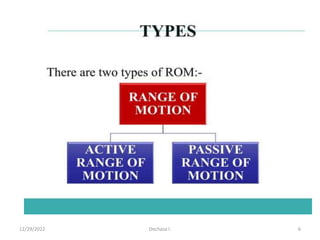
Discuss the types of range of motion
Discuss the contraindication of ROM
Enlist the point to be remembered while
performing the ROM exercises
12/29/2022 Dechasa I. 2
Introduction
Clients with restricted mobility are unable to
perform some or all range of joint motion
exercises independently.
The easiest intervention to maintain or improve
joint mobility for client is use of range of motion
exercises.
If joints are not moved periodically, joint may be
become fixed in one position and client loses
normal uses of the joint.
So, range of motion exercises are very important
12/29/2022 Dechasa I. 3
Definition
Range of motion (ROM) is the maximum
amount of movement available at a joint in
one of three cardinal planes of the body.
The magnitude of rotatory motion that a body
segment moves through or can move through.
The arc of motion may occur either at a single
joint or at a series of joints.
The starting position for measuring all ROM is
either the anatomical or neutral position.
12/29/2022 Dechasa I. 4
Purposes
To promote health by improving functioning of
the circulatory system and lungs.
To prevent the stiffness of joint
To delay degenerative change
To restore muscle function in diseases, injury or
deformities
To promote physical mobility and improve gait
To prevent deformity
To improve blood supply in vascular disorder
To reduce stress
To rehabilitate the patient
12/29/2022 Dechasa I. 5
.
12/29/2022 Dechasa I. 6
Active range of motion/AROM
Exercises are highly independent, performed
solely by client/patient
Unassisted voluntary movement of joint
(Quality of ROM)
The PT may be provide the verbal cues
12/29/2022 Dechasa I. 7
Passive range of motion/PROM
Attained by the external force by examiner
(quantity of ROM)
Normally, PROM is slightly greater than AROM
because joints have a small amount of motion
at the end range that is not under voluntary
control.
It can help to prevent stiffness from occurring.
It is practiced on a joint that is inactive
12/29/2022 Dechasa I. 8
Active assisted ROM
Performed by a client with some assistance
Client move a limb partially through its ROM,
but needs help completing the ROM.
12/29/2022 Dechasa I. 9
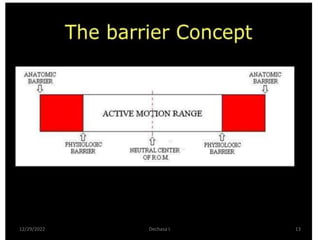
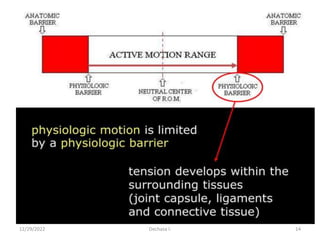
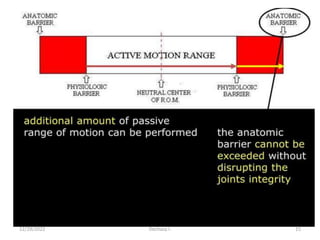
END FEEL
Nature of the motion barrier that characterizes
the type of tissue limiting range.
Normal or Physiologic end feels are:
 Hard
Soft
Firm
Capsular stretch
12/29/2022 Dechasa I. 10
End feel…..
Hard (bony): An abrupt, hard stop to
movement when bone contacts bone; for ex.:
Passive elbow extension. the olecranon process
contacts the olecranon fossa.
Soft (soft tissue opposition): When two body
surfaces come together a soft compression of
tissue is felt, for ex.: in passive knee flexion, the
posterior aspects of the calf and thigh come
together.
12/29/2022 Dechasa I. 11
End feel….
Firm (soft tissue stretch): Firm or springy
sensation that has some give when a muscle is
stretched. for instance: passive ankle
dorsiflexion performed with the knee in
extension is stopped due to tension in the
gastrocnemius muscle.
Capsular stretch: Hard arrests/stops to
movement with some give when the joint
capsule or ligaments are stretched. The feel is
similar to stretching a piece of leather, for ex.:
passive shoulder external rotation
12/29/2022 Dechasa I. 12
12/29/2022 Dechasa I. 13
12/29/2022 Dechasa I. 14
12/29/2022 Dechasa I. 15
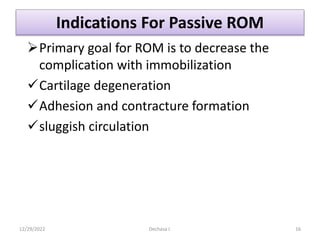
Indications For Passive ROM
Primary goal for ROM is to decrease the
complication with immobilization
Cartilage degeneration
Adhesion and contracture formation
sluggish circulation
12/29/2022 Dechasa I. 16
Goal for PROM
Maintain joint and connective tissue mobility
Minimize the effects of the formation of contracture
Maintain mechanical elasticity of muscle
Assist circulation and vascular dynamics
Enhance synovial movement for cartilage nutrition
and diffusion of materials in the join
 Reduction or inhibit pain
Assist with the healing process after injury or
surgery
Help maintain the patient’s awareness of movement
12/29/2022 Dechasa I. 17
Indication for Active and Active assistive ROM
A patient is able to contract the muscles
actively and move a segment with or without
assistance, AROM is used
A patient has weak musculature and is unable
to move a joint through the desired range, A-
AROM is used to provide enough assistance to
the muscles in a carefully controlled manner
(progressively strengthened)
12/29/2022 Dechasa I. 18
Goal for AROM
Maintain physiological elasticity and
contractility of the participating muscles
Provide sensory feedback from the contracting
muscles
Provide a stimulus for bone and joint tissue
integrity
Increase circulation and prevent thrombus
formation
Develop coordination and motor skills for
functional activities
12/29/2022 Dechasa I. 19
Limitations of ROM Exercises
PROM Does not;
 Prevent muscle atrophy
Increase strength or endurance
Assist circulation to the extent that active,
voluntary muscle contraction does
Alters/halts disease progression in chronic
stage like RA, OA etc
12/29/2022 Dechasa I. 20
Limitations of AROM
For strong muscles, does not ;
maintain or increase strength
develop skill or coordination except in the
movement patterns used
12/29/2022 Dechasa I. 21
Contraindications
Joint Inflammation/effusion
swelling
Severe/acute pain
12/29/2022 Dechasa I. 22
Principles and procedures for Applying ROM Techniques
Examination, Evaluation and Treatment Planning
 Examine and evaluate the patient’s impairment
and level of function
Determine any precautions and prognosis
 plan the intervention
Determine the ability of the patients; PROM, A-
AROM or AROM
Determine the amount of motion
12/29/2022 Dechasa I. 23
Decide pattern can best the goal
 Anatomic plane of motion ; frontal, sagittal,
transverse
 muscle range of elongation
 combined patterns
 diagonal motion
 functional pattern
 ADL
12/29/2022 Dechasa I. 24
Monitor the patient’s general condition and
responses during and after the examination
and intervention:
Change in vital sign,
Warmth and color of the segment,
ROM,
Pain
Quality of movement
Document and communicate
Re-evaluate and modify
12/29/2022 Dechasa I. 25
Patient preparation
Communicate with the patient : describe the
plan and method
Free the region from restrictive clothing etc
Position the patient in a comfortable
Position yourself so proper body mechanics
can be used
12/29/2022 Dechasa I. 26
Application of techniques
 To control movement, grasp the extremity
around the joint
 Support areas of poor structural integrity :
hyper-mobile joint, recent fracture site or
paralyzed limb
 Move the segment through its complete pain
free range to the point of tissue resistance
 Perform the motions smoothly and
rhythmically, with 5 to 10 repetitions
12/29/2022 Dechasa I. 27
Fire your Questions Now?
Thank U for Ur time
& patience !!!!
12/29/2022 Dechasa I. 28

Range of Motion - Copy.pptx

  • 1.
    For 2nd yearPhysiotherapy Students Range of Motion Dechasa Imiru Department of physiotherapy Jimma University 12/29/2022 Dechasa I. 1
  • 2.
    Learning objectives At theend of this presentation the students will be able to Define range of motion/ROM Describe the purpose of ROM Discuss the types of range of motion Discuss the contraindication of ROM Enlist the point to be remembered while performing the ROM exercises 12/29/2022 Dechasa I. 2
  • 3.
    Introduction Clients with restrictedmobility are unable to perform some or all range of joint motion exercises independently. The easiest intervention to maintain or improve joint mobility for client is use of range of motion exercises. If joints are not moved periodically, joint may be become fixed in one position and client loses normal uses of the joint. So, range of motion exercises are very important 12/29/2022 Dechasa I. 3
  • 4.
    Definition Range of motion(ROM) is the maximum amount of movement available at a joint in one of three cardinal planes of the body. The magnitude of rotatory motion that a body segment moves through or can move through. The arc of motion may occur either at a single joint or at a series of joints. The starting position for measuring all ROM is either the anatomical or neutral position. 12/29/2022 Dechasa I. 4
  • 5.
    Purposes To promote healthby improving functioning of the circulatory system and lungs. To prevent the stiffness of joint To delay degenerative change To restore muscle function in diseases, injury or deformities To promote physical mobility and improve gait To prevent deformity To improve blood supply in vascular disorder To reduce stress To rehabilitate the patient 12/29/2022 Dechasa I. 5
  • 6.
  • 7.
    Active range ofmotion/AROM Exercises are highly independent, performed solely by client/patient Unassisted voluntary movement of joint (Quality of ROM) The PT may be provide the verbal cues 12/29/2022 Dechasa I. 7
  • 8.
    Passive range ofmotion/PROM Attained by the external force by examiner (quantity of ROM) Normally, PROM is slightly greater than AROM because joints have a small amount of motion at the end range that is not under voluntary control. It can help to prevent stiffness from occurring. It is practiced on a joint that is inactive 12/29/2022 Dechasa I. 8
  • 9.
    Active assisted ROM Performedby a client with some assistance Client move a limb partially through its ROM, but needs help completing the ROM. 12/29/2022 Dechasa I. 9
  • 10.
    END FEEL Nature ofthe motion barrier that characterizes the type of tissue limiting range. Normal or Physiologic end feels are:  Hard Soft Firm Capsular stretch 12/29/2022 Dechasa I. 10
  • 11.
    End feel….. Hard (bony):An abrupt, hard stop to movement when bone contacts bone; for ex.: Passive elbow extension. the olecranon process contacts the olecranon fossa. Soft (soft tissue opposition): When two body surfaces come together a soft compression of tissue is felt, for ex.: in passive knee flexion, the posterior aspects of the calf and thigh come together. 12/29/2022 Dechasa I. 11
  • 12.
    End feel…. Firm (softtissue stretch): Firm or springy sensation that has some give when a muscle is stretched. for instance: passive ankle dorsiflexion performed with the knee in extension is stopped due to tension in the gastrocnemius muscle. Capsular stretch: Hard arrests/stops to movement with some give when the joint capsule or ligaments are stretched. The feel is similar to stretching a piece of leather, for ex.: passive shoulder external rotation 12/29/2022 Dechasa I. 12
  • 13.
  • 14.
  • 15.
  • 16.
    Indications For PassiveROM Primary goal for ROM is to decrease the complication with immobilization Cartilage degeneration Adhesion and contracture formation sluggish circulation 12/29/2022 Dechasa I. 16
  • 17.
    Goal for PROM Maintainjoint and connective tissue mobility Minimize the effects of the formation of contracture Maintain mechanical elasticity of muscle Assist circulation and vascular dynamics Enhance synovial movement for cartilage nutrition and diffusion of materials in the join  Reduction or inhibit pain Assist with the healing process after injury or surgery Help maintain the patient’s awareness of movement 12/29/2022 Dechasa I. 17
  • 18.
    Indication for Activeand Active assistive ROM A patient is able to contract the muscles actively and move a segment with or without assistance, AROM is used A patient has weak musculature and is unable to move a joint through the desired range, A- AROM is used to provide enough assistance to the muscles in a carefully controlled manner (progressively strengthened) 12/29/2022 Dechasa I. 18
  • 19.
    Goal for AROM Maintainphysiological elasticity and contractility of the participating muscles Provide sensory feedback from the contracting muscles Provide a stimulus for bone and joint tissue integrity Increase circulation and prevent thrombus formation Develop coordination and motor skills for functional activities 12/29/2022 Dechasa I. 19
  • 20.
    Limitations of ROMExercises PROM Does not;  Prevent muscle atrophy Increase strength or endurance Assist circulation to the extent that active, voluntary muscle contraction does Alters/halts disease progression in chronic stage like RA, OA etc 12/29/2022 Dechasa I. 20
  • 21.
    Limitations of AROM Forstrong muscles, does not ; maintain or increase strength develop skill or coordination except in the movement patterns used 12/29/2022 Dechasa I. 21
  • 22.
  • 23.
    Principles and proceduresfor Applying ROM Techniques Examination, Evaluation and Treatment Planning  Examine and evaluate the patient’s impairment and level of function Determine any precautions and prognosis  plan the intervention Determine the ability of the patients; PROM, A- AROM or AROM Determine the amount of motion 12/29/2022 Dechasa I. 23
  • 24.
    Decide pattern canbest the goal  Anatomic plane of motion ; frontal, sagittal, transverse  muscle range of elongation  combined patterns  diagonal motion  functional pattern  ADL 12/29/2022 Dechasa I. 24
  • 25.
    Monitor the patient’sgeneral condition and responses during and after the examination and intervention: Change in vital sign, Warmth and color of the segment, ROM, Pain Quality of movement Document and communicate Re-evaluate and modify 12/29/2022 Dechasa I. 25
  • 26.
    Patient preparation Communicate withthe patient : describe the plan and method Free the region from restrictive clothing etc Position the patient in a comfortable Position yourself so proper body mechanics can be used 12/29/2022 Dechasa I. 26
  • 27.
    Application of techniques To control movement, grasp the extremity around the joint  Support areas of poor structural integrity : hyper-mobile joint, recent fracture site or paralyzed limb  Move the segment through its complete pain free range to the point of tissue resistance  Perform the motions smoothly and rhythmically, with 5 to 10 repetitions 12/29/2022 Dechasa I. 27
  • 28.
    Fire your QuestionsNow? Thank U for Ur time & patience !!!! 12/29/2022 Dechasa I. 28