Infrared Spectroscopy
Interpretation
5/22/2020 1
Prepared By :
Mahendra G S
M-Pharm,Pharmaceutical
Chemistry
JSSCP, MYSURU
Interferogram
 The interferogram at the right
displays the interference pattern
and contains all of the spectrum
information.
5/22/2020 2
 A Fourier transform converts the
time domain to the frequency
domain with absorption as a function
of frequency.
 Identification of functional groups on a
molecule – this is a very important tool in
organic chemistry
 Spectral matching can be done by computer
software and library spectra
 Since absorbance follows Beer’s Law, can do
quantitative analysis
5/22/2020 3
Use of IR spectra
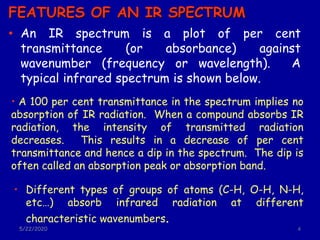
• An IR spectrum is a plot of per cent
transmittance (or absorbance) against
wavenumber (frequency or wavelength). A
typical infrared spectrum is shown below.
5/22/2020 4
• A 100 per cent transmittance in the spectrum implies no
absorption of IR radiation. When a compound absorbs IR
radiation, the intensity of transmitted radiation
decreases. This results in a decrease of per cent
transmittance and hence a dip in the spectrum. The dip is
often called an absorption peak or absorption band.
FEATURES OF AN IR SPECTRUM
• Different types of groups of atoms (C-H, O-H, N-H,
etc…) absorb infrared radiation at different
characteristic wavenumbers.
• No two molecules will give exactly the same
IR spectrum (except enantiomers)
• Simple stretching: 1600-3500 cm-1
• Complex vibrations: 400-1400 cm-1, called the
“fingerprint region”5/22/2020 5
Baseline
Absorbance/
Peak
IR Spectrum
Infrared Spectrum of Propanal (CH3CH2CHO)
4600 3800 3000 2200 1800 1400
0
10
20
30
40
50
60
70
80
90
100
1000 800 600 400
C=O
Percenttransmittance
Wavenumber (cm )-1
5/22/2020 6
Describing IR Absorptions
IR absorptions are described by their frequency
and appearance.
• Frequency (n) is given in wavenumbers (cm-1)
• Appearance is qualitative: intensity and shape
• conventional abbreviations:
vs very strong
s strong
m medium
w weak
br broad
sh sharp OR shoulder
5/22/2020 7
 In general, the IR spectrum can be split into
four regions for interpretation:
 4000  2500 cm-1: Absorption of single bonds
formed by hydrogen and other elements
e.g. OH, NH, CH
 2500  2000 cm-1: Absorption of triple bonds
e.g. C≡C, C≡N
 2000  1500 cm-1:Absorption of double bonds
e.g. C=C, C=O
 1500  400 cm-1: This region often consists of
many different, complicated bands. This part of the
spectrum is unique to each compound and is often
called the fingerprint region. It is rarely used for
identification of particular functional groups.
5/22/2020 8
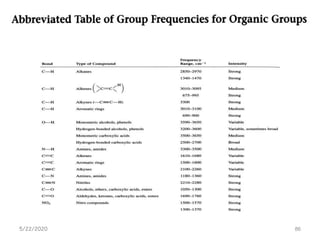
Summary of IR Absorptions
5/22/2020 9
BASE VALUES
(+/- 10 cm-1)
These are
the minimum
number of
values to
memorize.
O-H 3600
N-H 3400
C-H 3000
C N 2250
C C 2150
C=O 1715
C=C 1650
C O ~1100 large range
5/22/2020 10
O-H STRETCH
5/22/2020 11
Typical Infrared Absorption
Regions
O-H
2.5 4 5 5.5 6.1 6.5 15.4
4000 2500 2000 1800 1650 1550 650
FREQUENCY (cm-1)
WAVELENGTH (mm)
O-H C-H
N-H
C=O C=N
Very
few
bands
C=C
C-Cl
C-O
C-N
C-CX=C=Y
(C,O,N,S)
C N
C C
N=O N=O*
5/22/2020 12
• O-H 3600 cm-1 (alcohol, free)
• O-H 3300 cm-1 (alcohols & acids, H-bonding)
5/22/2020 13
3600 3300
H-BONDEDFREE
broadens
shifts
The O-H stretching region
O
H
R
O
H
R
R O
H
R
OH
H
R O
R H
O
HYDROGEN-BONDED HYDROXYL
Many kinds of OH
bonds of different
lengths and strengths
This leads to a broad
absorption.
Longer bonds are
weaker and lead to
lower frequency.
Hydrogen bonding occurs in concentrated solutions
( for instance, undiluted alcohol ).
“Neat” solution.
5/22/2020 14
“FREE” HYDROXYL
R O
H
CCl4
CCl4
CCl4
CCl4
CCl4
Distinct bond has a well-
defined length and strength.
Occurs in dilute solutions of alcohol in an “inert” solvent like CCl4.
Solvent molecules
surround but do not
hydrogen bond.
The “free” hydroxyl vibrates without interference from any other
molecule.
5/22/2020 15
Cyclohexanol
5/22/2020 16
OHO-H
H-bond
C-H
C-O
CH2
ALCOHOL
neat solution
,
Butanoic Acid
5/22/2020 17
CH3 CH2 CH2 C OH
O
O-H
H-bond
C-H C=O
CH2
C-O
CARBOXYLIC ACID
neat solution
C
O
OH
RC
O
O H
R
CARBOXYLIC ACID DIMER
Strong hydrogen bonding in the dimer weakens the OH
bond and leads to a broad peak at lower frequency.
5/22/2020 18
N-H STRETCH
5/22/2020 19
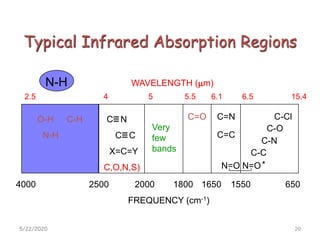
Typical Infrared Absorption Regions
N-H
2.5 4 5 5.5 6.1 6.5 15.4
4000 2500 2000 1800 1650 1550 650
FREQUENCY (cm-1)
WAVELENGTH (mm)
O-H C-H
N-H
C=O C=N
Very
few
bands
C=C
C-Cl
C-O
C-N
C-CX=C=Y
(C,O,N,S)
C N
C C
N=O N=O*
5/22/2020 20
The N-H stretching region
• Primary amines give two peaks
• Secondary amines give one peak
• Tertiary amines give no peak
5/22/2020 21
N
H
H
N
H
H
symmetric asymmetric
N-H 3300 - 3400 cm-1
CH3
CH2
CH2
CH2
NH2
NH2
NH2
scissor
CH2
CH3
PRIMARY AMINE
aliphatic
1-Butanamine
5/22/2020 22
NH2
CH3
NH2
Ar-H
-CH3
benzene
Ar-H
PRIMARY AMINE
aromatic
3-Methylbenzenamine
5/22/2020 23
NH CH2 CH3
NH
benzene
Ar-H
CH3
SECONDARY AMINE
N -Ethylbenzenamine
5/22/2020 24
N
CH3
CH3
no N-H
benzene
CH3
Ar-H
Ar-H
-CH3
TERTIARY AMINE
N,N -Dimethylaniline
5/22/2020 25
C-H STRETCH
5/22/2020 26
Typical Infrared Absorption Regions
C-H
2.5 4 5 5.5 6.1 6.5 15.4
4000 2500 2000 1800 1650 1550 650
FREQUENCY (cm-1)
WAVELENGTH (mm)
O-H C-H
N-H
C=O C=N
Very
few
bands
C=C
C-Cl
C-O
C-N
C-CX=C=Y
(C,O,N,S)
C N
C C
N=O N=O*
We will look at
this area first5/22/2020 27
•C-H aldehyde, two peaks (both weak)
~ 2850 and 2750 cm-1
3000 divides
UNSATURATED
SATURATED
•C-H sp stretch ~ 3300 cm-1
•C-H sp2 stretch > 3000 cm-1
•C-H sp3 stretch < 3000 cm-1
The C-H stretching region
BASE VALUE = 3000 cm-1
5/22/2020 28
3000
-C-H=C-H
31003300
=C-H=
2900 2850 2750
-CH=O
(weak)
increasing CH Bond Strength
sp3-1ssp2-1ssp-1s
increasing frequency (cm-1)
aldehyde
increasing s character in bond
increasing force constant K
STRONGER BONDS HAVE LARGER FORCE CONSTANTS
AND ABSORB AT HIGHER FREQUENCIES
CH BASE VALUE = 3000 cm-1
5/22/2020 29
Hexane
5/22/2020 30
CH3
CH2
CH2
CH2
CH2
CH3
CH
stretching
vibrations
ALKANE
includes
CH3 sym and asym
CH2 sym and asym
CH bending vibrations
discussed shortly
C-H BENDING
5/22/2020 31
• CH2 bending ~ 1465 cm-1
• CH3 bending (asym) appears near
the CH2 value ~ 1460 cm-1
• CH3 bending (sym) ~ 1375 cm-1
5/22/2020 32
THE C-H BENDING REGION
C
H
H
C
H
H
C
H
H
C
H
H
C
HH
C
HH
Scissoring Wagging
Rocking Twisting
Bending
Vibrations
~1465 cm-1
~720 cm-1
~1250 cm-1
~1250 cm-1
in-plane out-of-plane
METHYLENE GROUP BENDING VIBRATIONS
5/22/2020 33
CH3CH2
1465 1460 1375
asym sym
METHYLENE AND METHYL BENDING VIBRATIONS
these two peaks
frequently overlap
and are not resolved
C-H Bending, look near
1465 and 1375 cm-1
C
H
H
H
5/22/2020 34
CH3CH2
1465 1460 1375
asym sym
13701380
13701390
C
CH3
CH3
C CH3
CH3
CH3
C CH3
METHYLENE AND METHYL BENDING VIBRATIONS
geminal dimethyl
t-butyl
(isopropyl)
two peaks
two peaks
The sym methyl peak
splits when you have
more than one CH3
attached to a carbon.
ADDITIONAL DETAILS FOR SYM CH3
one peak
5/22/2020 35
Hexane
5/22/2020 36
CH3
CH2
CH2
CH2
CH2
CH3
CH
stretch
CH2
bend
CH3
bend
CH2
rocking
ALKANE
1-Hexene
5/22/2020 37
CH2
CH CH2
CH2
CH2
CH3
=CH
CH
C=C CH2
CH3
bend
CH
ALKENE
Toluene
5/22/2020 38
CH3 C=C
benzene
CH3
Ar-H
Ar-H
AROMATIC
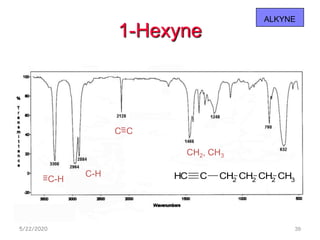
1-Hexyne
5/22/2020 39
CH C CH2 CH2 CH2 CH3
C=C=
=C-H= C-H
CH2, CH3
ALKYNE
C10H22
C12H26
Similar
But Not
Identical
Fingerprinting
5/22/2020 40
C N AND C C STRETCH
5/22/2020 41
Typical Infrared Absorption
Regions
C=N
C=C
=
=2.5 4 5 5.5 6.1 6.5 15.4
4000 2500 2000 1800 1650 1550 650
FREQUENCY (cm-1)
WAVELENGTH (mm)
O-H C-H
N-H
C=O C=N
Very
few
bands
C=C
C-Cl
C-O
C-N
C-CX=C=Y
(C,O,N,S)
C N
C C
N=O N=O*
5/22/2020 42
The triple bond stretching region
• C N 2250 cm-1
• C C 2150 cm-1
5/22/2020 43
=
=
The cyano group often gives a strong, sharp peak
due to its large dipole moment.
The carbon-carbon triple bond gives a sharp peak,
but it is often weak due to a lack of a dipole. This is
especially true if it is at the center of a symmetric
molecule.
R C C R
Propanenitrile
5/22/2020 44
CH3
CH2
C N
C=N=
NITRILE
BASE = 2250
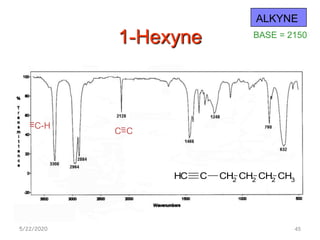
1-Hexyne
5/22/2020 45
CH C CH2 CH2 CH2 CH3
C=C==C-H=
ALKYNE
BASE = 2150
C=O STRETCHING
5/22/2020 46
Typical Infrared Absorption
Regions
C=O
2.5 4 5 5.5 6.1 6.5 15.4
4000 2500 2000 1800 1650 1550 650
FREQUENCY (cm-1)
WAVELENGTH (mm)
O-H C-H
N-H
C=O C=N
Very
few
bands
C=C
C-Cl
C-O
C-N
C-CX=C=Y
(C,O,N,S)
C N
C C
N=O N=O*
5/22/2020 47
 This region stretches from about 1800 to 1650
cm-1 - RIGHT IN THE MIDDLE OF THE SPECTRUM
 The base value is 1715 cm-1 (ketone)
 The bands are very strong !!! due to the large
C=O dipole moment.
5/22/2020 48
 C=O is often one of the strongest peaks in
the spectrum
THE CARBONYL STRETCHING REGION
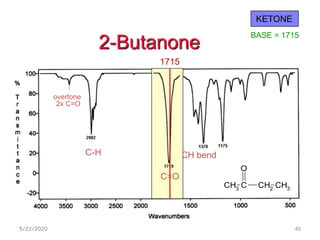
2-Butanone
CH3 C CH2 CH3
O
KETONE
C=O
C-H
overtone
2x C=O
CH bend
BASE = 1715
1715
C=O
5/22/2020 49
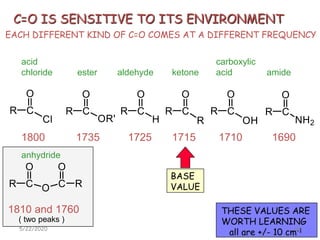
CR
O
H
CR
O
O C R
O
CR
O
Cl
CR
O
OR'
CR
O
R
CR
O
NH2
CR
O
OH
169017101715172517351800
1810 and 1760
BASE
VALUE
acid
chloride ester aldehyde
carboxylic
acid amideketone
anhydride
( two peaks )
EACH DIFFERENT KIND OF C=O COMES AT A DIFFERENT FREQUENCY
C=O IS SENSITIVE TO ITS ENVIRONMENT
THESE VALUES ARE
WORTH LEARNING
all are +/- 10 cm-15/22/2020 50
1.225 A 1.231 A 1.235 A 1.248 A
acid
chloride
ester ketone amide
C=O BOND LENGTHS IN CARBONYL COMPOUNDS
shorter longer
1780 cm-1 1735 cm-1 1715 cm-1 1680 cm-1
5/22/2020 51
Ketones are at lower frequency than Aldehydes because of
the second electron-donating alkyl group.
Acid chlorides are at higher frequency than ketones because
of the electron-withdrawing halide.
Esters are at higher frequencies than ketones due to the
electron-withdrawing oxygen atom. This is more important than
resonance with the electron pair on the oxygen.
Amides are at lower frequencies than ketones due to
resonance involving the unshared pair on nitrogen. The electron-
withdrawing effect of nitrogen is less important than the
resonance.
SUMMARY
Note the electronegativity difference, O versus N, weights the
two factors (resonance/ e-withdrawal) differently in esters
than in amides.
Acids are at lower frequency than ketones due to H-bonding.5/22/2020 52
CH3 C CH2 CH3
O
KETONE
C=O
C-H
overtone
CH bend
BASE = 1715
2-Butanone
5/22/2020 53
1719 x 2 = 3438
overtone of strong C=O peak
3438
CH3 CH2 CH2 CH2 CH2 CH2 CH2 CH2 C H
O
ALDEHYDE
C=O
CHO
CH bend
BASE = 1725
Nonanal
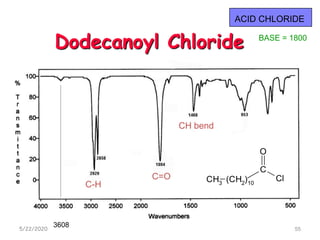
5/22/2020 54
3460
C
Cl
O
CH3
(CH2
)10
ACID CHLORIDE
C=O
C-H
CH bend
BASE = 1800
Dodecanoyl Chloride
5/22/2020 55
3608
C
O
O
CH2 CH2 CH3
CH2
CH3
ESTER
C=O
C-O
C-H
BASE = 1735
Ethyl Butanoate
5/22/2020 56
3482
C
OH
O
CHCH3
CH3
CARBOXYLIC ACID
C=O
O-H
C-H
C-O
BASE = 1710
2-Methylpropanoic Acid
5/22/2020 57
C
O
OH
RC
O
O H
R
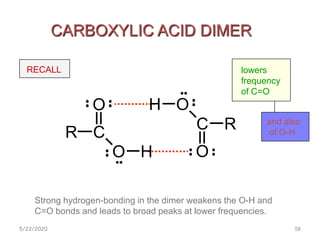
CARBOXYLIC ACID DIMER
Strong hydrogen-bonding in the dimer weakens the O-H and
C=O bonds and leads to broad peaks at lower frequencies.
lowers
frequency
of C=O
and also
of O-H
RECALL
5/22/2020 58
C
NH2
O
CH2
CH3
AMIDE
C=O
NH2
C-H
CH bend
BASE = 1690two peaks
sym / asym Propanamide
5/22/2020 59
C=C STRETCHING
ALKENES
AROMATICS
5/22/2020 60
Typical Infrared Absorption
Regions
C=C
2.5 4 5 5.5 6.1 6.5 15.4
4000 2500 2000 1800 1650 1550 650
FREQUENCY (cm-1)
WAVELENGTH (mm)
O-H C-H
N-H
C=O C=N
Very
few
bands
C=C
C-Cl
C-O
C-N
C-CX=C=Y
(C,O,N,S)
C N
C C
N=O N=O*
5/22/2020 61
The C=C stretching region
 C=C double bond at 1650 cm-1 is often weak or not
even seen.
 C=C benzene ring shows peak(s) near 1600 and 1400
cm-1 , one or two at each value - CONJUGATION LOWERS
THE VALUE.
 When C=C is conjugated with C=O it is stronger and
comes at a lower frequency.
5/22/2020 62
1-Hexene
5/22/2020 63
CH2
CH CH2
CH2
CH2
CH3
ALKENE
oops
C=C=C-H
C-H
aliphatic
C-H
bend
Toluene
5/22/2020 64
CH3
AROMATIC
benzene
oops
benzene
C-H
C=C
Typical Infrared Absorption
Regions
C-O
2.5 4 5 5.5 6.1 6.5 15.4
4000 2500 2000 1800 1650 1550 650
FREQUENCY (cm-1)
WAVELENGTH (mm)
O-H C-H
N-H
C=O C=N
Very
few
bands
C=C
C-Cl
C-O
C-N
C-CX=C=Y
(C,O,N,S)
C N
C C
N=O N=O*
5/22/2020 65
C-O STRETCHING
5/22/2020 66
The C-O stretching region
The C-O band appears in the range of
1300 to 1000 cm-1
Look for one or more strong bands
appearing in this range!
Ethers, alcohols, esters and carboxylic
acids have C-O bands
5/22/2020 67
CH3 CH2 CH2 CH2
O CH2 CH2 CH2 CH3
ETHER
C-O
BASE = 1100
CH2 CH3
bendingC-H
Dibutyl Ether
5/22/2020 68
O CH3
AROMATIC ETHER
benzene oops
C-O
C-H
aromatic
BASE = 1100
Anisole
5/22/2020 69
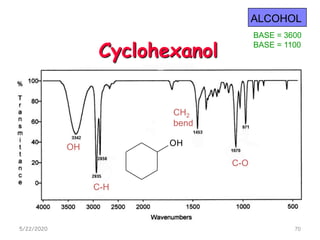
OH
ALCOHOL
BASE = 3600
BASE = 1100
OH
C-O
CH2
bend
C-H
Cyclohexanol
5/22/2020 70
C
OH
O
CHCH3
CH3
CARBOXYLIC ACID
OH
CH C=O
C-O
2-Methylpropanoic Acid
5/22/2020 71
C
O
O
CH2 CH2 CH3
CH2
CH3
ESTER
CH
C=O
C-O
Ethyl Butanoate
5/22/2020 72
N=O STRETCHING
5/22/2020 73
Typical Infrared Absorption
Regions
N-O
2.5 4 5 5.5 6.1 6.5 15.4
4000 2500 2000 1800 1650 1550 650
FREQUENCY (cm-1)
WAVELENGTH (mm)
O-H C-H
N-H
C=O C=N
Very
few
bands
C=C
C-Cl
C-O
C-N
C-CX=C=Y
(C,O,N,S)
C N
C C
N=O N=O*
5/22/2020 74
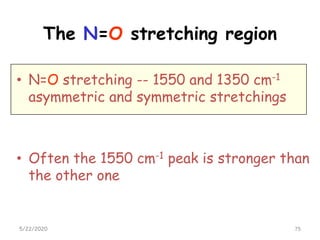
The N=O stretching region
• N=O stretching -- 1550 and 1350 cm-1
asymmetric and symmetric stretchings
• Often the 1550 cm-1 peak is stronger than
the other one
5/22/2020 75
CH3
CH
CH3
NO2
NITROALKANE
N=O
N=O
C-H
gem-dimethyl
2-Nitropropane
5/22/2020 76
Typical Infrared Absorption
Regions
C-Cl
2.5 4 5 5.5 6.1 6.5 15.4
4000 2500 2000 1800 1650 1550 650
FREQUENCY (cm-1)
WAVELENGTH (mm)
O-H C-H
N-H
C=O C=N
Very
few
bands
C=C
C-Cl
C-O
C-N
C-CX=C=Y
(C,O,N,S)
C N
C C
N=O N=O*
5/22/2020 77
The C-X stretching region
 C-Cl 785 to 540 cm-1,
often hard to find amongst the fingerprint bands!!
 C-Br and C-I
appear outside the useful range of infrared
spectroscopy.
 C-F bonds can be found easily, but are not that
common.
5/22/2020 78
CCl Cl
Cl
Cl
Often used as a solvent for IR spectra.
When it is used, spectra show C-Cl absorptions.
C-Cl
Carbon Tetrachloride
5/22/2020 79
Cl
C-Cl
oops
benzene
C=C
benzene ring
combination
bands
Chlorobenzene
5/22/2020 80
=C-H OUT OF PLANE BENDING
5/22/2020 81
H
H
H
OUT-OF-PLANE BENDING
above
below
PLANE
(OOPS)
H
ALKENES
BENZENES
also with
5/22/2020 82
Monosubstituted
cis-1,2-
trans-1,2-
1,1-
Trisubstituted
Tetrasubstituted
C C
H
R H
H
C C
H
R R
H
C C
R
H R
H
C C
R
R R
R
C C
R
R R
H
C C
R
R H
H
Disubstituted
10 11 12 13 14 15
1000 900 800 700 cm-1
s s
m
s
s
s
m
=C-H OUT OF PLANE BENDING
ALKENES
5/22/2020 83
10 11 12 13 14 15
1000 900 800 700 cm-1
Monosubstituted
Disubstituted
ortho
meta
para
Trisubstituted
1,2,4
1,2,3
1,3,5
BENZENES m
s s
s
s s
s
s
s
s
m
m
m
m
OOPS
RING H’s
combination bands5/22/2020 84
5/22/2020 85
5/22/2020 86

IR Interpretation